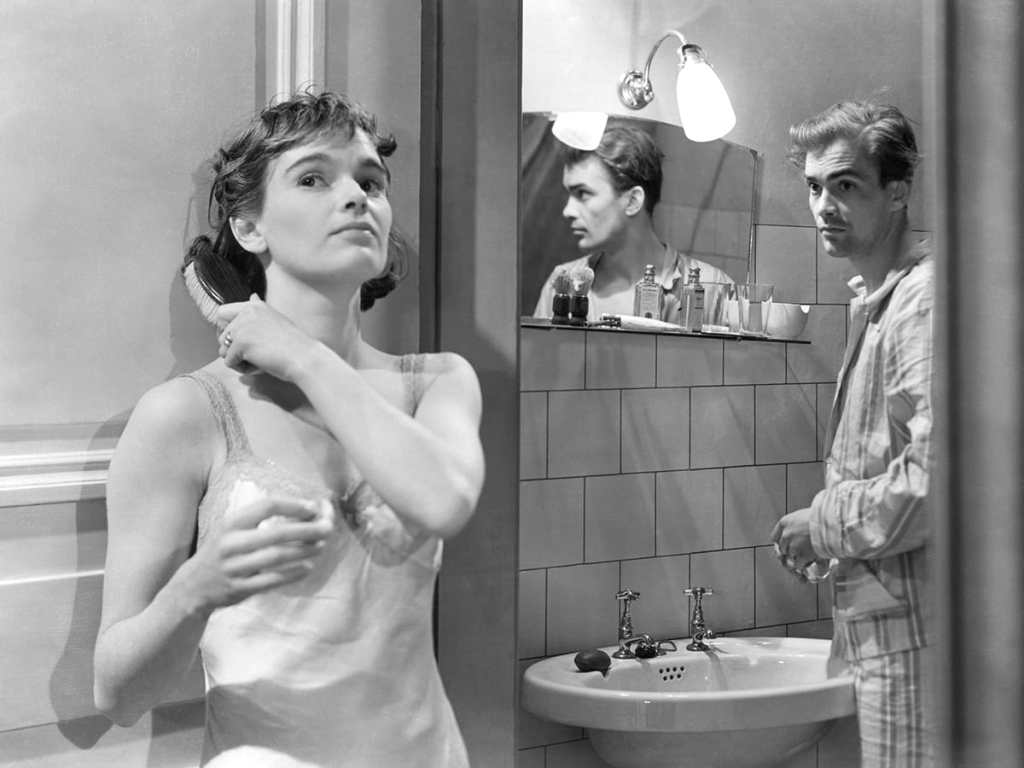
Port of Call doesn’t make a great first impression. In the context of Bergman’s complete oeuvre (if movie watching had a progress bar, we’d be somewhere between 80% and 90% through his filmography), its first fifteen, twenty minutes or so is more striking in its images than its storytelling, as the latter seems oddly impersonal, almost generic. Once past the initial hurdle of a decidedly middling beginning, however, there’s more to like about Port of Call than is immediately apparent.
It’s a difficult act to follow Persona, and Criterion probably made the right choice when it decided to follow Bergman’s monolithic masterpiece with a number of his earlier, smaller films, in which he was trying to find his voice as a director. Thirst is one of those films. It’s by no means bad – in fact, some of the later films that are more clearly Bergman’s work are probably worse films (and yes, All These Women, I’m looking at you). However, it is a film that in the context of Bergman’s filmography feels like he was trying his hand at themes and techniques that he’d later use to better effect.
Join us every week for a trip into the weird and wonderful world of trailers. Whether it’s the first teaser for the latest instalment in your favourite franchise, an obscure preview for a strange indie darling, whether it’s good, bad, ugly or just plain weird – your favourite pop culture baristas are there to tell you what they think.
It’s Easter Sunday, so Sam’s pick for this week’s instalment of Six Damn Fine Degrees is quite fitting: Franco Zeffirelli’s Brother Sun, Sister Moon about the life of Saint Francis of Assisi – a film that Roger Ebert memorably called “an excess of sweetness and light”, with dialogue consisting of “empty, pretty phrasing”. Not all Easter excesses of sweetness consist of too much chocolate pressed into bunny form!
And here we are: perhaps the film by Ingmar Bergman that is most famous, apart from The Seventh Seal, and probably the one most written about in film studies. Persona may not be as immediately iconic as the film that brought us a medieval knight playing chess with Death, but it is undoubtedly one of the films most responsible for the director’s reputation – as a master of his craft, but also as a storyteller who did tremendous work especially with his female protagonists (sorry, Max von Sydow, but it’s true) and whose films explore harrowing psychological and metaphysical territory.
Join us every week for a trip into the weird and wonderful world of trailers. Whether it’s the first teaser for the latest instalment in your favourite franchise, an obscure preview for a strange indie darling, whether it’s good, bad, ugly or just plain weird – your favourite pop culture baristas are there to tell you what they think.
Get ready for Bergmanception: you know how Woody Allen has long been a big Bergman fan and how many of his films are clearly inspired by Bergman’s? Well, the beginning of The Serpent’s Egg feels a bit like Bergman got Allen and his creative team to create the titles. White writing in a timeless serif font on a black screen, listing the cast and crew, accompanied by jaunty 1920s jazz tune – it’s all there. Except even at his most glib, Allen did not make films as sour as The Serpent’s Egg.
Join us every week for a trip into the weird and wonderful world of trailers. Whether it’s the first teaser for the latest instalment in your favourite franchise, an obscure preview for a strange indie darling, whether it’s good, bad, ugly or just plain weird – your favourite pop culture baristas are there to tell you what they think.
Is it strange that I associate adultery with the 1960s and 1970s? Obviously I don’t think that adultery was invented in 1963, just after sexual intercourse (because, after all, Don Draper got there much earlier, right?), but when I think of the stories of or about the time, what comes to mind are the novels of John Updike or novels like The Ice Storm, which is set in the early ’70s. When I think adultery, I first and foremost think of men with sideburns wearing corduroy suits, sleeping with the wives of their colleagues or friends, much more so than I think of crazed blondes that boil bunnies before breakfast.
The Touch (1971)
In that respect, Ingmar Bergman’s The Touch, the first English language film by the director, is a good fit for the era. Adultery, check. ’70s hairdos, check. (There are probably few actors whose hair denotes the ’70s as much as Elliott Gould.)
And somehow, none of the people in these adulterous relationships seem to be happier due to their affairs. You can see why Bergman would be drawn to this material.
Join us every week for a trip into the weird and wonderful world of trailers. Whether it’s the first teaser for the latest instalment in your favourite franchise, an obscure preview for a strange indie darling, whether it’s good, bad, ugly or just plain weird – your favourite pop culture baristas are there to tell you what they think.
Not all films by Ingmar Bergman can be stone-cold classics, and Matt definitely wasn’t convinced that After the Rehearsal belongs in that category. Nonetheless, this late-career TV movie set in the world of theatre has found a second life on the stage – and since YouTube doesn’t seem to have a trailer for After the Rehearsal that can actually be embedded, here’s a trailer for a Dutch theatre company’s double-header of After the Rehearsal and Persona. None more Bergman!
I’ve said before that I greatly enjoy the film historian’s approach that Criterion’s Ingmar Bergman’s Cinema allows me to take to the director’s work. While the films are largely organised thematically rather than chronologically, just having the vast majority of Bergman’s works in one handy package means that I’m not just seeing these films in isolation but in relation to one another. That comparison adds another dimension to my appreciation of the films that is often fascinating and illuminating.
Mind you: the flipside of this is that sometimes it can get quite tiresome to watch yet another Bergman film obsessing about the same concerns and voicing the same attitudes. We’ve now had a series of films of his focused on art and artists and especially the theatre, either literally or metaphorically, starting with Sawdust and Tinsel. By the time we get to After the Rehearsal, a 1984 TV movie starring Bergman regulars Erland Josephson, Ingrid Thulin, and Lena Olin (who looks much younger in this than her actual age of 29), it’s difficult not to give an exasperated sigh: All right, enough with all the theatre!




 A Damn Fine Cup of Culture