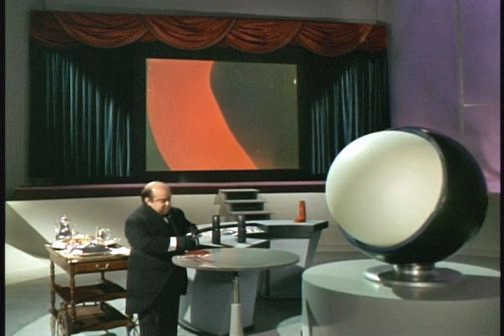
… and yes, you’re right, that post title needs to be read in a booming voice. (Don’t turn around now, by the way – there’s a giant white inflatable ball right behind your chair!)
While the title is prompted by us having only one more episode of The Prisoner to watch (my thoughts will follow in an upcoming post), this is actually more of a “Did you know that you could waste hours by following these links?” kind of post, plugging the following two things:
How long has it been since I’ve plugged anything HBO-related? The A.V. Club‘s John Teti has just finished his series of reviews-cum-analysis of the second season of Six Feet Under. Some of the most insightful writing I’ve seen on the series and especially on Nate and Brenda – and it’s made it clear that it’s time for me to watch the series again in its entirety.
So, what’s special about it, I hear you asking? (Yes, I hear your voices in my head, because that’s how I roll. At least when I haven’t taken my meds.) The specialitude of this post comes from the following: you’re unlikely ever to check out any of what I’m writing about below, because it’s all about this year’s Edinburgh Fringe – so, unless you’ve already seen some or all of the shows I’ll be talking about, you’ve missed them! Ha! Cue comment about the fleeting, ephemeral nature of art, followed by silence as the tumbleweeds roll by.
Assassins
“Everybody’s got the right to be happy… everybody’s got the right to their dreams.” Sounds like common, especially American, musical fare, doesn’t it? Cheerful, inspirational, and simplistic hogwash, most likely? Well, in Sondheim’s Assassins, the protagonists’ right to be happy finds its expression in killing the President of the United States, or at least doing your darnedest to reach that goal. The show we caught – and it was sheer luck, down to two wonderful people who didn’t pick up their tickets for some reason – wasn’t perfect, not least because we sat more or less right next to the small orchestra, which made the non-mic singing difficult to understand at times… but even under these circumstances it’s clear that Sondheim’s musical is sharply written, very funny, and surprisingly chilling. If your culture is founded on the lie that you can make it if you really try, that even a nobody from a small town can become a millionaire – or a president – where does that leave you when your dream just won’t come true? Does it leave you permanently disaffected – or do you pick up a gun and show that you can make a difference because, after all, this is America?
Statements After An Arrest Under The Immorality Act
The title of this play by South African playwright Athol Fugard almost rivals that of my favourite deconstructivist western of the last, let’s see, forty or fifty years – but the play itself isn’t unwieldy or overly long in the least. Performed by a amazing, fearless cast in an effectively minimalist staging, Statements is a beautiful, poetic and essentially tragic story about lovers who, by decree of the state, shouldn’t be. Even 40 years after it was originally written, addressing the racial segregation under Apartheid, the play feels fresh, relevant and utterly touching.
We saw two further South African productions – a raw, sweltering Mies Julie (adapted from Strindberg) and Woza Albert!, but it’s Statements that made the deepest impression.
… last but not least
Where to begin? Not everything we saw was brilliant, and a couple of plays were dismal (The Intervention, I’m looking at you!), but there were lots of moments of magic, from the beautiful, sad and endlessly inventive The Fantasist (manic depression, with puppets! see below for a trailer) to Centralia (equal parts WTF?!, mad giggles and poignancy) to Rites and Regulations (a fairly simple but moving play about funeral rituals in Singapore, pressing all my funereal buttons), from Educating Ronnie (about a young man’s exploration of friendship, charity and guilt – another trailer waiting below) to Pierrepoint (about Britain’s last hangman – again, great performance and chilling ending – and another trailer, seriously, when did stage plays start having trailers?) and Planet Lem (socio-critical sci-fi – on stilts! did you know that Polish people are a bit off their trolley?). All in all, to anyone who’s got an interest in theatre and what it can do, Edinburgh during the Fringe is well worth visiting – we’ve seen 25 shows in one week and feel utterly invigorated. Well, we would, if it weren’t for that nasty cold bug we picked up travelling back on easyJet…
I’ll be on vacation the next two weeks, so chances are I won’t get around to posting any updates. Here’s hoping that I’ll be back bursting with bloggy inspiration at the end of August!
When I was at Uni studying (and later teaching) English Literature, the BBC Shakespeares were spoken of in hushed tones as the most boring thing this side of a Romanian stop-motion remake of Solaris dubbed by a narcoleptic with a speech impediment. Want to make your students hate Shakespeare as much as the average UK pupil does on leaving school? Have them watch the BBC Shakespeares! In spite of actors that have proven to know their way around a iambic pentameter or two, these television versions of Shakespeare’s complete dramatic works made from the mid-’70s to the mid-’80s were complete duds, dramatically speaking, at least according to English Department legend.
Fast forward to 2012, the year that Brits try to put the ‘Great’ back into ‘Great Britain’ with the help of Sir Simon Rattle, Rowan Atkinson and a skydiving Queen Elizabeth. Two years before the 450th anniversary of Shakespeare’s birth and produced by Sam Mendes (the erstwhile Mr. Kate Winslet and director of the upcoming Bond flick Skyfall), the BBC got together an impressive set of actors, including Ben Whishaw, Julie Walters, Patrick Stewart, Jeremy Irons, Tom Hiddleston and a guy last seen having sexual intercourse with a pig, for big budget TV versions of the four history plays Richard II, Henry IV Part 1, Henry IV Part 2: Henry Harder and Henry V: The Sequeling. And while I can’t speak for the horrors of the earlier BBC Shakespeares, these four TV versions definitely don’t have to hang their heads in shame – as teachers the world over will be ecstatic to hear, since they can fill two to three school lessons with the watching of one of these.
The Hollow Crown, as the quartet was named after what may be the most famous (and rightly so) monologue in Richard II, was fairly entertaining to watch, though very much improved when the subtitles kicked in – being able to read Shakespeare’s lines while listening to the actors definitely helps my comprehension. Not perfect, and some of the character choices were weird: does Richard II make more sense by being turned into the most queenly king since Marlowe’s Edward II, with Whishaw in the title role channelling both Gloria Swanson and Katherine Hepburn? Also, having seen Michael Gambon as a very funny, charming and ultimately poignant Falstaff, I found Simon Russell Beale’s take on the character too low-key to make his relationship with Prince Hal all that credible and his eventual fate as moving as it ought to be.
My main two bones of contention with Mendes’ BBC Shakespeare have to do with the language, though:
1) Too many of the actors try to make the iambic pentameter sound like regular, realistic TV dialogues – and that just don’t fly. Ignore that Shakespeare’s language is stylised and you end up with clumsy, overly earnest delivery that actually comes across as less realistic rather than more. Accept the language for what it is, play the metre, and don’t keep making short pauses to indicate, “I’m thinking about what words to use here!” and the language comes alive. Actors are often told to fresh-mint the language, to speak it as the words came to them that very minute – and that’s true… to an extent. Fresh-minting Shakespeare’s words doesn’t require an actor to stop, start, hesitate, wait a beat, continue, pause some more. Tom Hiddleston, whose acting I otherwise enjoyed a lot, tended to be particularly guilty of this.
2) Shakespeare tends to have his stage directions hidden in plain sight – that is, he puts them in the lines. “Why look’st thou so fearfully and pale?” reminds the actor it’s addressed at that he should look scared, for instance, in case he’d forgotten. (And yes, that line is made up, but the plays are full of similar – though undoubtedly less clumsy – lines.) The lines in effect are prompts, both for the actors and for the audience – if something cannot be shown fully, speak it so the audience can imagine it. It’s one of the elements that, if done well, engages the audience more fully, asking them in effect to become part of the mis en scene: they’re props masters as well as stage designers, filling in the blanks with their imagination as prompted by the actors. The four Hollow Crown parts, as is so much TV, are done in a realistic style, showing what is shown, from armies (although, admittedly, the armies don’t have the CGIed numbers of the Battle of Helm’s Deep) to castles to ships on the ocean – yet the plays aren’t stripped of such lines, so we end up both seeing the armies, castles and ships while being told about them, rendering too many of Shakespeare’s lines redundant. To my mind, the productions should either have dared to veer from their somewhat restricting realism at times or they should have dared to cut the language to a much larger extent. As it is, it’s difficult not to come away from these films thinking, rather unfairly, “Gosh, that Shakespeare guy must’ve been paid by the word! You could’ve left out half that stuff!” This is especially apparent when it comes to the Chorus in Henry V, who quite literally tells the audience repeatedly, “We can’t show all of this, so I’m describing it for you to imagine!” while the images on the screen showed you exactly those things. They tried to make it work with some sleight of hand involving one of the peripheral characters, but the trick only served to highlight the redundancy of it all. Want to do a realistic made-for-TV Shakespeare? Accept that you’ve stripped a third of the lines of their purpose and cut them.
In spite of these two things, which probably bug me more because otherwise the productions were smart and well crafted, The Hollow Crown was fascinating for the impressive cast, but it mostly felt like proof of concept. If they look critically at what worked and what didn’t – which I hope they will – and learn from these things, whatever follows this historical quartet might end up quite glorious.


 A Damn Fine Cup of Culture