Welcome to Six Damn Fine Degrees. These instalments will be inspired by the idea of six degrees of separation in the loosest sense. The only rule: it connects – in some way – to the previous instalment. So come join us on our weekly foray into interconnectedness!
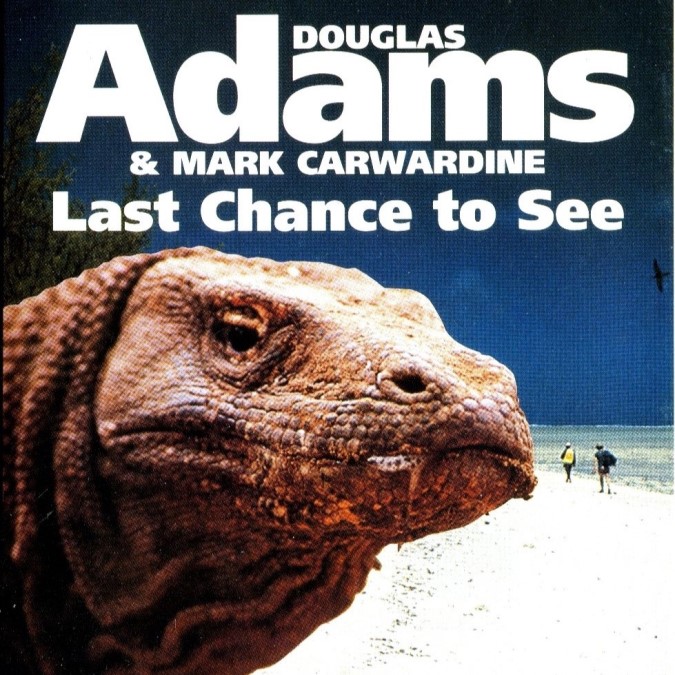
The early ’80s were a great time as a kid to discover Douglas Adam’s Hitchhikers Guide To The Galaxy. I saw the BBC TV series first, then I caught the BBC Radio series – recording each episode onto cassette for future enjoyment. And then I discovered the books. I devoured the first novel: it was like the adaptations but with more jokes. Same with the sequel The Restaurant At The End Of The Universe, which was possibly one of the first “proper” books I read in a single day. Life, The Universe and Everything felt a little different, even threatening at times to tell an actual story. But still enough lunacy to keep me happy.
Then I read the fourth. And something felt amiss. I missed the sheer inventive freewheeling chaos of the first two books. They felt like jumping on board a speeding treadmill, trying to keep up with not only the number of jokes but the sheer chaos of the storytelling. The excitement that literally anything could happen to the lead characters. Or that the book’s narration would tell us that absolutely anything could happen in a universe so vast and messy, it would be impossible for a plot to fit.
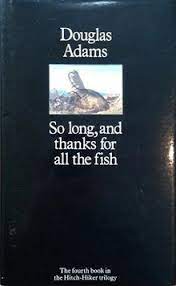
So Long And Thanks For All The Fish was still funny, but it felt like someone had told the universe it had to grow up and settle down. I missed the feeling as I read it that the story was racing along, just about laying the tracks down in front of it however it could to stop it crashing. Worse than that, it seemed to be going backwards. Recycling mad moments and lines (including the book’s own title) from its own earlier stories. I don’t think its a problem when science-fiction stories become franchises, but I do think those franchises have a problem when they become focussed on going back to their own continuity. I loved the throw-away chaos of the early books, but those throw-away lines became flat and less interesting as they became plot lines in this fourth book.
The Dirk Gently books came along and they were fine. They were funny but I didn’t love them. Adams was such a success now that he took huge advances for his books, and then seemingly hated the task of writing them, an antipathy that seemed to be suck energy out of the books. Adams was still a genius, though. Even a weary Adams forcing himself to finish to finally make the umpteenth novel deadline had enough comedic talent to still make the book worth reading.
To me, they weren’t lifeless they just lacked the overflow of supercharged vibrant creativity of the first few incarnation. I came to the conclusion that while I enjoyed Adams, that vital spark had gone.
I think it was because I wasn’t quite as enthused by him anymore that I missed the Last Chance To See radio series. I discovered it when someone in my family (not me) got the book for Christmas. Idly I began reading it. And discovered that same vitality I had missed in the recent books. This wasn’t freewheeling chaos, but Adams felt enthused again. The brilliance, beauty and chaos he filled a science-fiction universe with the original Hitchhiker’s was now being revealed about the planet he (and I) lived in. I devoured the book that Christmas, leaving whichever family member had actually been given it to wait until Boxing Day before they even got near their own present. (Sorry, Mum).
It didn’t last – Adams returned to seemingly having to meet formal obligations with a fifth Hitchhikers books, which felt like an aging cover band trying to crank out the famous hits one more time. But I started discovering the stuff where Adams seemed engaged and interested. Such as Hyperland – the prescient 1990 documentary exploring the potential of the emerging internet. And I finally got round to the Meaning of Liff, which remains an underrated gem of wise observation and whimsy. The best of Adams still remains up there with comedy writing at its finest.
 A Damn Fine Cup of Culture
4 thoughts on “Six Damn Fine Degrees #142: Douglas Adams’ “Last Chance To See””