Welcome to Six Damn Fine Degrees. These instalments will be inspired by the idea of six degrees of separation in the loosest sense. The only rule: it connects – in some way – to the previous instalment. So come join us on our weekly foray into interconnectedness.

~ There are answers to everything. There were answers everywhere you looked…
In Act 2, Scene 2 of Hamlet, two courtiers appear in order to gain the Prince’s confidence and to spy on him. Our “much changed” Prince appears to have gone bonkers, and the two old friends are to find out what afflicts him. The King can barely tell them apart and the Queen steps in to correct him.
King
Welcome, dear Rosencrantz and Guildenstern.
Moreover that we much did long to see you,
The need we have to use you, did provoke
Our hasty sending…
Queen
Good gentlemen, he hath much talked of you,
And sure I am, two men there is not living
To whom he more adheres.
After having given their Royal instructions, the King thanks them:
“Thanks, Rosencrantz, and gentle Guildenstern.”
“Thanks, Guildenstern and gentle Rosencrantz”, the Queen corrects him, although the infinitesimal pause before “gentlemen” implies that she is not sure either.

These two minor Shakespearean characters are at the core of Tom Stoppard’s play Rosencrantz and Guildenstern Are Dead. And while in Hamlet they first appear in Act 2, Stoppard gives them a life well before that. Before their appearance at the Royal Court, it appears they were sent for. Well, they think they were sent for, but by whom and to what purpose isn’t yet quite clear to them. What they seem to be sure about is that it is a matter of great urgency. On their way to their first appearance at the court of Denmark (they obviously have no inkling of the plot they’re about to become part of), they toss coins. Only the coins keep turning up heads. Only heads. More than eighty-five consecutive times. Which leads to an argument as to how it is possible for this to happen, what significance to place on these occurrences, and, incidentally, if they remember how long they have been flipping coins at all, when it comes to that. Guildenstern, the more cerebral of the two, devises a great many theories as to why every spun coin should turn out heads. From “A spectacular vindication of the principle that each individual coin spun individually is as likely to come down heads as tails and therefore should cause no surprise that each individual time it does”, to simply “divine intervention”. While travelling further, they meet a band of tragedians. After asking what it is, precisely, that they do, the Player states:
“We keep to our usual stuff, more or less, only inside out. We do on stage the things that are supposed to happen off. Which is a kind of integrity, if you look on every exit being an entrance somewhere else.“
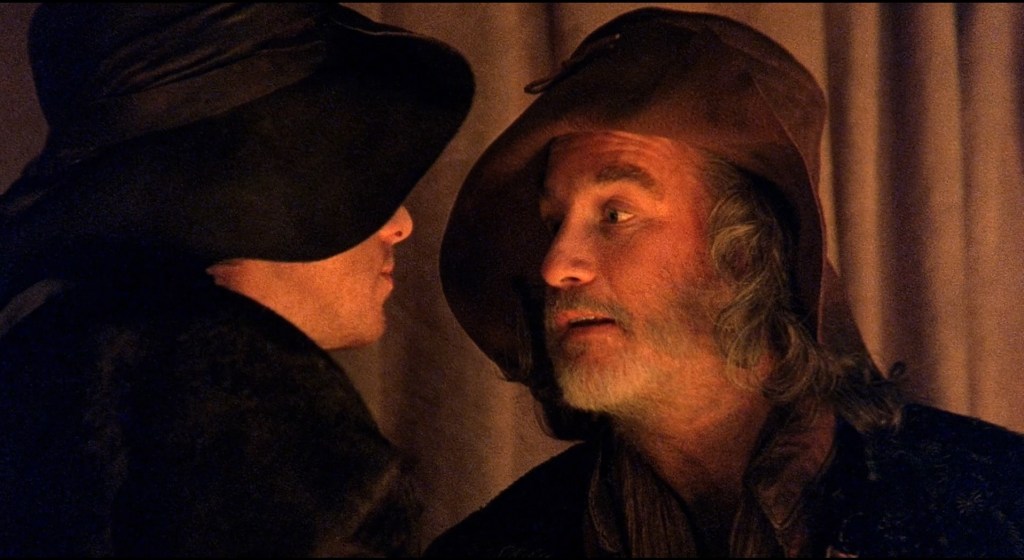
These tragedians will turn out to be the very players whom the advisor to the court of Denmark, Polonius, announces in the same Scene 2 of Act 2, after Rosencrantz and Guildenstern have their visit with Prince Hamlet. The very players who will be given a speech by Hamlet in Act 3, an indictment rather, to recite. The play within the play, to be performed before the murderous King and his accessory the Queen, in order to expose their guilt of the murder of the late king, Hamlet’s father. On stage, the things which are supposed to happen off.
But before their fateful appearance in that court, at that pivotal meeting on the road, the Player must first play a discomfiting game of Heads or Tails with Guildenstern, in which each coin consecutively, inevitably, comes up heads.
And so Rosencrantz and Guildenstern live out their existence, such as it is, in the wings of the play. Snippets of Shakespeare’s famous dialogue fly by as they try to figure out what exactly it is they are supposed to do, in this story in which only Hamlet’s faithful friend Horatio will ultimately be left standing.
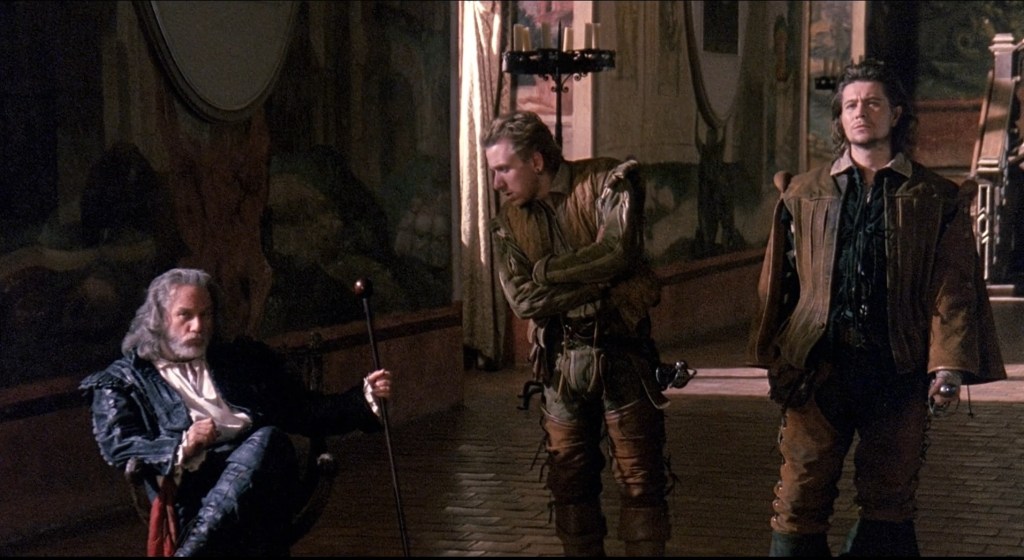
Stoppard’s play, of which there have been several audio recordings, was finally filmed in 1990, directed by Stoppard himself – although it is more of a revision than an adaptation. “I don’t feel protective towards the play at all,” Stoppard told the LA times in 1991, “I mean the play’s still there anyway. And there were one or two things that I was quite glad to lose.”
And so he did. While the film is wordy, the play is even more so. According to Stoppard himself, in the same interview, about half the original play has been left by the wayside. Listening to a contemporary version of one of the audio plays, it is not hard to see why. The dialogue is stagy in the extreme, and while that is a given, as it is written for the stage, it would not have worked as a film. Even as it is, critics were divided about the transition. “As a play,” Ebert writes, “Rosencrantz and Guildenstern is fascinating; we use our knowledge of Hamlet to piece together the half-glimpsed, incomplete actions of the major players, whose famous scenes we see a line or a moment at a time. As a movie, this material, freely adapted by Stoppard, is boring and endless. It lies flat on the screen, hardly stirring.”
Respectfully, I disagree. That it now seems old-fashioned, even gimmicky, might be true. But there is certainly life there. As there is still life in the play. Not just because the language is particularly clever, which it is, nor because it’s mordantly funny, which it also is. But mainly because at the very heart of the film is the niggling suspicion that, like our moribund protagonists, we may not be the lead characters in our own story. And with Gary Oldman and Tim Roth butting, ahem, heads as our two fated leads, it still charms.
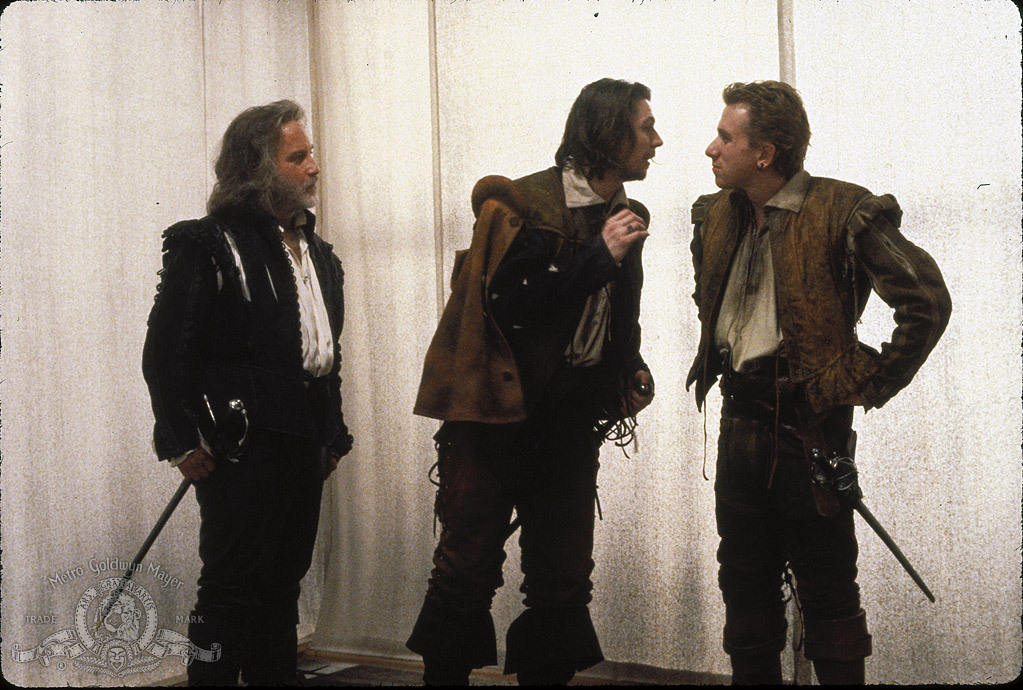
*The screenplay opens by the seaside, but as they couldn’t find a suitable spot, the scene was filmed in a cement quarry in Zagreb, Croatia.
 A Damn Fine Cup of Culture
4 thoughts on “Six Damn Fine Degrees #176: Rosencrantz and Guildenstern Are Dead”