Welcome to Six Damn Fine Degrees. These instalments will be inspired by the idea of six degrees of separation in the loosest sense. The only rule: it connects – in some way – to the previous instalment. So come join us on our weekly foray into interconnectedness.
Even though these days I’m much more about film and TV, there was a time when literature came first for me. I studied English and American Literatures (as it was called at the time), and later I taught the subject. I had much more time – and, frankly, energy – to read a lot… and even better, while working at uni I was paid to read. And teach, do research, supervise and counsel students, do some admin, assist the professor who was supervising my PhD thesis. I didn’t love every single one of those tasks, certainly – but still, it was a very good time for someone who loved books.

It’s also during that time that I started to get into drama in earnest. Our department had a fairly active drama community, and while I never felt 100% comfortable being on stage myself, this is where I discovered how much I enjoy directing. Sadly, that’s something that didn’t survive my move into other professions: like so many, I had a choice between staying in academia, which would have come at a personal price I wasn’t willing to pay, or leaving and doing other kinds of work, and it’s the latter that won out. I miss a lot about my years working at university (and this site and our podcast are to some extent my way of making up for what I left behind), but I never regret the choice itself.
I think it’s also in no small part due to my love for theatre that developed during that time that I am much less prone to complain about remakes and the like than what seems to be the vast majority (or at least a very loud minority) of moviegoers and purveyors of Film Discourse. Don’t get me wrong: I’d agree that a large number of all the remakes, reboots and re-whatevers are creatively bankrupt and don’t have a single strong idea to motivate them, other than “People remember this, don’t they? They’ll pay to see it remade, right?” But, quite honestly, I roll my eyes every time that hoary conversation comes up about the death of originality. My stance probably has softened somewhat since my uni days, but I still do believe that there is very little under the sun that is genuinely new. Most stories have been told, most characters have been written – but that’s not the same as saying that everything is unoriginal and stale. How you recombine and remix these tropes and types, how you reinterpret them: that’s where most newness comes from.

In discussions about remakes, people tend to bring up the position that remakes should be reserved for films that have a good story but that, for one reason or another, didn’t live up to their potential. The idea is that a remake is a second chance at getting a story right. I’m not opposed to remaking films that weren’t particularly good, but I find that notion painfully narrow, as it seems to suggest there is one ideal way of telling a story, and once you’ve found this, you’re done. The story has been told the way it ought to be. You can move on. Which, quite honestly: What? I mean, what?! To my mind, each telling of a story is an interpretation, and the more interesting a story is, the more it lends itself to different readings, perspectives and approaches.
When it comes to remakes, and to adaptations in general, I think of them along similar lines as I would think about a new production of, say, Hamlet. There is no correct, best way of doing Hamlet. Literature isn’t like video games: you don’t 100% Hamlet and then move on, never to think of it again. Even if we just think of film adaptations: Laurence Olivier’s 1948 black and white Hamlet is different from Franco Zeffirelli’s version, or Kenneth Branagh’s, or Michael Almereyda’s, in which Ethan Hawke famously soliloquises while wandering the aisles of a Blockbuster. (Remember those?) Each era, each filmmaker, each context produces a different Hamlet, and while not all of them are necessarily good, the idea isn’t, and should never be, to produce the one, true, perfect Hamlet. This extends beyond the relatively straightforward adaptations I’ve mentioned (and yes, for all of its modern trappings, Almereyda’s Hamlet is also fairly straightforward – there’s nothing that is inherently weirder about doing a soliloquy in a video-rental store than there is about having all the female parts played by boys). The Lion King doesn’t rejig Hamlet because all previous adaptations got the material wrong somehow, it does so because that’s what interpretation does: it reinterprets.
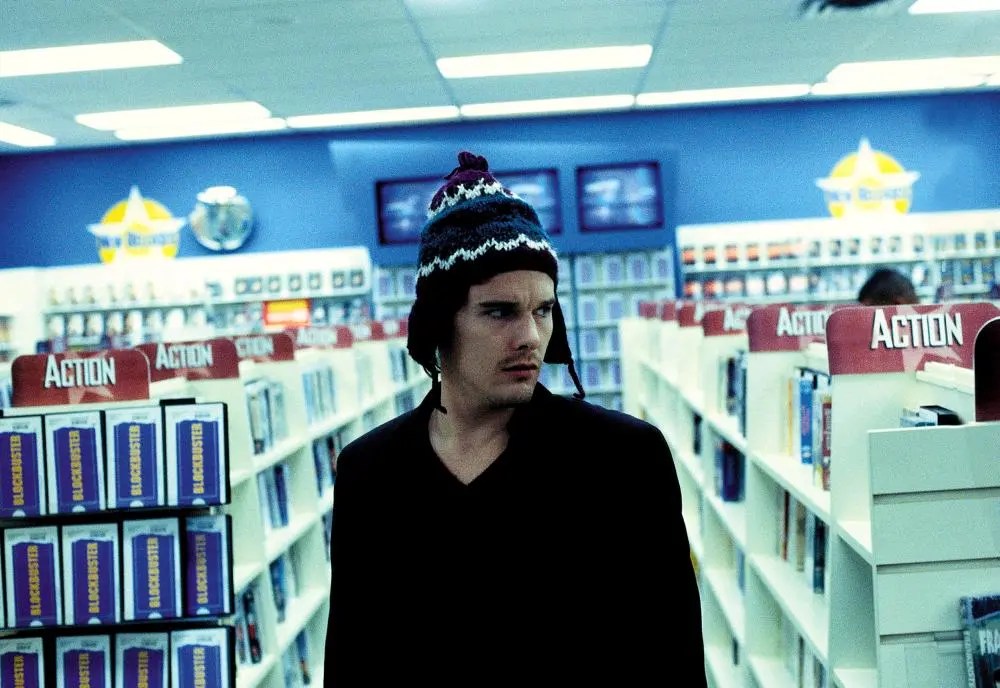
Having said that: as much as I enjoy different takes on the same material, whether we’re talking about remakes and the like or about different stagings of a play, it has been known to happen that I watch a version of a story that I like so much, it practically ruins all other versions of that story for me. Tom Stoppard’s film adaptation of his play Rosencrantz & Guildenstern Are Dead (which Julie wrote about so beautiful last week) comes close to this, but it is saved from this fate because Rosencrantz & Guildenstern is very much a stage play at the core of its being, and therefore its true home is the theatre. Stoppard’s film gets the material as right as is possible in a medium that is something of an uneasy fit for a play that is suffused with the language and imagery of the stage.
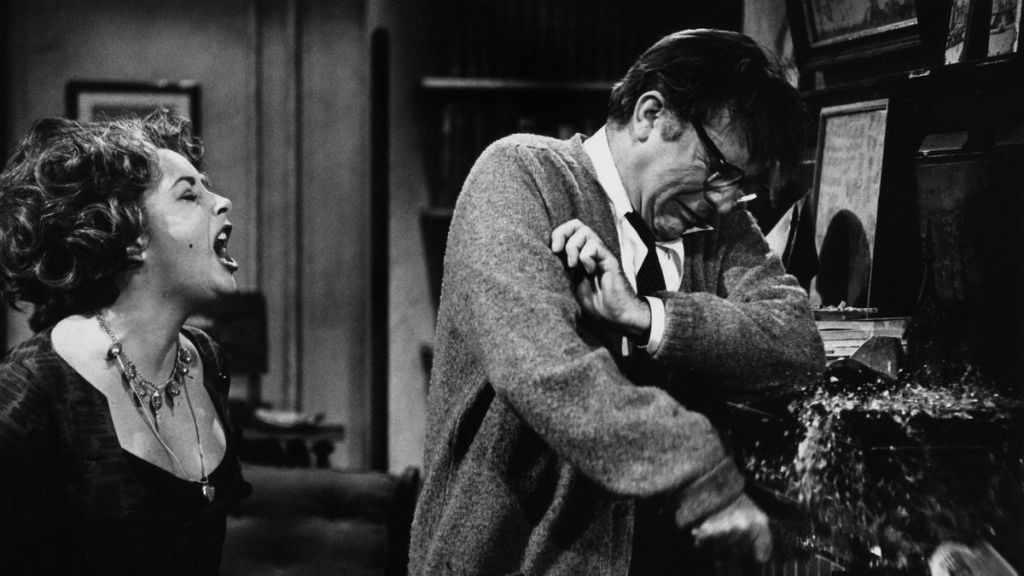
No, for me the best example of a definitive version is Mike Nichols’ 1966 film adaptation of Edward Albee’s iconic play Who’s Afraid of Virginia Woolf? And ironically it’s not even because that film is perfect. Nichols and his collaborators made some choices in adapting the play to a different medium that betray their insecurity in adapting theatre for the screen: the sequence in which George and Martha leave the claustrophobic setting of the play and take their guests Nick and Honey to a roadhouse for, you’ve guessed it, more drinks, remains a mistake that is all the more frustrating for being so completely unnecessary. (Just because something is a film doesn’t mean that it can’t be set in one location only – just ask Alfred Hitchcock, certainly one of the most cinematic Hollywood directors.) So yes, even my definitive version isn’t really definitive. What it does boast, however, is the definitive cast: Richard Burton and Elizabeth Taylor embody their parts perfectly, as do George Segal and Sandy Dennis, and they all do so to such an extent that they make up for any shortcomings in the adaptation to a different medium. In my mind, Burton is George and Taylor is Martha. When I read any excerpt from the play, even if it was rephrased or cut for the film, it is their performances that I imagine. Looking at the Wikipedia page for Who’s Afraid of Virginia Woolf?, I see the names of lots of actors I like (Patrick Stewart, Melinda Dillon, Carrie Coon, Rupert Everett, Russel Tovey, to name just a few) and I can see what they might bring to the various parts – but I suspect I’d find it very difficult to see them as anything other than actors playing these parts. Burton is George, Taylor is Martha, and that’s that.
I might have had a chance to remedy this and to come to accept Nichols’ film adaptation as one particular staging of the material rather than its definitive version: in 2017, Imelda Staunton and Conleth Hill played Martha and George in a stage production in London, and when I looked at the poster, I could absolutely see Martha in Staunton’s face, a different Martha than the one Taylor played, but just as much the character. But, sadly, I missed that chance, so unless another perfectly cast version pops up, I’m back to where I was. I know what George and Martha and Nick and Honey look and sound like. I know what the definitive version of Who’s Afraid of Virginia Woolf? looks like.
Even if, at heart, I know that there is no such thing as a definitive version.

 A Damn Fine Cup of Culture
3 thoughts on “Six Damn Fine Degrees #177: The definitive version”