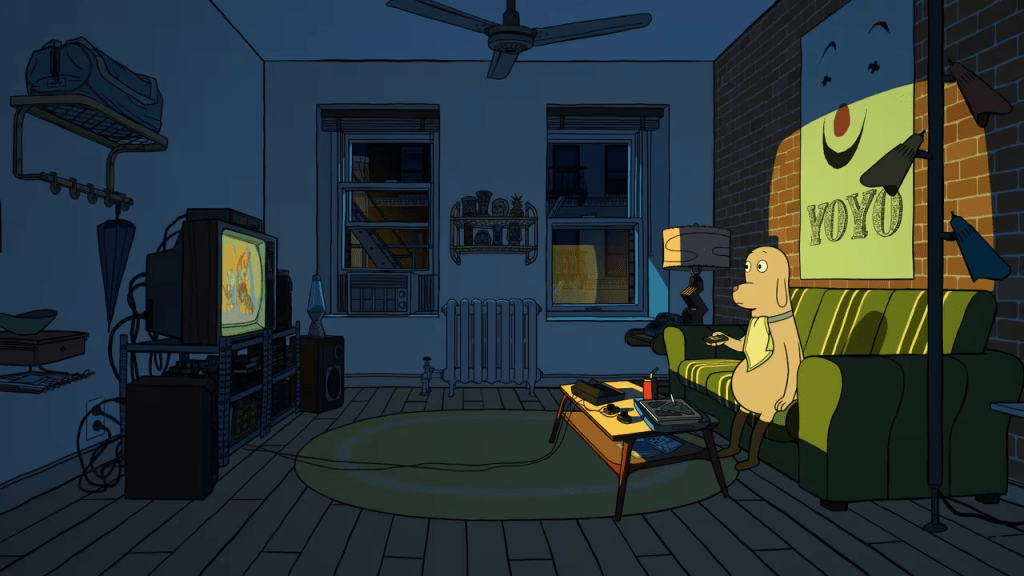
It’s Manhattan in the 1980s, and Dog is lonely. He, differently from everyone around him, has no one to share his life with – so when he sees an ad on TV for robot friends, he doesn’t hesitate. Soon a large, heavy box appears and Dog sets about assembling his new friend. He and Robot immediately hit it off, and Dog’s life changes.
Until the day he takes Robot to the beach, and everything is turned upside down.
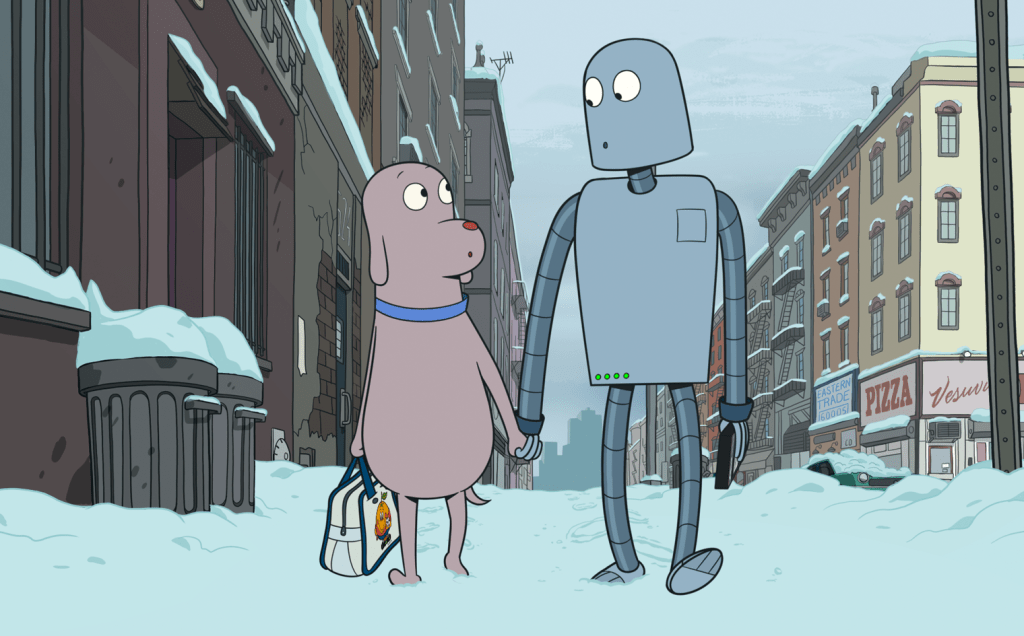
Robot Dreams is a beautifully made animated film. At a glance it may look like it is telling a story for kids. Everyone in the world it depicts is an animal, and it doesn’t use spoken language, only emotive sounds. But the apparent simplicity soon reveals that there’s more going on here. There is a specificity to the Manhattan of Robot Dreams as well as to its inhabitants: this isn’t just a fun cartoon city populated by cute anthropomorphised animals. This world is very clearly set in a time and a place that is recognisable, and the characters, while stripped down to a handful traits (and used for some great background gags, such as the hedgehog selling balloons at the beach or the elephant and mouse sharing a rowing boat in Central Park), are equally specific, from the moose-and-cow couple in the apartment across the street to the abrasive punks that Dogs just a little scared of. Director Pablo Berger and his team, adapting the graphic novel of the same name by Sara Varon, have done a fantastic job of using short vignettes, or sometimes really just the way a character moves, to give us a clear, strong impression of who these people are. They may just be called Dog or Robot, but again, the apparent simplicity doesn’t hide their individuality.
And then there are the themes that Robot Dreams are about: Dog’s loneliness isn’t the loneliness of a child looking for friends, it is the loneliness of someone who finds themselves in a big city, surrounded by people, but unable to connect. It’s not entirely clear just why Dog is lonely: he seems to be a nice, kind, open character, though there seems to be an underlying fear there. Once he gets together with Robot, it almost seems like he needed a friend in order to find the courage to be more outgoing and find friends. Robot unlocks that in him.
And this is where we can’t really get around some spoilers, so if you want to watch Robot Dreams unspoiled, stop reading at this point. The film is delightful and sweet and definitely worth watching.
See, the thing is this: Robot won’t be around forever. That trip to the beach ends up with his joints having rusted. Robot can’t move, and Dog can’t move his heavy metal friend on his own. He returns the next day, after a sleepless night, but he finds that the beach has closed down for winter, with Dog on one side of the beach, and poor, mostly motionless Robot on the other. Dog tries to break in, but he ends up getting arrested. Meanwhile, and this is where the title of the film (and book) comes from, Robot dreams: he dreams of escaping the beach and returning to the apartment he shared with Dog, but he wakes up before the two can be reunited. Each of Robot’s dreams becomes more and more surreal (the film is wonderfully inventive in this), but the end is always the same: Dog remains out of reach.

Finally (and a lot happens before the story comes to this point), Robot is stolen and sold as scrap to a junkyard, where he is bought by a racoon named Rascal, who repairs him and becomes a friend. When Dog returns to the beach after it has opened for summer, all he finds is one of his legs, which is all that is left behind. Dog is heartbroken, but he finally gets a new robot (this one called Tin) and moves on – but both Dog and Robot cannot really forget their original friends and their friendship. And even in a big place like Manhattan, you’re bound to happen upon the people you know.
This will probably sound odd, but there is more than a little Past Lives (directed by Celine Song and starring Greta Lee) to Robot Dreams. In Past Lives, the main character Nora finds herself torn between the Korean man she loved and her American husband, and the versions of herself that were left behind or that never truly came to be. Robot Dreams likewise turns out to be about relationships and moving on, and mourning what has come to an end. It is especially this, the film’s emotional resonance, that worked brilliantly for me, and all the more so because Berger segues to deftly from the story about friendship we thought we were watching to one about two people torn apart struggling to get together again, and suddenly we find ourselves in a story about two people who, through circumstance much more than volition, have found others to connect – but feelings don’t just end, relationships don’t just end. A loss is a loss, even if you have found (or been found by) someone new. Love doesn’t just end.

Because, really, Robot Dreams is a love story. Sometimes relationships last longer than the love underlying them, and sometimes it is the love that outlives the relationship. Life happens. People move away, others remain. Few can, or should want to, live in the absence that is a relationship interrupted.
But while Robot Dreams resonated with me on an emotional level, my brain has issues with the film and the story it tells – issues that I’m sure could have been fixed, but I wonder if fixing them would have made Robot Dreams work less well emotionally. I had no issues whatsoever accepting a 1980s Manhattan populated by animal people, or a cow and a moose linked romantically, or a dog buying a robot and the two of them becoming best friends. But is Robot Dreams about friendship, or is it about something else? In the film’s final act, Robot spots Dog walking through town with Tin, his new robot friend, and he’s torn: should he return to his friend, or should he remain with Rascal, his new friend, and leaving Dog and Tin in peace, rather than risking upsetting these new relationships? If this is a story about friendship: why on earth are these animals only capable of entertaining one friendship at a time? So, is Robot Dreams about romantic relationships – and, perhaps more importantly, about monogamous relationships? This rings more true, but at this point my brain starts thinking about the implications of the story: were we invested in a romantic relationship where one partner was literally bought and assembled by the other? What about agency? And what about Robot’s feelings: if the robots of this world are programmed to love, are we even watching love, or are we sentimentalising a complex but mechanical set of inputs and outputs? Is Robot a sort of slave that people buy in order to fulfil their emotional (and romantic) needs, or is he a machine?
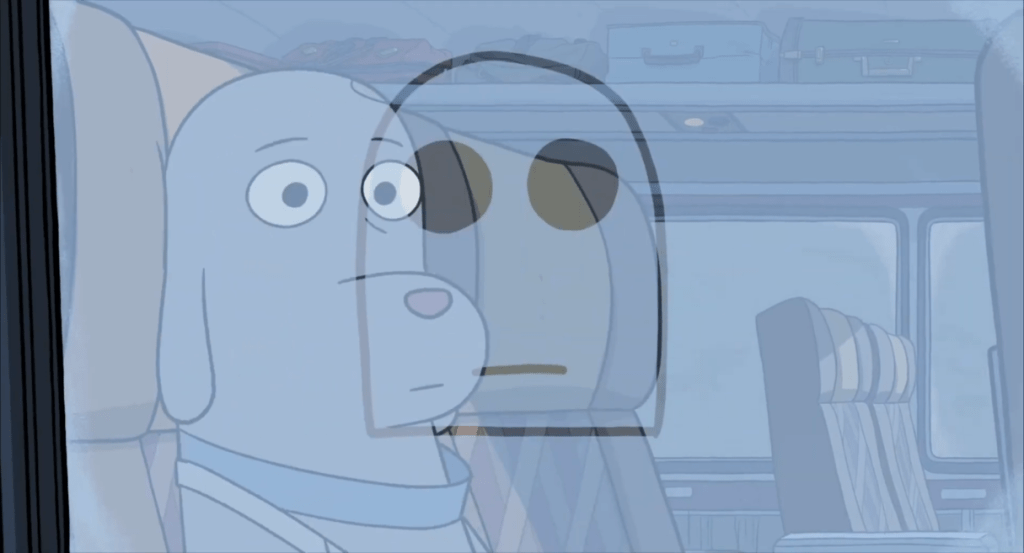
The thing is: I don’t think the film is about any of the above. Robot Dreams isn’t A.I. or Ex Machina, and it works beautifully on an emotional level. But the odd implications that the oddly monogamous relationships of Dog and Robot carry are not something we bring to the film: its entire ending hinges on this. We need to accept that there are good reasons why Robot concludes he can have one relationship or another, but not both – and that is where my brain cannot help but go, “… hang on a minute.” It’s not that Robot Dreams is a film that asks you to switch off your brain in order to enjoy it, but – and this may sound odd for an animated film about cartoon animals – your enjoyment of it may well suffer if you bring overly literal thinking to it. The concreteness and specificity of this world that is so clearly New York and so clearly set in the ’80s makes a lot of the story look and feel reasonably literal, but Robot Dreams works best as a tone poem of sorts about the yearning for companionship, the pain that comes with the end of a relationship, and what it means to let go and move on.
I suspect that even more literal-minded people will find a lot to enjoy about Robot Dreams. It is delightful and inventive, and it has a surreal streak that keep it from becoming mawkish or heavy at all times. Will its poetry work on everyone? I’m not sure, but I would dearly like to see more films like this. There are other filmmakers working in animation that tell emotional stories, but they often veer towards the sentimental, making it obvious what the audience is supposed to feel. Robot Dreams is more delicate, and the emotions it evokes may be more fragile. If this can be brought about by a film like this one, about a cartoon dog and a cartoon robot, living in a world populated by animals, with dream sequences inspired by Busby Berkeley and The Wizard of Oz, then that is something to be celebrated.

 A Damn Fine Cup of Culture
Stumbled upon this review randomly on BlueSky and wanted to comment how much I enjoyed your write-up. I like what you said about the film being like a tone poem about companionship and that it’s not literal-minded. Robot Dreams is absolutely written like a love story (especially in regards its ending) in the symbolic sense, even though there is no romance in the film.