Welcome to Six Damn Fine Degrees. These instalments will be inspired by the idea of six degrees of separation in the loosest sense. The only rule: it connects – in some way – to the previous instalment. So come join us on our weekly foray into interconnectedness!

Although I try to avoid plot spoilers, for those who have never seen L.A. Confidential: skip this article and see the film first. It’s worth it, and inevitably there will be minor spoilers ahead.
L.A. Confidential is one of those films frequently just described as “noir”, and so it is, but in the same way Who Framed Roger Rabbit is just a cartoon. It is based on the James Ellroy novel of the same name, but rather than a stylized “noir in Technicolor”, it makes a deliberate effort to be as naturalistic as the genre allows. Instead of the shadow play that we associate with film noir, many key scenes play out in broad daylight. It is only as we progress into the film that the light, and the plot, thickens. The film is set in Los Angeles mid-1950s, a time in which scandals were starting to bubble up to the surface, via exposé magazines such as Confidential. In the absence of social media or the internet, these items of “information” were considered insider knowledge, to be exploited by gossip columnists, usually without much concern for the truth let alone any scruples. In the movie, this group of people is represented by Sid Hudgens (Danny DeVito) of Hush Hush magazine, who provides us with the voice-over at the beginning of the film.

The three leads play it as straight as possible. Our protagonists, all policemen, each bring a different perspective to the plot. There’s Edmund Exley (Guy Pearce), the do-gooder cop who wants to do everything by the book but is also driven by his overriding ambition. Bud White (Russell Crowe), a man who is often used as muscle, but who has both hidden depths and also deep-seated (and explosive) psychological issues. And Jack Vincennes (Kevin Spacey), who lives to be an “advisor” on the TV show Badge of Honour. In this fictional television procedural, police officers are always the good guys combating crime in the city, like in the real-life show Dragnet, and in stark contrast to the corruption that the actual LAPD was suffused with.

It is worth considering that when this film came out in 1997, both Pearce and Crowe were relative unknowns. The audience, therefore, wasn’t given any clue as to their characters. They’re blank slates as we follow them through the story and find out what they are really made of. While the film is based on a James Ellroy novel, and uses that kind of language, (the script is peppered with slurs so offensive, it almost serves as an inoculation) delivery is straight. None of the wink-wink, nudge-nudge or hardboiled Chandlerisms. As an example, at one point Jack Vincennes is haggling with gossip journalist Sid Hudgens about the gratuity he’ll be getting for a setup, involving a low-grade drug bust, to be used as gossip-rag fodder. “Jack, it’s Christmas!” Sid tries to mollify him. “No,” retorts Vincennes “It’s felony possession of marijuana.” This bad joke is told completely unironically, by a character who clearly customarily makes bad jokes, thinks it makes him look suave, and – crucially – a character who keeps getting away with doing so. It is this kind of attention to the personalities that inhabit this world, that makes L.A. Confidential so outstanding. This stellar ensemble cast is also frequently photographed together, so that there are often multiple characters on the screen, each lending a different aspect to the scene. About halfway through the film, Sid Hudgens tries to set up out-of-work actor Matt (a stellar Simon Baker) with the DA to – again – get juicy material for his gossip rag. We get Spacey’s reactions in he background as Hudgens lies and wheedles at the very reluctant and frightened Matt, promising him a part on Badge of Honour, if he manages to seduce the DA: an obvious impossibility once he has been featured in the gossip columns. Vincennes looks pained only to change to a completely straight face, once the poor actor, about to become an unwilling male escort, directs his gaze at him.

The plot is involved, though less so in the film than the book. It turns around several threads. Sex workers who are made to look like movie-stars, with or without the aid of plastic surgery, presided over by millionnaire sophisticate Pierce Patchett (David Strathairn). A multiple murder in a coffee shop, in which a cop ends up killed. An enormous amount of missing heroin and a power vacuum following the arrest of a big crime kingpin. There are several deaths, which may or may not be related, and these threads are followed by our trio individually, or sometimes in tandem. At points it seems impossible to gather all these threads back together, but the film does this in such a masterful way, it still holds up in a rewatch. It is all right there in front of us, the whole time.
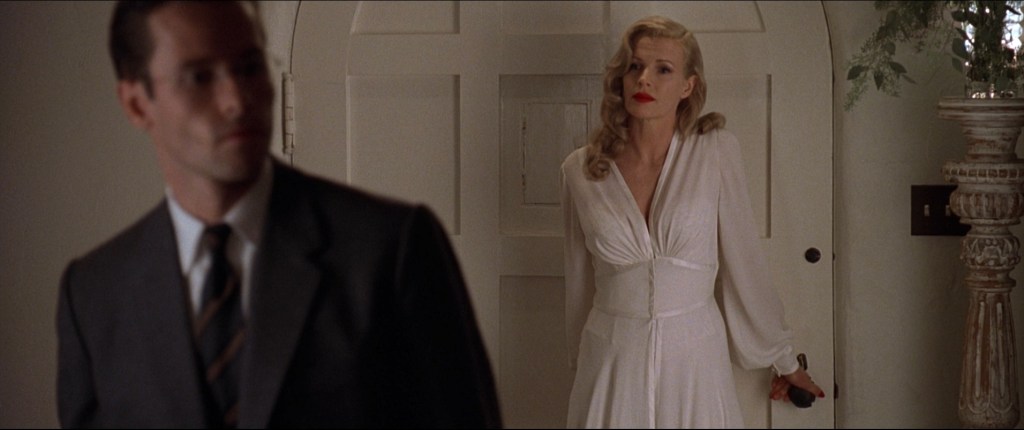
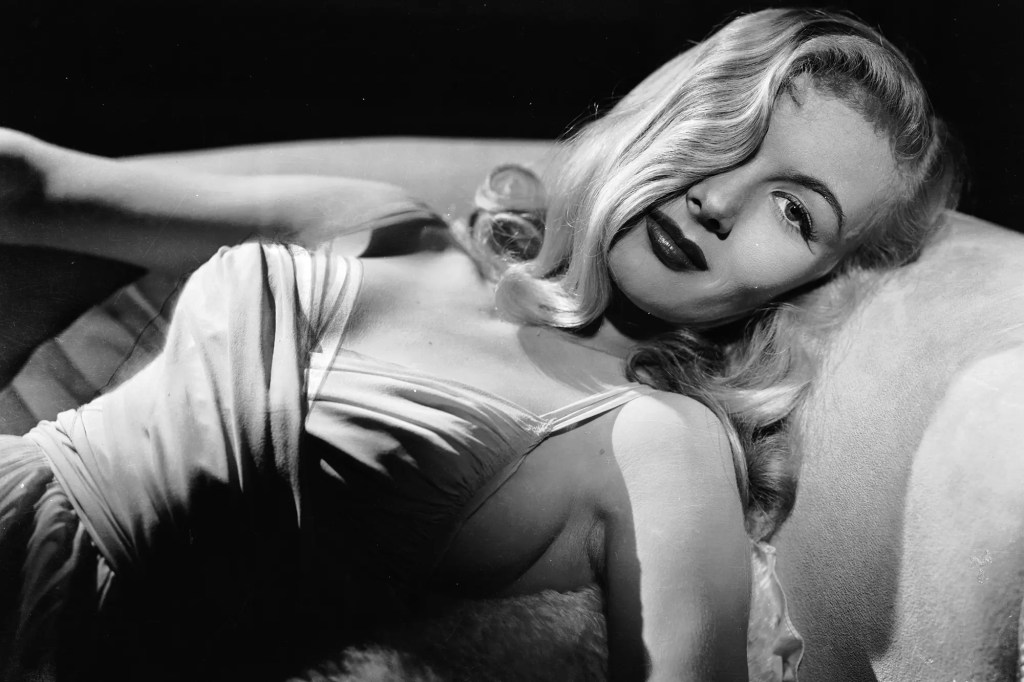
The period details are also worth noting. While following one of the threads in the plot, Bud White meets, and falls for, Lynn Bracken (Kim Basinger), one of the movie-star escorts. When she lets him into her personal room, as herself, the movie hints, rather than her “character” (she’s the escort service’s Veronica Lake), we see the book How to Cook a Wolf on the nightstand. How to Cook a Wolf is an idiosyncratic 1942 work by M.F.K. Fisher, a stylized “cookbook” that serves as a kind of lyrical essay on food as a form of self-sufficiency. Written after the attacks on Pearl Harbour, it is part black-out crisis cooking and later it also became a criticism of the indulgence of the postwar years. This is one of the fantastic examples of period detail as it is used in the film. Does it tell us something about Lynn Bracken? Or perhaps it doesn’t mean anything at all and is just there.
While the film has many aspects which richly reward multiple viewings, the psychological progression our three main characters go through is the real heart of it. Consider, for example, a key interrogation Exley conducts. It is full of harsh, offensive slurs and backhanded tactics designed to make the suspects talk. In the glass of the interrogation room, we see the reflection of Vincennes’ face: watch his expression and you may conclude something about his character that the script itself never makes explicit, and is certainly not in the book. Something that may be part of the reason he goes off on his own investigation, an investigation that will eventually land him in the lion’s den. All three characters must, in their individual journeys, find a form of redemption. Whether that be through honour, through justice or through love. The movie is smart enough to allow us to make up our own mind about these people, who they become, and whether they deserve what they get in the end.
When L.A. Confidential was considered for the Oscars, the film won two. It was nominated for a whopping nine, but it was to be Titanic which swept the board that year. L.A. Confidential, however, survives as a classic in its own right, nearly thirty years on, and still rewards repeat viewings. If you decide to revisit it, it may turn out to be an even better film than the one you remember.

 A Damn Fine Cup of Culture
3 thoughts on “Six Damn Fine Degrees #217: L.A. Confidential, revisited”