Welcome to Six Damn Fine Degrees. These instalments will be inspired by the idea of six degrees of separation in the loosest sense. The only rule: it connects – in some way – to the previous instalment. So come join us on our weekly foray into interconnectedness!
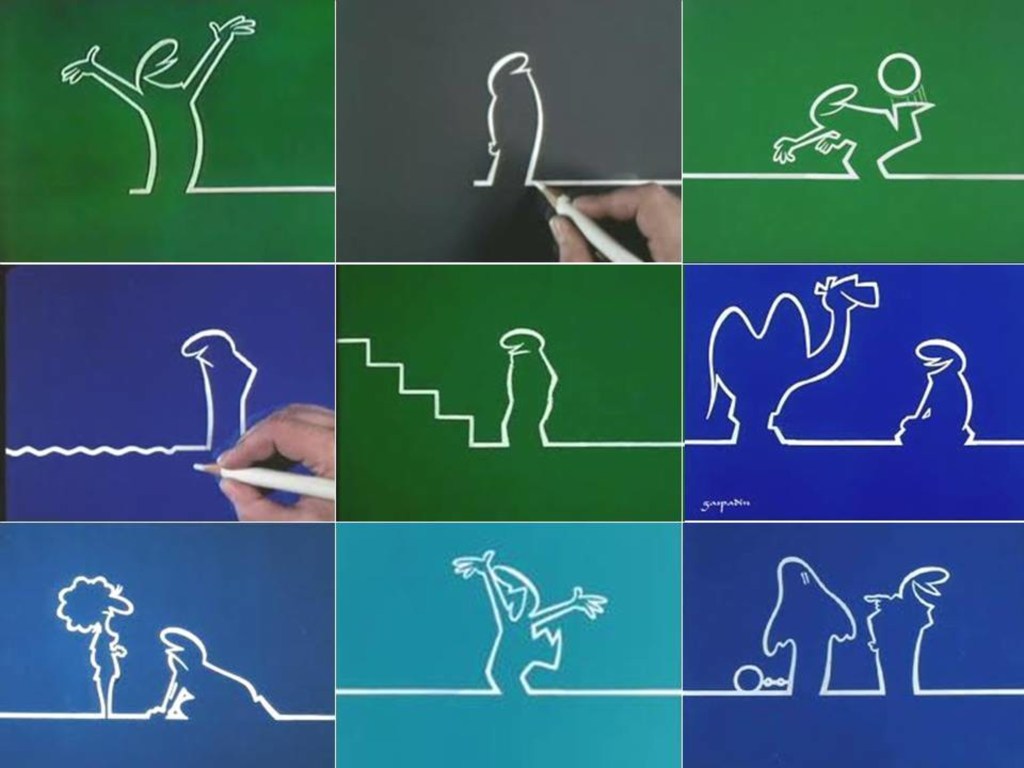
Italian TV cartoons that were the joy of our youths? Reading Alan’s piece from last week, I didn’t have to look far: To me, La Linea, the little angry man hand-sketched by a cartoonist on a line, was an ever-present phenomenon in 1980s television.
On German TV stations, La Linea (or Mr. Line, as he was originally called) would fill in the gaps between broadcasts and in the shortest amount of time imaginable get himself worked up over something. The often-seen hand of a cartoonist helped out at times continuing the line or adding an obstacle to Linea’s adventures. Often, he would bicker and complain, demand assistance and attention or simply get himself into trouble. The simplicity of the concept was so effective that I would always hope for yet another small story to appear whenever I was watching something else.
Little did I know at the time that it had been created in the late 1960s by Osvaldo Cavaldini to advertise a pressure cooker by Italian cookware company Lagostino, and that by 1972, La Linea was first all over Italian television and even film intermissions. By the late ’70s, it was all over international television, appearing in over 50 countries and garnering several awards for his creator. Called anything from Mr. Curious (in Turkey), Cool Dwarf (in Hungary), or Badum Badum (in variations in most Slavic-language countries), everybody seemed to enjoy the ‘Line Man’ immensely.
The character, voiced in incomprehensible gibberish with a few Italian or English words thrown in, was voiced by Carlo Bonomi, who would later be the voice of Milan’s Central Station, Swiss broadcast’s Pingu, and several of Switzerland’s European Song Contest transmissions. His edgy, cheeky and precocious work on La Linea would also work so well because, without a real language, his adventures would be completely universal.
The complete adventures of La Linea as a 4+ hour marathon!
The secret of La Linea was also his often villainous behaviour, so instead of heroic storylines, one could really enjoy all the challenges, obstacles and difficulties he had to overcome, and there was an enormous sense of schadenfreude involved. Some even saw a philosophical dimension in La Linea’s relationship to the helping hand of the cartoonist: was this a reflection on man’s predestined fate in the universe, a creative maker that would challenge us and often either help us out last minute or add fresh challenges to our plates?
Its cultural impact is undeniable, and even though Cavaldoni passed in 2007, there is no shortage of Linea’s popping up in graffiti art worldwide. Also, homages to La Linea have appeared in music (Jamiroquai’s “Don’t Give Hate a Chance” and Gigi d’Agostino’s “Bla Bla Bla”, for example), in film (Pixar’s 2020 Soul features counselors who were modelled on La Linea), and, of course, advertisements – be it American cars, Polish telecommunication or Icelandic banking. And even if these days, the traces of the cartoons might be disappearing slowly, its over 100 episodes still work like a charm and can be found widely online.

 A Damn Fine Cup of Culture
3 thoughts on “Six Damn Fine Degrees #219: Osvaldo Cavandoli’s La Linea”