Welcome to Six Damn Fine Degrees. These instalments will be inspired by the idea of six degrees of separation in the loosest sense. The only rule: it connects – in some way – to the previous instalment. So come join us on our weekly foray into interconnectedness!


Last week, Sam talked about the classic novels that were an essential part of an English curriculum, and I can well remember something similar from my school days. Those books that were seen as being the official, proper and right things for developing minds to read. However, they were not the only books out there. Alongside the worthy classics, there were popular reads that nonetheless bore the taint of scholarly respect. No teacher would be too angry with you if you were reading an Agatha Christie.
Beyond those, though, you entered the realm of the books that, conventionality suggested, you weren’t really meant to be reading. The trashy, the populist. Books that somehow carried the stigma that it was somehow wasting all the effort you had put into learning to read to engage with this undignified nonsense. Into this category fell science fiction, fantasy and horror. These books could be fun, but you weren’t going to get anything out of them.
So when I started thinking about the books young me read for this article, the one book from that period that I kept coming back to was one that was definitely not School-Approved: Greg Bear’s 1985 science fiction novel Blood Music”
I think the reason this book stuck with me for so long is that it was just the right mix of easy reading, big ideas, scientific speculation, thriller and light body horror. To pre-teen me, this was The Good Stuff and left a lasting impression, shaping my tastes for future reading as much as any of the school curriculum.

Blood Music is the story of a scientist trying to alter human blood cells to create tiny biological nano-robots. The scientist – amazingly called Vergil Ulam, a name that seems more anagram than man – learns that his work is to lose its funding and he’s told to destroy it all. Instead, he chooses to smuggle it out by injecting those cells into himself. This then proceeds to go in very unexpected directions, as the scientist quickly realises that the cells in his body have somehow developed a consciousness and are thriving. I guess the airport paperback pitch for this would be: what if humanity faces (spooky fanfare) an intelligent disease?
From that summary, you’d probably imagine the story goes on a conventional narrative arc, the usual journey that such a B-movie setup might take you on. Humanity faces a terrible threat, an eccentric band of scientists have to fight both the growing power of the smart nanocells but also their closed-minded pen-pushing bosses up in whatever laboratories have for City Halls. Or, at least, that is where young me probably thought it would go. The thrilling enjoyment of reading it realising it wasn’t going down that road is a happy memory from that time.
I’m not going to go bat for this book as a true lost literary masterpiece. In many respects, re-reading the book is to realise just how ingrained it is with many of the cliches and prejudices of science fiction at the time. The main scientist at the start is a bit of a schlubby loser, but thanks in part to the plot hijinks, he gets to leap into bed with a beautiful young lady he thought was out of his league. And yet, such was my youth at the time, I think I probably read that thinking, “Wait!? The obvious stand-in for the middle-aged writer can get it together with a woman whose personality is best described as ‘sexy’? What an unexpected turn-up, I bet I’m not going to read this in loads of other science-fiction books by middle-aged writers going forward.” Or as I would have expressed it back then: “Cool!”
There’s an odd, dispassionate clunkiness to the writing at times, and many of the characters introduced seem to exist just to dump the (admittedly interesting) exposition and scientific theories rather than actually have anything by way of an actual character. And the less said about the female character who is meant to have a learning difficulty, the better.
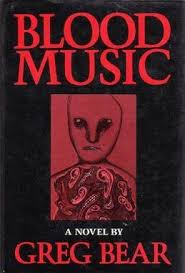


And yet: re-reading the book still reminds me of the thrill pre-teen me had with it. When the book makes huge hard sci-fi swings or jarring narrative leaps into a transformed Earth, such ambition still feels like fun. It’s also not a long book, so you can be done with it before its flaws become genuinely annoying. And, of course, being a decades-old sci-fi novel, finding a new copy of the book invariably ends up exploring a giant library of fabulously mad book covers.

Before Blood Music I tended to read science fiction for the evil robots and humanoid heroics. After reading it, I sought out the high concept stuff, the heavy tomes from the big ideas merchants like Isaac Asimov, Arthur C. Clarke, Frank Herbert and Greg Bear himself, reshaping my tastes for fiction. Indeed, Bear in this period was to enjoy quite an Imperial phase of science-fiction novels that get the right balance between exploring ideas and being page-turners, most notably the multi-award-winning Eon. And while it’s fair to say that much of this output has dated, that spirit of taking on the big ideas is still a basic ambition I find thrilling in new science fiction.
Crucially, though, I don’t mean to rave about this stuff to damn the school curriculum. In fact, I also have fond memories of some of the books I studied, or the more mainstream classics I ended up reading anyway. My first thought was to pick one of those for this. And yet, like the microscopic intelligent noocytes of the book, Blood Music had got under my skin – a fun, if flawed, read that I’ll still happily go back to. As The Waterboys sang around the same time this book got published – “I have heard the Big Music, and I will never be the same” – well, young me got his taste for high-concept sci-fi when he read the Blood Music and I’ve never shaken off the high-concept sci-fi infection ever since.
 A Damn Fine Cup of Culture