Welcome to Six Damn Fine Degrees. These instalments will be inspired by the idea of six degrees of separation in the loosest sense. The only rule: it connects – in some way – to the previous instalment. So come join us on our weekly foray into interconnectedness!

Carole Lombard’s unique status as the lady of screwball comedy, as well as her unexpectedly salty sense of humour and use of language, were at the centre of last week’s post. It reminded me, of course, that the final comedic performance released during her lifetime – before it was tragically cut short by the infamous Nevada plane crash in 1941 – was Mr. and Mrs. Smith, Alfred Hitchcock’s one and only pure foray into pure American screwball (and now annoyingly mixed up with the 2005 Brangelina flick of the same name). Even though Lombard’s penultimate performance is easily eclipsed by her last role in Lubitsch’s To Be or Not to Be, I thought that reevaluating her Hitchcock role was certainly worth my while, especially since it’s one of the most overlooked and most easily criticised Hitchcock entries.
The two had immediately struck up a friendship upon the Hitchcocks’ arrival in Hollywood in 1939. Alfred and Alma even rented their first Bel Air home from Lombard and her equally famous husband, Clark Gable. Lombard had come to an impasse in her career after trying her hand at dramatic roles and failing at the box office. She had come up the Hollywood ladder by way of early comedic success and a brief marriage with fellow actor William Powell. The 1930s then cemented her image as the Queen of Screwball with highly successful turns in Twentieth Century (1934), Hands Across the Table (1935) and her Oscar-nominated performance in My Man Godfrey (1936). By the time Hitchcock met her, she had also become one half of Hollywood’s ‘supercouple’ alongside Clark Gable. Gable and Lombard, as they were eternalised in 1976’s biopic starring James Brolin and Jill Clayburgh, were the talk of Tinseltown when the Hitchcocks settled in town.
Both the already famous British director, who had been lured to Hollywood and away from Europe on the brink of World War II by producer David O. Selznick, and Lombard shared the wicked sense of humour and salty language so well described in Alan’s post. Their mutual pranks must have started early on and culminated in delicious fashion during the filming of Mr. and Mrs. Smith. Lombard had a soft spot for the screenplay written by screwball specialist Norman Krasna and pitched it first to RKO and then to Hitchcock. Most critics and biographers claim the director must have done it as a favour to Lombard, who also co-produced the film, and due to his infatuation with the actress. Howard Maxford’s The A-Z of Hitchcock even claims he was out of his depths making a straightforward comedy, despite quoting the many favourable reviews and financial success at the time of its release. So I was wondering, of course, how it would hold up to my second-ever viewing with no particular memories from the first time I saw Mr. and Mrs. Smith some twenty years ago.
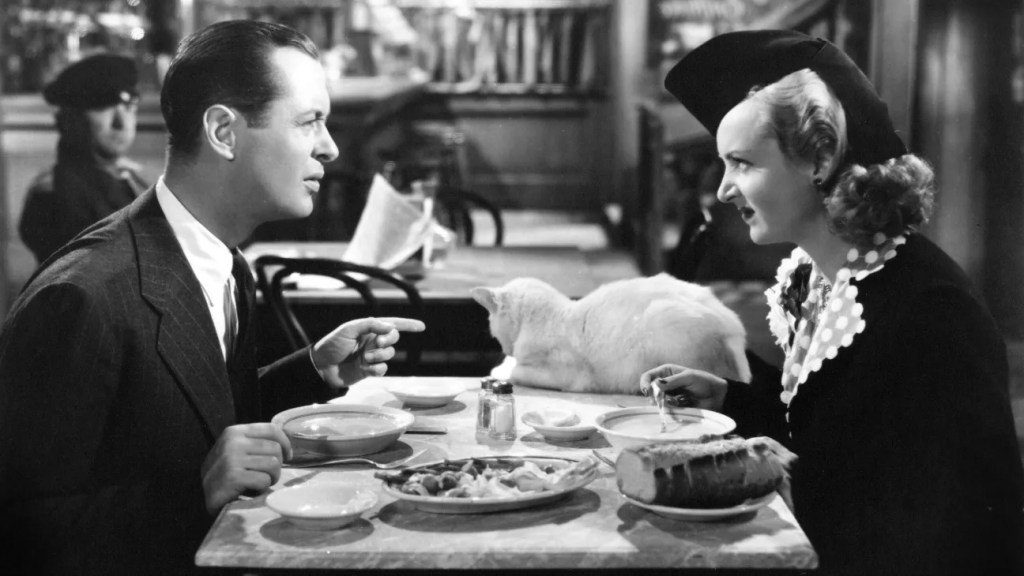
What transpires from the start is that Hitchcock is emulating the classic American screwball tropes, from the New York skyline, the Fifth Avenue apartment and the downtown offices to the highs of upper-crust functions and the lowdowns of dingy dive bars and restaurants. At the centre is the kind of remarriage storyline popular at the time, allowing more leeway under the Hayes Code to depict marital divides, divorce issues, adultery and courtship, all with the goal of getting the split-up couple back together. Lombard and Robert Montgomery are clearly having a good time playing the titular pair, and Hitchcock quickly asserts he is in the director’s seat: the initial camera pan elaborately establishes that their relationship has been in disarray, and the couple has taken three full days stuck in their bedroom before they resolve one of their epic conflicts. We move from Montgomery’s Mr. Smith across a messy carpeted floor to a tossing Mrs. Smith peeking up from under the blankets at a fresh morning. Soon they (and their feet under the table) are united at breakfast over one critical question and a slightly too honest answer: would Mr. Smith marry his wife all over again if he had the chance? His answer is a surprisingly resounding no.
This film’s McGuffin is revealed soon after when their marriage licence actually turns out to be inexistent due to a legal technicality. So, instead of a quick remarriage, the setup is rife for a comedy of errors and misunderstandings in classic screwball fashion. The pace of the sequence of events that follows is fast and sharp, the dialogue witty, and the production values admirable. Highlights include the couple’s attempt at a romantic night at one of their formerly favourite restaurants, now in a dilapidated state, much like their marriage. “Mamma Lucy” is now run by a crook, and not even the cat squatting on their dinner table touches the soup – much to Mr. Smith’s suspicion. Later, the couple tries to evoke each other’s jealousy by dating other people, resulting in some hilarious setups at a dinner dance, complete with juxtaposed Hitchcock blondes and bloody noses. In the meantime, Lombard’s Mrs. Smith is trying to have a good time with her husband’s business partner at the New York World Fair – only to be stuck on the parachute ride in pouring rain and trying to avoid a cold by getting her new love interest blind drunk.
Of course, one could argue as some critics did (and even Hitchcock claimed), that the director was just adapting the delightful details of Krasna’s script and filming his actors in well-prepared setups. Yet their playful mood, the sense of timing and comedic build-up and the technical execution are just too good for that. There is an infectious sense of fun in all this. Reading about the pranks going on during filming, this is easily confirmed. Lombard especially seems to have delighted in pulling Hitch’s leg, at one point arranging to bring three cattle in pens to the set, complete with the name tags of the main actors around their necks. Both Hitchcock and the press clearly understood this in reference to the director’s famous quip that “All actors are cattle”. Later on, when Lombard spontaneously sat in the director’s chair during the famous Hitchcock cameo, she had him do the small bit in front of the Fifth Avenue apartment over and over again, much to the enjoyment of the rest of the crew – and Hitch.
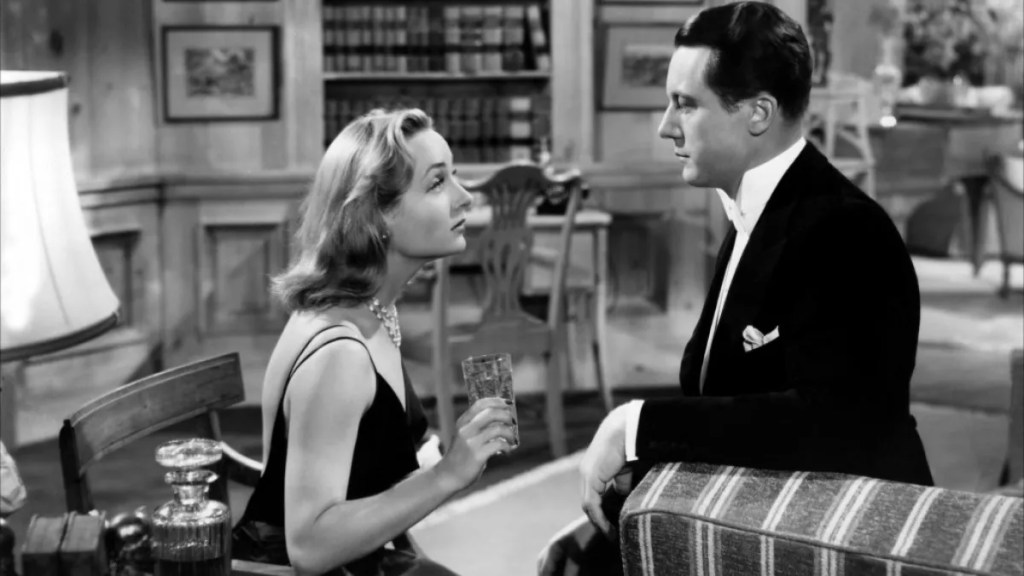
By the time we reach the snowed-in cabins of the final third of the film, we are in for a highly enjoyable finale. Reminiscent of The Lady Vanishes and the original The Man Who Knew Too Much, the wintery setting isn’t the background of some murder or spy mystery, but it offers wall-to-wall housing to confuse and resolve the last strands of the plot, especially the realisation that despite the couple’s differences and efforts to highlight them, they are complicit in their pranks and their feelings for each other. The final scene shows them teasing each other with a pair of skis forming a cross in front of them. Is this supposed to be a symbol of the burdens they will continue to bear? Or the final obstacle on their path to eternal happiness? Knowing Hitchcock, Lombard and Montgomery, I suppose it’s something much saltier and a double entendre!
With Lombard’s tragic passing a year after the film’s release, there was never a chance for the director and star to join forces again. Hitch and Alma were of course devastated at the loss of one of their earliest Hollywood friends. One can only imagine what they could have still accomplished together. Maybe Mr. and Mrs. Smith wouldn’t have remained the only pure Hitchcock comedy (even if arguably The Trouble with Harry and Family Plot come close). With Lombard gone, the famous cool blondes in his films would be played initially by Joan Fontaine and Ingrid Bergman, before Grace Kelly became his ideal image of dramatic and comedic actress. Lombard’s performance is much in that vein in this film already.
As a pure marital romp, Mr. and Mrs. Smith is to some extent a great exception in Hitch’s filmography, but elements of screwball and slapstick, macabre and dark humour, as well as marriage comedy always found a place in his films. Whereas these often just seem there to release tension after scenes of suspense, Mr. and Mrs. Smith proves that they can still work together on their own to make for a delightful experience. Hitchcock & Lombard certainly made sure of that!

 A Damn Fine Cup of Culture
Whatever the film I can never resist Carole Lombard. She was so beautiful, but didn’t seem to take herself too seriously. Carole was a master of her craft, and it’s so sad she didn’t get to make many more films after this one.