Welcome to Six Damn Fine Degrees. These instalments will be inspired by the idea of six degrees of separation in the loosest sense. The only rule: it connects – in some way – to the previous instalment. So come join us on our weekly foray into interconnectedness!

Alan: At the end of last week’s post, Matt asked the question about what it was about audio adaptations specifically that might stimulate the imagination differently to other media. It’s a good question, but in the world of horror there was once another medium that for young me was the ultimate in spooky stimulus.
When I was quite young, the nearby town got a brand spanking new library. And it was bigger than I could ever imagine a library could be – it even extended over two floors, which seemed to make it incomprehensively vast for someone like me who still needed to stretch upwards to peer over the checking-out desk.
Such was the epic scale of this place that when visiting with my mum I could comfortably wander off and explore the world of books, while she hunted titles elsewhere. And that was where I discovered… the horror section of the VHS corner.
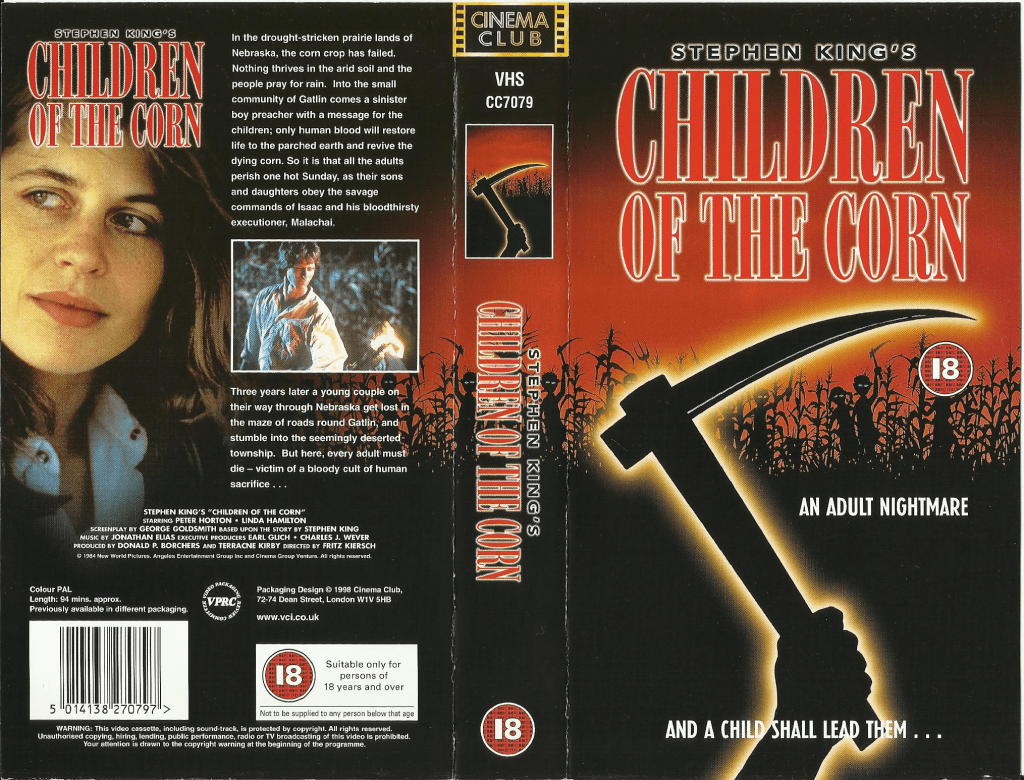
I still remember the giddy thrill of it. All these lurid titles, available only to those 18 or over, just sat on the shelf within easy reach of a child. This was the era of the video nasties panic in the UK, so these weren’t the very worst titles – but what there was felt slightly scary to take off the shelf and read. All these boxes, all in the most gaudy, eye-catching design with incredibly alluring covers.
And once you’d picked up a box from its amazing cover – oh, the joy of the back of the box. Salacious images from the title, and a potted summary of the plot that made it all sound like the goriest, most terrifying thing you could imagine. And that was the thing: I would imagine. Children Of The Corn, Scanners, The Birds, Inseminoid, The Amityville Horror. The versions of these stories conjured up by the front cover and back blurb had everything a young mind forbidden to see these films could conjure up.
Of course, the downside of this is that when I was old enough to watch these films, most of them never quite lived up to the grotty, epic horrorfests I had imagined. The ropey special effects of the period weren’t a patch on the glorious scenes I had conjured up viewing the VHS boxes. And rather than the wall-to-wall terror of heads exploding, birds devouring humans and farmyard slaughter, they had padded the things with boring stuff like daft plots and one-dimensional characters. Honestly, far too many were an example of a situation where the best format was the VHS box itself, rather than the film it contained.
Julie: This Halloween, as every Halloween, and Christmas, and in fact on most days of the year, I consume an inordinate amount of audio content. Over the years, I’ve grown a pretty substantial (and oddly eclectic) audiobook collection, and I have so many podcasts on my Patreon, I can’t even keep up with all the bonus material. Apart from its obvious benefits (convenience, I can wash dishes while listening to the opinion pieces), audio is also… magic.
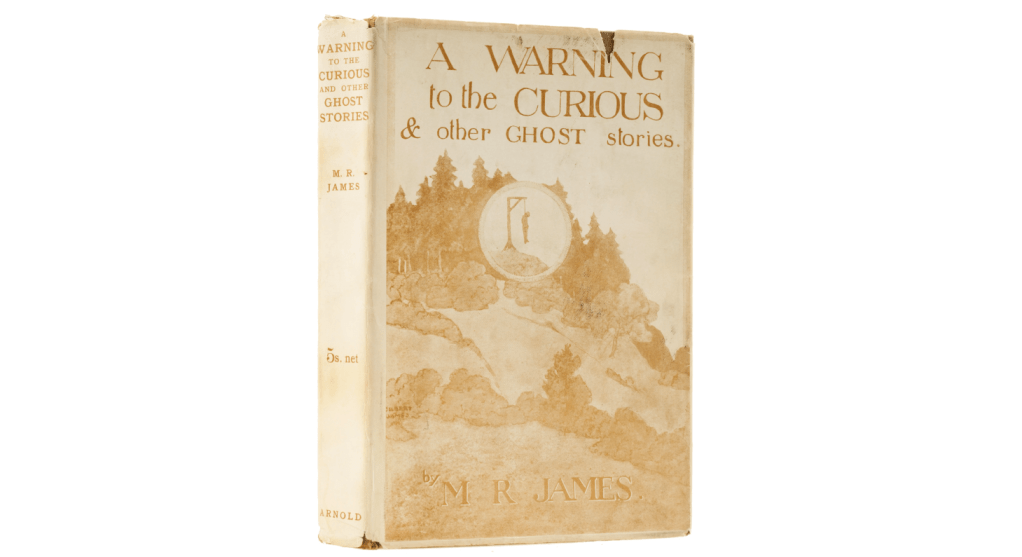
Some books I own three times over. My M.R. James’ ghost stories have several different voices. The Complete Ghost Stories Collection is read by the wonderful Jonathan Keeble, I have two volumes as read by Derek Jacobi, and several individual stories as read in the beautifully modulated tones of David Suchet. And then, of course, there are the versions read by Christopher Lee. These are, to me, rather like special editions of physical books: to enjoy as their own thing. There is quite a bit of non-fiction in my audio collection: Hollywood biographies take up a big chunk of my SD card, to the surprise of absolutely no one. There may even be readers who have noticed that I sometimes also source my blog posts from audiobooks. Some of these (auto-)biographies, like Barbara Streisand’s My Name is Barbara, is read, or rather told, by Streisand herself. Some are read by the author (such as Finstad’s absolutely definitive Natalie Wood biography).
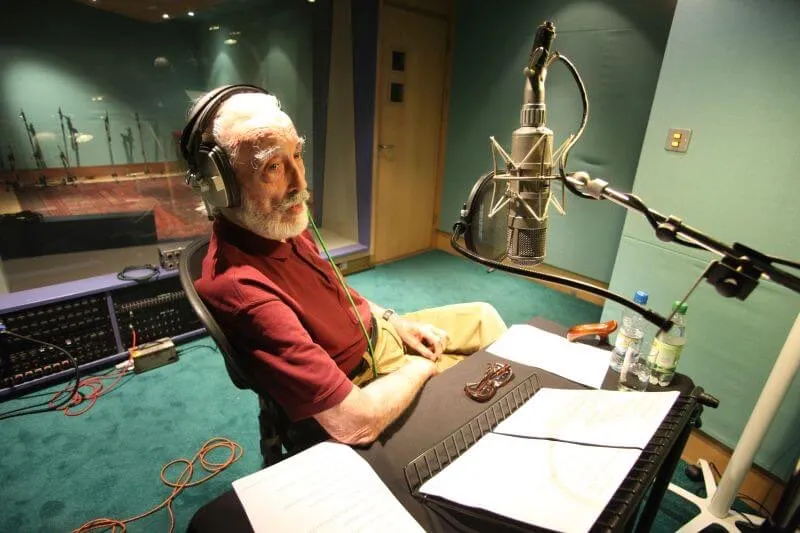
But for non-fiction, as it is for fiction, the reader makes all the difference. Kate Reading is a favourite, so is Andy Serkis, but there are many others. And then there are radio plays or full-cast productions. A famous one is Lincoln in the Bardo, where you will find many famous names in the cast. Or smaller gems such as Douglas Adams’ Dirk Gently’s Holistic Detective Agency, with Olivia Colman and Peter Davison among others. No AI voice can possibly ever top that. Audio is an enrichment, not just a chilly recitation of books you haven’t read yet. Even if the rendering of M.R. James’ stories, as they play in your head, will forever sound just like Jonathan Keeble, sometimes mildly interrupted by Suchet or Jacobi.
Sam: Both Matt and Alan seem to point out in their previous posts how the feeling of true horror is often conjured up from what we imagine – be it audio tracks that stimulate our imagination or simply the foreboding covers of VHS tapes that then turn out to not only be nasty but often worse films. In my late childhood and early teenage, I was faced with both of these instances – until one film finally lived up to all the expectations.
Swiss children of the 1980s almost naturally grew up listening to audio cassettes, or Hörspiele in German, and our family proudly collected them by the dozens. There was a healthy scene of Swiss theatre and TV actors who majorly contributed to an ever-growing number of original stories and literary adaptations in the audio format: names such as Jörg Schneider and Paul Bühlmann, Ines Torelli and Ursula Schäppi were instrumental in bringing to life the stories of ‘Kasperli’, ‘Pumuckl’ and ‘Rössli Hü’, staples of Swiss children’s literature.
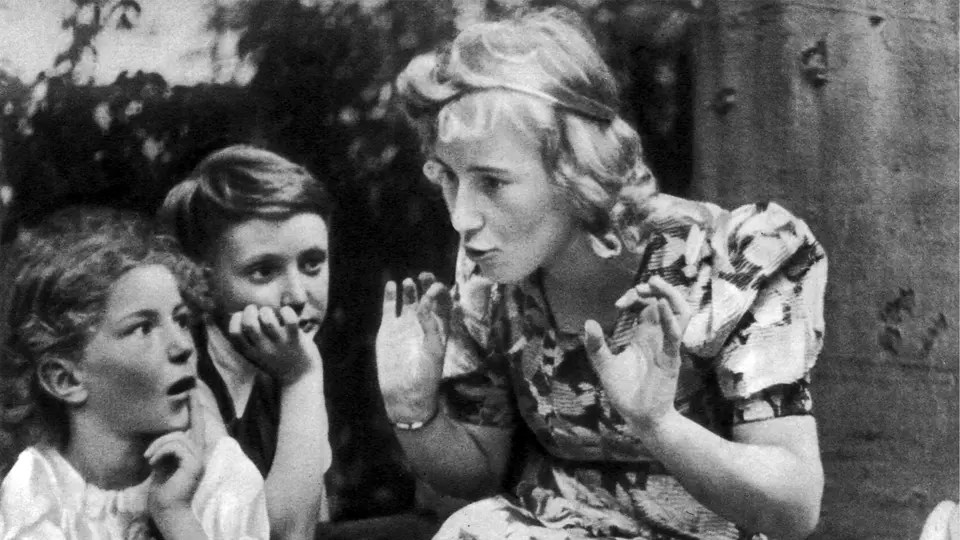
One voice towered above them all: the Eastern Swiss twang of Trudy Gerster, formidable actress and impersonator of every imaginable character and emotional spectrum of childhood. First discovered just before World War II broke out as the country’s ‘national mother’, she became the voice of several generations’ goodnight stories. My sister and I stacked a wide range of her stories on cassettes in our rooms and listened to them regularly. And while her rendition of “The Little Mermaid” might be her most touching accomplishment, it was her anthology tape of ghost stories that made her our heroine of sound. Each moment of creepy suspense was heightened by her voice modulations and timbre, and her ability to change moods and atmosphere on a dime. Our imagination was highly stimulated and our expectations for future ghost and horror stories were running high…
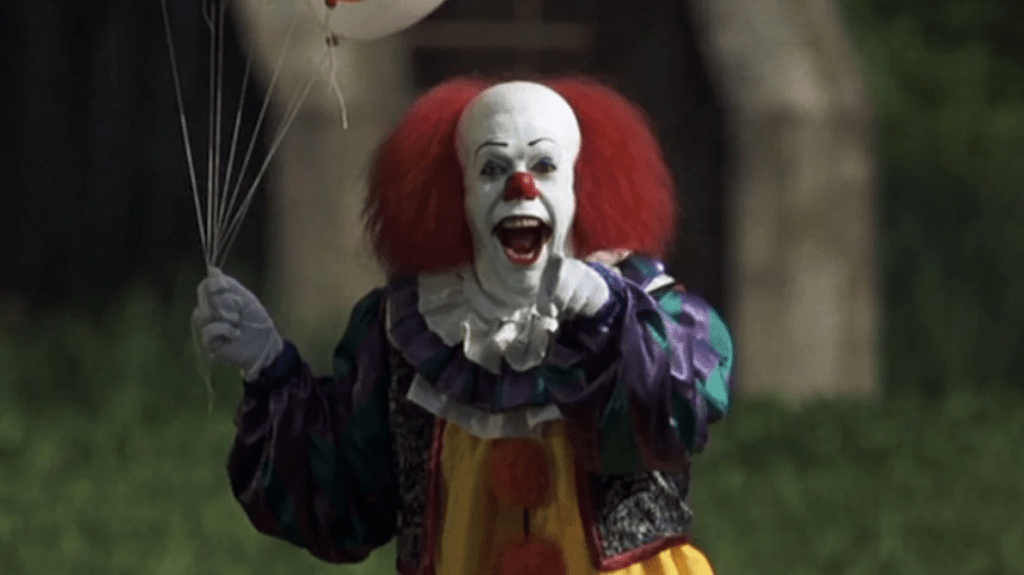
Trudy Gerster continued to enthral one more generation after us, and while she passed away in 2013 at the age of 93, her voice has continued to resonate for children since. In the meantime, I moved on to horror films, many of which never quite lived up to that special atmosphere of cassette recordings. Only when I came across my first Stephen King adaptation in the early ’90s did the promise and the impact of a story (both visually and aurally) match my expectations: my enduring trauma with IT (1990) was about to begin…
 A Damn Fine Cup of Culture