Welcome to Six Damn Fine Degrees. These instalments will be inspired by the idea of six degrees of separation in the loosest sense. The only rule: it connects – in some way – to the previous instalment. So come join us on our weekly foray into interconnectedness!

The past and the way it influences the present featured strongly in the last two instalments. Being from Vienna, I very much enjoyed and related to Matt’s dive into his trip to neighbouring Prague. I’m even a little sorry that I’ll now proceed to wrench this theme of past and present onto a completely different track.
Let me take you back to the year 2005 and a release that you probably missed because there was so much else going on.
2005 was certainly a year for blockbuster fantasy. Harry Potter and the Half-Blood Prince was crushing overall book sales (not just fantasy), selling millions immediately on release. On the other end of the market, George R.R. Martin had just released his long-awaited A Feast for Crows. Neil Gaiman was busy promoting Anansi Boys. And two YA authors burst onto the scene: Stephanie Myers, kicking off the craze for sparkly vampire romance with Twilight, and Rick Riordan, repopularising Greek mythology with The Lightning Thief (Book One of the Percy Jackson-series).
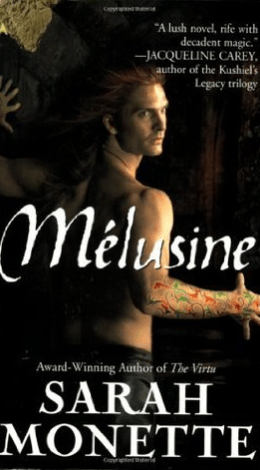
Into this booming market, an as-yet unknown writer made her debut: Katherine Addison, who published Mélusine under the pseudonym of Sarah Monette. It was the first of a series called The Doctrine of Labyrinths, and it was a remarkable novel that nobody quite knew how to describe or categorise.
Nine years later, Addison would become famous with The Goblin Emperor – a gentle novel, that would draw in many readers with its themes of loneliness and the search for friendship. But before that, she clearly had something big to get off her chest. The Doctrine of Labyrinths is a dark fantasy series, and the first to masterfully explore the topic of complex trauma.
These days, you’ll find people discussing different kinds of trauma and trauma therapies quite knowledgeably on social media. The awareness is there that healing from it is not a one-and-done thing but a complex and difficult process. Twenty years ago, we didn’t often express it in those terms, and we certainly didn’t see it laid out that way in genre fiction.
Then Mélusine came along, all louche and pissy and sharp, and simply went there.
It’s not that trauma had never loomed large in fantasy plots. It played out in sadistic ways all the time (looking at you, George R.R. Martin). However, Addison provided a counterpoint against the way traumatic events in fantasy tended to unfold, and then the characters assimilated them and moved on with the plot. In her world, trauma is an active participant in the plot, a force that shapes the characters and their moves in alienating ways. Healing is a drawn-out process with frequent setbacks that follow piecemeal progress. You fumble around in the pitch dark, and then you find you’ve been moving in circles instead of forward.
That is the topic which first time writer Katherine Addison set out to address in a whopping four-book series. And I am obsessed with how she pulled it off. To be clear: If anyone can cast trauma as the central theme of a fantasy adventure and suffuse the topic with hope and humour, it is Addison. She has proved herself over and over again to be a consummate storyteller, brilliant worldbuilder, and minute observer of characters.
In 2005, Publishers Weekly described Mélusine as “extraordinary”. Other blurbs went with “lush”, “rich”, or “gothic”. (And one ended up disappointing quite a few readers by mislabeling it as an “m2m romance”). Personally, I think “lurid”, “in your face” and “unapologetic” cover it a lot better.
Mélusine follows the (mis-)adventures of half-brothers Felix and Mildmay – one a charming, cruel court wizard, the other a street criminal and ex-murderer who is, nevertheless, the more relatable of the two. It’s written alternatingly from both their points of view. The narrative voices – particularly Mildmay’s, who is a born storyteller, but also Felix, who talks exactly like a prat like him would – are a joy to read.
We only get to see about five pages of Felix being a jerk, though, before someone perpetrates an act of thaumaturgical violence on him and he goes insane. So, yes, he narrates 90% of his story while out of his mind. I’m almost gleeful about how Addison pulls that off, too.
From then on, it’s up to Felix and Mildmay on their chaotic road trip to find a cure for the madness. In later books, they set out to restore the magic artefact that got broken and defeat Felix’ all powerful nemesis. All the while, they’re having adventures in creepy settings with an assortment of eccentric side characters who all have their own thing going on.
So, in a very literal sense, this is a book about two traumatised characters bonded together in a way neither of them truly understands. And Addison does not stint. She front-loads the two of them with ten people’s worth of suffering. Both start off in life with a sort of Oliver Twistian child thief background. They then encounter just about anything you might consider abuse at a very young age, ramping up as they grow older. The book just kind of barfs trauma at them from the outset and never lets up.
But it’s also a book that deals with trauma on a metaphorical level. It offers insight into how people learn to survive, maladaptively or not.
Felix and Mildmay start looking more and more like two sides of the same person. Mildmay embodies the unspeakable past that Felix has wallpapered over. But it is Mildmay who is the strong one. Without him, Felix would have died before the end of book one, and boy does he know and resent it. Mildmay, I think, sees Felix as aspirational, as the best part of himself that must be preserved at all costs. He understands his own value as a weapon but believes himself too deeply flawed to be trusted as the wielder, so he looks to Felix to give him meaning. Thus, Labyrinths takes a look at how someone might treat the ugly part of himself that has helped him survive and that fills him with shame.
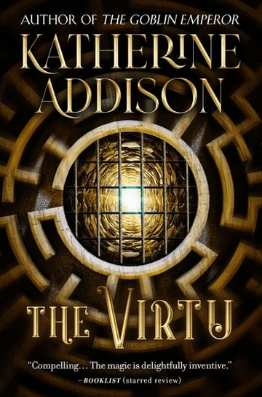
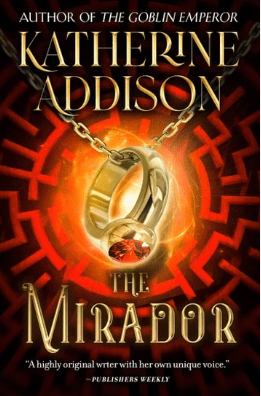
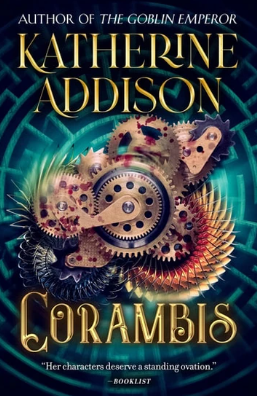
The Doctrine of Labyrinths unfolds its depth on a second reading. For instance, the way that Felix and Mildmay keep stumbling onto and through sinister labyrinths changes from weirdly repetitive to meditative and insightful. Cursed jewels, a dream garden, vengeance spirits and a sacrifice machine also play parts both directly and as a representation of inner states.
Like the minor villain Thaddaeus – who bullies Felix because he can’t handle the feeling of solving a problem and then finding out that it didn’t stay solved – I found it hard to deal with the setbacks. The way Felix would have a kind, reasonable moment and then one conversation later abusive Felix would make a comeback. It took me some time to realise that while he had already resolved at the end of book one to treat Mildmay the way he deserves, he literally did not know where to even start. Because Felix had never learnt how to relate to someone without one person mercilessly wielding power over the other. And he had internalised only one possible response to vulnerability.
I appreciate this now with hindsight, having read all four books. On my second read, the character arcs became clearer, the alternating setbacks and progresses more obvious. And my knowledge of the characters making it to a quietly hopeful ending had helped me relax into the story. And so, Felix and Mildmay have become two of my favourite characters, whose relationship makes me smile. But the first time round, I was ready to give up at book three.
I feel like we are used to a lot of fantasy having safeguards: The protagonists we like may be mean to each other, but there are limits. As a reader, you never have to fear that your favourite really goes too far. He’ll do something nasty, and the person he loves will be hurt, and then he comes to his senses. Because he’s good people. You know what I mean?
This series takes a risk. It makes you care for the growth of its characters and then it says, “Hold my beer.” It makes you care about people you don’t even like, while you’re yelling at the pages. Just like the cruelty Felix has had to endure, the savageness he visits on the people he loves knows no safeguards. Again and again, he sabotages his life and disappoints the readers. Against all odds, this lack of a safety net is as exhilarating as it is off-putting. As only the truth can be.
The true victory comes not when Felix destroys his old nemesis who made him the way he is, or when he repairs the things he broke. These events that provide climaxes in the actual fantasy plot change nothing or they even make things worse on a relationship level. True victory arrives in stages, at those moments when both Mildmay and Felix come to terms with – and learn to let go of – why they are the way they are.
This is a cathartic story, a generous story. One might say a dramatic, overwrought story, the sort that appeals to your inner emo teen. The world-building with its magical systems is off the charts, the cast of characters quirky and memorable, the depth of care and understanding beautiful. But what I admire most about it is its courage: Its willingness to risk alienating its readers in order to give them something truly remarkable.
 A Damn Fine Cup of Culture