I used to love reading fantasy and science fiction literature. Or rather, I used to love the idea of sci-fi and fantasy. My parents never got that I enjoyed stories that were out of this world, so to speak. (One of my defining childhood moments: My uncle sends us Star Wars: A New Hope on Betamax tape, taped from Channel 4. We watch it, and I love it. My parents think it’s a waste of time and tape over it the next day. It’s a miracle I didn’t go Michael Myers on them. And by that I mean Halloween Michael Myers, not the “Groovy, baby!” kind.) I loved The Lord of the Rings, Madeleine L’Engle’s Wrinkle in Time and Diana Wynne Jones’ Chrestomanci books.

And then I read too much fantasy. I watched too much sci-fi. And so much of it is poorly written, derivative dribble, disposable junk. I was fed up with bearded, grumpy wizards trying very hard not to be Gandalf, I was sick and tired of chosen ones and ancient prophecies and evils sweeping the land. I had enough of names that looked like the deformed offspring of multiple apostrophes and the bottom of the bag of letters at the end of a game of Scrabble.

It was Joss Whedon’s Firefly that reinstated my belief in good science-fiction. Neil Gaiman largely did the same for fantasy, but I didn’t like his last couple of books that much – apart from which he tends to write metafiction rather than straight fantasy (whatever that may be). There’s always a self-aware, postmodern twinkle in his authorial eye, it seems.
Yesterday I finished China Miéville’s Perdido Street Station. Arguably it’s fantasy, although it’s set in a universe that is closer to our world than to Middle-Earth or the books of Terry Brooks or Robert Jordan. There are no elves, dwarves or dragons (nor thinly veiled copies of them). Magic is a technology, essentially. And New Crobuzon, the monstrous city in which the story takes place, is reminiscent of Victorian London much more than of the pastoral fantasies or the hackneyed medieval towns of your common garden variety of fantasy.
What sets Perdido Street Station apart from those other fantasies is that it feels real. Not epic. Not mythological. Real. It’s fantastic enough to serve as escapist fare, but it’s not the sanitised, Disneyfied kingdom of Far, Far Away. What also sets it apart, and this may surprise some of those who have read it, is the economy of Miéville’s writing. Yes, the book is long – it’s over 800 pages long, in fact – but in the end I felt that no character, no scene, no piece of description didn’t serve a function. So often, bad or mediocre fantasy novels are filled with pages and pages of clumsily handled world creation, which feels like the author trying to show off his or her imagination, more often than not:
“Hey, look at this sentient bird-fish-dinosaur creature I’ve just come up with! And the deities it worships! And the weird, elaborate rituals in which the sentient bird-fish-dinosaur sacrifices his firstborn! And now we’ll never hear anything about them again. Because I’m so inventive, I don’t even have to use my bird-fish-dinosaur for anything else than showing off my imagination!”
Not so in Perdido Street Station. The book is wildly inventive, but everything is there for a reason. Yet the novel feels organic rather than constructed. And I never felt the sort of laziness you get in generic fantasy, namely that the author is simply ticking off all the things the readership wants: Old mentor figure: check. Orphaned hero-to-be: check. Evil lord, comes with his own minions: check. Instead, we have a novel that doesn’t have a clear-cut antagonist. The protagonists aren’t heroes, even if they end up being heroic, more as a way of staying alive than anything else. Some of the novel is genuinely unsettling. And it’s a deeply, densely political world – not the way George Lucas tried to bring in politics in his Star Wars prequels, but infinitely more believably and fascinatingly.
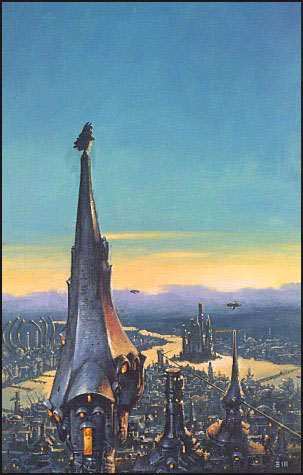
I don’t want to go on at great length (already having done so, of course), but my suggestion is this: if you used to love fantasy but then grew tired of it, or if you believe that you “outgrew” the genre – give Miéville a try. Check out Perdido Street Street Station. And if you don’t like it, write me… so I can tell you how and why you’re just, like, so wrong.



 A Damn Fine Cup of Culture