Join us every week for a trip into the weird and wonderful world of trailers. Whether it’s the first teaser for the latest instalment in your favourite franchise, an obscure preview for a strange indie darling, whether it’s good, bad, ugly or just plain weird – your favourite pop culture baristas are there to tell you what they think.
How do the films we watch as children affect our taste as adults? And what if we don’t really watch children’s films when we’re growing up, but instead our parents take us to see Amadeus or The Last Emperor? Matt has a thought or two on these questions.
One of the things that video games can do magnificently is create worlds. These posts are an occasional exploration of games that I love because of where they take me.
There are a number of films that have been immensely influential on video games. Their thumbprints can be found all over gaming. An obvious example of this is Aliens; even beyond actual adaptations of the IP, you find the trope of space marines fighting insectoid xeno creepy-crawlies on hostile planets again and again – and sometimes, ironically, it’s the literal, licensed Aliens spin-offs that are among the games worst at replicating the Aliens playbook, more so than the games that are basically Aliens with the registration number filed off.
Another one of the clear inspirations for many games are the Indiana Jones films. It’s a perfect match, really: Indy makes for an appealing character type that gamers would want to play, there’s the appeal of mysterious legends and foreboding ruins, and the films are even structured in ways that lend themselves to being translated into the gaming medium: find artefact A, which opens door B, behind which there’s puzzle C, and so on, leading to legendary MacGuffin Z. Cue end credits.
Welcome to Six Damn Fine Degrees. These instalments will be inspired by the idea of six degrees of separation in the loosest sense. The only rule: it connects – in some way – to the previous instalment. So come join us on our weekly foray into interconnectedness!
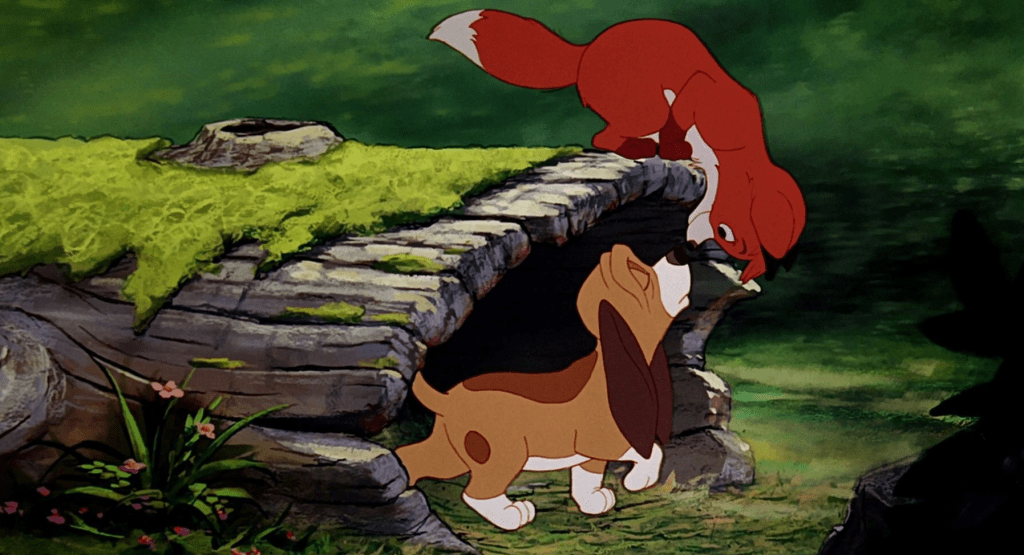
When I was a child, before the age of 7 or so, my parents took the family to the cinema once a year. Always on the second Sunday of Advent, we’d go and see whatever Disney movie was on – and it seems that there always was a Disney movie on at that time, sometimes a new one, sometimes a rerun. I don’t much remember the actual films: I have faint memories of seeing The Fox and the Hound, which would fit with the timeframe I’m talking about, and I think that Robin Hood and The Aristocats were also among the Disney films I saw when I was very young. I remember the tradition, though, which included us going to eat at an Italian restaurant after we left the cinema.
Join us every week for a trip into the weird and wonderful world of trailers. Whether it’s the first teaser for the latest instalment in your favourite franchise, an obscure preview for a strange indie darling, whether it’s good, bad, ugly or just plain weird – your favourite pop culture baristas are there to tell you what they think.
Want something new in your streaming playlist? Once again, Melanie delivers a top-notch tip in her latest Six Damn Fine Degrees post, this time about Chinese historical drama Flourished Peony. (Make sure to switch on subtitles in the trailer below!)
Hundreds of films and TV series make it onto our screens each year – but just as many vanish, some before they ever make it in front of an audience. The second episode of our summer series, the Lost Summer, is dedicated to these: the films that are destroyed or vanish into some vault, the TV series that were never archived, or even the legendary scenes that are much talked about but never seen. Join Julie, Alan and Sam as they explore the romance and the frustration inherent in this vast library of lost film and TV. Why are we fascinated so much by what is lost? Why are the movie and television industries often so cavalier about preserving this cultural heritage? And which of the vanished would our cultural baristas most like to see found again?
Join us every week for a trip into the weird and wonderful world of trailers. Whether it’s the first teaser for the latest instalment in your favourite franchise, an obscure preview for a strange indie darling, whether it’s good, bad, ugly or just plain weird – your favourite pop culture baristas are there to tell you what they think.
Welcome to Six Damn Fine Degrees. These instalments will be inspired by the idea of six degrees of separation in the loosest sense. The only rule: it connects – in some way – to the previous instalment. So come join us on our weekly foray into interconnectedness!
I think it’s fair to say that, after Wes Anderson has directed 11 feature films (12 if you count The Wonderful Story of Henry Sugar and Three More, which Wikipedia does), I am something of a fan – and yet, I don’t really think of myself as such. Of his last eight films, starting with Fantastic Mr. Fox (check here for a typically wonderful Six Damn Fine Degrees by Julie about the film), I’ve loved several and enjoyed the others a lot. Admittedly, I have some issues with the early films of his I’ve seen – Rushmore, The Royal Tenenbaums, The Life Aquatic -, but after a streak of eight movies that I like or even love, shouldn’t I be able to say that I like the work of Wes Anderson? And, if not, why?
Join us every week for a trip into the weird and wonderful world of trailers. Whether it’s the first teaser for the latest instalment in your favourite franchise, an obscure preview for a strange indie darling, whether it’s good, bad, ugly or just plain weird – your favourite pop culture baristas are there to tell you what they think.
In this week’s Six Damn Fine Degrees: more books (Melanie wrote about making her way through Lois McMaster Bujold’s Vorkosigan Saga), so even less of an opportunity to post a fitting trailer! So, if it’s not too much of an insult to fans of the saga, here’s a trailer for the third season of a different sci-fi saga: Apple TV’s adaptation of Isaac Asimov’s Foundation. Obviously we need more adaptations of long-form sci-fi!
Our recent podcast episode on David Lynch, marking the start of our 2025 series Lost Summer, prompted us to pick up where that episode left of: for two of the films we discussed earlier this month, Blue Velvet and Twin Peaks: Fire Walk With Me, there are extensive sets of deleted scenes that, if they had not ended up on the cutting room floor, would have made both films into something very different. Sam and Matt watched these scenes – 51 minutes for Blue Velvet, a whopping 91 minutes for Fire Walk With Me – and talk about these and the notion of deleted scenes in general. Would Fire Walk With Me have been a better film if it had included all that material about the town of Twin Peaks, as fans and critics had hoped for when it was released? What can deleted scenes say about the virtues of leaving some things out? How do fan edits, a practice which has become highly accomplished in many cases, figure into this, and into the question of which version of a film is the real deal?



 A Damn Fine Cup of Culture