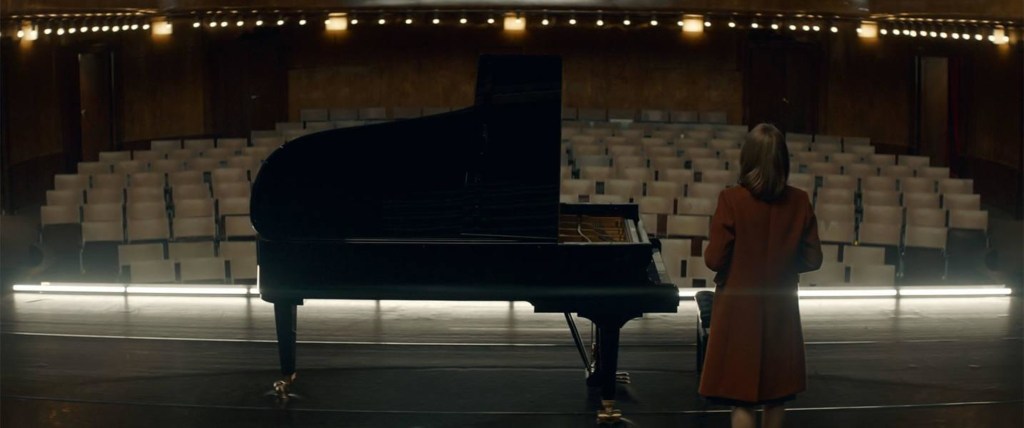
Lara begins as the story of a suicide postponed, and the question that hangs over the film is whether it will end with Lara finishing what she began. Even before she gets the chair and steps on it, it’s clear that Lara isn’t just looking out of the window to enjoy the view of Berlin. There’s something in how she holds herself that seems… defeated, perhaps. This is not a woman who sees her life as a bouquet of possibilities. This is a woman who has had enough. Enough of what, though? Of whom?
Shakespeare once wrote that all the world’s a stage – but what if you turn that upside down and try to make your stage into all the world? This is what Cayden Cotard, sadsack protagonist of Charlie Kaufman’s directorial debut Synecdoche, New York attempts. Does he succeed? Does Kaufman’s first film as writer and director work as well as those of his scripts filmed by other directors, such as Being John Malkovich or Eternal Sunshine of the Spotless Mind? Is Cotard (played by Philip Seymour Hoffman) relatable in his neurotic urge to make up for his lack of control in his life by means of his art, or is he what keeps the film from greatness? And, in the end, what the hell is it all about?
For this month’s journey into metafiction, Julie and Matt are joined by Eric, culture buff and contributor to A Damn Fine Cup of Culture. Get yourself some coffee, tea or whatever else keeps you afloat during these strange and trying times and join us for episode 32 of the podcast!
Shakespeare once wrote that all the world’s a stage – but what if you turn that upside down and try to make your stage into all the world? This is what Cayden Cotard, sadsack protagonist of Charlie Kaufman’s directorial debut Synecdoche, New York attempts. Does he succeed? Does Kaufman’s first film as writer and director work as well as those of his scripts filmed by other directors, such as Being John Malkovich or Eternal Sunshine of the Spotless Mind? Is Cotard (played by Philip Seymour Hoffman) relatable in his neurotic urge to make up for his lack of control in his life by means of his art, or is he what keeps the film from greatness? And, in the end, what the hell is it all about?
For this month’s journey into metafiction, Julie and Matt are joined by Eric, culture buff and contributor to A Damn Fine Cup of Culture. Get yourself some coffee, tea or whatever else keeps you afloat during these strange and trying times and join us for episode 32 of the podcast!
Each Friday we travel back in time, one year at a time, for a look at some of the cultural goodies that may appear closer than they really are in The Rear-View Mirror. Join us on our weekly journey into the past!
Häxan, a Swedish-Danish silent film from 1922, is a fascinating cultural artifact in so many ways, even before you get to the bit where witches kiss the devil’s behind. Historically, culturally and cinematically, it constitutes a trip to a very different time and place – both in terms of its depiction of medieval Europe and of when and where it was made. There is a strangeness to the film that is intriguing, but at the same time its format is oddly familiar – more so now, perhaps, than it would have been ten, twenty years ago. Because, essentially, Häxan is an extended video essay.
There’s this man, Bill Drummond, who tells us to Imagine Waking Up Tomorrow and All Music Has Disappeared. All instruments and all recording devices, too. We wouldn’t even know what music was, and we would have to re-invent it by using our voices. That is Drummond’s mission. He has fun with the concept, but he is also utterly serious – driven, almost. He gathers people all over the world (prayer groups, schoolkids, construction workers) and tells them that they are part of a choir called ‘The17’. He tells them what to sing and records them. He arranges people in a huge circle, for instance in Berlin, calls the project ‘Surround’, and has them shout at each other like in Chinese Whispers. He has become a performance artist, using print, graffiti and paintings in his latter years, but music and sounds are at the center of what he does, at least in this documentary.
Join us every week for a trip into the weird and wonderful world of trailers. Whether it’s the first teaser for the latest installment in your favourite franchise, an obscure preview for a strange indie darling, whether it’s good, bad, ugly or just plain weird – your favourite pop culture baristas are there to tell you what they think.
What better way to while away a pandemic-caused lockdown than by watching something really, really long? Isn’t that exactly what makes Netflix, Hulu, Amazon Prime, Disney+ and their like such an attractive proposition these days? Most of us have to stay home more or less all the time, so having things to keep us busy – books, films, TV series – is a lifesaver. The longer, the better, right? We don’t want to be done barely a week after we’ve started!
So a fourteen-hour film should be just what the doctor ordered, wouldn’t you say?
Join us every week for a trip into the weird and wonderful world of trailers. Whether it’s the first teaser for the latest installment in your favourite franchise, an obscure preview for a strange indie darling, whether it’s good, bad, ugly or just plain weird – your favourite pop culture baristas are there to tell you what they think.
Each Friday we travel back in time, one year at a time, for a look at some of the cultural goodies that may appear closer than they really are in The Rear-View Mirror. Join us on our weekly journey into the past!
1924 was a good year in culture. James Baldwin was born, author of the novel Go Tell It on the Mountain (1953), the collection of essays Notes of a Native Son and If Beale Street Could Talk, which Barry Jenkins adapted into a beautiful movie in 2018, and much, much more. So was Marcello Mastroianni, the archetype of the disaffected Italian playboy, and Hollywood icon Lauren Bacall. The composer Gabriel Fauré died (you’ve certainly heard the sublime “In Paradisum” from his Requiem), as did Franz Kafka – and indeed Vladimir Ilyich Ulyanov, better known as Lenin. Thomas Mann’s novel Der Zauberberg (The Magic Mountain) was published, as well as E.M. Forster’s A Passage to India.
In other words, there would be a lot to write about with respect to 1924, so honestly, there is little excuse for… this.
Join us every week for a trip into the weird and wonderful world of trailers. Whether it’s the first teaser for the latest installment in your favourite franchise, an obscure preview for a strange indie darling, whether it’s good, bad, ugly or just plain weird – your favourite pop culture baristas are there to tell you what they think.
Join us every week for a trip into the weird and wonderful world of trailers. Whether it’s the first teaser for the latest installment in your favourite franchise, an obscure preview for a strange indie darling, whether it’s good, bad, ugly or just plain weird – your favourite pop culture baristas are there to tell you what they think.
 Shakespeare once wrote that all the world’s a stage – but what if you turn that upside down and try to make your stage into all the world? This is what Cayden Cotard, sadsack protagonist of Charlie Kaufman’s directorial debut Synecdoche, New York attempts. Does he succeed? Does Kaufman’s first film as writer and director work as well as those of his scripts filmed by other directors, such as Being John Malkovich or Eternal Sunshine of the Spotless Mind? Is Cotard (played by Philip Seymour Hoffman) relatable in his neurotic urge to make up for his lack of control in his life by means of his art, or is he what keeps the film from greatness? And, in the end, what the hell is it all about?


 A Damn Fine Cup of Culture