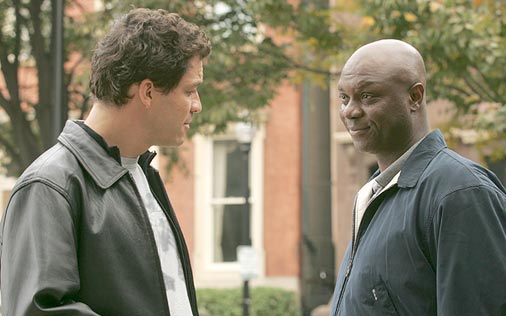
It was you, Bodie. You broke my heart.

Life (and Death) on the Streets

I feel old. I been out there since I was 13. I ain’t never fucked up a count, never stole off a package, never did some shit that I wasn’t told to do. I been straight up. But what come back? Hmm? You’d think if I get jammed up on some shit they’d be like, “A’ight, yeah. Bodie been there. Bodie hang tough. We got his pay lawyer. We got a bail.” They want me to stand with them, right? But where the fuck they at when they supposed to be standing by us? I mean, when shit goes bad and there’s hell to pay, where they at? This game is rigged, man. We like the little bitches on a chessboard.

Poor Bodie. Poor loyal, misguided, tragic Bodie. Like so many on The Wire, we’ve seen him do terrible things ever since he and Poot shot Wallace back in season 1 – yet he wasn’t a bad guy. He wasn’t evil. He was just one of those little bitches on a chessboard, just like another tragic player who decided that enough was enough and ended up hanging from a prison doorknob with a belt around his neck.

Poor Randy. Screwed over by the stupidity of a cop who doesn’t get that he’s betraying this kid – but screwed over even more by a society where talking to a cop is much worse a crime than putting a bullet in someone’s head, it seems, and by a system that at best can keep an account of the people it’s failing – but actually helping them? Sorry, no. Not enough money, not enough people to do the work, not enough of an incentive to cut through the red tape.

Poor Carver, trying so hard to do right by those under his care. Poor Dukie, for whom a day in high school is more frightening than a life on the corners. Poor Michael, killing his soul to protect his little brother. Poor Bubbles, saddest of all. You all broke my heart… and I know I’ll be back for more.

bubbles

I’d thought that season 2 of The Wire was as tragic as it would get. Frank Sobotka going to his death, thinking that he had even the tiniest chance of patching things up for himself, his nephew, his union, for the men he felt responsible for. But the slow, drawn out death of the working stiffs’ union doesn’t hold a candle to the perpetual, systemic sickness which The Wire, season by season, evokes for us, and the way it infects the youngest already.

With “Final Grades”, the season 4 finale, The Wire may just have topped Six Feet Under as my favourite series. The care and intricacy with which the characters are developed, the interconnecting themes play out – has there ever been a series as perfectly constructed yet feeling so right and so true? I could point to episodes, plot strands and even characters in Six Feet Under that didn’t add anything much to the overall series. The Wire? Everything adds to the whole, coming together with dizzying precision, affecting me to an extent that I never would have expected from what looks like a naturalistic cop series about drugs and crime.

Chris, Michael and Snoop (shudder...)

All of this might sound like The Wire is too complex, too constructed for its own good, but the scenes and the characters breathe with a lightness of touch that has to be seen over a number of seasons to be appreciated. It’s only when you take a step back that you can see just how perfectly wrought the series is.

Okay, enough of this clumsy attempt to put into words the effect that “Final Grades” had on me. Unless you’re scared of spoilers, you may want to check out this page (http://www.theguywiththeglasses.com/2008/03/wire-top-scenes.html) as it deftly picks some of the best scenes of the series up to the end of season 4.

And, apart from anything else, it’s good to see a quality series that actually makes it to the end without being cancelled prematurely. (There is something cruelly ironic about releasing a DVD set called Deadwood – Complete Collection. Be honest, cocksucker, and call it what it is: Deadwood – Dead Before Its Time or Deadwood – We Killed It Because We Had To Pay For This Weirdo Surfer Dude Series or Deadwood – Because A Good Novel With The Final Chapter Ripped Out Is Still A Good Novel, Right?)

Shame I’ve already used “A Death in the Family”…

Anyway, it’s really two deaths I’ll be writing about. And the whole notion of family… well, let’s put it this way. It’s complicated.

I’m currently rewatching The Sopranos and I just finished season 3 (“… In which an old friend’s son is shot in the back of the head and Meadow interrupts a sentimental song with thrown chunks of bread and a rendition of a Britney Spears classic”). While the series dealt in ambiguities from the very beginning, season 3 is perhaps the first one where the audience’s complicity is brought to the fore. We root for Tony Soprano, paterfamilias to two families, but for all his charm and for all our sympathy for him (when he’s not being an asshole to the people around him) he is evil – if he is defined by who he is and what he does, he’s evil. Less so than the outright psychos in his entourage (I’m mainly looking at you, Paulie and Ralphie) and more self-aware, but he enables them and depends on them and their actions for his own success.

Up to the end of season 3, we’ve never seen him quite this manipulative and hypocritical, and now it’s seeping into his children more and more. Knowing quite well on one level that her idiot ex was killed because of the system her father upholds, she now defends it – to the face of idiot ex’s sister and with a degree of self-righteousness that is nauseating.

He's behind you!

The problem I have with rewatching The Sopranos, though, is that differently from, say, Deadwood, Six Feet Under or (most of all) The Wire the episodes and seasons are pretty much exchangeable. There’s very little character development – which may be the point, but if you could watch the episodes in pretty much any order and the only thing you can determine by whether it’s season 1, 3 or 6 is how old the kids are and whether Pussy Bompensiero is around? In my books that diminishes the lasting appeal and success of the series.

Talking of deaths in series: since Switzerland is a couple of months behind the States with respect to TV, we only got to see the House season 4 finale now… and what a downer that one was. Even though season 4 was the shortest season of the series ever, most of the episodes after House had chosen his new team felt like retreads (or, in fact, re-re-retreads), but the two finale episodes, “House’s Head” and “Wilson’s Heart”, were among the best and definitely the emotionally strongest episodes. I remember pretty much hating Robert Sean Leonard in Much Ado About Nothing, but together with Hugh Laurie he carries the series even in its most generic episodes. Give him material such as this and he absolutely shines. (And I don’t know what it is, but give me a well-acted man crying his eyes out in a series and I get a big lump in my throad…)

I still don’t think that Kate Beckinsale is talented or particularly beautiful, though, so there.

Give me Emma and Kenneth any time. Please.

Hamsterdam and the gooey kablooie

You have to admire Stringer Bell’s attempts to de-thuggify the Baltimore drug trade. His endeavours to get his business away from the drive-by shootings and everyday violence is one thing; his sweet, endearing (not words easily used when it comes to The Wire, except for everyone’s favourite addict Bubbles) meeting rules are something else altogether. It wouldn’t feel more strange to have these dealers and “soldiers” in the drug war speaking in Jane Austenese.

Season 3 of The Wire once more is among the best TV there is. It’s smart, impeccably crafted and unexpectedly funny. (A shout-out has to go to “My dawg…”.) I’m also finding it less affecting than the second season, though. Is it that the stevedores represented by Frank Sobotka had more pathos? Frank’s final episode nearly had me in tears. Or is it that I, in spite of my impeccable bleeding heart credentials, can relate better to pudgy, corrupt white guys with receding hairlines than to black hoppers slinging red tops and getting hot and bothered about semi-automatics.

There’s more than enough here to get to the viewer, though: Cutty’s attempts to get back into the game after 17 years in prison, or Bunny Colvin’s subversive social experiment born out of a frustration with the shambles and hypocrisy of the war on drugs and a wish to do something, however radical, that might actually break the stalemate and help.

And on that happy note I’d like to thank Amazon for its special offers. (No, I don’t get paid for this. I should, though!) Thanks to them, seasons 4 and 5 of The Wire are on the way and I don’t even feel too guilty about spending the money. I’m slowly running out of interesting HBO series, though… so in one, two years’ time I’ll either be reduced to Sex and the City – or it’s back to Six Feet Under. In which case I might as well rename this blog “Fisher & Sons”.

His name is Snot Boogie?!

This film nerd here is a complex beast. On the one hand, I get as much childlike joy out of well-executed genre films that follow the formula to a T. I enjoy the climactic showdown between Hero and Villain. On the other hand, I cackle gleefully when a film (or a book, for that matter) frustrates my expectations. No Country for Old Men is a good case in point, where the supposed hero dies off-stage and isn’t even killed by the bad guy of the piece. Even Raiders of the Lost Ark, a genre movie if there ever was one, doesn’t end with the hero triumphing: it ends with the hero tied to a stake as the ultima deus ex machina comes and melts the faces off a bunch of undeserving unbelievers.

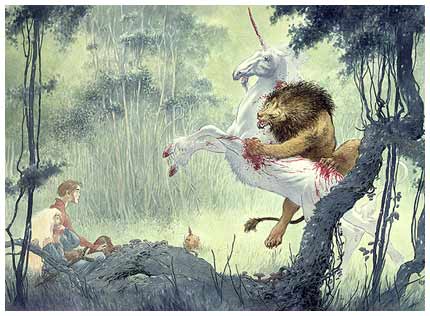
I just finished re-reading Neil Gaiman’s Stardust. I’d last read it in the summer of 2001, just after graduating. I have fond memories of sitting in a French café in Edinburgh during festival time, drinking good coffee, eating croissants and not looking up from my book until I’d finished half of it in one sitting. What I remembered much less was the plot, at least beyond the broad strokes. What I definitely didn’t remember was how differently it told its story from how Hollywood would (and, from what I’ve heard, did) do it. Here too, we don’t get a showdown with the villainess – instead, we get a melancholy coda and a bittersweet ending that made me realise how rarely Hollywood does “bittersweet”. I know that most Gaiman fans prefer American Gods, but I must say that even without Charles Vess’ pictures (I have the non-pic edition), this is a beautiful, wonderfully light, exquisitely crafted fairytale. In comparison, I feel that American Gods collapses under its own ambition, because its dozens of ideas never really come together in a fully satisfactory way.

Narnia it ain\'t...

Oh, and in case you’re wondering about the title of this entry? Well, we’ve just started watching The Wire season 1. Very different fare from Buffy, if you would believe it… But intriguing, with carefully drawn characters and lots of shades of grey. Definitely looking forward to seeing more of it – and telling you all about it, in epic detail. Shudder and despair.