Mad about the boy

Most of what I’ve read about Richard Linklater’s Boyhood has been complimentary to the point of gushing. Recently, though, I read a forum post that compared the film to a dancing bear – it’s not such much what it does than the sheer fact that it does what it does that makes it remarkable. The post concluded that people should go and see Boyhood, but it still came across as somewhere between condescending and dismissive. Go and see the dancing bear, because you won’t see another one any time soon!
Growing up in front of our eyes

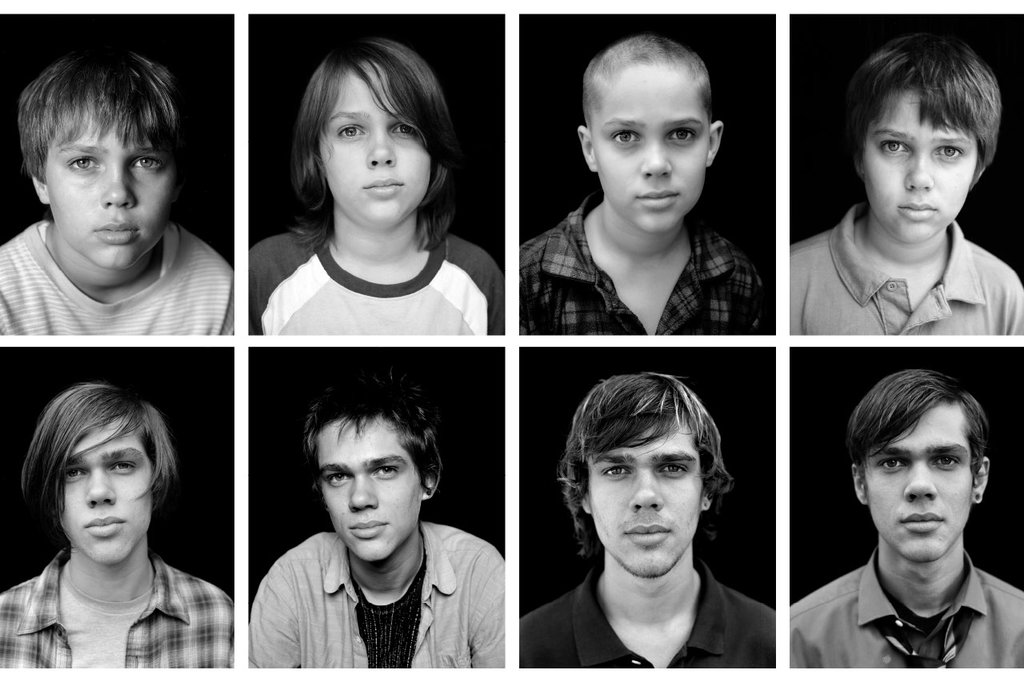
Yet, while I don’t want to be dismissive of a film that obviously resonates with many people, part of me sees what the poster was saying. Boyhood is a good film by a talented filmmaker – though one that is rather hit-and-miss for me – but take away its most defining feature, and what remains? The movie’s biggest asset is that it was filmed over more than ten years using the same actors, so we literally see the people on screen growing up before our eyes. Gone is that often distracting effect of a shift in time being indicated by a change in actors who, at best, look kinda similar to their younger or older selves. Gone is that even more embarrassing effect of changing age being indicated by uneven makeup, clothes and wigs or bald caps, which is convincing one out of 99 times and laughable and sad the rest of the time.

It’s not altogether fair to ask what is left of a film if you take away its defining feature – but few films have one single defining feature. Boyhood is well crafted and serviceable throughout, with some elements standing out (for a film that’s as long as this one, it flows remarkably well) and others falling short (some actors who may or may not be related to the director may not always be altogether convincing in their parts). It’s enjoyable, engaging and altogether likeable, and it is too smart and self-aware to fall for the faux-depth that coming-of-age films focused on thoughtful, artistic young people can have.

Still, none of these are altogether exceptional – the one exceptional thing that Boyhood undoubtedly has is its sheer verisimilitude. The actors become the characters, not so much by dint of their acting but because they do one of the things that is always, and usually not particularly well, faked in films. The effect is engaging and intriguing – yet is verisimilitude what I look for in films? It works for Boyhood, but it does most of the heavy lifting. The ghost of Goddard’s “The cinema is truth 24 frames per second” (though I doubt he meant it all that literally) haunts the film, but if truth and reality become the same the medium leaves me behind. The logical development of the film would seem to be documentaries along the lines of the Up series, yet cinema can never be a complete, unadorned reproduction of reality – if indeed it should aim for this to begin with. Does verisimilitude come closer to truth, or even to a more partial, incomplete though still relevant truth? Other than the stylistic effect of one element of reality, what do we get out of watching Ellar Coltrane – rather than Ellar Coltrane as well as two or three actors looking somewhat like him – grow up?

It looks like I’ve ended up being similarly condescending towards Linklater’s latest. Ironically, I would still say I very much enjoyed Boyhood; I just don’t think I am particularly interested in what it does. Like Mason, Boyhood is likeable and engaging – but in the end I don’t think its standout feature is all that far from being a gimmick. If it is used again, I hope it’s put to the service of a more ambitious film.

________ will remember that.

The recent Telltale Games series – The Walking Dead, which is currently in its second season, and The Wolf Among Us, based on Bill Willingham’s Fables – make great use of that phrase. They provide the player with relatively limited choice, but they put you in control of how you behave towards others, how you treat them. You may just have tried to cement a shaky alliance by siding with a frightened father over the rest of the group: Kenny will remember that. Or you have just had your character, Sheriff Bigby Wolf – yes, that’s the Big Bad Wolf of fairytale fame in human shape -, beat up a murder suspect in the hope of scaring a confession out of him: The Woodsman will remember that.

The Telltale games, especially the recent ones, have mostly received good to great reviews, but there’s been criticism of what they do since the beginning. Choice and consequence: these are one of the Holy Grails of many gamers, and a fair number of them see the choices in the two aforementioned series as shallow at best, false at worst: the plot largely remains the same, regardless of what you do and what the other characters remember. If someone is fated – or, more accurately, written – to die, they will die. Sometimes the plot may branch in small ways, but these branches are usually closed quickly in favour of a tightly constructed story arc.

What changes, though, is your relationship to the characters you interact with. Kenny will remember that you sided with him at a time when he felt most alone – and, perhaps more important, you will remember. You’ll feel like a good guy, or conflicted over siding with a decent but choleric man who acts before he thinks. The interaction may be shallow in one sense, but in another it is far more nuanced than the binary, “Choose your own adventure”-style story choices in some games lauded for giving the player agency. I don’t dislike those games, but I find Telltale’s, let’s say, relationship-based interactivity more engaging. Their games give you the sort of choices that at least I can relate to: in real life, I rarely am faced with deciding between remaining loyal to a corrupt lord that nevertheless provides stability or joining a rebel army whose dedication to the cause borders on fanaticism. The choices I have are usually about my attitude towards others and how I express this: do I snap at someone because I’m tired and they pushed the wrong buttons, or do I let it go? These are the decisions that in aggregate shape who I feel I am.

The Wolf Among Us

Obviously games are often escapist fare, and many enjoy making decisions that they are unlikely ever to face in real life. I won’t deny that the escapist side of games appeals to me too – yet I like some reality in my escapism. I like to feel with characters in unreal worlds that nevertheless resonate and feel real to me. In that respect, I usually stand with good old Marianne Moore, not just with respect to poetry: I want “imaginary gardens with real toads in them”, and not just toads but Kennys, woodsmen and Big Bad Wolves that, for their red eyes and sharp claws, are relatable, are people. Telltale’s choices aren’t epic, they’re human-scale, and they are a large part of what makes their tales of the zombie apocalypse and of exiled fairytale characters trying to make a life in ’80s New York interesting to me: the premises come to life most in how they juxtapose the fantastic and the real, the supernatural and the essentially human. Being an asshole or a nice guy, taking the easy way or sticking to your beliefs, even if you can’t change where things end up, perhaps especially when these choices end up not making a dent in reality – they nevertheless define who you are. Games, perhaps more than other media or art forms, offer interesting ways of expressing yourself.

Clementine will remember that. As will I, because that decision was mine in a meaningful way. When I choose to side with one faction over another in The Witcher II, I do so because I want to see all the material the developers created, to get my money’s worth. I know I will go back to choose the other faction later on. When I make choices as an ex-con trying to do right by his surrogate daughter in a dangerous world, or as a sheriff with deep-rooted anger issues trying to solve a murder, most likely I won’t go back to listen to the other branches on the dialogue tree. I’ve made my choice, and I, too, will remember that.

P.S.: There’s one instance where The Wolf Among Us uses, and subverts, the “_______ will remember that.” trope to great comedic effect. The game’s almost worth playing just for that.

J’ai une âme Lynchian

Wow, Bob, wow. I’ve posted in the past on Twin Peaks, especially in the early days of this blog, but darn it, if it isn’t that time of the year when you just need a post on Lynch’s special slice of pie, with or without a damn fine cup of coffee. The occasion? The imminent release of Twin Peaks: The Entire Mystery Blu-ray. I’d heard about this one before, and so far I hadn’t even been on the fence: I am the proud owner of the slightly tacky-looking complete Twin Peaks TV series on DVD, so why upgrade an early ’90s series shot for television to a storage medium that, more likely than not, wouldn’t make it look or sound all that much better?

Cue this preview for The Missing Pieces, which is exclusive to the new release. Now, the following may not be particularly exciting or indeed mean anything much to non-fans of the series, but I remember in the early days of internet coming upon a newsgroup FAQ of Twin Peaks, and that FAQ outlined the many, many scenes that had been cut from Lynch’s follow-up/prequel to the series, Fire Walk With Me. When the film came out, many fans complained that there wasn’t enough of, well, Twin Peaks in it: many series favourites were relegated to mere cameo appearances, if indeed they were in Fire Walk With Me at all. The Missing Pieces doesn’t completely remedy that, but it comes close: it consists of 90 minutes of deleted and alternate scenes from the film, edited by the mad man himself.

If anyone had asked me a month ago if I was excited for the show’s Blu-ray release, I would have found it difficult to muster more than a profound “Meh.” I like the series, but with more than twenty years since it originally came out (and with absolutely packed DVD/Blu-ray shelves covering 1 1/2 walls of our living room), I thought that I’m absolutely okay with what I have on DVD. And then came the preview video, and it hit me right in the talking log. The circle of sycamores. Leland Palmer stomping through his living room like an ogre. The Little Man jiving it up. Agent Dale Cooper blowing someone (his eternally unseen assistant Diane, perhaps?) a kiss.

Garmonbozia

The funny thing is, there are things about Twin Peaks that is deeply iffy, first and foremost the acting. Some of it works in that stylised, surreal way that Lynch’s characters have. Some of it is middling at best. And some of it is downright painful. Yet somehow, to Pavlovian me, that doesn’t even matter so much, and that is probably exemplified best by Laura Palmer. When the series came out and I first watched it in my late teens, was I in love with poor, doomed Laura? Quite possibly a bit, as much as one can be in love with a character who is dead by the time the series begins. Not for me the lure of sexy Audrey Horne, the all-American beauty of Shelly Johnson or the more mature charms of Norma Jennings: no, for me it was all about the girl wrapped in plastic – which may explain a thing or two about my romantic history.

I don’t know what exactly I’m expecting from The Missing Pieces, and it’s unlikely the added pixels will reveal anything more about what exactly Bob is or what fate has in store for Agent Dale Cooper. Twin Peaks, even in HD, is the opposite of high definition: it gets blurrier the closer you look at it… but in the static, you may just see the sycamores swaying in the wind. And you may just see me in the branches that blow.

Arthouse oinks

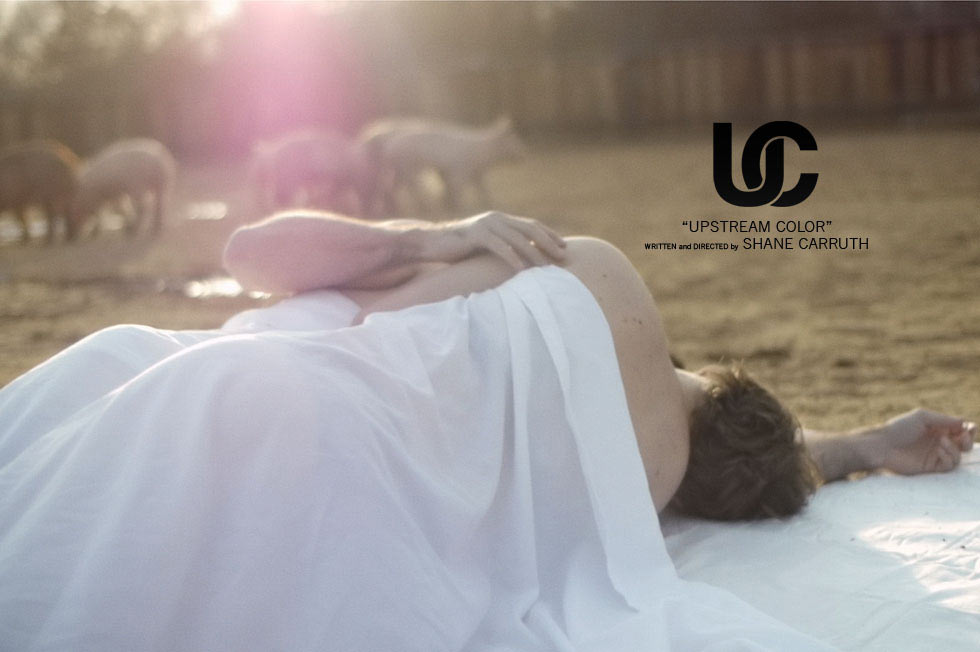
I was expecting to like Upstream Color. I like cerebral sci-fi with an emotional core, I like elliptic storytelling and filmmaking, I love the film’s look and atmosphere.

Yet I came away from the film, Shane Carruth’s follow-up to his headscratcher Primer, feeling sort of aggravated. I didn’t hate Upstream Color, but seeing how critics loved it I couldn’t help feeling underwhelmed. Carruth is a skilled craftsman, he appears to have his very own vision of what he wants to do with the medium, and that’s something I respect. However, I don’t think that Upstream Color is as smart – or as affecting – as it sets out to be, and that’s because to my mind the pieces don’t really fit together very well.

uc_2

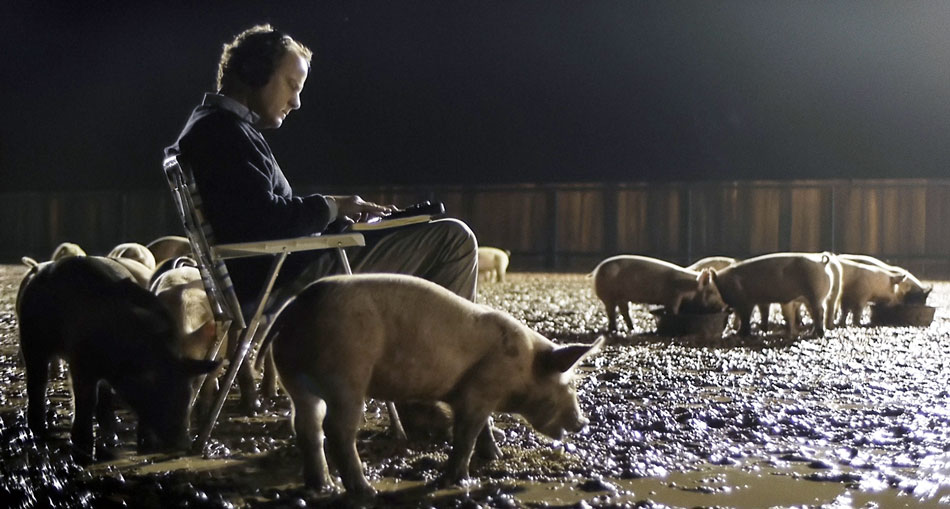
The story is weird and complicated to follow but not as complex as it might appear at first: there are these grubs that seem to allow for some sort of mental synchronisation between people. An identity thief uses these grubs to steal people’s identities and brainwash them into transferring their entire wealth to him, after which he leaves them unaware of what exactly has happened. Meanwhile, another man (called the Sampler in the film’s credits) finds the people who have been grubbed thus, extracts the parasites from the Thief’s victims and puts them in pigs, which allows them to mentally tune into the people the grubs originally came from, seeing, hearing and feeling what they are experiencing. So far, so huh. One of the Thief’s victims, a woman called Kris, loses her job and emotional stability after having been abducted and ruined by his machinations. A man named Jeff (played by Carruth himself) finds himself attracted to Kris and starts pursuing her romantically; it turns out that he’s also been grubbed and that the two of them are somehow in sync, to the extent that they cannot keep their thoughts and memories separate.

There is more that happens, involving porcine pregnancies, blue flowers and Inception-style murder, but the bulk of the film is about Kris and Jeff’s relationship. The sci-fi angle could skew this in intriguing ways, but my main problem with Upstream Color is this: the two stories (grubs, identity theft and telepathy vs. relationships, blurring boundaries and questions of identity) don’t end up working well with each other. Some ideas are either underdeveloped or appear arbitrary: why can the Thief use the grubs to program his victims, in effect hypnotising them like a cheesy silent movie villain? Yes, we see identities blur and thoughts and feelings wander from one being to the next, but that’s because the grub link has been established. The Thief’s powers seem something entirely different. Similarly, the film pulls a plot element out of thin air: Kris is suddenly revealed to be unable to have children, which her doctors attribute to cancer, though which may be due to the worms – whichever it is, the film doesn’t care to make this particularly coherent.

Upstream Color

As viewers, we’re asked to fill in many blanks. That’s fine, but filling in the blanks should add to a better understanding or stronger engagement in the film. Instead, here it feels like busywork: plugging the gaps in a story that, at least in the form it takes on screen, is underdeveloped. Individual elements are interesting, but they pull the film into different directions, and other parts of Upstream Color seem too designed to come across as meaningful – when, to my mind, meaning isn’t something that should be signalled and symbols rarely work best when they’re overtly insisted on.

The script has potential, and Carruth is a highly skilled filmmaker. In this case, though, it feels like he was too much in love with his ideas. The Sampler and his farm of telepathic pigs could be intriguing, but it distracts from the rest of the story. When Kris ends up enacting revenge against him, although the person who ruined her life was the Thief, it doesn’t resonate, it doesn’t read as dramatic irony: instead, it comes across as, again, arbitrary. Given a rewrite, Upstream Color could have been a film I like or even love – instead, I can’t help but see it as too much of a disappointing mess.

And, for a film that makes it harder for the viewer to follow than is justified by what it seems to be aiming at, it’s probably par for the course that there are no subtitle options whatsoever. I guess that deep meaning is most effectively conveyed by unsubtitled actors mumbling and muttering their dialogues.

All fun and games, until someone loses his head

I understand that the following might get me defenestrated, decapitated, poisoned, disembowelled and/or otherwise treated harshly – but I think that Game of Thrones is overrated. Don’t get me wrong: it’s a great series with a cast that well night perfect, characters that are engaging, production values that are amazing, complex storylines that are riveting and setpieces that are stunning. It’s head (not Ned’s, obviously) and shoulders above a lot of TV. Nevertheless, on a list of favourite series it wouldn’t make it into my Top 5: I’d take The Sopranos, Deadwood, Six Feet Under, Breaking Bad and The Wire over it any day, to name just a few.

Thing is, for all its strengths the series is pretty much entirely about itself. It has little to say about our world. I’m not denying the series all relevance, but for all the cruelty and political intrigue of the world it depicts it is still escapism. Does it need to be anything more? Most emphatically not – but it makes the superlative praise the series gets ring somewhat hollow.

Hmm... My shoelaces are untied.

My impression is that because the series is brutal, because it kills our darlings, people implicitly see it as something more than escapist entertainment. “This is what the world is really like – cruel, amoral and swift to kick you in the privates, steal your silver and stab you in the spleen!” Except I doubt that most of its fans live in a world in any real sense that is like Westeros. Does Game of Thrones have anything much to say about power, responsibility, pragmatism and honour in a world of shifting alliances and uncertain motives? It probably does, although not all that much beyond what makes an intriguing story. Then again, it doesn’t need to – but its fans sometimes behave as if the series is completely new and does things that haven’t been tried before.

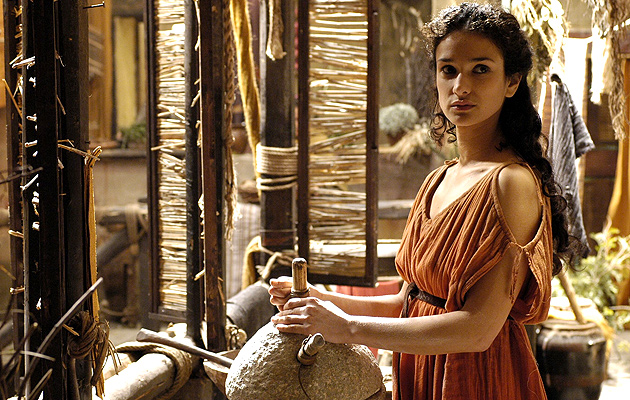
What puzzles me most is how Game of Thrones is almost universally hailed, yet HBO’s earlier series Rome barely made it to the end of season 2. In so many ways, Rome is an amazingly close precursor to the sprawling Westerosiad. Sex and violence? Check. Political intrigue? Check. Exotic locales? Check. Moral ambiguity? Check. Ciarán Hinds, Indira Varma, Tobias Menzies? Check, check and check again. (We’re still waiting for Ray Stevenson to make it to Westeros and for Kevin McKidd to be saved from his Seattle day job by a crazed, bomb-wielding, suicidal plane crash-cum-zombie apocalypse.) In terms of format, tone, characters, visual identity and, obviously, Nipple Count (and no, that’s not a character on the X-rated Sesame Street spin-off), the two series are very similar. Certainly, there are no ice zombies and dragons in Rome, but is that what makes Game of Thrones a success whereas the earlier series floundered? When people praise the series’ complexity, its characters and the world it evokes, are they actually saying that dragons, ice wights and boobs are cool? Or was the world not yet ready for a series of this kind when Rome was first aired?

Two.

There’s something about about the way the internet has embraced Game of Thrones that recalls self-perpetuating feedback loops. People don’t just get excited about the latest episode, they get excited about the latest round of YouTube videos depicting fan reactions. Watch total strangers scream at their TVs as Prince Fringfrang of House Shmoodle gets his arms torn clean off! Controversial scenes? Check out the clickbait: Why women like The Walking Dead better than Game of Thrones! (Not a joke, that one…). There’s something performative to the fan hype, as if people think they’ll become more interesting if they’ve got a video of themselves shrieking at Ned Stark’s decapitation or if they’ve got a blog post about what people on the internet say about-

Okay, gotcha. I’m feeding on, and into, the hype machine as much as everyone else. And who am I to tell the internet that it’s overrating its latest darling, especially if I then go and wax gastronomical about Hannibal after posting my own clickbait? So, to close this meandering post: if any fans of Game of Thrones are still reading this, I’m not telling you to stop enjoying the show or talk about it. But if you get bored waiting nine months for season 5, do check out Rome, especially season 1. You might enjoy it. And you won’t have to worry about book readers spoiling next episode… just pesky historians. Just don’t enter “does caesar” into the Google search window, lest the auto-complete function ruins it for you.

All the world’s a sound stage

Holy Motors is not a film for those looking for a strong storyline or for conventional entertainment. It’s not a film for the artistically squeamish or for those with no time to give to experimental cinema that is unconcerned with pleasing its audience and often downright absurd. It is one of the more exhilarating cinematic experiences I’ve seen in the last year or so – although it is definitely not for everyone.

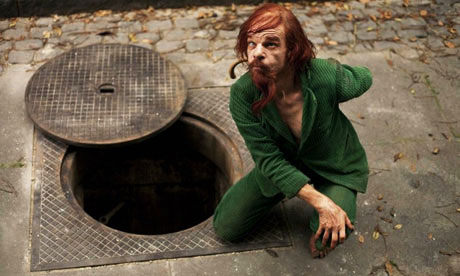
A plot summary is relatively easy to give yet beside the point to some extent, because the film’s effect mostly lies in how it does what it does. A man named Monsieur Oscar is driven from one mysterious engagement to another – nine, all in all – by his elderly female chauffeur. In the spacious back of the stretch limousine he puts on make-up and one costume after another, slipping into wildly different roles: an old, possibly Romanian beggar woman, a motion-capture actor in an altogether too fetishistic rubber suit, an anarchic sewer-dwelling troll-like creature, a scarred killer – as well as his lowlife mobster victim – but also a middle-aged father driving his daughter home and an old man dying in his bed. Even when he goes home at night, his home is another fiction entirely different from the home he left in the morning, his family (in a disconcertingly funny revelation) made up of chimpanzees. Everything is a part, it’s fictions all the way down. Is there a real Monsieur Oscar beneath the masks, the make-up and the (for the most part ostensively stylised) scenes he plays? Does he even know himself? (The ambiguity of that question was unintended, but it is quite fitting.)

Holy Motors

It’s not only the protagonist’s ontological state that is questioned; only one scene makes explicit that the person Monsieur Oscar interacts with is also an actor (possibly with her own stretch limo and chauffeur, unless these are reserved for the more seasoned actors), but the strangeness of the different scenes and the reactions of the people whose lives cross with his at least make us wonder whether most if not all the people in the universe of Holy Motors are simply moving from one acting engagement to the next. Now you’re a photo model. Now you’re a receptionist. Now you’re a lover. Now you’re a mourner. Now you’re dead (your gravestone linking to your personal website in one of the film’s offbeat jokes).

The film has been interpreted as being about cinema, although its director Leos Carax has denied this interpretation. More likely, at least to my mind, it is about how our lives are made up of roles and how in many of them we have precious little agency of our own. We put on our costumes, our masks, and we act what we think is required of the part. Not particularly new or original, I grant – but then, as I mentioned earlier, Holy Motors works largely because of its verve and energy, the conviction with which it and its main star Denis Lavant throw themselves into the different episodes. An art house film this is, obviously, but not the po-faced or even the self-consciously, needily quirky kind of film that sometimes feels as generic and by-the-numbers as the latest Bayfest or Snyderama. Holy Motors‘ energy is more anarchic, at times downright punk, though it is not in your face in every single scene.

In one sequence, the film indeed aims for something more poignant. Its themes of alienation and loss of identity (if indeed there ever was an identity to lose) may already hint as such poignancy, but it comes to the fore when Monsieur Oscar comes upon another stretch limo, finding in its back a former lover called Eva, played by Kylie Minogue. The two, having half an hour between engagements, talk about the twenty years they have to catch up on, and Eva sings a sad song about the people they once were before she sends Monsieur Oscar away. As he exits the building where they talked, he sees that Eva apparently has committed suicide by throwing herself off the roof. The sequence and especially Minogue’s song is superficially affecting, but it suffers from the films ontological twists and turns: we’ve seen the protagonist get stabbed and (apparently) bleed out, yet character death only meant that it was time for the next role. Why shouldn’t Eva get up, brush off the dust and hop into her limo the moment we’re not watching any more? What makes one death more real than another – and if death isn’t real for these actors, what is the point of the sequence and its underlying sadness? Holy Motors seems to come down heavily on the side of nothing being real, everything being an act, but then it can’t really have its cake and eat it.

Except it could. On stage more often than on the screen, I’ve seen performances that held the brittle balance between emotional authenticity and obvious artifice, where a character’s death mattered even while you are fully aware of the actor living and breathing. We are capable of buying into a fiction with our hearts and minds while knowing it’s a fiction. Holy Motors could have done this, and as a result the Kylie Minogue sequence would have gained a resonance that is hinted at but finally remains out of the film’s reach. However, as a result the film might have lost some of its anarchic energy: part of what makes it work is that it doesn’t take itself all that seriously, that it revels in its own ridiculousness. As it is, Monsieur Oscar’s meeting with Eva is something of an irritating foreign body in the film: it is streaked with sadness, yet Holy Motors would seem to render this sadness a non sequitur. (In fact, other than the actors’ words, we have little evidence that this is not another one of Monsieur Oscar’s engagements, although one that adds an even more pronounced metafictional turn of the screw.)

Regardless of this, which others seeing the film might respond to altogether differently , Holy Motors is well worth checking out. It is inventive, evocative, often funny (if you like your humour absurd), and it may just have the most rousing entr’acte in all of cinema. And that’s not even mentioning the gratuitously grotesque prosthetic hard-on, which is a more believable special effect than anything encountered in Sharknado.

You died, rinse, repeat

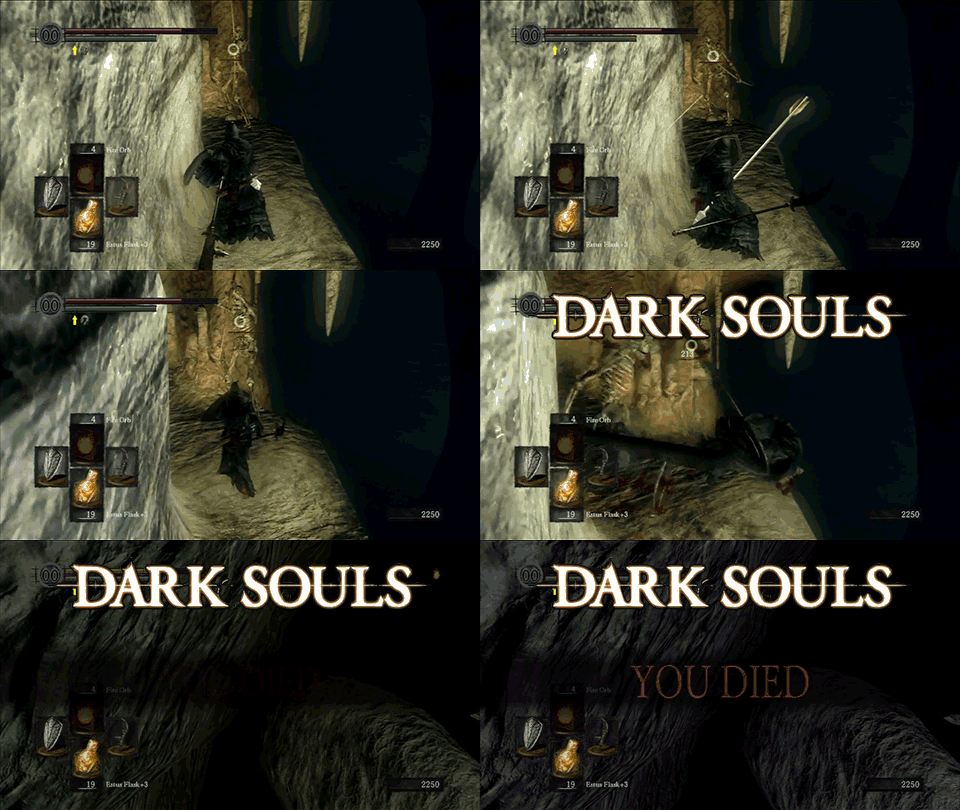
I admit: even though I’m pretty self-assured, not least when it comes to my media consumption, I still feel faintly embarrassed about telling people that I play games. It’s not even my age;  I don’t mind being a gamer at the age of 38 (soon to be 39). It’s not entirely the subject matter either; there are many games that are embarrassing, juvenile rubbish in terms of their aesthetics and writing. No, I think what it is most of all is how gaming can reduce me to one of the dumber monkeys in a Skinner Box: it’ll have me doing the same thing over and over and over with little immediate reward. Take my current addiction, Dark Souls 2, a game so proud of its own difficulty that its central hub area has a monument to all the player deaths the game has garnered worldwide.

At present, the monument lists over 100 million deaths. Let’s be clear about what this means: people playing Dark Souls 2, like me, have been doing minor variations of the same thing over and over again, and dying again and again. Ideally they progress a bit in between deaths, but if they’re anything like me they’ll die dozens of times in the same situation, doing pretty much the same thing and trying to figure out how to change it up so they can die a split-second later, hit an enemy for just a bit more damage, and slowly but surely inch their way to getting through that bit alive – only to die again (and again and again, clap clap) two rooms further on.

What is it that makes such an exercise in repetition and masochism engaging and even entertaining? Obviously there are the moments when you actually make it, when a combination of learning, skill, strategy and sheer luck lets you whittle that enemy’s hit points down to zero, when you dive under an enemy mage’s spell and stick him with the pointy end, when you turn a corner and find a momentary sanctuary there – but most of the time you’re busy pulling that lever and wondering why you’re not getting that piece of cheese or the fish biscuit you were hoping for. You’re a rat in a maze. A beautifully rendered, darkly romantic, imaginative maze, but even that beauty is lost as you’re getting skewered, flash-fried and/or magic missiled for the nth time.

There have been articles about the inherent pointlessness of Dark Souls and similar games, and as much as gamers tend to dislike critical looks at their hobby, I do think it’s a valid question: what are we getting out of the endless rinse-and-repeat cycle? At what point have we succumbed to the gamers’ version of Stockholm Syndrome and we keep pulling that lever not because we expect a fish biscuit but because we’ve come to like it?

Now excuse me, I’ve got a lever to pull. And to be stabbed in the back by an Undead Knight while doing it, most likely.

You died. Again. Wimp.

Having your meth and smoking it

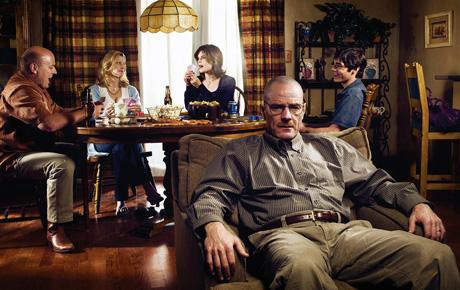
Is there such a thing as too satisfying? There’s definitely such a thing as too neat, and I’m afraid that’s what I take away from the final episode of Breaking Bad. I enjoyed it, definitely – but coming as it does after “Granite State”, the penultimate episode, it feels too much like the series was tied up with a bow. It’s an enjoyable finale, but it is also a safe finale, and that I find a little disappointing.

Now, “Granite State” (especially in combination with the episode that precedes it, “Ozymandias”), that would have been a more courageous finale, and a more frustrating one. Not The Sopranos, “Made In America” level frustrating, but close. It’s a deeply moralistic episode, but one that is very much in line with the series as a whole. Walter White may have wanted to be Heisenberg, criminal mastermind and all-round badass, taking care of his family and, well, taking care of his enemies at the same time. In practice, though, he was petty, vindictive, scared yet oblivious of – or, worse, indifferent to – what he was doing to his family and the people around him. He used others, he rationalised horrific acts, because he could always pretend to himself that he was doing it for his children.

Family man

“Ozymandias” and “Granite State” stripped all of this away and revealed what Walt had become: powerless and unable to save his brother-in-law, yet venomously evil towards Jesse for turning against him. Bit by bit, Walt either watched everything he cared about crumble or actively contributed to its destruction. If the road to hell is paved with good intentions, he had left behind that road at this point and was safely in hell – which turned out to be a remote, tiny cabin in New Hampshire. Walter White’s hell was being stuck in a small room by himself, with only himself as company, his ill-gotten gains less useful than the month-old newspapers from which he cut articles about the exploits of the great, mythical Heisenberg.

“Granite State” was anything but easy to watch, revealing not only what Walt had achieved to himself but also that some of the things we enjoyed watching most had led him there. It was often as much fun for Walt to don the black pork pie hat and become Heisenberg as it was for us to watch him, but the episode no longer allowed us to indulge in the fantasy of there being two Walters: the one whose actions we despise, and the one we root for. Both of these were the same man, understandably acting out against the shit hand fate had dealt him, but relinquishing all responsibility for his actions in doing so. He didn’t kill Jane, and she was bad for Jesse anyway. He didn’t cause those planes to crash. Gale had to die because otherwise Mike would have killed Walt. Gus had to die because it was either him or Walt. That kid had to die because- The “Ozymandias”/”Granite State” double bill cut through the bullshit and said, “No, Walt. You got yourself here. Live with it.”

And then came the last five minutes of “Granite State” and the segue into “Felina”, which was largely Walter being badass, Walter finding some form of redemption, Walter shooting a dozen evil neo-Nazi fucks to bits. Some viewers theorised that most of the episode was Walt’s dream, and while this strikes me as an overreading there’s a kernel of truth in it: “Felina” does play like wish fulfillment. Not entirely – we don’t get a tearful, loving reunion between Walter Jr. and his father (most likely over breakfast, though with real bacon this time round), but we get the closest the series can credibly get to a making-up scene between Skyler and Walt. Our protagonist/anti-hero still dies, but he doesn’t die of cancer, going out in a blaze of glory instead – and saving Jesse to boot. It’s all very neat and it leaves you feeling considerably better than “Granite State” does, but it does feel like something of a missed chance.

Breaking Bad has always played with the ambivalence of Walter White. Is he heroic or an anti-hero? Is he the series’ protagonist or its bad guy? Are we rooting for him or are we watching him lose all sympathy as he’s got more and more blood on his hands? It’s the tension between those two that drove the series much of the time. “Ozymandias” and “Granite State” came down heavily on the side of consigning Walt to a hell of his own making, which I consider more in line with the series’ thematic thrust, but “Felina” pulls him out of that hell to give him the kind of ending he wants. Breaking Bad largely drops this tension, splitting up those two sides into separate episodes. (It’s like the series’ equivalent of that Star Trek episode where a transporter accident results in two Kirks: one gentle but weak, the other strong, ruthless and even more of a dick than Classic Kirk.) Ending on the episode that is Walt’s version of who he wants to be feels a bit like a cop out, even if it also gives us a scene where he finally admits, to himself as much as to Skyler, that he did it all for himself, that what drove the actions of Walter White wasn’t his family so much as his ego.

Have a drink, Walter

Looking back at the series, including its ending, I definitely consider Breaking Bad one of the best series I’ve seen. The writing, acting and directing are up there with the best of HBO. Even with my reservations about the final episode, I enjoyed the series, including its ending. It’s just… too neat. Too much what Walt, and we, might want, rather than what the series itself calls for. Breaking Bad most definitely decided at the very end that it wanted to have it both ways: it leaned more towards what feels good than what is fitting.

P.S.: For further reading on a series finale that aired more than half a year ago (!), I can very much recommend the AV Club’s review, as well as Alan Sepinwall’s original review and his revisit of “Felina”.

She, Herself and Spike

Spike Jonze is that rare creature, a filmmaker who is not only interested in but can actually combine the emotional and the intellectual. He did fantastic work with Charlie Kaufman (and indeed his elusive twin brother, Donald), and I greatly liked his adaptation of Maurice Sendak’s Where the Wild Things Are, though I have to confess that I never read the book as a kid and have no loyalties to the original work. His most recent film, Her (described by Wikipedia as a “science fiction romantic comedy-drama”, that most perennial of genres), was successful with audiences and critics alike, and there is a lot to like about the film. It is smart, sweet and heartfelt.

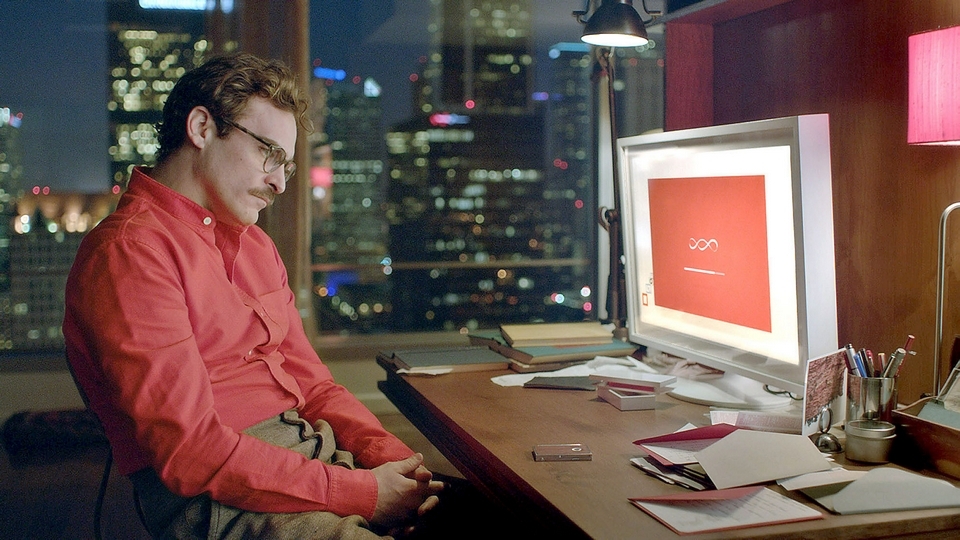
It should have been the perfect film for me – yet it wasn’t. In part, that’s due to my inflated expectations; largely, though, it’s Charlie Brooker’s fault. Obviously. More precisely, I think I had his “Be Right Back” from the second series of Black Mirror in mind, where a dead spouse is imitated by an artificial intelligence. The comparison is not an entirely fair one: Jonze is telling a different story from Brooker, and his story about a man falling in love with his AI operating system wants to be romantic to begin with, something “Be Right Back” isn’t interested in being.

http://vimeo.com/61215171

The thing is this: I can accept the premise of a sentient, sapient AI with emergent feelings. I can buy a man, especially a lonely, depressed one, falling for his very personable operating system, especially if it’s voiced by Scarlett Johannson. However, in wanting to deal with this scenario in terms of romance, the film seems to ignore one thing: an operating system is a tool. It does what you tell it to do. This is not a relationship of equals, at least not to begin with – it’s a relationship where he can tell her what to do and she does it, and most likely he can switch her off or deinstall her if he wishes. She exists solely for him. I absolutely understand that Theo Twombly, more than ably played by Joaquin Phoenix, falls in love with his OS, Sam, and he’s nice and sweet in his interactions with her – but I have a problem with the film ignoring, or not recognising, the fundamental inequality of the relationship and the hints of Pygmalion, because to my mind these are inherent in the premise.

Through a mirror brightly

The film could easily work with this and still tell the same story. As Her develops, so does she – Sam, being a virtual being not only capable of evolving but predicated on it, outgrows Theo and moves on. I wouldn’t even need the gender dimension to be brought into it (although there are definitely gender-related questions to ask about the film, such as: why do all its nebbish male characters tend to be with more beautiful women? To what extent is Her an unacknowledged male geek fantasy?), but the way that Jonze ignores the digital elephant in the room, that to begin with Sam is entirely in Theo’s power, regardless of how much she’s supposed to be her own person, is an issue that kept me from fully engaging with the film. It’s almost as if Jonze was too much in love with his premise and ironically ended up idealising it too much – unless there’s a more self-aware subtext here that was intended all along, which might mean that my own private OS is in dire need of an upgrade, let alone of evolving.

Building worlds

Although I enjoyed Captain America: The Winter Soldier quite a bit, quite possibly more so than any Marvel film other than (predictably) The Avengers and (surprisingly) Iron Man 3, I won’t be writing a straight review of it. Enough has already been written about how it shakes up the fictional universe begun with the first Iron Man film and about its overtones of ’70s political thrillers, which don’t actually hold up all that well except on the most superficial level.

Suffice it to say, I liked the film – but mostly I like what it does, and what the Marvel  movies have been doing, which as far as I know is pretty unique to cinema. Worldbuilding is something that so far has been done best in long-form formats: Tolkien, for one, did a magnificent job of it in The Lord of the Rings, but he has hundreds and hundreds of pages to do so as well as several other books to contribute to the creation of Middle-earth. Series in various media also have a lot of potential when it comes to worldbuilding, whether we’re talking about comic books or TV series. Some films have done the same, but it’s probably not the format’s main strength: you have examples such as the Star Wars series, but on the whole creating interesting worlds that live and breathe takes time, and the genres that lend themselves to worldbuilding (e.g. fantasy or sci-fi) also tend to produce plot-heavy – and setpiece-heavy – films that simply don’t have the breathing space that makes for the successful evocation of fictional universes.

In the Marvel films, the makers have succeeded at this by creating a network of characters and events that relate to each other yet still result in individual stories. You can watch Captain America 2 without knowing what happened in the Iron Man films, The Avengers or even the first Captain America movie, but having an idea of what happens outside the confines of this one film adds a sense of scope that the usual SFX of Mass Destruction don’t have. As I was watching the movie, I wasn’t thinking of sequels, prequels and franchises: I was thinking that here was a world that’s alive beyond any individual entry. What is going on in Captain America 2 resonates beyond Cap’s story. Even if the stories being told are still pretty basic, predictable tales of superheroics – and no, Robert Redford does not make this film Three Days of the Condor – there’s something exciting to the way the Marvel films have come to suggest that there’s plenty of space to be coloured in beyond the lines of Captain America 2 or Iron Man 3 or The Avengers. To me, it feels there’s a world out there, and it exists whether we’re presently looking at it or not – and that may be one of the best things that can happen to a fictional world.

Marvel Cinematic Universe

It also presents a storytelling challenge, because I’d argue that in the long run it gets boring if every single story told within this universe is about averting some world-shattering calamity. That’s one of the strengths of serial formats: they give the storyteller space to tell the smaller stories too. Not every Marvel comic is about some super villain’s latest plot to destroy New York, the Earth or the universe. Look at something like Joss Whedon’s Buffy and Angel: yes, there are Big Bads and plot arcs, but there are similarly more intimate stories. Does Hollywood have something similar to offer? Can there be Marvel movies that aren’t about defeating this bad guy or stopping some major evil plot? Or will we get to the point where each and every one of these films is essentially the same story given a slightly different coat of paint based on which superhero has the lead part? If this happens, all the world-building will fall flat, because at this point the universe no longer feels like one and begins to feel like a Setpiece Generator. There have already been hints of this, for instance in Thor: The Dark World‘s “Let’s destroy London!” climax. Here’s hoping that Marvel can continue to build on what’s most intriguing about this project and that they avoid having created a world that lives and breathes only to bore the hell out of us.