Giacomo Casanova: a man of many talents (allegedly). Check out his Wikipedia entry – which he would have probably loved doing! – and you’ll find that he “was, by vocation and avocation, a lawyer, clergyman, military officer, violinist, con man, pimp, gourmand, dancer, businessman, diplomat, spy, politician, medic, mathematician, social philosopher, cabalist, playwright, and writer”. (Wikipedia’s “citation needed” never seemed more apt.)
Yet, ask anyone what they know about Casanova, and they’ll tell you one thing: he was the lady’s man, a playboy extraordinaire, a big hit between the sheets. No one remembers the diplomacy, the philosophy, the writing. He might as well have been little more than a walking phallus, a sex toy with aristocratic aspirations.
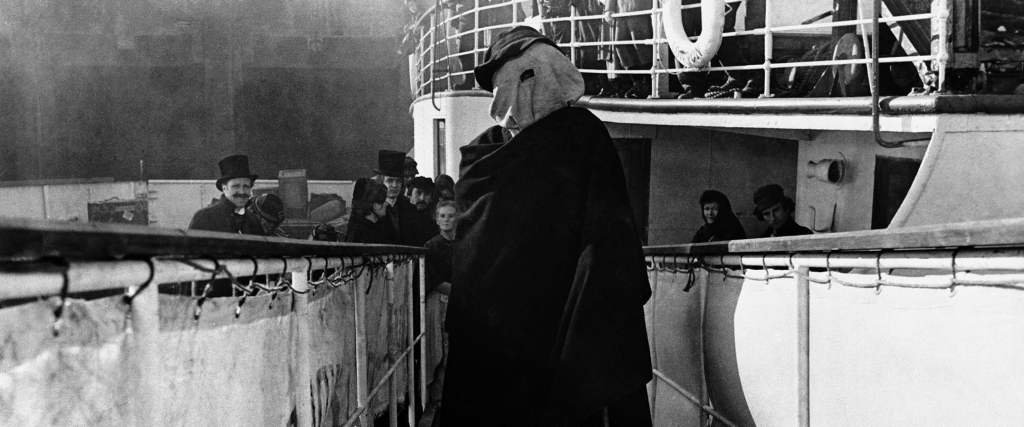
Was The Elephant Man (1980), David Lynch’s follow-up to his first feature Eraserhead, my first Lynch? I’m not sure: it’s possible that I saw Twin Peaks first, at least the first half or so of the series, in a German dub, or perhaps I caught Blue Velvet on television late one night. It is even possible that I watched Eraserhead first and am repressing that traumatic memory. But The Elephant Man is often brought up as a good way to get started on Lynch: it tells a fairly straight-forward story, one that is based (albeit loosely) on the life of Joseph Merrick, a man suffering from severe deformities who lived in late 19th century London. You can see what would have drawn Lynch to the material, but the resulting film does not have the expressedly avant-garde edge of Eraserhead or of many of his later works. Aside from The Straight Story, it’s probably the film by Lynch that I would recommend first to people who haven’t seen anything else by him, unless I knew that they were into surrealist art.
But does that make The Elephant Man less Lynch, somehow?
It seems that Fellini’s Amarcord, a semi-autobiographical film inspired by the director’s childhood in and around Rimini, is a tremendously easy film to like. Critic Vincent Canby called it “Fellini’s most marvelous film” and “extravagantly funny”, while Roger Ebert described it as “a movie made entirely out of nostalgia and joy”.
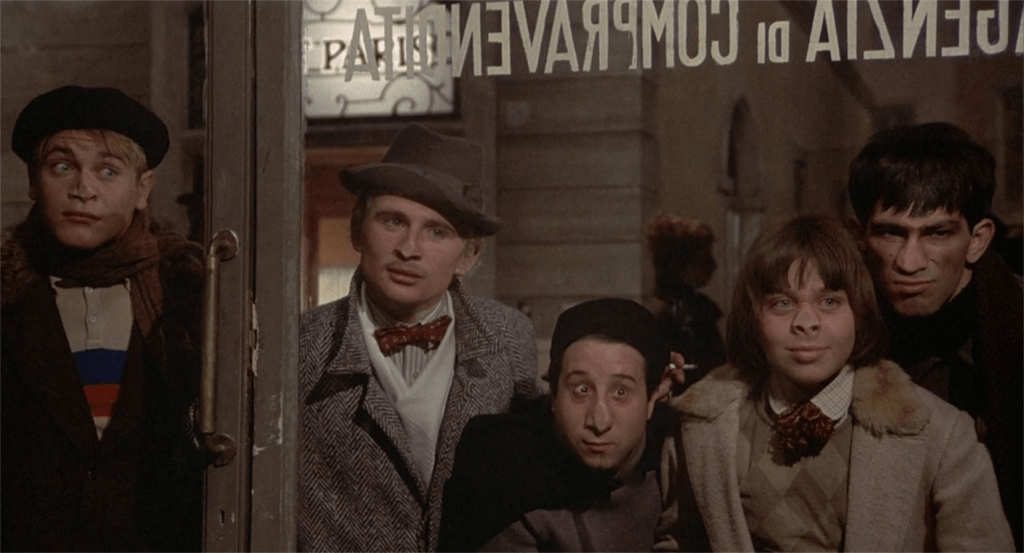
Me, though? More than halfway into Amarcord, I would have said that I’m not a fan at all. I didn’t find it funny or joyous. One of the tropes I’m more than a little tired of is: boys will be boys – and as a result I would’ve gladly thrown all of these guys below under a car.
I admit: knowing many of those old, black-and-white monster movies only from short snippets or animated GIFs, I tend to go in assuming that they’re kinda silly, and while you might enjoy them, it’ll be the kind of enjoyment that comes with an ironic distance. You enjoy them for their silliness, their camp aspects. You enjoy them because it’s so obviously a guy in a rubber suit stomping on toy cars.
Sometimes that may be true, or you might enjoy the historical aspect, or the craftsmanship of a time when the effects guys were literally making up a new industry. Sometimes, though, you can watch one of these films and realise that they still work as what they were meant to me: earnest works of horror. Perhaps not in their entirety – but there’s an earnestness and filmmaking skill on display that can’t be dismissed with any amount of jaded irony.
There are so many iconic directors that came out of the Nouvelle Vague, the French New Wave. Obviously there’s François Truffaut and Jean-Luc Godard, and even if you don’t like either or both, there’s no getting past them. Then there are the likes of Rohmer and Rivette, and others associated with (but not always counted as part of) the Nouvelle Vague, such as Resnais, Demy or Varda.
And then there is Claude Chabrol, who stands out for his dedication to genre cinema, something that is rare in the movement. He is one of the directors I’ve been aware of for a long time, but I had only seen a couple of films: The Colour of Lies (original title: Au coeur du mensonge, translated more accurately as At the Heart of the Lie), a thriller that I enjoyed at the time but that didn’t leave all that much of a trace, and the Highsmith adaptation The Cry of the Owl (Le cri du hibou), which I absolutely hated. Highsmith should be a good fit for Chabrol, but this particular adaptation didn’t work for me, leaving some characters utterly vague, others grotesquely one-note, and all of them annoying. (I later saw the more recent English-language version with Paddy Considine, which was almost aggressively mediocre but nonetheless felt like an improvement on Chabrol’s take.)
Because of this, I went into La Ceremonie with some trepidation: would I bounce off as much as I had with The Cry of the Owl? Does Chabrol just not do it for me all that much? Should I go back to the less genre-minded members of the French New Wave?
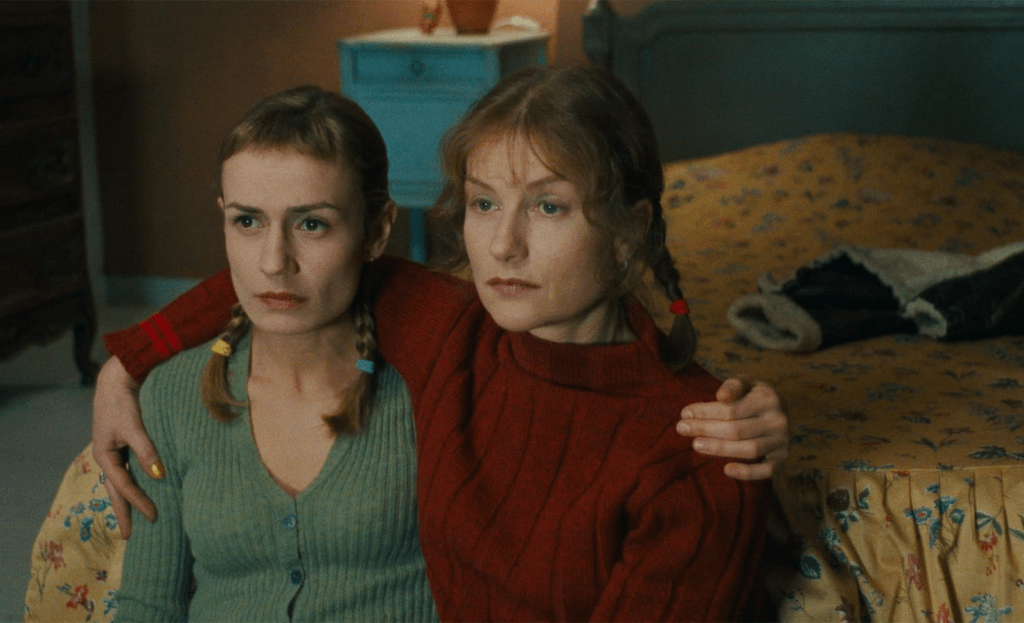
I’ll cut it short: even if I’d not seen any other Chabrol films at all – hell, even if I’d only seen, and hated, The Cry of the Owl -, La Ceremonie‘s strength would be enough to make me a fan. This is a definite keeper – that is, if you’re okay with thrillers that leave you feeling deeply uneasy for days.
Is Roma a sort of stealth sequel to Fellini’s previous film, Satyricon? It can certainly be seen as such: like the film Fellini made three years earlier, it is a sprawling tapestry that is focused less on telling a coherent plot than on moving from episode to episode and from setpiece to setpiece. Where Satyricon depicted, and satirised, ancient Rome, the city’s story is taken into the more recent past and even the present in Roma, making the two films a sort of History of Rome, Parts I & II. But where the earlier film was based on the writings of Petronius, Roma‘s angle is decidedly subjective.
Two adolescents jump off a moving train. Shouts come from the train, and shots, but who would stop at the behest of people who are already shooting at you? The young men continue running, shedding the long coats marked “KL” (for Konzentrationslager, concentration camp – an abbreviation that was later changed by the SS to “KZ”, allegedly for its harsher sound) as they move further and further into the forest, cold, hungry, ill-prepared for their journey.
But, before long, we get the sense that, run as they might, the two men are doomed. And perhaps more than that: perhaps they are dead already.
Welcome to ancient Rome, filtered through Federico Fellini’s sensitivities – which may as well be saying: unfiltered. But this isn’t your parents’ ancient Rome, or perhaps it is exactly your parents’ ancient Rome: one that is filled with corruption, debauchery and cruelty. Expect images, scenes and ideas that go far beyond the strangeness and excess of earlier Fellini films: here’s a beautiful young woman who won’t put out to just anyone, so an old sorcerer curses her so that fire comes out of her vagina (which the villagers use to light their kindling), and there’s a dead poet whose last will was that his belongings go to those who will eat his remains, so they begin to tuck in.
Stop me if you’ve heard this one before: pupils from a girls’ school in Australia go on an outing to a nearby geological formation. Some of the girls go to explore the area – and disappear. One turns up later, with no memories of what happened. The others remain gone. No traces are found, no blood, no bodies. Nothing.
The mystery is never solved. And it is this, not knowing what happened, that begins to corrode the lives of those left behind.
We’re back, several months after 8 1/2 (sorry!), with a film that I find frustrating and confounding – and yet I’m difficult to shake it off: Juliet of the Spirits. Two years after Fellini’s last film, and after two movies in which Marcello Mastroianni played variants (albeit more overtly attractive ones) of the director himself, Fellini cast his wife Giulietta Massina, for the first time in eight years (he’d last directed her in Nights of Cabiria) – and, in a twist on what he’d done with Mastroianni, Masina plays a character not dissimilar from herself: Giulietta Boldrini is an upper-class housewife, married to a philandering, self-centred husband, and while the details are vague but specific enough to show that the Boldrinis aren’t literally Fellini and Masina, the constellation of their marriage isn’t a hundred miles from that of the famous film-making couple.





 A Damn Fine Cup of Culture