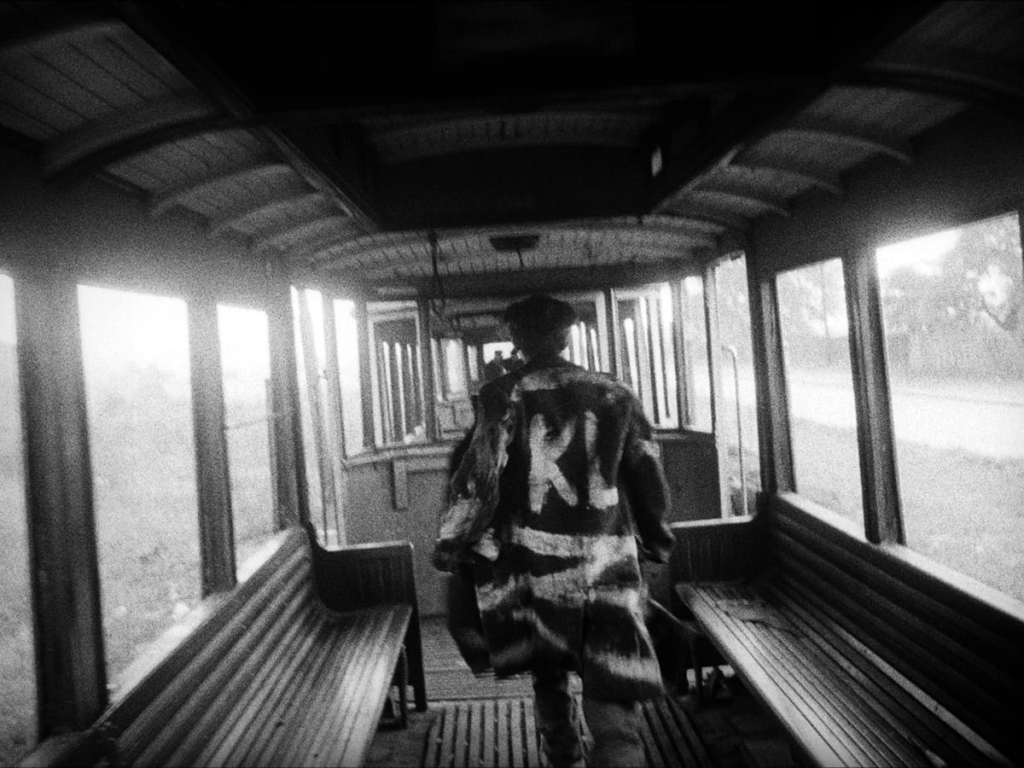
Two adolescents jump off a moving train. Shouts come from the train, and shots, but who would stop at the behest of people who are already shooting at you? The young men continue running, shedding the long coats marked “KL” (for Konzentrationslager, concentration camp – an abbreviation that was later changed by the SS to “KZ”, allegedly for its harsher sound) as they move further and further into the forest, cold, hungry, ill-prepared for their journey.
But, before long, we get the sense that, run as they might, the two men are doomed. And perhaps more than that: perhaps they are dead already.

Diamonds of the Night, directed by the Czech filmmaker Jan Němec and released in 1964, is based, albeit loosely, on the autobiographical novel Darkness Has No Shadow by Arnošt Lustig, a Jewish writer. As an adolescent during the Second World War, Lustig was sent to the concentration camps: first to Theresienstadt, later to Auschwitz, and even later to Buchenwald. He survived not only these ordeals but also an escape from a train that was taking him to Dachau. He returned to Prague and took part in the 1945 uprising against the German occupation. The autobiographical element that forms the premise of Diamonds of the Night is clear – although the two protagonists in Diamonds of the Night meet with a very different fate. But what fate exactly?
Němec’s film is light on dialogue and not particularly bothered with a complex plot. We see the two young men trying to survive in the wet, cold woods. We watch them as they come across a farm and the younger of the two follows the farmer’s wife into the house to ask for food, knowing that he is risking their lives. They try to eat the bread they receive, but their stomachs are no longer able to take solid food and they cough up blood. Eventually, they are found by a group of elderly German men with rifles – are these hunters that just happen to come across them, or are they in fact hunting the boys? The old men capture the teenagers and detain them, rowdily celebrating their catch with food, beer and songs. Finally, the teenagers are taken outside, apparently to be executed by the shooting party – but instead the old men clap and laugh and sing a song, letting the boys go.
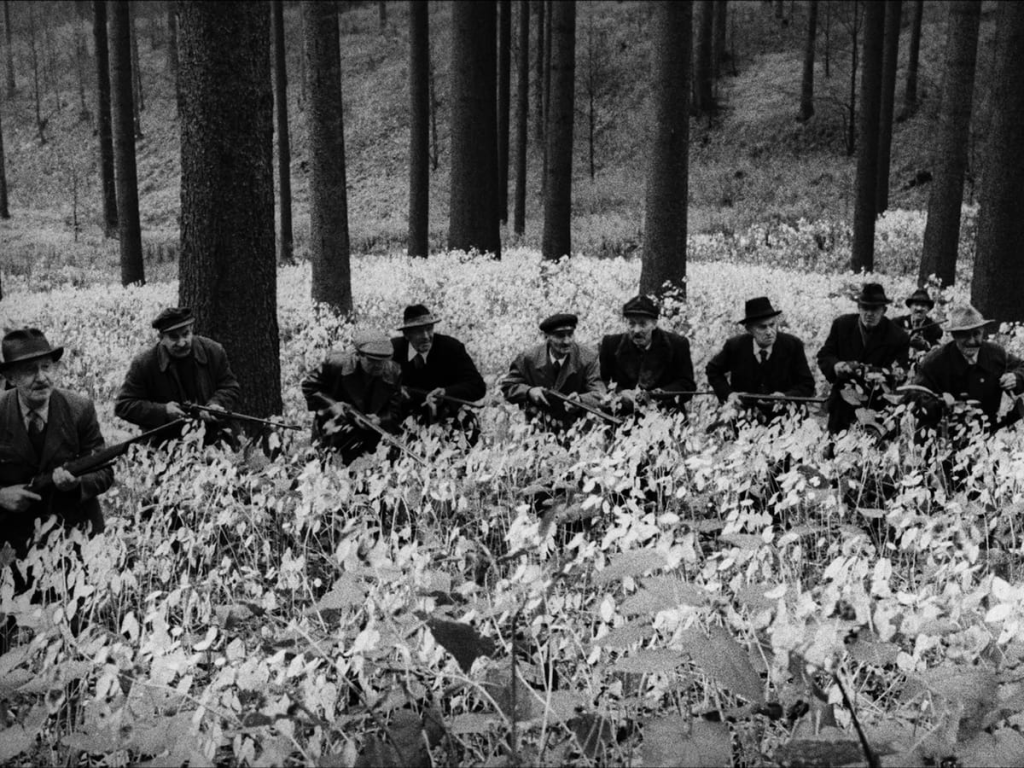
But no, that’s not how the story goes. We hear the gunshots. We see the protagonists lying dead in the mud. And throughout the film we see… what? Memories. Fantasies. Or perhaps alternatives to what actually happens. We see the younger of the two men back in Prague, taking a tram, talking to a girl, passing Nazi soldiers without incident. He (still? again?) is wearing his coat marked “KL”. No one takes notice. No one cares. He is free. We also see him with the farmer’s wife, repeatedly: sometimes he kills her so she can’t give them away, sometimes she seduces him, sometimes she just gives him a few slices of bread and he leaves. Are these things he imagines? Things he’s afraid might happen? Are all these scenes equally true, or at least equally possible, until the story continues?
There is a quality to Diamonds of the Night that recalls William Faulkner’s prose: the disjointedness of the narrative, the stream of consciousness and chronological leaps, leaving the viewer to piece together the different pieces. But Diamonds of the Night isn’t a puzzle, or at least not one that we are asked to solve any more than its protagonists are. The point seems to be to juxtapose the different possibilities – while always being clear about the likely outcome. In the terms set up by the film, it doesn’t matter whether the young men kill the woman or thank her, it doesn’t matter whether the old men capture them or let them go, it doesn’t even matter if they are executed there and then or not. The “KL” on their coats might just as well read “Dead”, they’re dead men walking, because that’s what this world has designated them to be, and these letters are still there, albeit invisible, after they’ve taken off their coats. The possibility space that Němec’s film invokes is actually its opposite: it is an enumeration of everything that became impossible for the two men when they boarded that train, and probably even before that. In that respect, there are overtones of Ambrose Bierce’s “An Occurrence at Owl Creek Bridge”, or even of Herk Harvey’s eerie horror classic Carnival of Souls, in which the protagonist is dead already but does not know it, unwittingly waiting to catch up with her death. At the end, we briefly see the young men lying dead in the mud: is it the mud outside the beer hall, and they were killed by the shooting after all? Or is it the mud where they jumped off the train, and they were killed while escaping? Is it the mud at Theresienstadt or Auschwitz, Buchenwald or Dachau?
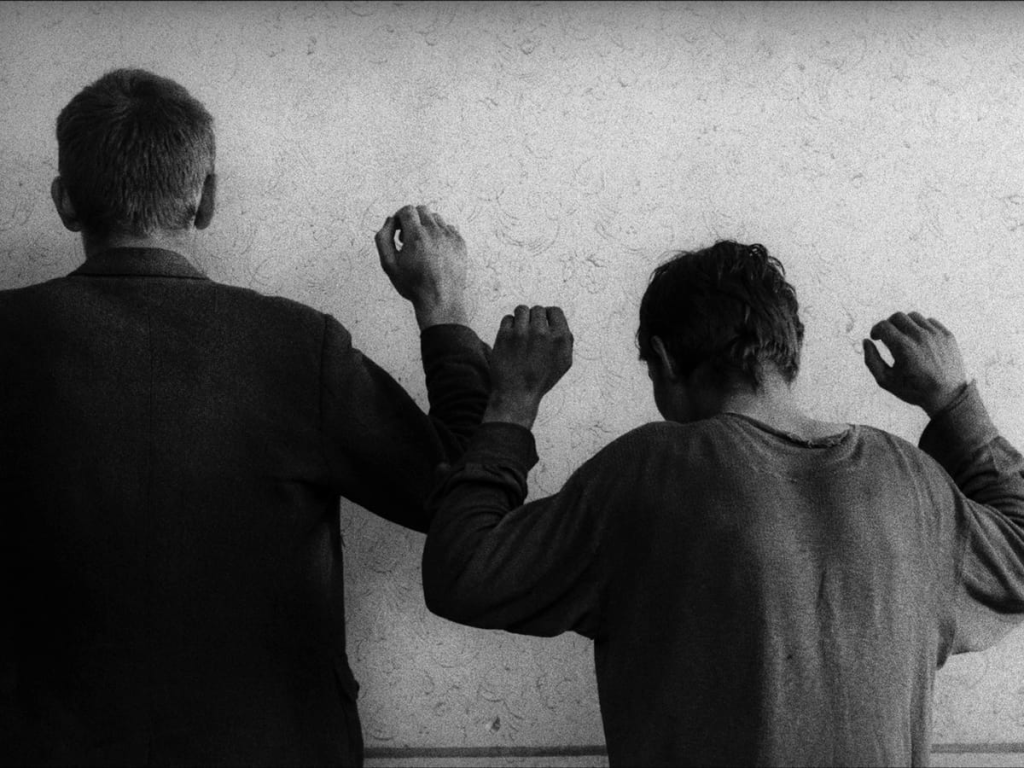
Verdict: Diamonds of the Night was director Jan Němec’s first film. It shows in some ways: he arguably overdoes some of his techniques when he cuts away frequently to scenes of an ambiguous nature or when he heightens the perverse jocularity and repugnance of the old men who have caught the two boys. For me, there came a point when the repetition lost its effectiveness but instead became tedious, even though the film is little more than an hour in length. But Němec’s use of repetition doesn’t come across as the insecurity of a young artist but rather the opposite. He trusts his artistic instincts, and he trusts his material and collaborators – and there may even be a purpose to him risking tedium: it underlines the situation his protagonists are caught in. They may think that they have agency as they run from the train: their escape has given them some control over their lives. But, really, their fate is already set out and, if anything, they are running towards it. If there is a sense that Němec should get on with it because we know where this is going, the tedium heightens the suffering of the protagonists.
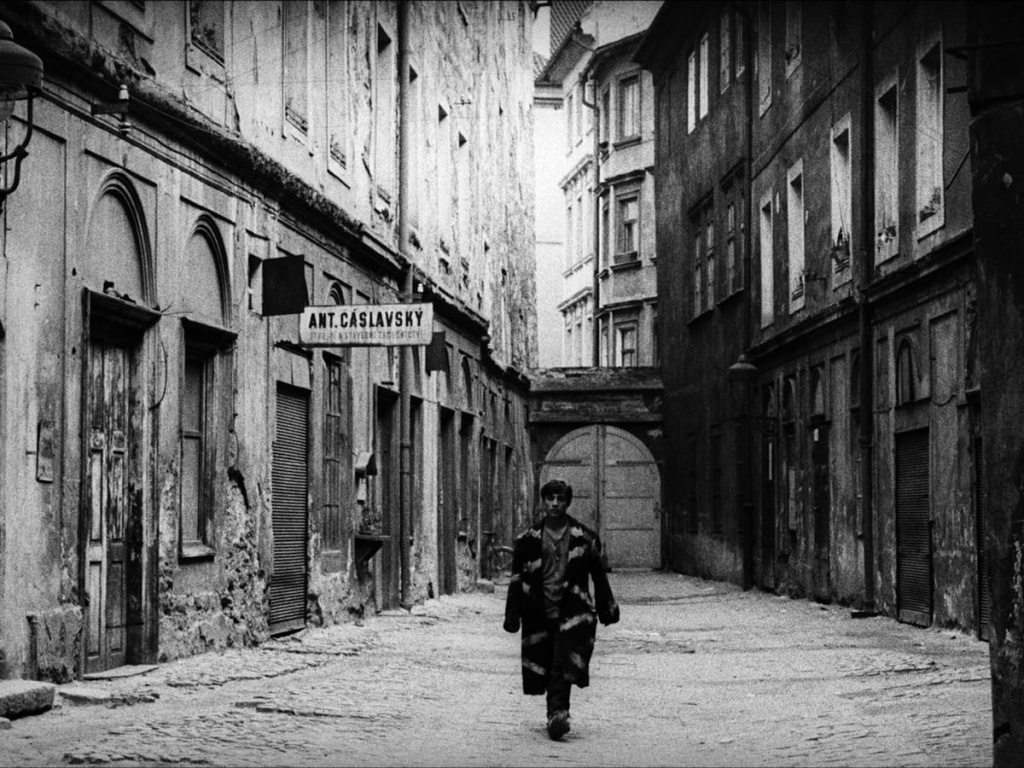
Another quality of Diamonds of the Night may render it less effective for some: while this is a film about two young men escaping the train that is to take them to a concentration camp, there is relatively little here that renders the context specific. Are the two protagonists Jewish? The link to author Lustig’s biography suggests it, but the film doesn’t give much of an indication why the young men are taken to the camps. There is little of the iconography of similar films set during the Second World War: we see some officers wearing Nazi insignia in the dreamlike scenes that show the younger of the two escapees back in Prague, but the old men who hunt and catch the two could be any old men eager to do the bidding of a state that is willing to murder those who do not fit in and that has given them permission to do whatever they like. Němec’s film isn’t vague, but its specificity is reserved for the personal, the intimate: the faces of people, the nooks and crannies of Prague, the tactility of the forest mud and the rain. Němec’s later films, which did not have the same historical setting, quickly came to be seen as subversive by the Communist regime; the ways in which the director aims for more universality than audiences may have expected from a film adapting the memoirs of a Jewish author who escaped the concentration camps may have prompted the regime to pay closer attention to Němec.
Whatever can be criticised about Diamonds of the Night: it is a fascinating film, combining sensuous naturalism with a dreamlike structure to great effect. It is angry, especially in its final third and the depiction of the smug, sickening old men hunting the protagonists and then celebrating their catch, and it is mournful in how it evokes the hopelessness of an escape that may have been over before it ever properly began.
I keep coming back to this: what I’ve seen of Czechoslovakia’s New Wave is more subversive and radical than what audiences might expect of the cinema coming out of a communist country during the Cold War. These films are well worth seeking out – and I hope that Criterion continues releasing the works of these fascinating filmmakers.
 A Damn Fine Cup of Culture
One thought on “Criterion Corner: Diamonds of the Night (#969)”