Why you, you doidy rat…!

There’s exactly one thing I would change about Martin Scorsese’s The Departed: the last thirty seconds or so. The rat on the balcony railing. To me, at least, it felt like an insulting wink to the audience: “This is what the movie’s been about. Get it? Get it?”

 I probably found it more insulting because the rest of the film is nearly perfect: the casting, the acting, the cinematography, the editing, the choice of music. I haven’t seen Infernal Affairs, the original Korean movie that Scorsese’s film is based on, so I won’t say anything about remakes at this point, except for this: if a remake is this good, what does it matter that it’s a remake? That’s a discussion about cultural imperialism, perhaps, but it’s not what I’m interested in here. I’m interested in what may be Scorsese’s most enjoyable movie ever.

Of course, there were lots of people who complained when Scorsese was awarded the Oscar for this film, and indeed, he should’ve received the Academy Award for some of his earlier work too. But what gets up my nose is that most of those who complained felt that The Departed is somehow less good a movie because it isn’t deep – and by deep they mean existential, or perhaps they mean, “If you can enjoy it, if you can have fun watching it, chances are it isn’t that good.” Which is silly, pretentious snobism. I don’t want every single one of Scorsese’s movies to be Taxi Driver or Raging Bull. True, these films have more social depth, they’re more tragic, but I hate the knee-jerk equation of ‘tragic’ with ‘good’ or ‘important’. Please note that I also hate the reverse snobism that goes something like this: “Oh, you’re so la-di-dah with your Stanley Kubrick, Ingmar Bergman and François Truffaut, elitist gits! Go and jerk off to your boring, black-and-white arthouse bullshit, while I enjoy Die Hard!” Just like I don’t always want The Seventh Seal, I don’t always want Star Wars or The Rock either.

And I appreciate craft. In my opinion, there’s a lot to enjoy about, say, Die Hard, because it’s one of the best crafted films in its genre. There’s a lot to enjoy about the deft lightness of Soderbergh’s Ocean’s Eleven remake, just as there is a lot to enjoy in Jules et Jim. The things you’re enjoying are simply very different, but all of these films are by filmmakers who are amazing craftsmen. And quite often it’s genre cinema where you get great examples of the craft: Blade Runner, The Godfather, Out of Sight, Aliens.

And it is in terms of craft that The Departed absolutely excels. From the first few shots in the movie, you know that this was made by people who know what they’re doing. When I saw the film at the cinema, it was the first time that I had an inkling what critics mean when they talk about “muscular filmmaking”. In spite of the clumsy allegorical rat at the very end, I left the cinema energised and wanting to see it again. So, for all those who thought that the film wasn’t ‘deep’ enough, here’s another clip. It expresses quite neatly what I think about arrogance towards genre cinema. Enjoy.

P.S.: I am not saying that all quality is relative; I hope you understand that. As far as I’m concerned, the difference between, say, Raiders of the Lost Ark and Citizen Kane, or indeed between Raging Bull and The Departed, isn’t one of quality. It’s not that one film is better than the other – it’s the subject matter and its treatment that are different. Arguably one is deeper than the other, but in the end depth is something I can take or leave. Sometimes I want an intricate seven-course meal, and sometimes I want a hamburger… but I want a good hamburger.

Bourne to be shaken, not stirred

Eugh. Okay. I apologise for that double-whammy of a pun. But I promise, it’s appropriate. Sort of.

I like the Bourne movies. I like how they’re set in the real world, in places I recognise and may even have been to. I like how they’re not about over-the-top villains out to rule the world – or otherwise destroy it. I also like Jason Bourne’s resourcefulness, his efficiency, and Matt Damon makes the character and his action man exploits feel credible.

I also like shaky cam. I thought it was effective in the first two Bourne movies, and when it’s done well it gives films an immediacy and a documentary feel that fits certain stories very well. In my opinion, Battlestar Galactica makes it work really well, for instance.

Yesterday I saw The Bourne Ultimatum at the cinema, and fifteen minutes into the film I started to develop a slight headache. At first I thought that the shaky cam was more pronounced than in the earlier films in the series, but then I realised that I’d seen those on DVD only. Now, I’ve got a fairly big, 42″ television, but it’s still different. The entire screen is in your field of vision. It’s much less dizzying. And that’s when I started to understand why many people compained about the shaky camera work. It’s quite a strain, on your eyes, your neck and your brain. I’m sure that if I’d just seen the film on TV to begin with, I again would have thought: “What on earth are these people complaining about?”

It took me perhaps an hour to get used to the cinematography, but I persisted, mainly because the film never lets up. The story isn’t highly original – basically it’s the first two movies all over, with some of the names and faces changed – but it bursts with kinetic energy, and it is choreographed brilliantly. There’s an early sequence at Waterloo station that is almost balletic in its elegance.

Unfortunately, the film has lost some of what made its predecessors better in the end. For one thing, Bourne is less vulnerable. He survives when he shouldn’t, or at least he shouldn’t be able to get up and go after the bad guy. In the first two films Bourne felt more real because you could always just about believe that this highly trained ex-agent could escape from this or that predicament, but you weren’t 100% certain he’d make it. This time he crosses the line into Superman-dom too often.

The other thing is that Bourne is emotionally less vulnerable. Bourne – the character and the films – has never been about emotions, yet there was the additional impulse that Franka Potente’s Marie gave the story. The main character was made more human due to her, and her death – one of the few shocking demises in US action cinema – did pretty much drive the second movie. It gave Jason Bourne a tangible reason to pursue his goal. THere’s a scene early in the third film, in which Daniel Brühl (of Goodbye Lenin fame) plays Marie’s brother. Unfortunately it is so subdued, it feels like it’s only paying lip-service to Marie, like no one’s heart was really in it. The scene might have been more effective if Brühl’s character had been introduced in one of the earlier films, but with no run-up there’s also practically no pay-off. The scene feels like it should be in the DVD’s “Deleted Scenes” section.

P.S.: The Bourne Ultimatum ends with a remix of Moby’s “Extreme Ways”. The original’s much better, though. Enjoy!

It happened at the movies… (2)

28 Days Later and Millions – these films couldn’t be much more different in terms of what they’re about, yet they’re so obviously directed by the same person… I missed the former at the cinema due to middling reviews (and probably also the agonised moans of zombie aficionados all over the internet). Then, after I’d already pretty much forgotten about the film, a friend lent it to me on DVD. I didn’t expect much when I popped the disk into the player, but I was very positively surprised to find one of the most atmospheric, effecive, thrilling and beautifully paced films I’d seen that year. Yes, the ending is a mess, but it can’t ruin what the first 75% of the movie has built up. The shots of a deserted London alone deserve to become one of the iconic images of British cinema.

Millions, too, was an unexpected joy. The film is wildly inventive and balances its sentimental elements (that feel truthful and are never overplayed) with a sly sense of humour. It’s on a very short list of Christmas films that don’t make me feel like throwing up my eggnog all over the prezzies. And it’s got two of the best child performances I’ve ever seen on film.

Add to these two cinematic surprises directed by Danny Boyle that I’d seen a marvellous stage adaptation of Alex Garland’s evocative novel The Coma, which you can find a trailer for here. Garland also wrote the script for 28 Days Later, so when I heard that the two of them had teamed up again for Sunshine, a sci-fi movie, I was excited.

After seeing the film at the cinema, I was disappointed. I’d wanted to like, even love, Sunshine, and again, the first 3/4 gave me a lot of material to love. If you submit to its slow buildup of tension, it’s one of the strongest films of a space mission going horribly wrong since 2001: A Space Odyssey. And then it attempts to become a metaphysical thriller – but it slips and becomes a somewhat more restrained (but not much better) take on Event Horizon. When I read the script afterward, I realised what they were going for, but unfortunately they didn’t quite manage. On a larger scale, it was 28 Days Later all over, but moer disappointing, since this time I expected something great to begin with.

Still, do the final 30-40 minutes destroy what came before? They almost did on my first viewing; nevertheless, the preceding scenes are what stayed with me. Boyle and Garland succeed at impressing something of the immensity of the sun, and of the astronauts’ task, on us. This isn’t Armageddon or Deep Impact, it’s not heroic Bruce Willis going off to save the world to the strains of Aerosmith. These are normal people who’ve been given a task that, if you think about it too much, will drive you mad.

And while the film’s sort-of-villain verbalises the metaphysical implications less than successfully, the visuals of the dying sun actually convey some of what he says. Staring into the annihilating fires is perhaps the closest you can get to looking at the face of God. It’s interesting, though, that Garland, an atheist, and Boyle, more of a doubtful theist, read their film, and its metaphysical dimension, in completely different ways: the movie is wise not to come down on any one side of the God issue. It just sits there, like the dying sun – and if you stare at it for too long, it may just burn off your face. Now didn’t your mother warn you not to sit too close to the telly?

P.S.: Here’s the film’s international trailer. I do apologise, though, for the criminally overused orchestral piece nicked from Requiem for a Dream. (How anyone can think it’s a good idea to use music from that film to evoke ‘epic-ness’ is beyond me.)

It happened at the movies… (1)

In the past year I haven’t really been to the cinema nearly as often as I would have liked to, for several reasons. All in all, this year somehow seems to have happened without me. I did catch a handful of movies that stayed with me, though, and they were all by directors whose work I’ve liked a lot in the past: David Fincher, Danny Boyle, Michael Scorsese and Christopher Nolan. Here’s the first of them:

Zodiac

Let’s get this out of the way: I like Alien 3. In many ways I like it better than Aliens; the latter is a great ride, but beneath its well-oiled craft it isn’t that different from many other ‘80s action movies, leaving gender politics aside for the moment. Most of the characters are broadly drawn cartoons. That’s okay, they don’t need to be anything else for the purpose of the film, but while it’s a fun film, it’s not an interesting film. It’s not an uncomfortable film. Alien, by comparison, has left its mark on many an impressionable filmgoer. Like its titular creature, it’s highly efficient, it’s vicious, and it gets inside you in unpleasant ways. At its best, Alien 3 also has that effect. It may be the most unsettling of the Alien movies. I’m certain that if it had followed directly from Ridley Scott’s nightmare rather than James Cameron’s rollercoaster, it would have been better received.

David Fincher is a highly talented formalist. His films are meticulously crafted and tightly controlled. Most of them are also rather show-offy. Especially Fight Club has a somewhat adolescent quality, wanting to impress you in spite of its fashionable nihilism: “Look at me! Not that I care, though.” It’s just a tad too infatuated with itself.

Zodiac is just as intricately crafted, but it doesn’t need to show off. In spite of its impressive running time, it’s a lean film that is immensely well made, and it impressed me all the more for not having to remind me again and again how well it is made. It is also an eminently frustrating film – it is about frustration, and it’s frustrating for the audience. The serial killer genre thrives on some sort of closure: at its most generic, it provides you with a neat ending, where the killer is caught (and, ideally, killed by the film’s hero). If it’s minimally clever, it’ll give you some sort of twist: it wasn’t actually John Smith after all who skinned all those women – it was Frank Jones, in the pantry, with the serrated knife! Zodiac instead doesn’t satisfy its protagonists’ obsession, nor ours: we don’t learn who the killer is. We only get a maybe. And since the suspect is dead, chances are we’ll never know for certain. Fincher’s film denies us a neat, comforting conclusion, so Robert Graysmith’s obsession isn’t validated in the end. All we’re left with is loose ends. Fincher’s Seven was already loathe to serve up a neat ending, but by comparison, it’s practically “… and they lived happily ever after.” The bad guy may win after a fashion, but he dies. We know he was the killer. In Zodiac, what we’re left with is an irresolvable question mark.

By the way, if you liked the film, you may want to check out Alan Moore’s comic From Hell. Do not confuse it with its film version, since the movie does something very different. Once you’ve read From Hell (it’ll take you a while, since it’s one big book), read the second appendix, also presented as a comic. It makes for an ideal companion piece to Zodiac.

From Hell

Also, look out for the continuation of this series in two or three days. In the meantime, we return you to our regular programme. Read you tomorrow.

The man whose career could survive a moustache

I’ve never seen the first film version of Solaris. I have a fairly high tolerance for slow movies, but I’ve never dared to test this tolerance on Tarkovsky’s film. (Personally, I blame Russian Ark, a slow Russian film that I found offensively boring.) However, being a Steven Soderbergh fan, I’ve seen – and enjoyed – his version* several times now. I love its elliptic quality. The film isn’t willfully confusing, but neither does it believe in making everythign absolutely clear – which, more often than not, I find utterly boring and just a tad offensive. I enjoy having to use my brain at least a bit when watching a movie, I like having to put in an effort to get something out of a book or film, because in the end you tend to get more out of such books and films.

It’s also one of the first films that show George Clooney’s acting range. He’s not perfect, and there are one or two scenes that stretch his abilities perhaps a bit too much; but then, what is the convincing way to react when you’re millions of miles away from Earth and wake up to find your dead wife in bed next to you?

(Beware: the excerpt above is 9+ minutes long, but it highlights the film’s beautiful cinematography and its wonderful, hypnotic score.)

Before Solaris, I thought that Clooney was best at the Cary Grant type of role, as he does so well in Out of Sight and Ocean’s 11. To my knowledge, Solaris was the first time he didn’t put in a movie star performance, where he wasn’t suave and glamorous (much like Brad Pitt in Babel). And after that, he showed that he could pull it off convincingly in Syriana and in his lovely little performance in God Night, and Good Luck, his second directing stint. I admire his willingness to put the film and the other actors first. There are few stars with his charisma that succeed as well at letting others dominate the screen when it’s right for the film. And there are few stars that are as willing to make a complete fool of themselves when the movie requires it.

Tom Selleck called. He wants his ’stache back.

And to conclude this Clooney love-fest: if you haven’t seen his first directing stint, Confessions of a Dangerous Mind, do so. It’s an intriguing, clever, highly entertaining film – and it’s got a wonderful sight gag that puts George’s mates Matt and Brad to perfect use. Talk about lead actors who can take a back seat, literally!

*I honestly wouldn’t call Soderbergh’s Solaris a remake, just as no production of Hamlet post-1603 is a remake of the original staging.

Demurely Wilde

There used to be a time, in the late ’80s and early ’90s when I thought that Hugh Laurie and Stephen Fry could only be booked as an ensemble. These days, both of them seem to have done well enough on their own. Laurie appears to have become more of a star, mainly thanks to his wonderful Gregory House, M.D. (Admittedly, the series wouldn’t work without him.) Fry, on the other hand, is less visible but does more different things, a small part in a movie here, writing novels there, and voicing interplanetary repositories of knowledge in between, all of which seem to fit him quite neatly.

We watched Wilde yesterday, a film for which I had fairly high expectations. Unfortunately, for me the high point of the film was seeing a teensy, pixie-ish Orlando “Not an elf yet” Bloom playing a rent boy, wearing a bowler hat twice his size. No, that’s not quite true. (Well, the bit about the bowler hat is.) Wilde isn’t a bad film: the acting’s quite good, as is to be expected with such a distinguished cast, and it’s handsomely made. But it’s basically a run-of-the-mill, all too earnest (the pun is accidental) period drama, the only difference being that the tasteful sex scenes are between men. There’s a German word that can’t really be translated – betulich – that fits the film, in my opinion. It roughly means “staid”, “respectable”, “well-meaning”. Is this what a Wilde biopic, or indeed any film, should be?

The problem mainly lies with the script. The characters are clear-cut from the beginning and remain static throughout. Oscar is sweet, witty, but too much of a doe-eyed romantic when it comes to beautiful young men. Bosie is a shallow, callous narcissist. Oscar’s wife Constance is hard done by, but loyal. The closest the film comes to character development is when one of the protagonists grows a moustache.

And while I didn’t watch the film for hot, sweaty man-on-man action, is it too much to ask that the homoerotic scenes are actually erotic? The sex scenes are entirely too coy. (There is one ironic camera pan from a Wilde coupling to the window drapes swaying in the wind, although that was perhaps the only glint of visual wit in the film.) As a result of the movie’s consistent respectability, there’s no sense of outrage at the late Victorian homophobia and hypocrisy, just a passive acceptance of Oscar’s inevitable fate, reinforced by the film’s score working hard to make it clear that we’re watching something tragic.

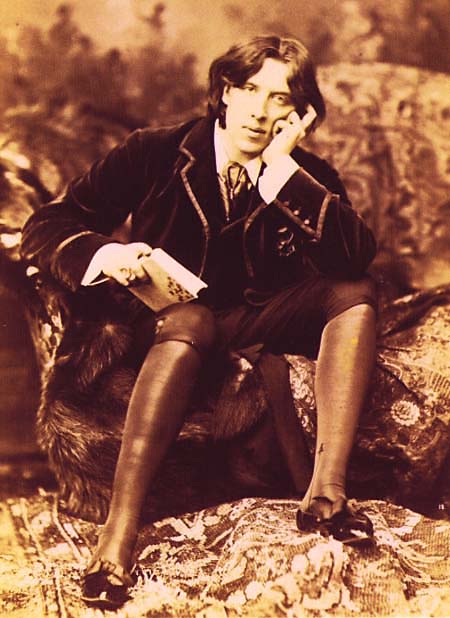
Oscar Wilde, looking stylishly bored

Finally, the film succeeded most in making me think that Oscar Wilde, for all his sparkling wit, may have been a sad bore. A nice guy, surely, and very sweet, but in the end faintly pathetic and faintly boring. Like one of his aphorisms on yet another souvenir mug sold cheaply.