There used to be a time, in the late ’80s and early ’90s when I thought that Hugh Laurie and Stephen Fry could only be booked as an ensemble. These days, both of them seem to have done well enough on their own. Laurie appears to have become more of a star, mainly thanks to his wonderful Gregory House, M.D. (Admittedly, the series wouldn’t work without him.) Fry, on the other hand, is less visible but does more different things, a small part in a movie here, writing novels there, and voicing interplanetary repositories of knowledge in between, all of which seem to fit him quite neatly.
We watched Wilde yesterday, a film for which I had fairly high expectations. Unfortunately, for me the high point of the film was seeing a teensy, pixie-ish Orlando “Not an elf yet” Bloom playing a rent boy, wearing a bowler hat twice his size. No, that’s not quite true. (Well, the bit about the bowler hat is.) Wilde isn’t a bad film: the acting’s quite good, as is to be expected with such a distinguished cast, and it’s handsomely made. But it’s basically a run-of-the-mill, all too earnest (the pun is accidental) period drama, the only difference being that the tasteful sex scenes are between men. There’s a German word that can’t really be translated – betulich – that fits the film, in my opinion. It roughly means “staid”, “respectable”, “well-meaning”. Is this what a Wilde biopic, or indeed any film, should be?
The problem mainly lies with the script. The characters are clear-cut from the beginning and remain static throughout. Oscar is sweet, witty, but too much of a doe-eyed romantic when it comes to beautiful young men. Bosie is a shallow, callous narcissist. Oscar’s wife Constance is hard done by, but loyal. The closest the film comes to character development is when one of the protagonists grows a moustache.
And while I didn’t watch the film for hot, sweaty man-on-man action, is it too much to ask that the homoerotic scenes are actually erotic? The sex scenes are entirely too coy. (There is one ironic camera pan from a Wilde coupling to the window drapes swaying in the wind, although that was perhaps the only glint of visual wit in the film.) As a result of the movie’s consistent respectability, there’s no sense of outrage at the late Victorian homophobia and hypocrisy, just a passive acceptance of Oscar’s inevitable fate, reinforced by the film’s score working hard to make it clear that we’re watching something tragic.
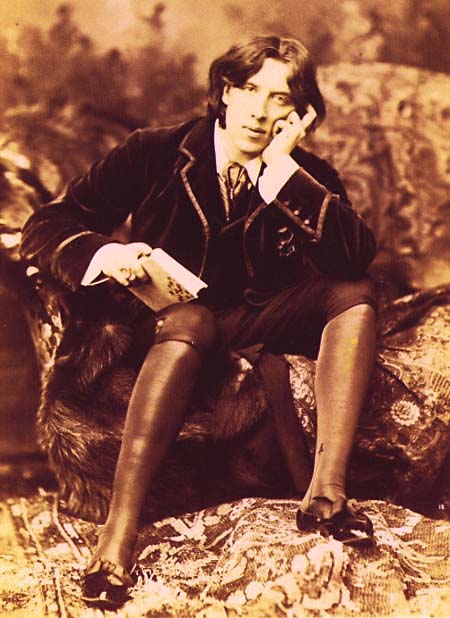
Finally, the film succeeded most in making me think that Oscar Wilde, for all his sparkling wit, may have been a sad bore. A nice guy, surely, and very sweet, but in the end faintly pathetic and faintly boring. Like one of his aphorisms on yet another souvenir mug sold cheaply.
 A Damn Fine Cup of Culture