Welcome to Six Damn Fine Degrees. These instalments will be inspired by the idea of six degrees of separation in the loosest sense. The only rule: it connects – in some way – to the previous instalment. So come join us on our weekly foray into interconnectedness!

In 2002 the UK TV Channel ITV announced that it was to begin producing an all new adaptation of Agatha Christie‘s Miss Marple novels. These would be big-budget, high-production-value affairs, with an eye on the global TV market.
At the time, this seemed like an obvious decision to make. Their long-running series adapting Christie’s Poirot was a massive critical and commercial success. Indeed, “Miss” was dropped from the title – to create a name and logo that would visually recreate that existing successful TV show.


The makers also tried to distance themselves from the earlier BBC Miss Marple starring Joan Hickson. Those, they argued, were very successful faithful adaptations, while their would be made using modern glossier TV methods and generally be shaped around what it was felt 21st century audiences might want from a Marple.
Only it didn’t really work. While David Suchet’s Poirot was to run for over twenty years, adapting pretty much all of Christie’s works starring the titular Belgian lead, Marple lasted only six seasons, with declining ratings and a change of lead. Later seasons were also to see the character inserted into non-Miss Marple mysteries such as Why Didn’t They Ask Evans or Murder Is Easy, but this mechanism that could have let the series run and run didn’t keep the productions from ending in 2013.
And to be honest, it was an axe that neither surprised or disappointed me. Because I don’t think this series was very good.
Now the temptation at this point would be to decry that it was this lack of fidelity to the books, that these so-called modernisations, these adaptations that dared to stray from the source, that was the cause of the problem. But I think this is to misdiagnose what went wrong. The problem isn’t that they changed things. It’s the way they went about changing things and, I think, their failure to learn from what had previously been done so well with the early years of Poirot.
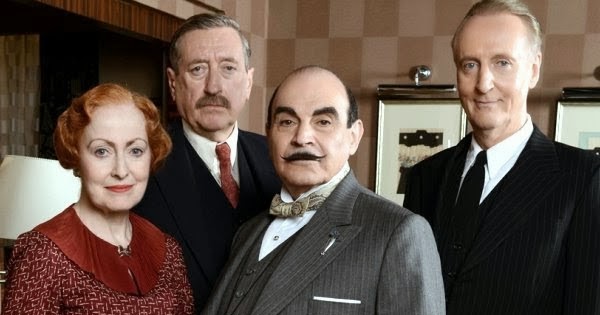
One of the key successes of this earlier series was that it didn’t assume that it would succeed just because it was a Christie adaptation, or that it featured one of her most famous creations, played by a brilliant actor. Instead it devised a show and format that worked on its own merits. They weren’t faithful adaptations; they were stories reworked to fit a cleverly devised format for the show.
The show they devised had a central team of recurring characters, created to have an engaging and likeable dynamic. They allow Suchet to present a lot of Poirot’s fastidious and arrogant behaviour but soften it in his interactions with his friends. Be it his secretary Miss Lemon, his friend Captain Hastings or even Inspector Japp. Alongside the mysteries, they allow for witty scenarios involving the lead characters, scenes that have nothing to do with the books but which make the series much more enjoyable. As we get to know these characters, the show becomes as much about how they interact as it is getting to see Christie’s elaborate resolutions of decades-old mystery stories.
Take for example the 1990 episode “Double Sin”. Alongside the crime and its solution, we learn that Japp is in town to give a presentation on his detective work. Poirot sneaks in to listen to what credits Japp might be taking, and we get a wonderfully scripted heart-warming moment, one that works all the better if you’ve been watching their dynamic in the show over the previous episodes.
These characters are instrumental in making Poirot himself more likeable. Suchet can’t help but invest a level of charm in the role that I don’t think is there in the books – but beyond that there are scenes created to show that underneath his eccentric, fastidious exterior is a likeable gentleman. And there’s some great payoffs – in the final scenes of the episode “The Yellow Iris”, as Hastings introduces a reluctant Poirot to the joy of good old fish and chips, Suchet delights in showing us his character is secretly enjoying this experience. Christie’s Poirot would never have had time for chips wrapped in newspaper, but the makers of the show know that their Poirot. Their mainstream TV hit Poirot is a different beast.
You could readily imagine that, even if Poirot and the Agatha Christie angle didn’t exist and they’d invented the whole format from scratch, this show would have been a success. Even the episode format is conducive to finding an audience – fifty-minute episodes encourage tight storytelling that helps a curious viewer get into the characters without testing patience. Only once the show had been a hit and they knew viewers were enjoying it did they begin introducing movie length adaptations. On its own terms it has all the qualities of a detective drama format that could run and run for years.
And it’s these qualities that are severely lacking in the Marple adaptations. They don’t devise a show format that would work even if they didn’t have the Christie brand. They assume everyone loves Marple, so just throw her into stories. Long stories. Surrounded by a celebrity cast all too frequently hamming it up as if these stories are so famous you can perform them like they’re all in a cosy crime Panto.
When they make changes to the story, it rarely serves to make us like the lead, giving us a reason to want to come back. Instead they are more often to indulge the celebrity cameoing in this episode, giving them enough to do to be worked into the promotion. And while Marple doesn’t have the rich treasury of short stories to make it easy to launch things with a more audience-friendly format, if you’ve committed yourself to non-faithful adaptations anyway, or inserting her into originally Marple-less mysteries, then you should be giving yourself more leeway to format the show to really focus on getting new viewers to like it.
All of which means that Geraldine McEwan, and then later Julia McKenzie, doesn’t get much to do but turn up as a two-dimensional likeable old lady trying to hold your interest for a full movie. She gets supporting characters in most episodes, but the chemistry with her sidekicks is mostly non-existent – there’s nothing to her character to create any friction or engaging drama with. She’s just nice. Compare that with the smart writing on Poirot that gives us the dynamic between the lead and Miss Lemon. Or Japp. Or Hastings. This is the stuff you want to get right to keep people coming back.
It’s not all bad, and there is fun to be had here. “Towards Zero” smartly adapts the original plot, suggesting that there’s actually some mileage in adding Miss Marple to stories she didn’t originally appear in. The first half hour of “4.50 From Paddington” understands the brief of adapting in the spirit of the pulp crime novel rather than the stately prestigious period drama. But when I start enjoying the show’s moments of lurid silliness and cavalier disregard for the source material, all too often it just reminds me of Margaret Rutherford’s Miss Marple movies which do all of this with so much more fun.

Of course, there were early warnings of the flaws that would undermine Marple in the other Christie show. In 1999, the company Chorian, more famous at the time for its nightclubs and entertainment venues, acquired the rights to Agatha Christie adaptations. They determined that the key to future success would be big productions, centred on the novels with a view primarily to prestige sales to the US. Hercule’s stable of friends get jettisoned from being regulars, the productions get glossier and the show is never quite the same again. There are still some great adaptations in those later years (“Five Little Pigs” is an astonishingly smart take on a richly complex original novel), but there are also episodes with all the flaws of the later Marple show. Yes, “Death On The Nile” I am looking at you here.
In 2011, having overextended itself buying the rights to the likes of Enid Blyton, the Mr. Men, Raymond Chandler and Beatrix Potter, Chorian filed for bankruptcy and the rights to Christie were sold to Acorn Media. Not long after this, the plug was pulled on the Marple series. Since then things have been pretty quiet for the character. There’s no new Marple series in the offing, nor big-budget films akin to Branagh’s recent Poirot trilogy. But I do hope that if they ever decide to bring the character back for television, they learn the lessons of these two Christie adaptations and make an enjoyable Miss Marple that can just run and run.
 A Damn Fine Cup of Culture
3 thoughts on “Six Damn Fine Degrees #203: A Tale Of Two Christies”