Welcome to Six Damn Fine Degrees. These instalments will be inspired by the idea of six degrees of separation in the loosest sense. The only rule: it connects – in some way – to the previous instalment. So come join us on our weekly foray into interconnectedness!
At some point when I was in my early teenage years, I found myself with a video tape of classic Merrie Melodies and Looney Tunes cartoons, which we’d got from an uncle or from some friends. In the end it doesn’t matter, because what mattered was the joy the video brought: these were the genuine classics of Warner Bros. animation, the likes of What’s Opera, Doc?, in which Elmer Fudd dresses up as Siegfried and sings “Kill the wabbit!” to the tune of Richard Wagner’s “Ride of the Valkryries”, and Duck Dodgers in the 24½th Century, the second-funniest piece of filmmaking about Mutually Assured Destruction.
The cartoons weren’t just funny, they were also subversive, in more ways than one: take Bugs’ continued play with gender roles and the way What’s Opera, Doc? both parodies the seriousness of opera and somehow still manages to embrace that seriousness in the end (“Well, what did you expect in an opera? A happy ending?”), or the sharp mockery of Cold War jingoism and one-upmanship. While like many cartoons the Warner Bros. classics thrive on familiar routines, on interactions we’ve seen and enjoyed a dozen times before, they were nonetheless radical in ways that I’m not sure parents sitting down their kids to watch some old-fashioned cartoons were altogether aware of.
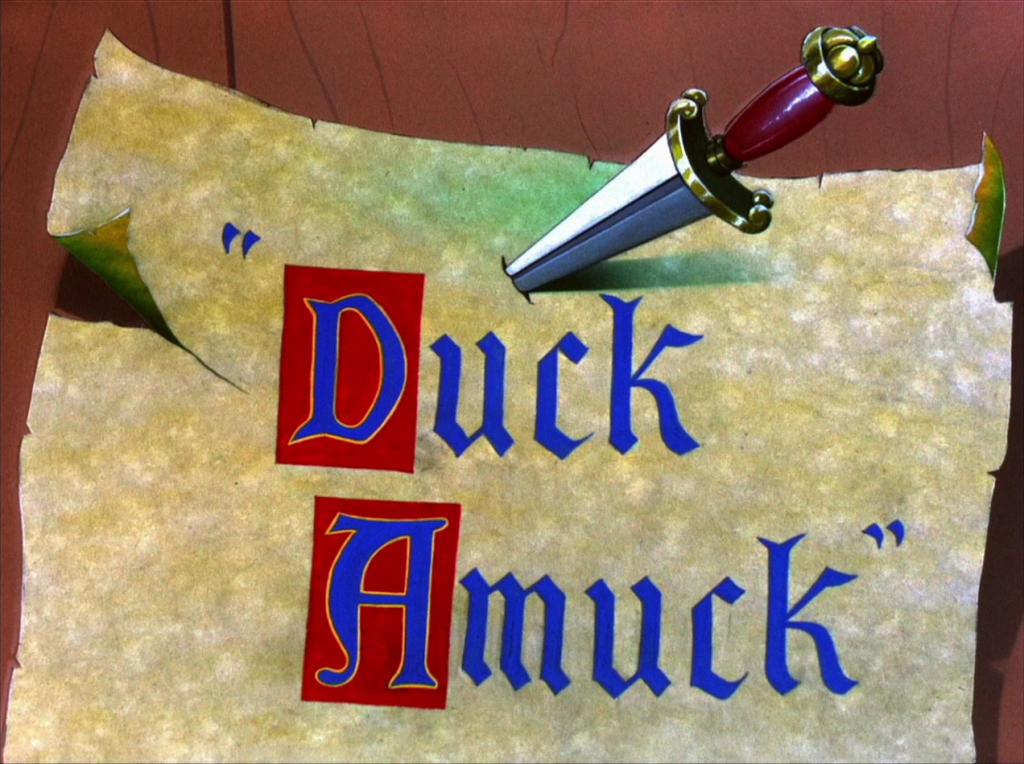
Quite apart from the subtexts, these cartoons were constantly subverting the conventions of storytelling in film. They broke the fourth wall so often and so consistently that, most likely, no one bothered to repair it anymore, because it would be mere seconds before Bugs Bunny or Daffy Duck would be back to shatter it with an enormous mallet or by running into it headfirst. And perhaps none of the cartoons on that tape did so as well as Duck Amuck.

It’s quite amazing to me that Duck Amuck (which is consistently voted onto lists of the greatest cartoons ever) came out in 1953, because I wouldn’t have expected an early ’50s cartoon to be this postmodern and meta – but meta was what fuelled many of the best of the absurdist gags in these cartoon shorts. The cartoon starts with a colourful backdrop of a Technicolor castle and Daffy Duck jumping into frame, dressed as a musketeer and waving around a fencing foil. However, as he launches himself at an unseen enemy to the right, the camera pans along with him and reveals… blank whiteness. The scenery hasn’t been finished yet, so Daffy looks at the camera and whispers: “Hey, psst. Whoever’s in charge here: the scenery! Where’s the scenery?” So a paintbrush comes into view and paints… a farm landscape, clashing with Daffy’s outfit and lines. Our intrepid duck goes offscreen and returns dressed as a farmer – at which point the camera pans again, and the farmyard backdrop turns into an icy landscape, complete with an igloo.
Soon, Daffy is at his wits’ end. The animator hasn’t done his job, and when the star of the show points this out, he complies in the most antagonistic way: first one incorrect backdrop after another, and then a big eraser just erases Daffy – though his voice is still there: “All right, wise guy, where am I?” So the animator redraws Daffy, this time complete with a sombrero and a guitar, and like the consummate professional our duck is, he rolls with it and starts to play – but there’s no sound… and when the sound comes back, after Daffy holds up a sign saying, “SOUND, PLEASE!”, it’s all wrong: the guitar sounds like a machine gun, like a donkey, Daffy’s voice is that of various animals.
The one-sided war between Daffy and the godlike animator escalates: the duck is redrawn as a surreal animal with a flower for a head and a flag for a tail, then black bars almost crush him against the side, and eventually the film stock falls out of sync with the shutter, so suddenly we have two half-frames on screen, one with Daffy’s upper half, the other with his lower half, so the two Daffys start arguing. And all the while, the animator (who remains unseen except for his pen, brush and eraser) keeps messing with our increasingly exasperated star.

So far, so cartoon. But what makes Duck Amuck meta is how it keeps ruining the audience’s suspension of disbelief, while at the same time reinforcing it through its strong central character. The cartoon keeps foregrounding that an animated film is isn’t real, it’s entirely created by an animator – and that makes it infinitely malleable. Turn Daffy into a surreal animal with a flag for a tail? Done. Erase all of him except for his beak? Done. Remove the sound, desync the projector, play the end titles in mid-cartoon? Done, done and done. And the protagonist is just as much a product of the animator’s craft, we’re reminded again and again – and yet, this duck isn’t willing to take it. He rails and rants… and none of it succeeds, but it gets us engaged in his plight. We know he’s just lines and colour animated at (probably) 12 frames per second, but it’s his fight against the unseen power determining his every moment of existence that makes him into more than just a vehicle for gags. Whether we want Daffy to succeed or enjoy his growing exasperation (or a bit of both), he’s both real and not real for us at the same time. In breaking the fourth wall, the cartoon subverts and reinforces its own reality. It wouldn’t be half as much fun if it didn’t: we understand that Daffy is not real and therefore the animator can do whatever they want with him, yet we need to think of him as someone whose existence matters, if not to us then at least to himself. We need to think of him as being able to feel joy and frustration and anger and relief, because otherwise we couldn’t feel any Schadenfreude: you don’t laugh at the misfortunes of chemicals on celluloid, arranged to look like a cartoon duck in various stages of exasperation. (Ceci n’est pas un canard.)
This is something I love about cartoons, and about animation in general: when it doesn’t hide that it is an artefact, something created by a team of artists, while still magicking its characters into life. It’s like the credit scenes in Laika Studios’ films, where we see the animators, over many, many hours, moving their puppets millimetre by millimetre so that they can take a single step. Seeing the puppets being moved by human hands doesn’t make the characters they portray any less real: in a weird way, it makes them more real, because we are aware of the act of magic that’s needed to breathe life into the lifeless. The characters of animation are like Adam and Eve, clay given existence by a set of eminently skillful gods. And, really, isn’t the way that their creator messes with the two of them – here’s an apple! no, you can’t eat it! like it here, huh? well, off you go! – disconcertingly similar to how Duck Amuck‘s unseen animator (whose identity is revealed at the end of the short) tortures Daffy? It would certainly make sense of so many things: there is a god, but basically he’s a dickish artist who likes the schadenfreude of putting his creations through one indignity after another, and finally, once our end credits have rolled, he grins into the camera and goes, “Ain’t I a stinker?”
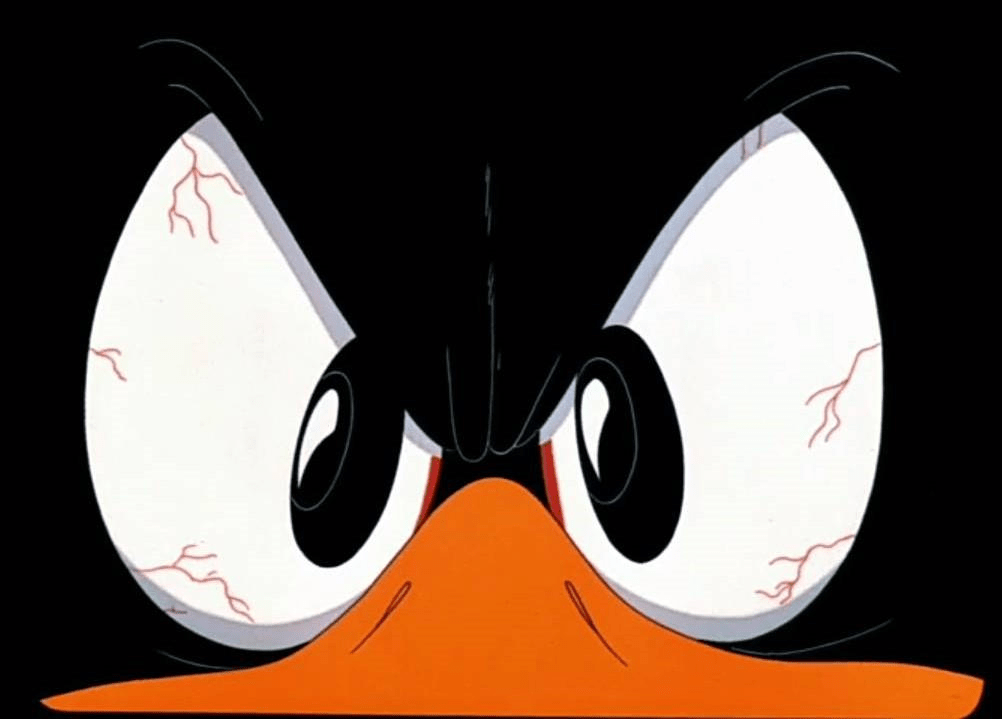
Duck Amuck can be seen in full length at the Internet Archive.
 A Damn Fine Cup of Culture
3 thoughts on “Six Damn Fine Degrees #220: The meta madness of Duck Amuck”