Welcome to Six Damn Fine Degrees. These instalments will be inspired by the idea of six degrees of separation in the loosest sense. The only rule: it connects – in some way – to the previous instalment. So come join us on our weekly foray into interconnectedness!
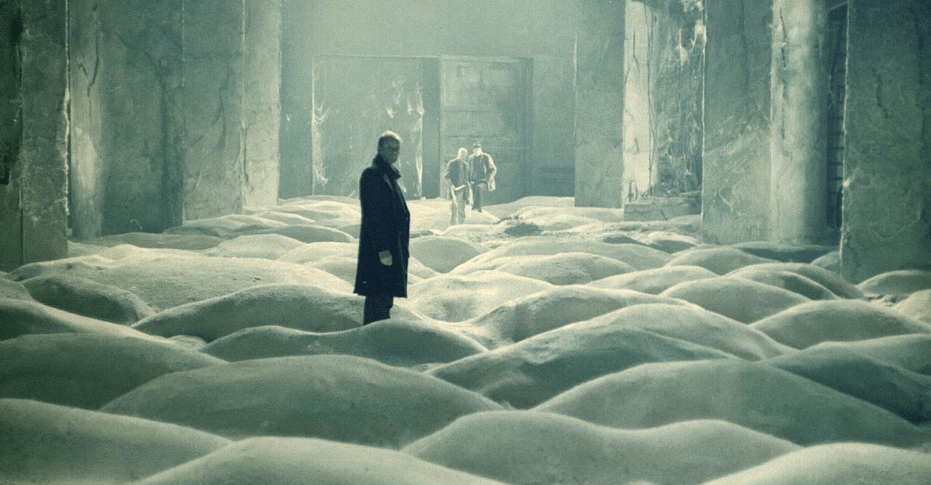
As a Damn Fine Cup afficionado, you’ve probably already seen Andrei Tarkovsky’s Stalker (1979) or read the novel it’s based on, Roadside Picnic by the Strugatsky brothers, or both. You’ll probably have informed opinions on each of them. If you haven’t: sorry, there are spoilers coming.
I came into an appreciation of the Picnic late, since I usually avoid fiction characterised as “bleak”. So now, 30 years after first having heard it described as a must read, I received a copy and gave it a shot. The first happy surprise was its brevity: 193 pages, barely a novel.
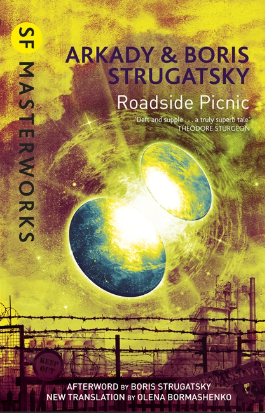
Roadside Picnic is based on the premise that alien visitors have left mysterious artefacts scattered around a place now called the “Zone”. This place is dangerous and full of ineffable forces. Some of the artefacts seem to have uses, but one wrong step in the Zone can prove fatal. Soon, a thriving black market emerges. The daring men who navigate the Zone to steal its treasures are called “Stalkers” and Red, whom we follow through the decades, is the best of them.
Red is full of a driving force that, in fiction at least, seems to be limited to men. He is always searching for something to satisfy the gaping hole in him, for that accomplishment that proves that he is someone, for his own path to walk. A passion he shares with such unlikely characters as Puss in Boots, Sherlock Holmes and the guy in that David Hasselhoff song.
But back to the artefacts: Longterm, they prove to have strange effects on the residents. The children of Stalkers, for instance, are born mutants, like Red’s daughter who seems to be turning into a monkey.
Roadside Picnic derives its name from a key passage: a scientist confesses his belief that the artefacts are nothing but remnants, carelessly thrown away by the aliens – just as young men would leave their trash on the ground after a picnic. And we’re just the ants crawling around in the mess. We might find uses for some of the things we find, but we’ll never understand their purposes or dangers.
It’s a slim book with a lot in it: social criticism around the question of who profits from treasures and who doesn’t, philosophy, tragedy, fatalism, and the nature of being human. It’s very Russian. But it took me until page 139 to realise that I was also looking at satire.
The scientist explains that the mysterious side effects of living near the zone aren’t limited to mutations. If a resident decided to emigrate to, say, Detroit, to open a barber shop, “all hell breaks loose. More than ninety percent of his clients die in the course of a year, they die in car accidents, fall out of windows, are cut down by gangsters and hooligans (…) The number of municipal disasters in Detroit increases sharply. The number of gas pump explosions jumps by a factor of two (…) Furthermore. The number of natural disasters in Detroit and its environs also increases. Tornadoes and typhoons, the likes of which haven’t been seen in the area since the 1700s, make an appearance.”
At this point I put down the book and thought, “Are you kidding me?! Oh.” Hats off, Boris and Arkady Strugatsky. You kept on going to see how far you could go, and I totally fell for it.
Anyway, I enjoyed Picnic a lot more than I expected to. It’s short and sharp, full of action in line with classic science fiction, and rich in ideas. It chronicles at a societal level what happens when new resources are discovered and it dissects on a personal level the effects on the human soul.
In his afterword, Boris Strugatsky calls Tarkovsky’s cinematic adaptation Stalker “brilliant” and credits the film for the novel’s continuing success. (Picnic remains the most popular of the brothers’ novels.)
Buoyed by the book’s satisfying landing and this recommendation, I searched out the move. Stalker is available with excellent English subtitles on YouTube. It takes the setting of the Zone and protagonist Red (with a somewhat more timid character profile). It accompanies Red and his two clients, the Writer and the Professor, on their way through the Zone. They are looking for a magical room that grants you your most heartfelt wish. This somewhat mirrors the last segment of the book, in which Red and his companion search for a similarly magical golden ball that demands a price for its activation.
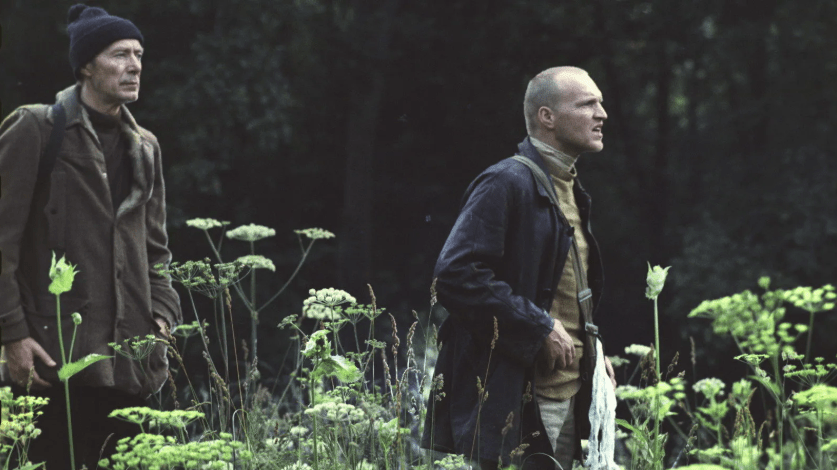
The movie’s focus is on the three main characters, their motives and self-hatred that propel them through the plot. (At this point: a shout-out to the amazing acting chops of Aleksandr Kaydanovskiy, Anatoliy Solonitsyn and Nikolay Grinko who inhabit these characters completely.)
It took me three weeks to get through it.
Because the movie is two hours and 40 minutes long, the first hour and 40 minutes of which show three men walking through an incongruous green landscape, philosophising and having mental break downs. I was ready to gouge my eyes out. But I did want to deliver a blog post about this, so I stuck it out. This movie is a classic, I told myself. There must be a point to all of this.
Also, the screenplay did gift me with my new favourite quote: “What kind of writer am I if I detest writing? It it’s torture for me, a painful, shameful occupation, something akin to extruding hemorrhoids.”
You know that this is going to go through my head every time I have to write copy that I’m not happy with. “Welp, coffee break’s over. Better go extrude some hemorrhoids.”
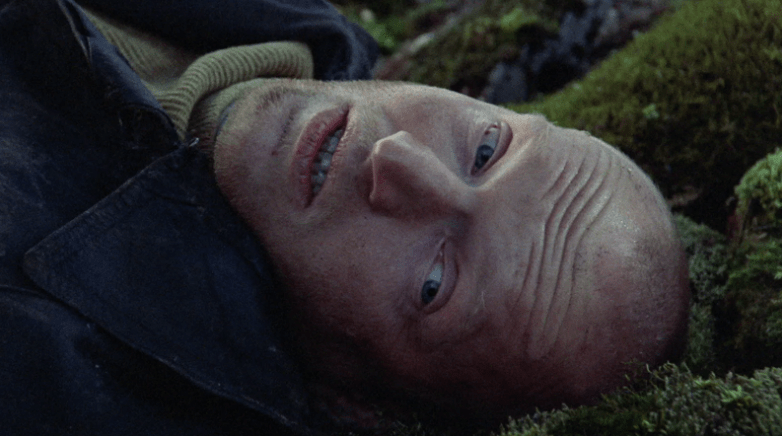
The last hour finally has our heroes reach the doorway of the mysterious room. At which point, inevitably, they have a devastating argument about whether to destroy it instead. They end up – well, I suppose I shouldn’t spoil that at least. I quite enjoyed this part, the thought experiment of what would happen if something were to grant you your innermost wish. Do you even know what it is? Are you sure? How bad could it possibly be? Though I much preferred the equivalent part of the book, that shows how far a man will actually go to have his wish fulfilled.
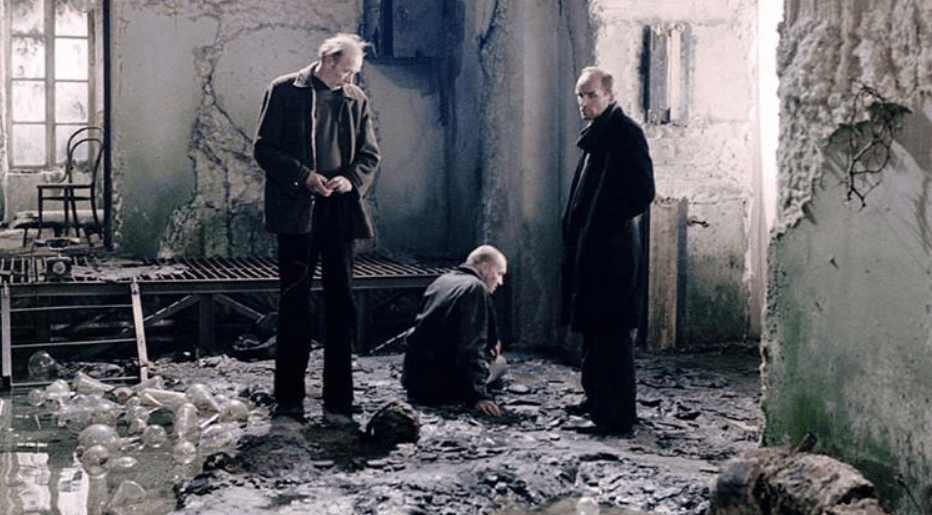
I think both movie and book describe the horror of seeing humanity reflected back in the alien. The alien calls to the surface the terribleness of the human soul because it suspends all the rules and regulations that we have bound our true nature with. And we are rightly unsettled by the glimpse we get of it.
I’m not saying there’s no value to the film. It’s probably really deep. I may just be in the wrong demographic for a five-minute shot of our guys half submerged in swamp mud and despair. I’m saying: if I’d written that movie, it would be a lot shorter and a lot more cheerful. Red would have realised what an amazing woman his wife is, he would have cleaned up, made love to her, and maybe taken up baking with the help of his monkey daughter.
So that was my review. You can @ me in the comments, if you disagree! I absolutely won’t be able to defend my position, but I’m very happy to hear yours.


3 thoughts on “Six Damn Fine Degrees #228: This movie’s no picnic”