Welcome to Six Damn Fine Degrees. These instalments will be inspired by the idea of six degrees of separation in the loosest sense. The only rule: it connects – in some way – to the previous instalment. So come join us on our weekly foray into interconnectedness!
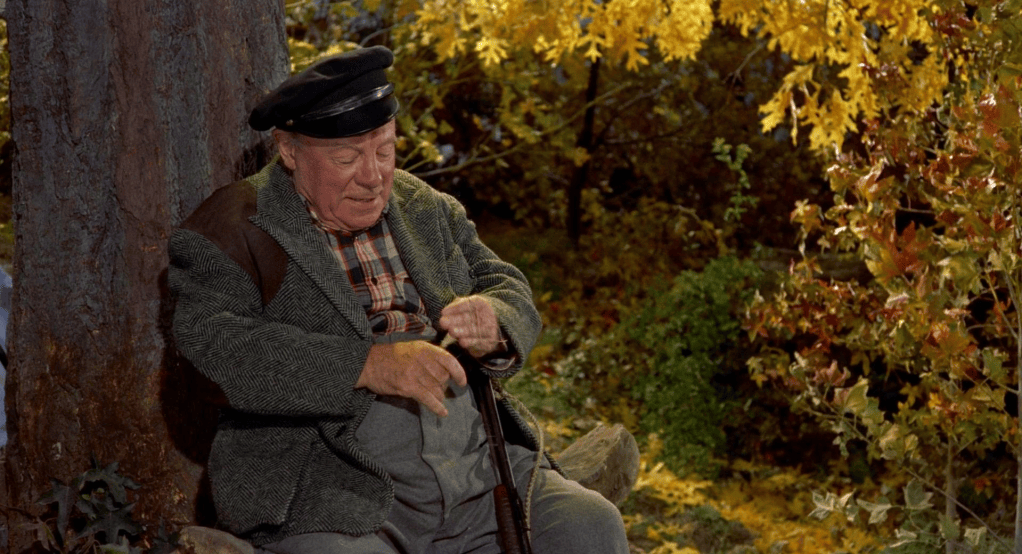
Whenever the leaves start turning, the air gets fresher and the sunlight changes, I frequently think of the opening shots in Alfred Hitchcock’s The Trouble With Harry (1955). This underrated black comedy by the director starts off with the most gorgeous Vermont fall scenes imaginable, lensed in VistaVision and Technicolor by Hitch’s favourite cinematographer Robert Burks and scored sparsely but beautifully by then first-time collaborator Bernard Herrmann. The drawn-out oboe tune is what I whistle whenever I walk through any comparably autumnal scene.
What makes The Trouble With Harry come alive is not necessarily a good script or nailbiting suspense but its comic performances. Obviously this was Shirley MacLaine’s first major role, and she’s a delight as a young mother of a very peculiar son. So is Mildred Natwick, as an elderly lady who might have been seen as a spinster at the time but is clearly open to romantic feelings. Even John Forsythe, who would later reappear in Hitchcock’s much lesser Topaz (1969) and in TV’s Dynasty, is sufficiently charming as an initially unsuccessful village painter. The titular character Harry is a corpse, of course, and the cast repeatedly circles, avoids, or moves the body on the local forest and village grounds.
Heart and center of these shenanigangs, clearly, is Captain Wiles, played with adorable gusto by Edward Gwenn. He’s not only cheekily poaching in the forest only to discover that he might have shot a man called Harry by mistake, but he also stirs up all kinds of trouble by trying to move the body from one place to another, bury it or hide it in people’s homes. This former sea captain (or so we think) has romantic inclinations too when he enjoys tea with Natwick’s Miss Ivy Gravely and is an apple red-cheeked, almost boyish presence in the film.
Edmund Gwenn hadn’t played many starring roles in his career prior to this, and he would soon pass away in 1959, but this film gave him a wonderful canvas to be foregrounded for once. The actor was born in London in 1877 and performed on stage before the First World War interrupted his career. He returned to the West End in plays by Bernard Shaw and J.B. Priestly and started appearing in several films. One of his first was Hitchcock’s sound version of The Skin Game (1931) and the director immediately took a liking to the charismatic actor, remembering him for later.
The Second World War was the reason Gwenn decided to settle in Hollywood among the British colony, where he had already appeared as Katharine Hepburn’s father in George Cukor’s Sylvia Scarlett (1935). Hitchcock cast him again in the director’s second American production, Foreign Correspondent (1940), where he played the role of a very Cockney-sounding assassin. For Hitchcock, who loved to find memorable faces for even small signature roles, Gwenn stood out. When he got into television with Alfred Hitchcock Presents, Gwenn would once again get a role in the 1957 episode ‘Father and Son’.
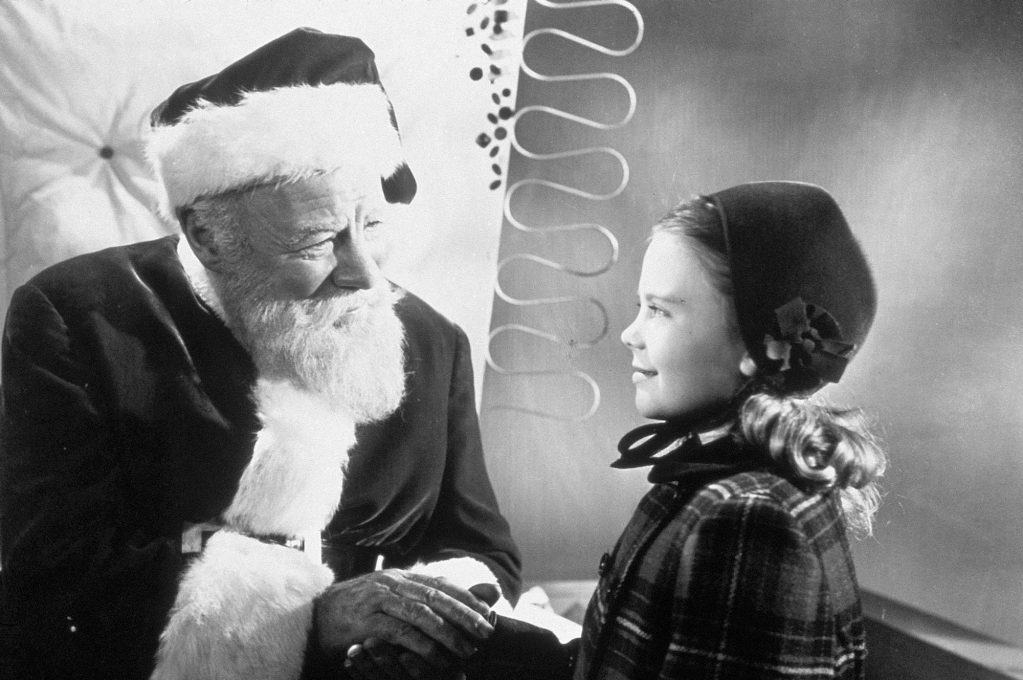
But first, Gwenn would garner his greatest success by playing Kris Kringle in George Seaton’s Miracle on 34th Street (1947). Initially just an old man hired to play Santa Clause at Macy’s department store in New York, Kringle soon lays claim to being the real Santa. The film became an instant Christmas classic and received three Academy Awards the following year, including two for writing (story and screenplay), as well as for Gwenn’s supporting performance. Even though Gwenn would appear in many more films, including Them! (1954), discussed in Julie’s latest post, his face would be forever associated with the Holiday season by millions since.
Which means, of course, that there is no better companion to bridge the current season between fall and Christmas than Edmund Gwenn! Start with his starring role as Captain Wilkes in Hitchcock’s unique comedy and end with the perennial classic tale of the department store Santa and you’ll experience a wonderful cinematic seasonal transition courtesy of one of the less famous but immediately memorable acting talents.
Gwenn’s life also took a rather macabre and cinematic turn when after his death by pneumonia in 1959, the urn with his remains was mysteriously lost. It turned out that because the urn was of an unusual shape and other urns were usually stacked on top of each other, Gwenn’s remains had been set aside and lost. Thankfully, in 2023, the urn was relocated on the Chapel of the Pines Crematory in Los Angeles. Thanks to researchers with a YouTube channel and a crowdfunding campaign, Gwenn’s ashes are now to be found at the Hollywood Forever Cemetery. Judging by the actor’s career, fittingly, a rather Hitchockian coda to its ending.
Listen to our Second Chances episode on The Trouble With Harry and Billy Wilder’s The Apartment.