 Lynne Ramsay’s You Were Never Really Here could have been made in the late Sixties, with John Wayne or Lee Marvin, or in the Eighties with Russell Crowe. Ramsay’s movie is based on a 2013 novella by Jonathan Ames, but it could also be based on a story by Jim Thompson from the Fifties. I understand the comparisons with Taxi Driver, since both movies are about traumatized outsiders confronted with violence (a lot of it their own), but You Were Never Really Here is pared down to a taut 90 minutes. Everything that does not belong to the story is not in there. Ramsay’s screenplay tells a lean, mean tale that would be ruined with too much dialogue or too much exposition. Three out of her four movies have literary origins, and she always films her own screenplays. Lynne Ramsay knows what she wants to say, and how to say it.

Travis Bickle tried to get out of his shell and find a girlfriend, no matter how clumsy his courtship was; such a thing is completely out of the question for Joe, who is deeply scarred by his war memories. Ramsay doesn’t overstate Joe’s backstory, but presents it in short, repeated, steadily extending flashbacks. These days, Joe is busy freeing underage girls from a sex trafficking ring, and he goes about his work by all means necessary. We see him buy a high-end hammer for every new job. It’s a kind of work that absolutely no-one else but him could do. Joe doesn’t mind because he has essentially shut down emotionally. That is why he is so successful at his job. Sometimes he sees suicide as a threat, sometimes as a solution, and the next moment, you find him contemplating a green Skittle.
The movie doesn’t over-psychoanalyse Joe, either. He is mostly silent, and his most frequent answer is What?, because his mind is elsewhere, or maybe he’s busy listening to the noise inside his head. His only attempts at a normal life are when he is taking care of his frail old mother, played by Judith Roberts, whom you might remember from Orange Is The New Black. Mum thinks it’s hilarious to play dead when Joe comes around to look after her. It’s a good thing Joe doesn’t scare that way. It’s the only funny scene in the movie, and it’s not really funny at all, if you think about it.
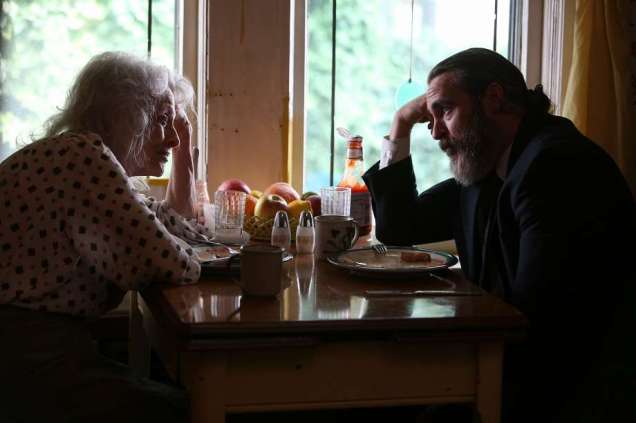 There is a strange paradox at the center of the film. We either see Joe or we see what he sees. Lynne Ramsay films him in such tight frames that it feels like we are sometimes there with him, in the same car, in the same room, that it’s hard not to feel trapped with him, and as soon as he is using violence, the movie makes us accomplices. The other side is this: since Joaquin Phoenix gives such a good performance, Joe seems to dissolve before our very eyes. I can’t really explain why, and it is all the more surprising because Joe seems to be such a doughy hunk, folded back into himself. Phoenix has played psychologically damaged men before, most of all in Paul Thomas Anderson’s movies Inherent Vice (2014) and even more so in The Master (2012). He is even better here. He is always dressed in black, with a scraggly beard, muttering admonishions to himself. There is a moment where he sits down in front of a shuttered high street shop, and he immediately passes for homeless.
 For a movie about a suicidal guy who uses hammers to free girls from brothels, there is not much violence. Some of it might not come from the blood, but from how Joe’s presence undeniably means life or death – life to the girls, death to their johns and pimps. There is a moment in the movie where Joe, in the middle of a hammer job, is lying on the floor, a dying bodyguard beside him. They join hands. That scene could have gone wrong, but here, it works. Dying seems to be a state of being that Joe understands instinctively.

 Sicario: Day of the Soldado is a textbook example of diminishing returns. What is missing most of all is Kate Macer, the Emily Blunt character from Denis Villeneuve’s original Sicario (2015), who provided us with an entry into the seriously skewed ethics of clandestine missions across the US-Mexican border in the unwinnable war on drugs. Also missing is Roger Deakins’ excellent camera work. Soldado, again written by Taylor Sheridan, and directed by Stefano Sollima, an Italian director with experience in crime stories (the Gomorra series), focuses instead on the two characters we already know: Matt Graver (Josh Brolin), the US government’s go-to guy for unsavoury operations and unusual footwear, and Alejandro (Benicio del Toro), the vengeful hired gun. This time round, the US government finds that terrorists disguised as Mexicans have crossed the border. That makes the crossing a terrorist act in their eyes, and so they are allowed to retaliate. See what I mean by skewed ethics?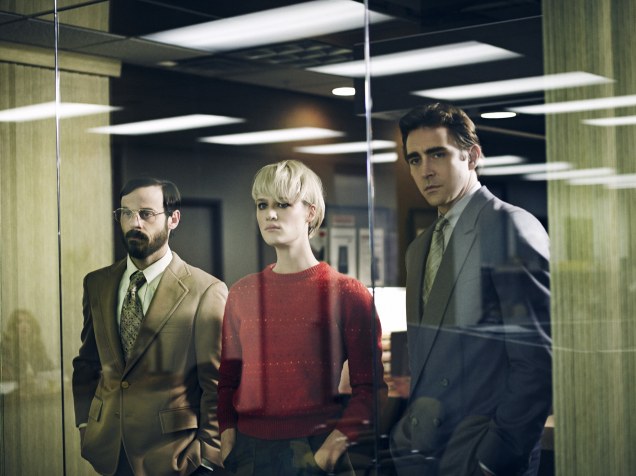
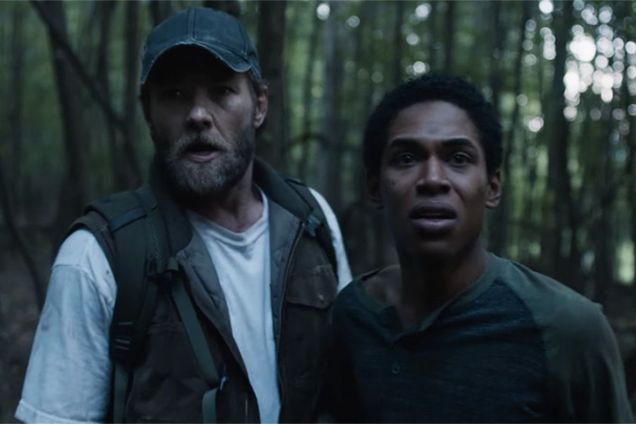 It Comes At Night made me realize that some horror movies have too many ingredients. This one here contains: a family of three in a boarded-up, but otherwise intact, creaky house in the woods, banks of fog, sleeplessness and nightmares. That’s it. There are no aliens, knife-wielding loonies, supernatural catastrophes, magical-realist occurrences, ominous messages from beyond, or ghosts of any kind. There is no longer any electricity, and there is also no nonsense about someone sabotaging the generator in the middle of the night because there isn’t one. Paul and Sarah and their teenage son Travis have to make do with camping lanterns. That sounds slightly arthouse-y and intellectual for a horror flick, but it’s way better than any other genre exercise I’ve come across lately, with the exception of
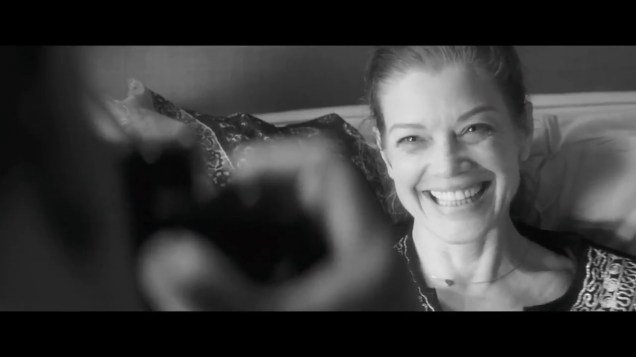 Marie Bäumer has been compared to Romy Schneider for so long that it was really only a question of time that she would play her. Emily Atef’s black-and-white 3 Days in Quiberon uses that likeness to great effect, so much so that when I picked the stills for this post, I had to check twice which actor I was looking at. The movie revolves around Schneider’s stay in a rehab resort on the French coast in March 1981, where she wants to give an interview to journalist Michael Jürgs from the German magazine Stern. It seems to be shot at least partly in its original locations. There is history between her and her favorite photographer Robert Lebeck, and she asks one of her friends, Hilde Fritsch, to come and keep her company. For Schneider, any interview was a double-edged sword because she inevitably would be asked about leaving Germany for France, the suicide of her first husband and the custody battle for her son, and of course about the Sissi trilogy. On the other hand, she was eager to go on making movies.
  It’s a good thing they still make them like this. A Quiet Place is more than one notch above the Insidious or Paranormal or Conjuring franchises; in fact, the movie has its roots as much in sci-fi than in horror, because they planned at an earlier stage to embed that story here into the world of Cloverfield. I don’t want to SPOIL the movie for anyone, but if you haven’t spent the last few weeks under a rock or in Area X, you know that A Quiet Place is about a family who find themselves alone in a post-apocalyptic world wherein you cannot make a single sound or the beasties in the woods will get you. It probably won’t surprise you all that much if I tell you that an early draft of the screenplay contained only one single line of dialogue.
 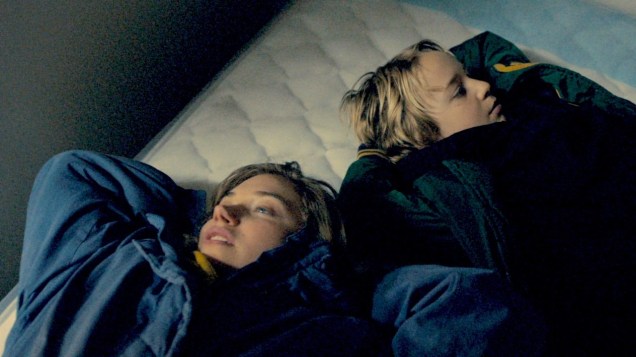 Mobile Homes is a good movie, no doubt, but there is a kind of void in its middle that prevents it from turning into a great movie. Bear with me. It’s the story of Ali (Imogen Poots), her young son Bone (Frank Oulton), and step-dad Evan (Callum Turner) who live out of Evan’s truck and drift from place to place, selling roosters for cockfights or reselling probably stolen household gadgets. They are chronically broke and often have to resort to dining and dashing, a trick that Bone has to do far too often. They are one broken exhaust pipe away from being homeless. I don’t doubt that Ali and Evan love each other, even if they also cling to each other out of necessity, and that Evan tries to be as good a step-dad to Bone as he can, although Ali and Evan often send Bone to find empty homes so they can do their B & E spiel. Life cannot go on like this for much longer.
  Remember Tonya Harding? She was that American ice-skater who bashed her opponent’s knee in with an iron rod, right? When was that? Late Eighties, no? What was the name of the other skater? Nancy… something. Hmmm. Nancy Kerrigan, yeah, that’s it. And that was just before the Olympics in Atlanta? Or Alberta?
  A Damn Fine Cup of Culture