You know, for kids!

Alice in Wonderland (and its sort-of-sequel, Through the Looking Glass) is an odd book, and my memory of it is just as odd. I can remember liking it, but when I try to remember the book, what comes to mind is John Tenniel’s illustrations, images from the Disney movie, scenes from Jan Svankmajer’s surrealist dream/nightmare – or, more recently, American McGee’s Alice with its twisted, dark Wonderland and music by Chris Vrenna.

Anything, but not the actual Alice in Wonderland. The original has become a sort of collection of memes: the Mad Hatter, the Cheshire Cat, the Jabberwocky. It’s a hypotext whose influence throughout literature, cinema, comic books, video games etc. is strong, but Alice itself has become distorted and murky behind all the copies, pastiches and parodies.

Tim Burton’s most recent film is called Alice in Wonderland, but it’s less of a direct adaptation than a hodgepodge of half-digested ideas and images from over 100 years of Aliceology. Like most of Burton’s films, it looks gorgeous, but like too many of his recent movies it feels like warmed-over Burton, down to the Danny Elfman score. The visuals are admittedly cool (and I have to admit that I watched the film on a BA transatlantic flight – small, fuzzy screens aren’t the best way to appreciate a Tim Burton film), with some fantastic character design, but the plot is predictable, the dialogues leaden and most of the acting vanishes behind the CGI. It’s as if Burton was given a beautifully surreal world but basically decided to tell Generic Fantasy Story X in this world. Despotic ruler, check. Chosen one, check. Needs to discover her powers and believe in herself, check. Special blade, check.

It’s a shame that such a creative, talented cast and crew could have come up with something that combines Lewis Carroll’s original story and Tim Burton’s sensitivities in weird and wonderful ways – but Burton’s sensitivities at this point seem to be a pale shadow of his earlier creativity. Worst of all, the man seems to have gotten old the way that Steven Spielberg has gotten old, meaning that in creating something that should burst with childlike energy and wonder, he’s come up with something that feels like a director in a midlife-crisis trying to pander to what he thinks is youthful and energetic. The worst example of this is the dreadful dance the Mad Hatter does towards the end of the film: even Johnny Depp with his considerable talent and charm can’t make it into anything other than an awkward attempt by the film to be ‘cool’ and contemporary.

Anyway, enough about Alice in Wonderland. I may get back to my 12 hours of blurry free films at a later date, but for now I want to leave you with this strange, strange video telling the Complete History of the Soviet Union through the lens of Tetris:

Fool me once…

Yup, I know… For one thing, it’s been ages since I last posted an entry. Shame on me. For another, April 1 has been and gone, so this is pretty late. Still, it bears reposting for the sheer geeky awesomeness: comic book publisher Top Shelf posted the following update on Alan Moore’s League of Extraordinary Gentlemen last Thursday. Shame it’s a joke.

Here’s the blurb they came up with:

When war-hero-turned-handyman Kesuke Miyagi is found drained of blood, it becomes clear that the occult gang known as the Lost Boys are targeting the only individuals that can stop them from complete domination of America. It’s the perfect case for the League of Extraordinary Gentlemen–except that their government contact, Oscar Goldman, disbanded the team in 1979 after they defeated Mr. Han’s army of the living dead.

Now, disgraced scientist Emmet Brown has to put together a new team to combat the growing threat of the Lost Boys and their leader, a newly resurrected vampire kingpin Tony Montana: Transportation specialist Jack Burton, ex-commando B.A. Baracus, tech wizard Angus MacGyver and the mysteriously powerful femme fatale known only as “Lisa.” But will Brown be able to stop the Lost Boys before time runs out?

On a somewhat less fun note, apparently the next real chapter of LOEG has been delayed until 2011. Bother.

Love, death, life and the silly sublime

To be fair: watching The Fountain recorded from digital TV, the compression turning any dark scene into black (“none more black”) with a handful of flecks of light, isn’t really the best way to see the film for the first time. Darren Aronofsky’s follow-up to his much-lauded Requiem for a Dream, the kind of film even I can’t describe as bitter-sweet, is intensely visual, and if the first five minutes turn into a frantic game of “It’s a… it’s an elephant, I think. A black elephant. At night. No, it’s a spaceship. At night. And it’s black. Is the TV on?”, the film suffers. (Or, depending on how you look at things, the audience suffers.)

The rare moments when I could not only see what was going on on-screen but actually saw enough of the image to appreciate it, the film definitely proved to be a feast for the eyes. And it wasn’t just pretty – much of what Aronofsky shows us is evocative and beautiful. (Pretty is to Beautiful as Liv Tyler is to Cate Blanchett, if you ask me.) There’s one image in particular, Queen Isabella’s chamber lit by hundreds of tiny lamps hung from the ceiling, that I found quite stunning.

Kitschy or sublime? You decide.

But while some of the imagery is sublime, some – especially in the last half hour of the film – are plain silly. I don’t mind the latent (or not so latent) ‘New Ageyness’ of The Fountain, because as a visual poem on love, death and a man’s inability to let go the film works for me. But then you got bald yoga master Hugh Jackman in the lotus position, floating towards some cosmic birth canal, and awe is replaced by incredulous giggles. Same goes for the scene where Jackman, as a Spanish conquistador, is consumed by flowers sprouting from his torso as if he was the world’s sexiest, silliest Paul Daniels magic trick. I get what the scene’s trying to do, but it just looks… well, naff. Combine that with the film’s po-faced tone and the film doesn’t do itself any favours.

At some point I hope to watch the film again, with subtitles (so I can figure out what those Spaniards are shouting in the rain) and adequate visual quality. I expect that it’ll pull me in more, which in turn might make me forget (or at least forgive) the unintentional humour of scenes that would have had Dr Manhattan raise one implacable, blue eyebrow. Clint Mansell’s lyrical score will definitely help – it did the first time, to the extent that I was more captivated by the end credits than by what had been going on ten minutes before.

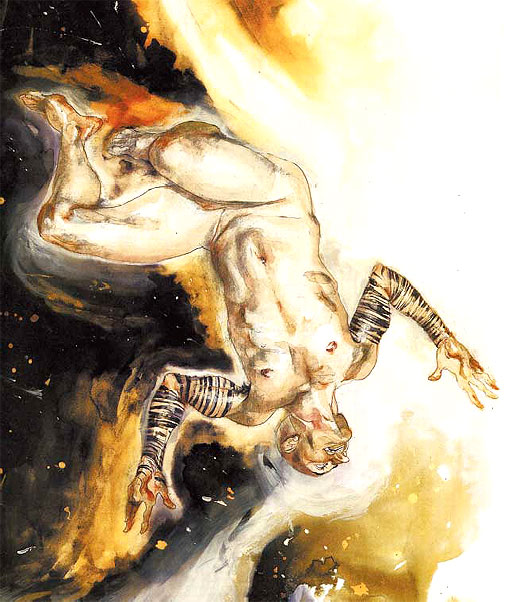
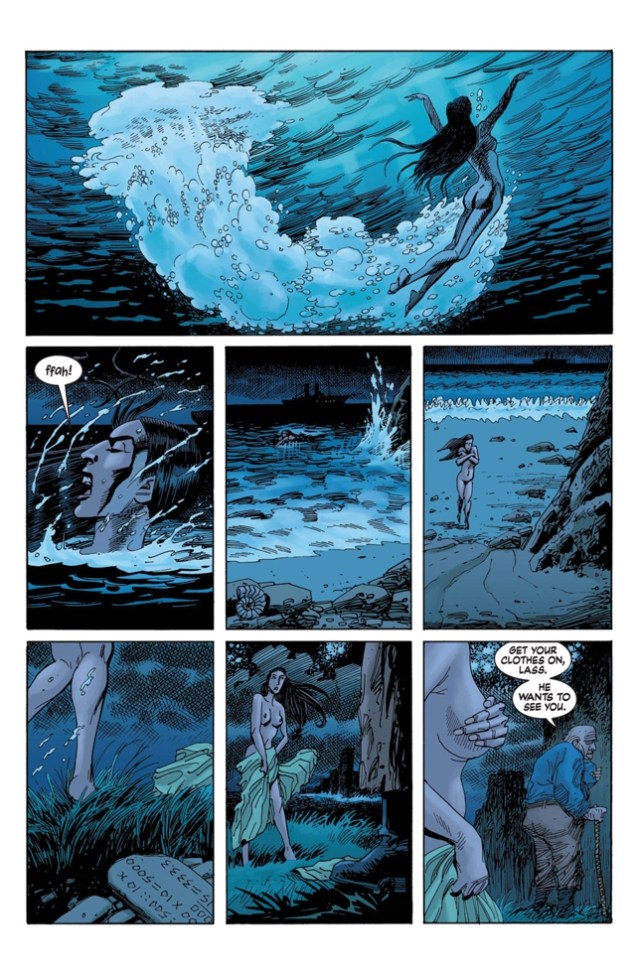
Right now, though, I think that The Fountain works much, much better as the comic book version, which the script was turned into after a first attempt to film it failed. It has all the elements of Aronofsky’s movie, but what looks silly in the film works much better in the stylised drawings (somewhat reminiscent of Dave McKean’s work on Arkham Asylum, although less abstract). It still borders on New Age kitsch, but as far as I’m concerned it pulls it off. Perhaps the best thing would be to read the comic while listening to Mansell’s soundtrack. And, if that’s your cup of tea, fantasising about Hugh Jackman.

Naked dude floating in space. Trippy.

P.S.: Much more nudity in the comic. (Both Rachel Weisz and Hugh Jackman remain chastely dressed throughout the film.) But it’s artistic nudity (“and in the end, isn’t that the real truth?”). And not even close to the full-on pornography of a Lost Girls.

Spiraling down towards madness

I don’t really know much manga. Yes, I’ve read Akira, and I quite enjoyed Osamu Tezuka’s Buddha, but other than that I simply haven’t read much. In addition, other than the original Dark Water I’m pretty ignorant about Japanese horror (other than having read reviews, and reviews of the American remakes – I don’t know anything, basically, I just meta-know!).

When I read about Junji Ito, though, I was intrigued. I don’t know what it was – the chills that his works evoked among the people who had read him, the single panel someone had posted? Perhaps it was just that I had time on my hands.

So I checked out Uzumaki. And I’m glad I did. But yes, some of it will haunt me.

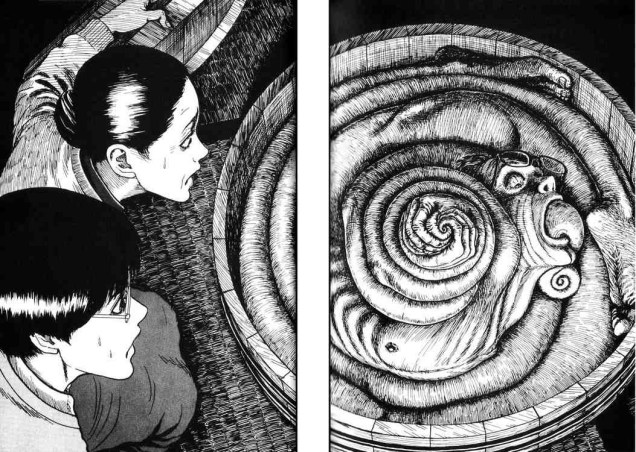
Differently from the Western horror I’ve watched or read, Uzumaki doesn’t go for full-on naturalism that is then invaded by some uncanny creature of the beyond. From the first, there’s something weird and uncanny about his stories. Is it that the people who become obsessed with spirals in the story are going mad, or is there something more to it? There is something obsessive in the storytelling itself, as each chapter takes us further down the spiral.

There are bits that are gruesome and gory (in moderation), but those aren’t really what had most of an effect on me. It’s the surreal that somehow becomes frighteningly compelling as it invades every aspect of the manga – there are overtones of Kafka, as people turn into giant snails, but there’s also something creepily funny about some of the chapters. It’s unsettling, to say the least.

So, if you’ve got time on your hands, you may want to check out Uzumaki. Beware, though – it is addictive, it is unsettling, and it may just burrow into your mind and leave little, spirally holes, as if someone had taken a corkscrew to your frontal lobes.

I made that last bit up...

Or did I?

Och fasa, och fasa…

… or whatever the Swedish use for “The horror, the horror”.

I missed Let the Right One In at the cinema, but I made sure to catch up with this well-received Swedish horror movie (that old chestnut!) as soon as possible. And I’m glad I did. It’s one of the most poignant, disturbing films I’ve seen in a long time.

In many ways Let the Right One In felt familiar: the look of the film – the faces, the clothes, the haircuts – was that of an urban Astrid Lindgren without the nostalgia. Critics with a thing for Freudian theory could probably have a field day talking about heimlich and the uncanny and the like; for the purpose of this blog, suffice it to say that Tomas Alfredson’s movie uses the familiarity and banality of the setting to great effect.

And it’s always great to see a film where the main characters are kids that are both well written and well acted, something that only a handful of directors can do. (Danny Boyle comes to mind.) The two protagonists, Oscar and Eli, are two of the most credible children I’ve seen in a movie, which is saying something considering that one of them is a vampire. Let the Right One In especially gets one thing right: its young protagonists are not idealised. Oscar’s reaction to being bullied viciously is a set of violent revenge fantasies not at all uncommon to boys of his age; I know that at times I was one good bullying away from going all Travis Bickle on some of the kids at my elementary school. Eli, the trickier character of the two because there’s no real template (there aren’t too many eleven-year-old-but-they’ve-been-eleven-for-a-long-time vampire girls-who-might-actually-be-castrated-boys that could have acted as consultants for this film), but the writing, the direction and the acting make her work. She’s both utterly believable as a girl (and it’s clear why someone like Eli would fall for her, possibly his first real love) and immensely unsettling as a vampire.

What I appreciate most about the film is how bravely it maintains its ambiguity. The relationship between Oscar and Eli is touching, and the feelings between them seem genuine, but there are enough hints suggesting that the old man Hakan that Eli travels with was once an Oscar. How much of Eli’s actions is actual love, and how much is her manipulating the boy into becoming what she needs him to become? In fact, with her forever stuck at eleven, how much of their continued fate together is inevitable, as long as they stay together? There are hints of Interview with a Vampire‘s Claudia in this thematic strand, but Let the Right One In arguably does something deeper, more poignant with it.

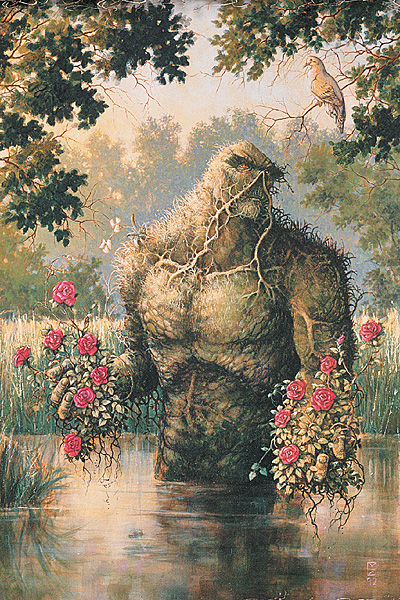
While we’re on the subject of horror: after League of Extraordinary Gentlemen: Century: 1910, I decided to give in to my Alan Moore cravings and got myself the first three volumes of his run of Swamp Thing. It’s fascinating to read these, because you can pick out themes and motifs that Moore later used, usually to better effect. At the same time, while Moore’s Swamp Thing (both the comic and the character) are complex, with richly metaphysical overtones, I have similar problems with it as I have with much of the first volume of Neil Gaiman’s Sandman. Both take the old staple of the horror comic and infuse it with mythology, deeper characterisation than you’d expect from the genre, and a degree of relevance, moving away from pure escapism, but they’re still both caught in the confines of the genre. The end result, at least for me, is a comic that tries to be more than just horror but just about not succeeding.

Still, it’s bound to be better than Wes Craven’s Swamp Thing movie. When all a film has going for it is Adrienne Barbeau’s breasts, well, then…

Swamp Thing (duh duh, duh duh!), you make my heart sing!

You can’t always go back

Before Sunrise seems to be one of those films that ‘people of my generation’ (the moment you use that phrase unironically, you’re getting old, man!) tend to like. Somehow many of them seem to feel that it captures their attitude towards romance and what they wish their EuroRail adventures had been.

Some films should be seen for the first time at a certain age. If you don’t see them when you’re ten or sixteen or twenty-two, you’ve forever missed your chance, and unlike your peers you won’t be able to watch them with a healthy dollop of nostalgia that makes them bearable to begin with. The Goonies is probably one of those films, with its ’80s cod-Spielbergian cast of kids. Having seen Before Sunrise for the first time less than a week before I turn 34 makes me think that this is another one of those films.

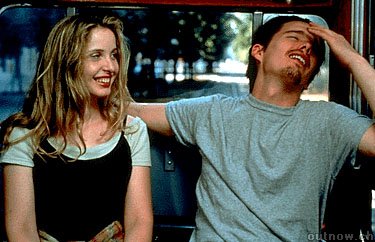
Gosh, aren't we all, like, cute and stuff?

It’s quite obvious that the movie itself is enamoured with its leads and their conversations – because that’s all there is. My thoughts, for most of the film’s running time, were, “Yes, I remember those kind of conversations, when I was an undergrad student, at 2am after lots of red wine.” In that situation, those wannabe deep talks are enough – but now? I sat there thinking, “Oh, grow up!” and making fun of the characters’ self-infatuation. Which worked for about ten, fifteen minutes… and then it got boring.

You can capture the feel of a certain age or a certain type of situation. You can do so with lots of affection. But the moment you give up on any semblance of critical distance, you’re likely to end up with something narcissistic – something you can only love if you identify 100%. But especially Julie Delpy’s Céline is way too serious about her ramblings, giving the impression of a second-year Philosophy student (with a minor in Gender Studies) thinking that she’s discovered The Meaning of Life. Personally I found Ethan Hawke’s Jesse somewhat more bearable, because I thought that he doesn’t have this po-faced seriousness, whereas my girlfriend found him way more annoying. Read into that what thou wilt.

On a somewhat more positive note: I received Alan Moore’s new comic this week, the cumbersomely titled League of Extraordinary Gentlemen, Volume III: Century: 1910 (if we want to be exact, we’d have to add the intriguing, Brecht-inspired subtitle, “What Keeps Mankind Alive”). It’s very clearly the first part only of a longer story (parts 2 and 3 are to follow in 2010 and 2011, alas), but differently from Moore’s Black Dossier, he’s actually telling a story in this one. And he’s up to his usual clever intertextual games, his major inspiration for this one being Berthold Brecht’s Threepenny Opera.

And yes, Moore and O’Neill still like a good bit of nudity, although there’s less of the actual sex. Regardless of whether you like that sort of thing or not, Kevin O’Neill’s compositions are gorgeous:

league-of-extraordinary-gentlemen-century-4

And to finish on a slightly less voyeuristic note – checking out the Threepenny Opera before reading Century: 1910 seems to be a requirement:

Sick squid? Not bloody likely!

Squid we can believe in!

The short version: I liked Zack Snyder’s Watchmen. It was by no means perfect and there are a couple of pretty bad flaws – mostly to do with the film’s interpretation of Adrian Veidt and the massive cuts in Laurie/Silk Spectre II’s backstory (to the point where there is almost nothing left of the crystalline glory of chapter IX, “The Darkness of Mere Being”) – but it’s the first film version of an Alan Moore comic that takes the source material seriously, even if it doesn’t always completely trust its audience.

One problem that Snyder seems to have, though, is that he’s too much in love with his talents and his cleverness. The use of music was one aspect of this, with too many jokes being used in a winking “Get it? We’re being clever as well as showing reverence to Moore’s original!” And whenever there was something semi-clever, Snyder had the tendency to linger on it for much too long, making these moments smug rather than witty and subtle. The cheesy soft porn scene on Archie? Prime example of that sort of smugness. Moore wasn’t above the occasional broad joke in the original, but they didn’t last for five minutes.

The other thing is Snyder’s propensity for over-the-top violence. Some fit okay, even though I didn’t particularly feel I needed to see a man’s arms being sawn off (not that the original scene with its throat-cutting was that much more harmless – I’ve got a thing about throat-slicing scenes…), but the first fight scene with Dan and Laurie didn’t make any sense story-wise. These two haven’t been wearing their costumes for years, they haven’t been out to beat up street ganes in a long, long time. Their first fight should be clumsy and exhilarating, not choreographed to a T.

My problems with the ending? No, they have nothing to do with Snyder’s re-interpreting the squid into S.Q.U.I.D. I agree that audiences wouldn’t have bought the comic’s finale – hell, I’m not sure I fully bought it, at least not the means by which Adrian executes his plans. What didn’t work was how clean everything was: in the original we’re treated to page after page of the apocalyptic, horrific results of Veidt’s plan. There’s nothing clean about it. Similarly, in the film Ozymandias more or less receives absolution from Dr. Manhattan – and in an utterly inexplicable move, the “Nothing ever ends” line that is so essential to the ending and to Adrian’s character ark is spoken, after her return from Antarctica, by Laurie in a conversation with Dan. As a wise man once said: Huh?!

Final quibble: why, oh why, did they feel the need to change the beautiful simplicity of “I did it 35 minutes ago”?

But still, as I said: I liked it… unlike a certain mustachioed madman.

Always running… from something!

Avid readers of this blog may have noticed that I’m fairly keen on Messrs. Vaughn and Whedon’s work in comics… so when Joss Whedon was set to write the next series of Runaways, I was excited. Both writers have similar strengths; their writing is witty, they create ensemble casts of characters that gel extremely well, and they tell a good story while providing more than enough ambiguity to keep things interesting beyond the plot.

I recently re-read Vaughn’s original three Runaways volumes and apart from a couple of minor issues (such as the slightly inconsistent quality of the artwork – there’s some gorgeous work there, but some panels and some of the inking feel rushed) I greatly enjoyed it. Coming away from Whedon’s run with the kids, however, has left me somewhat disappointed. When he’s at his best, Whedon is a fantastic storyteller, getting you involved way more than I would have expected from stories about teen vampire slayers or space cowboys. He’s not infallible, though; his first Serenity comic, while not abysmal, was in no way as memorable as the TV series, for instance.

And now, Dead End Kids: my first and main thought throughout was, “I wonder what Brian K. Vaughn would have made out of the material.” Again, Whedon’s writing isn’t bad, but there’s little of the sense of surprise or freshness that Vaughn’s stories had. The kids feel ever so slightly less real and more like comic book teens. (And don’t think you can worm your way into my heart by introducing a new regular character that comes from where I live, insiduous comic!) The art is absolutely fine, but it lacks the quirk of Alphona’s best panels. And the time travel gimmick, while fun, also comes across as a tad overused. In that respect, the story feels a bit as if Joss Whedon had written an episode of Star Trek.

Nevertheless, there are moments when Whedon’s talent shows. Even if the time travel plot is a tad overdone, its denouement is more poignant than I would have expected. There are some interesting hints at the direction in which especially one character might develop, with a daringly cruel punishment for two of the story’s villains. And there’s a couple of pages ending in the death of a minor (or should I say “small”?) character that had me giggle and go “Yewwww!” at the same time.

Was it worth getting the comic? Yes. Was it as good as the other volumes? That’s a definite no. In any case, I’m very much looking forward to Vaughn’s use of Whedon’s characters now. If I’m lucky, the first two volumes of Buffy: Season Eight (the comic-book continuation of a certain barely known TV series that Whedon supposedly had a hand in) should arrive this week, and if memory serves Vaughn has penned a Faith storyline. Should be fun to see how that one’s turned out.

On a very different note: we completed The Wire season 2. ***Warning: some spoilers to follow.*** Apparently there are people that didn’t like the second season too much, mainly because they wanted more Avon Barksdale, Stringer Bell and everyone’s favourite junkie Bubbles and fewer paunchy white guys with bald spots and union shenanigans. Okay, I could have done with more Bubbles too (who couldn’t?), but season 1, while tighter, didn’t have the tragedy of Frank Sobotka. The ending of episode 11, “Bad Dreams”, builds up to one of the saddest fade-outs I can remember. In a way, the reveal at the beginning of the twelfth and final episode of the season isn’t half as sad as seeing Frank walk towards his fate. Even Ziggy, one of the major fuckheads of television history, becomes a tragic character when you see the larger context of what is going on. Yet for all the sadness that permeates the season ending, the series never loses the anger and sense of humour that make it bearable. At least in the first two seasons – I may very well be setting myself up for a broken heart in any of the three remaining seasons.

Who watches the Watchmen? – We do, we do!

Okay, 95% of the people reading this will already know, and the other 5% are probably not interested – but for the remaining 0% (yes, that means you!), here’s the Watchmen trailer that came out recently:

Now, part of me looks at this trailer and thinks, “Wow… that is almost picture perfect!” Another part thinks that the last thing Watchmen is about are pretty pictures. This is a trailer, yes, which has one purpose: to get people excited and put asses in seats. But Zack Snyder strikes me as a director enamoured with glossy, stylised images – and that sort of thing tends to detract from the humanity of the characters. And one of the major points of Watchmen is that the superheroes in it (excepting Dr Manhattan, although that would make for a longer discussion) are utterly human. And the book is about ideas, not about wowing the audience with cool visuals.

Having said that, I like much of the casting. I like that Snyder didn’t go for the superstars (although I do think that Adrian Veidt could easily have been played by a good-looking star, since he is pretty much one of the biggest celebrities in the world he inhabits). I like the visual metaphor of the clockwork in the trailer. And I find the CGI representation of Doc Manhattan strangely affecting, especially in that shot where you’ve got three of them.

What worries me, though, is what I’ve heard about the ending. If it’s true… well, there’s one way of pretty much ruining Watchmen, and that’s by screwing with one or two elements of the ending. I just hope that they will be able to resist killing the ‘bad guy’.

Oh, and one last thing…

Heh...
Heh...

Hellboy is the new Miami Vice

Thanks to Hellboy II (or so I would imagine), I’ve been getting lots of hits in spite of a lack of regular updates. Messrs Mignola, Del Toro and Perlman, thank you very much! The film does look quite gorgeous, as do most of Del Toro’s films – obviously they give the Latin American version of Peter Jackson full reign, and his wild imagination thanked them accordingly.

But that’s not what I wanted to blog about. Instead, I’ve come to praise Yorick Brown, not to bury him.

Remember what I wrote a couple of days ago about Joss Whedon’s Astonishing X-Men? Well, Joss is not the only sadistic bastard out there writing comics. Enter Mr Brian K Vaughan, who recently finished his long tale of a man, his helper monkey and a world full of women.

While I enjoyed all ten volumes of Y: The Last Man (the final volume just came out), the series isn’t perfect. There are moments when Vaughan missteps. The plot could do with some tightening. And the hook and setup are so breathtakingly big that it’s almost impossible for the ending to satisfy fully.

Warning: Here be spoilers!

The story strand that perhaps worked least for me was Alter’s trajectory. She’s intriguing to begin with, but Vaughan didn’t seem to know where to take her. She ends up as someone who cannot cope and, as an alternative to suicide, tries to get someone else to pull the trigger by being an all-round homicidal bitch. We’ve had similar motifs with Hero, with 355 (although more subtly, perhaps) and even with Yorick. It doesn’t help that there are entire issues that seem to forget completely about her.

Regardless of that, though, issues 58-60 are heartbreaking. 355’s death (apart from a flashback to Yorick’s intervention in an earlier volume (Safeword) that didn’t work as well as it should have) is done beautifully and practically wordlessly, to devastating effect. Pia Guerra’s simple yet effective art is at its best in the facial expressions: 355’s final look at Yorick, his silent exchange with Alter, and his face as he looks up at Hero, unable even to begin to express what has happened.

Issue 60 is a tricky one: with its “60 years later” conceit, it could easily have fallen flat. And there is something alienating about seeing a world where most of the familiar characters are absent and Yorick appears to be an old, white-haired loon in a straightjacket. My first reaction to the final issue was one of feeling at a distance from the guy we’d just accompanied for several years through a post-gendercidal world, where before he’d always been the ideal screen for all us white, somewhat nerdy male Lit majors to project ourselves onto. But with every flashback filling in glimpses of what happens during the 60 years in between the last two issues, Vaughan hooked me more and more.

At first I would have said that the best, worst moment of the issue is Ampersand’s death, euthanised by an old Yorick wanting to spare his friend the pain. It’s a simple, touching farewell to a character who, with his Eeps and Cheeps has become as much of a person as any of the human characters. This was topped, though, by the silent, moving last three pages, as our escape artist Yorick gets out of his last fix. Vaughan and Guerra handle it perfectly, giving us and the characters just the right note to end on.

So, on that note: Thank you, Brian K Vaughan. Thank you, Pia Guerra. Thank you, Yorick, 355, Dr Mann, Beth, other Beth, Natalya and, of course, Ampersand. It’s been a terrific journey.

And if you break my heart again, Mr Vaughan, I will do real damage to you with the Absolute Sandman vol. 3.