Heavy heads and hollow crowns

When I was at Uni studying (and later teaching) English Literature, the BBC Shakespeares were spoken of in hushed tones as the most boring thing this side of a Romanian stop-motion remake of Solaris dubbed by a narcoleptic with a speech impediment. Want to make your students hate Shakespeare as much as the average UK pupil does on leaving school? Have them watch the BBC Shakespeares! In spite of actors that have proven to know their way around a iambic pentameter or two, these television versions of Shakespeare’s complete dramatic works made from the mid-’70s to the mid-’80s were complete duds, dramatically speaking, at least according to English Department legend.

Fast forward to 2012, the year that Brits try to put the ‘Great’ back into ‘Great Britain’ with the help of Sir Simon Rattle, Rowan Atkinson and a skydiving Queen Elizabeth. Two years before the 450th anniversary of Shakespeare’s birth and produced by Sam Mendes (the erstwhile Mr. Kate Winslet and director of the upcoming Bond flick Skyfall), the BBC got together an impressive set of actors, including Ben Whishaw, Julie Walters, Patrick Stewart, Jeremy Irons, Tom Hiddleston and a guy last seen having sexual intercourse with a pig, for big budget TV versions of the four history plays Richard II, Henry IV Part 1, Henry IV Part 2: Henry Harder and Henry V: The Sequeling. And while I can’t speak for the horrors of the earlier BBC Shakespeares, these four TV versions definitely don’t have to hang their heads in shame – as teachers the world over will be ecstatic to hear, since they can fill two to three school lessons with the watching of one of these.

The Hollow Crown, as the quartet was named after what may be the most famous (and rightly so) monologue in Richard II, was fairly entertaining to watch, though very much improved when the subtitles kicked in – being able to read Shakespeare’s lines while listening to the actors definitely helps my comprehension. Not perfect, and some of the character choices were weird: does Richard II make more sense by being turned into the most queenly king since Marlowe’s Edward II, with Whishaw in the title role channelling both Gloria Swanson and Katherine Hepburn? Also, having seen Michael Gambon as a very funny, charming and ultimately poignant Falstaff, I found Simon Russell Beale’s take on the character too low-key to make his relationship with Prince Hal all that credible and his eventual fate as moving as it ought to be.

My main two bones of contention with Mendes’ BBC Shakespeare have to do with the language, though:

1) Too many of the actors try to make the iambic pentameter sound like regular, realistic TV dialogues – and that just don’t fly. Ignore that Shakespeare’s language is stylised and you end up with clumsy, overly earnest delivery that actually comes across as less realistic rather than more. Accept the language for what it is, play the metre, and don’t keep making short pauses to indicate, “I’m thinking about what words to use here!” and the language comes alive. Actors are often told to fresh-mint the language, to speak it as the words came to them that very minute – and that’s true… to an extent. Fresh-minting Shakespeare’s words doesn’t require an actor to stop, start, hesitate, wait a beat, continue, pause some more. Tom Hiddleston, whose acting I otherwise enjoyed a lot, tended to be particularly guilty of this.

2) Shakespeare tends to have his stage directions hidden in plain sight – that is, he puts them in the lines. “Why look’st thou so fearfully and pale?” reminds the actor it’s addressed at that he should look scared, for instance, in case he’d forgotten. (And yes, that line is made up, but the plays are full of similar – though undoubtedly less clumsy – lines.) The lines in effect are prompts, both for the actors and for the audience – if something cannot be shown fully, speak it so the audience can imagine it. It’s one of the elements that, if done well, engages the audience more fully, asking them in effect to become part of the mis en scene: they’re props masters as well as stage designers, filling in the blanks with their imagination as prompted by the actors. The four Hollow Crown parts, as is so much TV, are done in a realistic style, showing what is shown, from armies (although, admittedly, the armies don’t have the CGIed numbers of the Battle of Helm’s Deep) to castles to ships on the ocean – yet the plays aren’t stripped of such lines, so we end up both seeing the armies, castles and ships while being told about them, rendering too many of Shakespeare’s lines redundant. To my mind, the productions should either have dared to veer from their somewhat restricting realism at times or they should have dared to cut the language to a much larger extent. As it is, it’s difficult not to come away from these films thinking, rather unfairly, “Gosh, that Shakespeare guy must’ve been paid by the word! You could’ve left out half that stuff!” This is especially apparent when it comes to the Chorus in Henry V, who quite literally tells the audience repeatedly, “We can’t show all of this, so I’m describing it for you to imagine!” while the images on the screen showed you exactly those things. They tried to make it work with some sleight of hand involving one of the peripheral characters, but the trick only served to highlight the redundancy of it all. Want to do a realistic made-for-TV Shakespeare? Accept that you’ve stripped a third of the lines of their purpose and cut them.

In spite of these two things, which probably bug me more because otherwise the productions were smart and well crafted, The Hollow Crown was fascinating for the impressive cast, but it mostly felt like proof of concept. If they look critically at what worked and what didn’t – which I hope they will – and learn from these things, whatever follows this historical quartet might end up quite glorious.

July Variety Pack (2)

Have I mentioned before that Criterion is planning to ruin me financially? As a matter of fact, I have my suspicions that the company was created entirely for that purpose. This guy’s version of a honeytrap? A life-long subscription to Criterion. I just haven’t figured out yet what the incriminating pictures would look like – although now that I’ve brought it up, I sort of wish I hadn’t…

The thing about Criterion (often in combination with the A.V. Club or with DVD Verdict) is this: it gets me to watch stuff I wouldn’t even have heard of otherwise, like A Night To Remember (discussed here). Or…

Make Way For Tomorrow

… a film that, if I’d read a plot synopsis beforehand, I would probably have avoided, because it sounds like sheer melodrama (even more so in black and white): an elderly couple losing their house and ending up separated, each staying with another one of their less than understanding children, and their final day together before they’re split up permanently. Yet it’s turned out one of the most poignant and sad films I’ve seen in a while, and the sadness of its last half hour doesn’t bear a trace of melodrama. Don’t let the text panel at the beginning fool you into expecting a moralising story about how children should honour their parents – the film is astute about the difficult relationship between parents, especially of the elderly kind, and their grown children, and it doesn’t ignore that its two protagonists aren’t the easiest of people to be with. What elevates the film from a good, though probably not special film to something great is the final act, which doesn’t make any concessions to an audience expecting a happy ending – or at least a clear denunciation of the children and an easily understood lesson in morality along the lines of “Thou shalt…” and “Thou shalt not…”. Instead what we get is an emotional honesty that hurts by being entirely unvarnished.

Jane Eyre

“Cary Fukunaga… Didn’t he do that film about gang brutality in Mexico, Sin Nombre or something? Sounds like just the right guy for that Jane Eyre flick we’re doing!” I don’t know what the producers were thinking when they hired Fukunaga for their adaptation of Charlotte Brontë’s classic – but they were absolutely right to do so, as the result proves. Jane Eyre is difficult to do right, as there’s a major temptation to streamline it into a generic historical romance, Jane Austen with less humour and more madwoman in the attic. The casting of two misfits who supposedly aren’t conventionally attractive with Michael Fassbender and Mia Wachowski would have suggested an audience-pleasing approach, but Fukunaga, his cast and his crew, while cutting their source down to the essentials (you can’t afford not to, unless you’re doing a BBC-style miniseries) get to the heart of Brontë’s novel. The casting and acting work wonderfully, the script is respectful of the original novel without being beholden to it, and the cinematography is breathtakingly gorgeous at times. I’ve sometimes described films as the moving equivalents of paintings – you’d want to frame them and put them on the wall, but you don’t necessarily want to pay attention and listen to them. Fukunaga’s Jane Eyre is the sort of film you want your eyes to feast on but there’s plenty to listen and pay attention to as well. And for all its beauty, it’s not your conventional pretty costume drama, thank god.

Benny’s Video

I know that at least one occasional reader of this blog hated this film with a vengeance when she saw it years and years ago. Myself, I wouldn’t say I’m a fan of Haneke’s, but I’ve found all of his films intriguing. It’s easy to get pissed off at what the films often do at a first glance: there’s something both didactic and smug about their themes and tendencies, as if Haneke judges you for watching, say, Funny Games and dares you to switch it off, while at the same time wanting you to continue watching to validate its thesis. At the same time, there’s usually more going on underneath the surface, and Benny’s Video is a good example of this. Going in, I expected a film about a young man desensitised to violence by the videos he watches, and there is some of that – but at the same time the videos are partly a red herring, as especially his parents prove at least as compromised as him, and they don’t have the convenient excuse of “Slasher flicks made me do it!” The film has some rough edges and some of the director’s decisions are questionable – at times the characters and their actions are sketched too cursorily, turning ambiguity into muddledness – but even at this early point in his career Haneke is masterful at staging scenes clinical yet uncomfortable without pushing any gratuitous viscera in your face. Even when I end up angry at Haneke’s manipulations, he makes me think more than most directors do… so perhaps he’s not doing such a bad job at being didactic after all.

Artifice, authenticity, affectation

If there’s one word I wouldn’t mind seeing banned from use for the next, hmm, fifty years, it’s this one: authenticity. Yup, that’s the one, the word I’ve come to dislike as much as its closeish relative, the phrase “Based on a true story!” What’s my beef with it? It’s either phony, self-aggrandising or both. A certain doddering old father once told his son, “To thine own self be true,” and as a motto it sounds quite nice, except – I think this notion of an “own self” to which you should be true is silly. Do something because you want to do it, because you think it’s right to do it – but talking about an authentic self that you should honour? That’s fine, as long as your “own self” is one of the good guys – but what if you consider your authentic self to be that of a xenophobic bastard who hates those bloody foreigners? Does the notion of authenticity* ennoble your arseyness? People’s identities, their characteristics, are fluid, and pretending that there’s a ‘real you’ inside you that’s a yardstick for all your actions is romanticised claptrap at best, disingenuous bullshit at worst.

If you’re still reading after this rant, you’re probably wondering: why does a geek blogger who usually writes about movies, games, books and comics post a diatribe against the word “authenticity”? Doesn’t he have first-person shooters to play and pretentious wankery to write about them afterwards? Bear with me, gentle reader – relevance (of some sort) is just around the corner. It’s basically this: the overuse of the A word extends to art critics and the culture pages of newspapers and magazines. “Authenticity” is used as a word of praise for movies, when usually writers use it as a way of making their “it’s, like, for real, man!” comments sound sophisticated. Let’s be frank: authenticity in art – including any art form that’s primarily about narrative fiction – is an effect. It’s an artifice. It’s like a Photoshop filter: turn up the authenticity to 10, eh? It’s the fashionable, and often trite and superficial, name given to works that used to be described as being in the style of realism or naturalism. It’s an author’s conscious choice on how to present their material. It’s a style, an artifice, pretending not to be one.

So, what’s brought on this tirade? Probably the fact that I recently re-watched Drive, a film I greatly enjoyed the first time and downright loved the second time. How does it tie into this extended waffle on authenticity? Pretty much by eschewing the Authenticity Effect altogether. Nicholas Winding Refn uses a decidedly theatrical style – perhaps not as much as in his earlier film, Bronson, but Drive is still markedly focused on its own artifice, in its visuals, its central performance, its choice of music. The director’s hand is visible throughout. Refn is clearly not interested in the pretense of reality – yet his film, for all its artifice, resonates with me. While I’m watching it, the Driver feels real to me – not in spite of the artifice but because of Refn’s immense skill at using artifice as one of the colours on his palette.

Art, at its best, doesn’t try to replicate the look of reality in a facile way. It embraces its own stylisedness, using whatever style is most suited to achieving a certain effect – and yes, that effect can be realism or naturalism… but neither of those automatically makes a film more authentic, unless our understanding of authenticity is hopelessly naive. “Based on a true story” doesn’t make that story more real, documentary visuals don’t render the subject more authentic. After all, what we’re looking at here is art, and the moment art denies its own artifice, it becomes schizophrenic or shallow. If art wants to be true to its own self, then it is most authentic when it accepts its own dependence on skilled, intelligent, passionate artifice.

*I seem to dislike the word so much I keep spelling it as “authenticify”… To mine own self spell true, eh?

P.S.: Having grown up in the ’80s, the aesthetics of Drive may very well feel more ‘real’ to me, because that’s what my childhood, filtered through TV, looked and sounded like.

July Variety Pack (1)

I’ve been away for work and needed to recover from my lack of sleep, which I hope excuses the lack of recent updates. I’m back now, though, with a healthy list of films etc. to blog about. To start off with, here’s Wot I Watched On My Telly Recently. (More Variety Packs may follow later this month!)

Lourdes

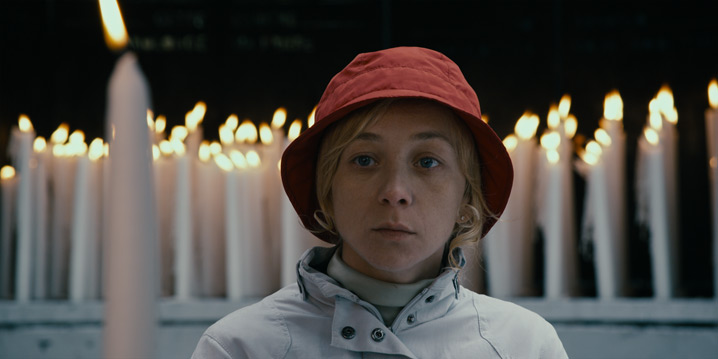
An Austrian-German-French co-production about pilgrims and/or tourists visiting Lourdes looking for miracles – probably doesn’t sound particularly appealing to most, does it? The film is definitely not for everyone, but it’s well worth checking out nevertheless, deftly mixing different themes and genres, from satire to psychological drama to a critique of the faith industry and of petty sanctimoniousness, while always feeling of one piece. Lourdes is also smart in that it doesn’t rely in any way on the viewer’s own beliefs (or lack thereof), and the performances are subtle and effective throughout. It’s the kind of film, though, where the truly interesting things go on inside the characters and remain implicit to the viewer.

A Night To Remember

Ah, Criterion — mon semblable, — mon frère! I’ve rarely gone wrong with Criterion DVDs, and the 1958 precursor to James Cameron’s Titanic didn’t disappoint either. The film makes an interesting counter-point to Cameron’s iceberg extravaganza; taking a disaster that lends itself to melodrama of the worst kind (which Titanic – the 1997 film, not the ship – indulged in some scenes, avoided in others), A Night To Remember is the more restrained, more British (for want of a better word) film, though it is exactly this restraint that makes it all the more devastating. It’s as impossible to avoid dramatic irony in filming the sinking of the Titanic as it is when referring to Mr. Lincoln’s night at the theatre, but the film doesn’t overplay its hand, nor does it go for a simplistic, smug class warfare view of 1st class passengers as parasites and steerage passengers as accented, saintly victims. Also, considering the film’s age, its effectiveness in depicting the disaster is in no way lessened by the datedness of its effects, which speaks for the quality of the directing, acting and script.

Che

I used to be a big fan of Steven Soderbergh. Starting with Out of Sight (still by far the best Elmore Leonard adaptation in my opinion, and the best use of Jennifer Lopez), I enjoyed almost every single one of his films, in terms of craft and storytelling. Yes, there were exceptions – Full Frontal comes to mind – but even slight works such as Ocean’s Eleven were examples of a director pretty much at the top of his craft. Then, probably around Ocean’s Twelve, something changed. I still liked the second cinematic méringue for its French New Wave experimental frothiness, but I started to get the impression that Soderbergh was mainly doing these films to scratch some private itch, and whenever he became aware of the audience and its wants and needs, as with Ocean’s Thirteen, there was something calculating and cynical about the films. Soderbergh, who’d always led with his intellect, seemed to have lost what heart there was in his films. I haven’t yet seen his most recent work, but Che, his two-parter about some guy on a t-shirt, failed to grab me, nor did it excite, educate, intrigue or irritate me in any way beyond the vague irritation that this Soderbergh guy used to have something to say.

Both parts of Che are beautifully shot, well acted and examples of great craftsmanship, but especially part 1 so assiduously avoids any suspicion of biopic clichés that it ends up a handsome but strangely empty variation on the theme of “What I did on my holidays”: And then Guevara went there. And then this member of his band of rebels died of a cough. And then that outpost was taken. Part 1 picks up towards the end, and part 2 benefits from the story’s more dramatic angle – if the first film is about Che’s (military) rise, the second depicts his slow, drawn-out fall – but just a bit more character, just a smidgen of story would have helped. As it is, the films feel strangely like a documentary shot by a cinematographer who wasn’t interested in much beyond how his film looks. You can do unconventional biopics and avoid the trap of facile psychoanalysis without stripping a film of personality altogether, Steven, m’kay?

Not your average assembly line heroes

As a nerd/geek since childhood, I’m a bit of an odd duck. I never read superhero comics as a kid. Asterix, yes, as well as Tintin, and for a while there I also read some of the Disney stuff, but never very avidly. The caped crusaders, men of steel, the uncanny mutants and amazing arachnid-boys, though? Nope. I was never particularly interested. Yes, I watched the occasional superhero movie and am still a fan of Burton’s Batman Returns and Nolan’s takes on the dark’n’depressed knight, I did catch most of the X-Men, Spiderman and Iron Man films at the cinema, but I never felt all that engaged. At their best they were a fun way of spending two hours, at their worst they were forgettable but had some cool special effects, but I didn’t get what would make people go and buy regular instalments of their favourite heroes’ comic series.

My first superhero comics were the more revisionist ones, Moore’s Watchmen, Miller’s The Dark Knight Returns (which I can safely say I didn’t like), later Mark Millar’s Superman: Red Son, all of which riffing to some extent on the comics that had gone before, and that I was aware of in a second-hand, “I’ve read about these…” way. The traditional superheroics, though? I wasn’t interested – unless they were written by someone whose writing I really liked. When Joss Whedon did his run on Astonishing X-Men, I bought the trade paperbacks and greatly enjoyed them, but I always put that down to Whedon doing his thing, not to anything intrinsic to comic book heroes. Same with Brian K. Vaughan’s Runaways, which reminded me a lot of Whedon’s TV work. (Ironically, I’m not a big fan of Whedon’s run on Runaways, which should have been a perfect fit but the writing was unengaging.)

What I liked about these especially – Whedon’s X-Men and Vaughan’s Runaways – was that they had characters who weren’t defined by their powers or gadgets. These were characters I’d want to spend time with even if they weren’t saving the world, beating up baddies or fighting their nemeses. And, more than that, they were about dysfunctional (surrogate) families, that old old Tolstoyan chestnut… Families that brought out the best and the worst in each other. Just like those other families in Whedon’s work, the Scoobie Gang, the crew of Serenity, even the team of Angel Investigations.

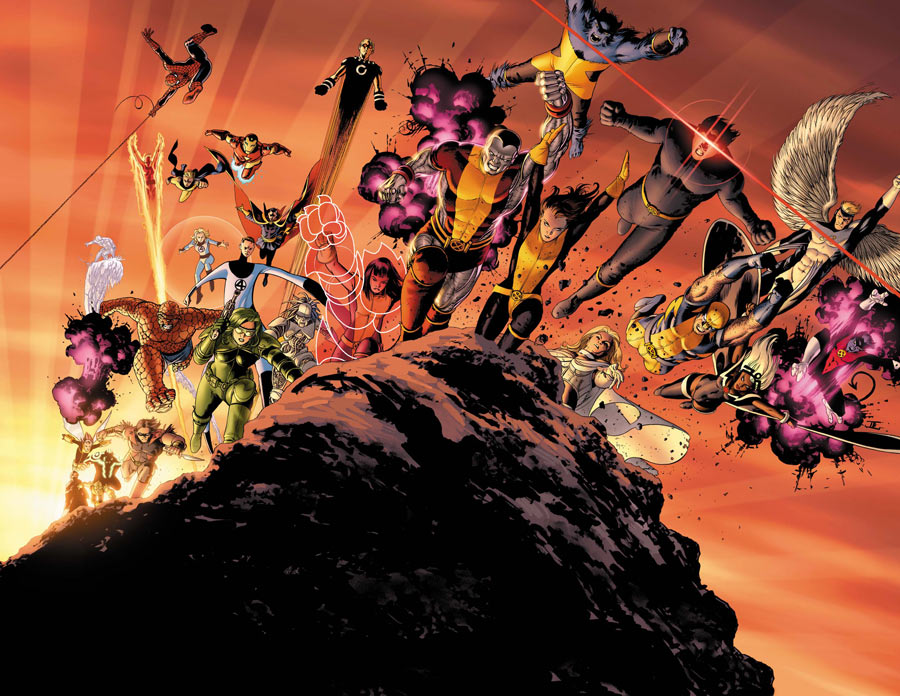
I didn’t realise that at their best, the superhero comics (at least Marvel – I have to say, I don’t know DC particularly well, although Vertigo’s Sandman is also about a dysfunctional family, of course) are exactly about that. They’re not about the BIFFs, the ZINGs and the POWs, they’re not about being able to punch someone through a mountain, climbing up vertical surfaces like a human spider or running at supersonic speed. And that’s exactly where Joss Whedon’s The Avengers took me completely by surprise. I went in thinking, “Well, I liked Iron Man, I like Mark Ruffalo and Jeremy Renner, and Scarlett Johansson is relatively easy on the eye. Perhaps Whedon will make this work.” I thought I’d probably not give a toss about Captain America (how can I, as a European pinko liberal commie of the worst kind?) or Thor (seriously, that outfit? the hammer?) or the Hulk (green, grotesque, always angry – Mr Hyde’s boring descendant, right?).

And yet, I sat in that cinema giggling with glee, whooping with joy, cheering at the heroic poses, applauding as an enormous motherfucking space serpent thing was punched in the face and went down! For the first time I realised what a joyous, potent blend these superheroics could be, and it was because Whedon made me care. I still don’t particularly need to go and watch Captain America or Thor (probably I will if it’s on TV, but I won’t go out and buy the DVDs), but watching the film’s heroes become a family, warts and all, overcoming their flaws and dysfunctions, and kicking some intergalactic ass? I get a big, goofy grin just remembering the film.

Some of my favourite bits:

  • Colour me green with surprise, but I loved the Hulk in this. More than that, I loved Ruffalo’s Banner and his Hulk. Poignant one moment, laugh-out-funny the next. “Puny god”, indeed!
  • Samuel L. Jackson’s Nick Fury wasn’t a showy role, it didn’t go for the SLJ effect (which by now has become as much of a cliché as Al Pacino’s “Hooah!” persona), but I loved the ambivalence. Yes, he’s a good guy, but he’s primarily a master manipulator. Usually these films reserve the manipulativeness for the bad guys.
  • Captain America’s joy when he finally got a cultural reference!
  • The confrontation between Loki and Black Widow. In so many ways.
  • Naked Bruce Banner and Harry Dean Stanton’s caretaker, accepting that this guy just happens to turn into a huge green monster occasionally. No big thing.
  • The moment when the Avengers finally, well, assemble. The moment is cheesy, glorious and 100% earned.

I came out of that cinema thinking, “I want to watch that film again. And again. And again. And possibly send Joss Whedon, his cast and his crew all the Swiss chocolate I can get my hands on.” I’d be lying if I said the film was perfect – it suffers from a beginning that is somewhat generic and unengaging – but I’ll say it again: The Avengers made me whoop with joy. It made me cheer at the heroic poses. This is no “good enough for its genre” flick, it’s no “well, there’ll be explosions, right?” In some ways it’s the polar opposite of Nolan’s Batman films – as good (or even better?), but doing something entirely different. I’ve seen and read the reinventions of the super hero genre. I’ve seen the revisionist takes. Only now have I seen what these stories can be, in their original form.

And I like it.

P.S.: I also like Film Crit Hulk’s take on The Avengers. The guy’s all-caps Hulk spiel takes some getting used to, and I understand that some people give up, but the guy writes well and makes intelligent points, and he cares about this stuff. Well worth checking out.

Game on, John

I’m sorry, this isn’t the promised Breaking Bad post yet – I got started on that one, but life (and exhaustion) got in the way even of mediocre writing. So, to distract you, here’s something shiny! (To my occasional guest blogger: I have an inkling that this may not be your kind of film – but hey, the trailer features John C. Reilly!)

So, for those of you whose childhood was sadly devoid of “Insert Coin” and “Press Button to Continue”, and whose dreams aren’t haunted by the WAKA-WAKA-WAKA of Pacman’s eating disorders, here’s another trailer, which is a good bit and has Christoph Waltz in it.

Here comes the rain again

Hang on, weren’t computer games about (male teenage) wish-fulfillment? Weren’t they about pretending to be overly-muscular he-men carrying weapons the size and weight of Texas, or knight templars wielding enchanted swords, or cocky, ersatzIndiana Jones explorers making sexy small talk while exploring dark tombs looking for the Whatsit of Certain Doom?

Instead I’m spending time in front of the telly running after my son, knowing I won’t get to him before something horrible happens. I spend time shaking the controller so that my overweight on-screen avatar shakes his asthma inhaler, then I press right on the analog stick so he actually takes a puff of his medication. And all the while the rain keeps pouring down.

Heavy Rain is a weird game. It’s derivative: the atmosphere is pure Seven, which is nowhere as obvious as when I visit a suspect’s apartment and the man, a religious nutter, has crucifixes hanging from his ceiling like so many Little Trees car air fresheners, and the music sounds like Howard Shore’s B-sides. The characters lack subtlety and their dialogues often clunky. There’s something almost laughable about how hard the game tries to be melancholy, weighty, tragic. And the gameplay feels like a mix between Dragon’s Lair quick-time events (press R1 now not to get knocked out by the prostitute’s choleric john!) and one of those hipster-witty, highly meta indie games mocking the usual epic dick-waving of video games by making you do utterly mundane, pointless things: yes, you can open the fridge, take out a carton of orange juice, shake it (wouldn’t want all the pulp to remain at the bottom of the juice carton!) and take a gulp, but it won’t get you any closer to finding the Origami Killer. In fact, I’m a couple of hours into Heavy Rain and most of the interaction I’m offered is of the juice-carton or asthma-inhaler shaking kind. There are important decisions (do you shoot a suspect? do you foil a robbery?), but they don’t make up the bulk of the game. Is this some weirdo wish-fulfillment for pretentious, self-aware dweebs approaching middle age – an ironic power fantasy for the disillusioned?

The thing is, though, the gameplay, allowing for actions veering between boringly banal and surreally pedantic, works in one important way: it puts you in the role of the character you’re playing in a most effective way. Heavy Rain provides the player with agency that precisely isn’t of the “I am a Jedi!” kind, which is always essentially “I am myself, but I am also invincible! Take that, 3rd grade bully who’s become an Imperial Stormtrooper!”; instead it makes it easier to slip into the skin of depressed father Ethan Mars or asthmatic private investigator Scott Shelby. It’s a bit like acting, where it can be the small actions and gestures, irrelevant to the plot, that make a character come alive – it’s the bits in between the showcase fights and high-tech investigation, between entering a suspect’s apartment and fighting off hooded intruders, that make the player empathise.

I’d hesitate to call Heavy Rain a good game. I’d definitely not want other games to copy its gameplay. But as an experiment in the potential and the limits of agency in gameplay, and in player identification, it’s fascinating. And I want such experimentation to be possible not only in small-scale indie games but also in Triple-A titles. Just like L.A. Noire, Heavy Rain may get quite a few things wrong, but what it gets right it does in ways that few other games have even attempted.

Dark is L.A. and full of terrors

When it comes to creating virtual worlds, Rockstar may just be the true heir of Origin Systems. Whether it’s the Liberty City of Grand Theft Auto 3 or GTA4, the fictionalised versions of Los Angeles, San Francisco and Las Vegas in GTA San Andreas, the boarding school and small town of Bully or the dying Old West of Red Dead Redemption, in my opinion Rockstar’s greatest creation to date.

L.A. Noire‘s sun-drenched yet crime-riddled 1950s Los Angeles is both an amazing feat and, quite possibly, Rockstar’s greatest wasted opportunity. It’s an impressive recreation, looking just like the movies, from Chinatown to L.A. Confidential – but where I enjoyed exploring San Fierro, New Austin and Liberty City, I never felt at home in this noirish L.A. In Rockstar’s other games, I’d forgo all automated options of getting around the place, I’d drive everywhere myself, just because I enjoyed hanging around in these cities. The games and their locations, they were one and the same. In L.A. Noire, though, I quickly started to ask my partner to do all the driving. In spite of the game’s title the place itself, Los Angeles, is a mere backdrop – and as it’s rarely integrated well into the game, it feels like an elaborate loading screen, or like a technically impressive but essentially lifeless cardboard backdrop – like The Truman Show‘s Sunhaven, and I was the unwitting Truman stuck there.

Unfortunately, L.A. Noire is full of wasted opportunities. The writing is great, as is most of the (voice) acting, but the game’s signature motion-capture technology veers into Uncanny Valley as often as it succeeds at bringing its characters to life.

The occasional disconnect between the characters’ faces and their bodies is one thing; another is that L.A. Noire doesn’t do photo-realism, doesn’t try to, so the animations, realistic down to the imperfections of involuntary twitches, don’t gel with the more stylised look. It doesn’t matter whether the latter is due to technical limitations – the result, while often impressive, does pull its audience out of the moment too often.

L.A. Noire could have managed to pull everything together with its gameplay, but alas, that’s another strike against the game. It’s not so much that it plays badly – what hurts L.A. Noire is that as a game it is bland. Rockstar’s other titles tend to be generous to a fault in the gameplay department, where you might get new elements introduced two thirds into a game’s plot. In its ’50s crime-and-punishment saga you’ll be doing pretty much the same from the first case you’re working to the last. Here a foot chase, there a car pursuit – and the game’s signature interrogations suffer from a lack of internal logic (seriously, guys, at times the choice between Doubt and Lie seems to have been down to a coin-toss).

In spite of all this, though, I’d be lying if I claimed that L.A. Noire didn’t have its compelling moments. As you progress from the first crime desk (Traffic) to the second (Homicide), the single cases start to connect, and the story ties in cleverly with the Black Dahlia murder. As the plot begins to cohere, the characters become more interesting, and the protagonist Cole Phelbs, while rarely likeable, turns into one of Rockstar’s trademark flawed anti-heroes. By the game’s ending, I felt for the guy and his messed-up issues.

In the end, L.A. Noire is a weak game with strong elements – and for a Rockstar game, it’s a failure. It’s a fascinating failure, though, and I’m curious to see how its experiments and assets – the motion-captured acting, the story structure, the ‘real’ location – pay off in future titles by the developer. Grand Theft Auto V will again be set in Los Santos, Rockstar’s earlier take on LA; I, for one, wouldn’t mind seeing L.A. Noire‘s fingerprints on it.