Le retour du sous titre

You know what’s almost as bad as not having any subtitles in a series of films filled by mumbling Yorkshiremen? (Note that in the meantime a friend’s lent me the German edition of Red Riding, which features subtitles along with the English audio track. Blessings upon their Teutonic heads!) Buying a DVD that advertises, right on the back, subtitles in every language under the sun, or at least in English, German, French, Russian and a fair number of other languages – but then the actual DVD bears little resemblance with what’s promised on the box.

Other than featuring Andrei Tarkovsky’s enigmatic Stalker, that is. I’ve been interested in the film for, oh, about 15 years now, ever since a friend mentioned to me that it’s one of his favourite movies. My interest was piqued even more when I played the Stalker games, although they’re based less on the movie than on the novel Roadside Picnic (and ironically, while the games are relatively thoughtful, they still look like an ’80s action movie next to Tarkovsky’s film). I ordered the DVD on Amazon.fr ages ago – precisely because the edition promised subtitles in lots of different languages – but only got around to seeing the film now.

First impression: man, my French sucks. I was never very good at it, but after letting what ability I had rust for 15 years I understood perhaps 40% of what was being said. (Or rather, 40% of the subtitles; I understood even less of the Russian dialogue, although I did understand “бутерброд”!)

Second impression: even if I understand fairly little and the film is extremely slow – there’s something eminently compelling to Tarkovsky’s style. Even more than Solaris (which suffered somewhat from being set in an outdated future, the fate of so much sci-fi) Stalker is hypnotic… and gorgeous to look at. It is atmospheric without going for any of the predictable tools of atmospheric film makers. The world of Stalker is ominous and eerie, yet at the same time naturalistic, creating an effect I haven’t seen in any other film. There’s something almost documentary in its visuals, yet there’s a dream-like quality – and it’s this seeming contradiction, this tension, that is utterly fascinating.

More than that, perhaps it helps to see the film in a language I don’t fully understand. Films that are put in the ‘art film’ box tend to have a certain portentous, somewhat affectated quality to them; as much as I like Bergman, for instance, a number of his films have a certain self-aware heaviness that can be more alienating than is necessary. Perhaps Tarkovsky’s work has this same quality if the viewer understands the dialogues enough to realise that they’re unintelligible – but my impression was that while the world and themes of the film are portentous, the characters feel real. Not 100% and not all the time, but they’re more than just vehicles for themes.

In the end, though, I can really only judge Stalker as a visual experience until I’ve rewatched it (after a French refresher, perhaps), and on those terms alone it’s well worth seeing. Even if there’s a relative scarcity of Ukranian mercenaries, radioactive mutants and frantic gunfights.
But if I get my hands on the people responsible for that mendacious DVD edition, je m’occupe de vos miches à la médiévale!

To the North – where we mumble as we bloody want!

I’m torn on the subject of subtitles. Of course I like to know what’s being said in films, but often the sound mix favours things other than what is spoken, added to which not every actor enunciates like Sir Ian McKellen. (Though that would be funny; imagine The Wire‘s McNulty intoning “What the fuck did I do?” in that marvellously fruity RSC drawl.) But a) when I’m looking at subtitles, I’m not looking at the actors, and b) so many subtitles don’t discriminate – what is whispered and is supposed to be hardly intelligible is usually presented as crisply as what is spoken clearly. Subtitles – the great leveller of dialogue. (Still – vastly preferable to dubs in 99.9% of all cases, though that’s a different discussion.) There are times when I prefer not to understand everything to having every single word spelled out for me in big frickin’ letters.

And then comes along Red Riding, a Channel 4 produced trilogy of films about murders and police corruption. A beautifully produced series of movies, gorgeous to look at, feeling like someone had taken the best elements of David Fincher’s Zodiac and James Elroy’s L.A. Confidential and put them together. Gritty, dark, complex, compelling.

And then those Yorkshire coppers and criminals open their mouths… and out comes – what? Strange vowel sounds. The occasional half-strangled consonant. Words that sound like the H.P. Lovecraftian equivalent of English spoken through snaggle-toothed, monstrous teeth and lips. Honestly, I was under the impression that ‘oop North’ it was all “All right, luv!”, but I thought they still spoke a recognisable form of English!

And these films live off their dialogue. The intricate plots within plots, the conspiracies and betrayals, are conveyed by speech… and half the time I have no idea whether the characters are talking or expelling phlegm from their throats! To be fair, the second of the three films – 1980, following 1974 – is easier to understand, not least because the worst offenders against clear speech are killed horribly in the first film. But still – even for native speakers of the language, I doubt that understanding those Yorkshiremen and their dark, corrupt doings comes easily.

So, what better than to activate the subtitles. To understand what people are saying. Bliss… except the DVD doesn’t feature subtitles. I can choose between Dolby 2.0 and Dolby 5.1 – but subtitles? Something that would actually help me understand what is going on? Something that would allow me to answer questions of the “So, explain this to me: what the bleep is going on?” kind with some sort of authority. But no – I have a lovely sound system, and all the good it does to me in this case is this: it allows me to hear the unintelligible noises with perfect, hifi quality. Thanks a bunch.

Note to self: next time, check out the German DVD edition after all. Perhaps they’re kind and wish their foreign audiences to know what’s going on. Because, let’s face it: bugger those Southerners if they can’t be bothered to live in Yorkshire!

P.S.: There’s something wrong when Peter Mullan is more easily understood than half the rest of the cast.

No more gifts from Mr Soze

By now most people will already have heard, but on 2 January 2011 Pete Postlethwaite died. He’s never been one of the big stars, but he was undoubtedly a great actor, with a presence and gravitas that made so many of his roles – even in bad films, and he definitely had those – worth watching. I first noticed him in The Usual Suspects, where he was the improbably named Kobayashi (with an even more improbable accent – which the dimwits at Empire magazine voted the ninth worst movie accent, completely failing to understand what was going on in the movie). Not many people could make the line “I may only castrate your nephew, Mr McManus” work as he did.

After that, he started popping up in a number of films (usually ones I caught a while after they’d been on at the cinema), and the moments he was on screen were usually among the best scenes in those films. He was a great Father Laurence in Baz Luhrman’s Romeo + Juliet, showing the kids how to do Shakespeare; and of course he was the heart at the centre of Brassed Off:

I didn’t necessarily go to see a film because of Postlethwaite, but I definitely enjoyed films more if he showed up. I will miss seeing his rough face, his gravelly voice. Pete Postlethwaite, films are poorer for having lost you.

You cannot be series!

It’s that time of year. No, not Christmas (which this is too late for anyway), not the end of one year and the beginning of another.

It’s time for a new series.

Within a short period we finished Carnivale and got to the end of the current (well, for Swiss standards) seasons of Fringe, True Blood and House. (The latter, while still blessed with a great main actor, should slowly be put out of its misery, mind you.) So, what were we to watch next? Mad Men? The Shield? I, Claudius?

What we went for instead: the grandpappy of the HBO series that I’ve gone on about at great and boring length before. Not the grandmother, Sex & the City, because the moment I start watching that series you may want to look out the window for four guys on horses. No, I’m talking about the testosterone-riddled Oz. Looking at the setting and cast, it very much looks like an audition for later series such as The Sopranos (hi, Edie!) or The Wire (seriously, does Bodie only come with a single change of clothes that he takes along to every series he does?). Like many of these other series, Oz takes something that is relatively high concept and sees what it can do with it. In this case, the concept is: let’s do a high-security prison series that isn’t about trying to escape and that doesn’t outstay its welcome three episodes into season 1.

Make no mistake: this is no Prison Break. This isn’t pulpy escapism with the occasional white supremacist of imprisoned mobster thrown in for light relief. It’s grandly operatic drama with shower rapes, murder and ethical dilemmas. It’s also strangely Spike Lee; perhaps it’s the racial tensions that feel a bit like a ’90s update of Do the Right Thing, but mainly it’s the directorial flourishes, camera and lighting work, and the stylised elements – especially the Greek chorus-type soliloquies provided by Harold Perrineau Jr.’s character (with Waaaaaaalt! barely a twinkle in his fresh-from-Romeo & Juliet eyes).

It’s also these soliloquies that are most responsible for me not taking to the series as immediately as I took to a lot of other HBO fare. Again, like Spike Lee, though at his worst, the speeches are often too on-the-nose and too smugly enamoured of their cleverness (which they aren’t – often they belabour the obvious) that they feel like a 21-year old film student’s “Wouldn’t it be artistic if…?” at 2am in the morning after lots of cheap red wine and Foucault.

Having said that, while we cringe at some of the series’ moments, we’re in it for the duration – not least because I’ve got the complete set. The material’s definitely interesting, and I’m happy to give Oz a chance to drop its self-conscious ‘tude and become more confident with what it’s doing and how it’s doing it. Who knows, it may even get to join the pantheon of those HBO greats by the end of the final season.

Well, if it doesn’t, at least it isn’t stuck on constant reruns of the same episode, with only the faces and the names of syndromes changing, or eager to do the tired, old “Will they, won’t they?” spiel. I bet I’m not the only one who wishes, in the case of certain other series, that it were lupus. The terminal kind.

Another Rather Lovely Thing

Remember me going on repeatedly and at great length about last year’s film The Assassination of Jesse James by the Coward Robert Ford? Well, I’m happy to say that this may give the film some attention, which it definitely deserves – although from a very odd direction. Animator Edmund Earle did a beautiful, surreal take on the upcoming Yogi Bear film (which may be almost as obnoxious as the recent Alvin and the Chipmunks movies), recasting Brad Pitt’s Jesse James and Casey Affleck’s Bob Ford with Yogi and Booboo. Earle has no affiliation with the Yogi Bear movie and seems to have created this beautifully animated short in his spare time, which should get him the admiration of geeks, nerds and filmaficionados everywhere.

Read this for details: http://blogs.wsj.com/speakeasy/2010/12/13/yogi-bear-alternate-ending-booboo-kills-yogi-parody-video-creator-speaks/

P.S.: A special Christmas prize may just go out to the first person who ‘gets’ the reference in this blog entry’s title…

Are we Lost yet?

Yes, once again I’m months behind the real world – but opinions that are full of themselves never go past their sell-by dates! Remember when everyone was talking about that final episode of Lost? Well, they’ve now shown it in Switzerland, so here I am, ready to put forward my opinion at a point when no one’s interested anymore.

A lot has happened since Lost began – and I’m not talking only in terms of polar bear attacks, electromagnetic incidents and casual time travel. Things in my life have changed in certain fairly fundamental ways, and some of my attachment to Lost comes from associating the series with some of these changes. I’ve mostly enjoyed the series, even at its most convoluted moments, in spite of getting annoyed as hell with characters such as Shannon, Boone or Charlie. (At least the series lost its knack of making these characters worthwhile only in time to kill them off.) I was even intrigued when the series stepped up its metaphysical Überbau by introducing the ancient fratricidal conflict between Jacob, the manipulative quasi-deity of the island who’d been ‘touching’ several of the Losties since they were children, and his smokin’ Cainesque brother, Dwight. (Okay, that’s not his name, but the writers were being just a tad too cute when they did their “I only came up with one name!” in-joke.)

When they introduced their flash sideways, with intriguing glimpses of a world where the Losties hadn’t become lost, where the island was at the bottom of the ocean, I was fascinated – at first, that is. I was curious: was this parallel existence the result of the bomb exploding at the end of season 5? Was it the world Smokey (sorry, make that Dwight) was trying to escape to – or was it a world in which he’d escaped the island and Jacob’s words about how this would destroy everything had proven so much, well, smoke and mirrors?

But then the writers fell back onto their old tricks: when in doubt, introduce new ambiguous antagonists (call them Yet Other Others), make the characters re-evaluate their allegiances and have your cast trek from one side of the island to the other. The problem with those tricks is mainly that of diminishing returns: do we care about yet another group of strange people who speak in riddles (the temple dudes or Widmore’s merry men and annoying woman)? Also, if we don’t know what either side in a cosmic conflict really is about, what does it matter whether Jack’s on one side or Sawyer’s on another? And yes, the island backgrop is nice to look at, but after six seasons even that has lost its initial charm.

In the end, this isn’t the major problem with season 6 and the series ending, though. Every season of Lost had its share of filler material that would have benefitted massively from tightening the story. The problem was this: the ending – in fact, both endings, the island storyline and the “is this heaven? – It’s Los Angeles.” metaphysics-for-the-21st-century one – rendered most of the six years irrelevant. The hatch, the numbers, the polar bears, the Others, the Dharma Initiative, Widmore, time travel, basically anything… It didn’t matter for either ending. And it’s no excuse to say, “It’s all about the characters, stupid!” – least of all if you’re writing a series that, week for week, was driven by the WTF?! question. What the fuck was that polar bear doing there? What the fuck is down that hatch? what the fuck is up with those numbers? Yes, you had nice flashbacks fleshing out the characters, but that doesn’t make the series about the characters – because, let’s be honest, would we have watched the series for six years if it hadn’t been for all the weird shit going down? Would we have sat through more than one Jack or Kate episode without them dangling the answer to some of our questions at least in front of our noses?

The series tried to make the finale not only big and loud (betrayals! fights to the death! Star Wars references!) but also meaningful in some ill-defined spiritual way, but the longer the season went on, the less it was able to answer the “So what?” question – in the end the only question that matters in entertainment. Obviously it’s an unfair question, because it can be asked of anything, and in the end no stories are necessary – but that’s where, as storytellers and entertainers, you have to keep the audience interested and distracted enough so they never feel like asking the question in the first place.

To be fair, the final episode had its share of emotional moments. I enjoyed it while I was watching it, and yes, I did feel moved by Sun and Jin’s moment of revelation at the hospital, or by Hurley’s realisation that the weight of Jacobhood was going to be placed on his shoulders. But with every new burst of flashback-revelation, with every montage of people falling in love, giving birth or staring down holes on the island, our old friend, Diminishing Returns (Dimi to his mates), struck – and by the end of it, what struck me were two things: a) how quickly the sideways universe unravels if you think about it too much and b) how little it ties back to what we’ve been watching since the beginning. It was a story that didn’t need the island – and that made the series as a whole ever so slightly pointless. Basically we got an ending that said: “You know, everything you’ve been watching over the last couple of years? You enjoyed it, right? Well, beyond featuring the same characters it’s pretty much unimportant to this story we’re telling about the afterlife.” The characters weren’t in sideways LA because they had been on the island, because of Jacob and Dwight, or because of the nuclear bomb. They were there because they all had, at some point or other, died. Their island adventures were pretty much incidental to that whole storyline – all that mattered was that they had met and played important parts in each others lives.

If a series’ ending tells us that, in the end, almost everything leading up to it is irrelevant, we’re in a bit of a quandary: do we dislike the ending, reject what it seems to imply and remember the series for the bits we enjoyed? Or do we embrace the ending and in the process come to realise that the series has more or less rendered itself pointless?

And for old time’s sake, I’ll end this blog entry without answering any of those questions. Cue credits!

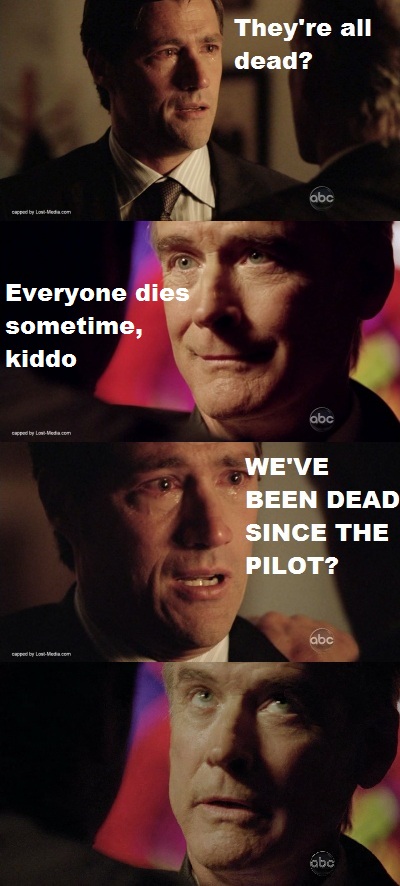
P.S.: I love this reply to some of the misunderstandings of the final episode:

Fringe dwellers

Remember the old days, when Lost was one of my favorite non-HBO TV series, a tasty snack in between the substantial but demanding Sopranos, The Wire or Deadwood? And Fringe was basically an X-Files knockoff for the 21st century – fun enough, but flimsy and without much of a voice of its own apart from having a gooey, gorey imagination?

Well, we’re now watching the final season of Lost on TV (Switzerland may have the cheese, chocolates and watches, but we get TV series late since everything has to be dubbed), and I’m afraid I’ve lost most of my interest. Sideways universe, shmideways universe, added to which I have pretty much had my fill of Jack, Kate et al. Yes, they obviously know where they want to take the series for the finale, but so many of the answers we get for the mysteries built up in the previous five seasons are banal, boring and not particularly convincing. Case in point: how did the Black Rock end up in the middle of the jungle? Big wave. Never mind that it smashed into a gigantic statue hard enough to smash the statue, but the ship’s still mostly, well, ship-shape.

But no, the series writers tell us, Lost is not about the mysteries – it’s about the characters! Obviously! I mean, it’s not as if the series’ main driver was that what kept the series going was questions like: What is the hatch? What are the numbers? What is the black smoke? Who are the others? Yes, Lost also spent a lot of time on its characters, especially in the flashbacks (and flash-forwards, flash-sideways and quite possible flash-upside-downs), but the impetus always, always came from the mysteries.

Fringe, on the other hand… It’s still frivolous entertainment, and like so many US series it suffers from the need to do 20+ episodes per season, but they’ve definitely shifted the overall mythology up a gear or two. They’ve become much more confident with their storytelling, to the point where they play with the format and the audience in delightful ways. To give just one example, consider the usual intro of the series:

… and now check out the intro they did for one episode set roughly 30 years earlier:

There’s a winking self-awareness that Lost has, well, lost if it ever had it (well, perhaps in “Exposé”, Nikki and Paolo’s final episode). There’s an awareness that this is silly stuff, but let’s just roll with it. And most of all, while the mythology is being built into something riveting and surprisingly poignant, it is never as convoluted as Lost has become. For all the heavy-duty plotting in Fringe, it’s the characters that keep the weirdness grounded – and enjoyable. Bring on season 3 of Fringe, and finally bring Lost to an end, so we can go back to remembering its early days when it was fresh and exciting.

Eagles on Pogo Sticks likes this.

Yesterday evening, before we went to the cinema, we were discussing David Fincher’s other films. Which did we like best? Which least? I came up with my personal Top Three films directed by Fincher (in no particular order): Seven, Fight Club and Zodiac, with Alien 3 receiving special mention. (It’s flawed but the bits that I like I pretty much love.) Seven is probably the moodiest of his films, Fight Club the most enjoyable and Zodiac is perhaps the most perfectly crafted Fincher film.

Since yesterday evening, I’ve added The Social Network to the Top Three (which therefore contains four titles now, risking a possible world-destroying mathematical paradox), albeit on probation. Will I still like it that much in a week’s time? In a year? Once I’ve seen it as often as the other films? (Zodiac I’ve only seen three times so far, but Seven was my film for bad moods for a while when I was often in a bad mood.) We’ll see, but for now I would say this: it’s Fincher at the top of his game (Ebert rightly calls the movie “splendidly well made”), working with a script that complements his considerable skills. This makes for an interesting comparison: The Curious Case of Benjamin Button was decried by some because that film’s script pulled it in the direction of a mawkish sibling to Forrest Gump (scripted by the same writer, Eric Roth, not to be confused with Eli Roth). I thought that Fincher’s cerebral approach made for a fascinating film that was pulled in two different directions, namely sentimentality on the one hand (script) and a weird sort of Verfremdung on the other (direction), resulting in a tension that didn’t always work in the film’s favour.

Aaron Sorkin’s script for The Social Network, though, is sharp and witty, with little trace of mawkishness. It’s not cold or unemotional in any way, but it doesn’t do the Spielbergian brand of emotion that requires heartwarming performances and a John Williams soundtrack so obvious it makes you feel a little queasy because the sentiment is laid on so thick. The film thrives on repartee and verbal barbs that is delivered at breakneck speed – I’ve rarely seen a movie that is so dialogue-driven and feels this fast (though not rushed).

I’ve seen TV series like this, though, especially one little known one about the president of some far away country. I think it’s called… let me see… The West Wing? Which, coincidentally, was also written by one Aaron Sorkin. Having watched the first four seasons of The West Wing (the ones during Sorkin’s time at the helm of the series), I find The Social Network‘s fictionalised Mark Zuckerberg a dark twin of Josh Lyman, deputy chief of staff to President Bartlet. Lyman is more likeable because he’s got a strong sense of ideals and ethics, but he shares so many qualities with Zuckerberg: the sense of intellectual superiority that goes hand in hand with deep-seated insecurity, the way that every conversation is seen as a battle, the intense need to win, to be right, even if it means being a dick to others – the atrophied social skills and emotional immaturity that is fun to watch with Josh because he works in an environment and with people that ground him every now and then.

While the origin story for Fincher and Sorkin’s version of the Facebook founder is perhaps too simple – Zuckerberg basically gets started on the road to Facebook because of the Girl That Got Away, throwing his social dysfunction right back in his face – it makes for an interesting foil with Josh Lyman. Without his Girl Friday, Donna Moss, would he become increasingly insufferable as Zuckerberg does, ending up a sad, pathetic geek with a brilliant mind?