It is all an illusion

Chances are that most of you (“you” being my real or imaginary readers – for all I know all of this blog’s visitors are advertising bots) won’t get a chance to see Sylvain Chomet’s L’Illusionniste, his first animated film after Les Triplettes de Belleville at the cinema. If you do get the chance, take it: there’s an additional layer of magic to seeing the film at a movie theatre, ideally one with red velvet curtains and comfy seats.

L’Illusionniste is a rare beast, a non-computer generated (although many scenes definitely received some help from the digital brush), non-3D animated film aimed primarily at an audience over the age of 12. (You won’t see L’Illusionniste lunchboxes at the shops.) It is also about a rare beast threatened by extinction: the old-fashioned, cabaret-type entertainer, in this case a stage magician. The film is set during the ’60s, at a time when the eponymous illusionist, like his fellow artists, clowns, acrobats and ventriloquists, has all but been replaced by proto-boy bands and electric Wurlitzers. (These days we’re nostalgic about the latter, even.)

The movie’s plot is of a crystalline simplicity and there are few if any surprises. The ageing illusionist, searching for the increasingly rare show he can do here and there, finds himself performing on the Hebrides, where his magic and old-school manners charm a young girl working as a cleaner. When his engagement is over, he heads for the mainland, and she follows him. The two settle in Edinburgh where he finds that his bagic has been too convincing: in order to keep the girl charmed, he provides her with more illusions, more magic – a pair of lovely shoes here, an elegant coat and Audrey Hepburn-type dress there. Except, of course, this sort of magic can’t be spirited from top hats or people’s ears, so the illusionist has to take on one deadening job after another to keep the girl in gifts. His increasing absence from her life, which he never explains to her, leads to her finding magic in another man instead, a handsome young beau, and the disillusioned illusionist moves out one day while she’s gone, leaving a card: “Magicians do not exist.”

And that summarises the film’s intriguing tension: magicians don’t exist, it is all a charming illusion, the penny in your ear comes out of the magician’s sleeve or palm, cleverly hidden, and the fat, belligerent rabbit was in the hat all along. And yet, and yet… The film, like its sad hero, is all about the charm of illusion, it magics us away to a time and place that is better, more charming than reality. It creates people that never existed, an Edinburgh that never was, and its touches of the real – the film idealises but does not Disneyfy – only add to the spell.

At the end, the illusionist acknowledges that there is no such thing as magic, and pretending that there is creates false expectations, hope and illusions of the dangerous kind: the shimmering red shoes, the beautiful dress, even the crayon miraculously regrown after it had been worn to a stump, act as gateway illusions. He is right: magicians do not exist. The film shows this – in 70 minutes of beautiful, touching magic.

East meets West, multipy by seven

Seven Samurai is probably the Kurosawa film that is most immediately enjoyable by Western audiences. The Japanese director has rarely been as culturally specific in his work as some of his compatriot film makers, finding inspiration in Hollywood westerns, and what is probably his best known film requires little in the way of cultural knowledge from audiences mostly ignorant of Japanese culture and history. (Hey, everything I know about Japan I learnt from Richard Chamberlain and Shogun!)

Which didn’t stop Hollywood director John Sturges from making a Western (in both senses of the word) remake of the film, The Magnificent Seven. Samurai (or, more accurately, ronin) become gunslingers, Japanese villagers become Mexican peasants, but the film remains largely unchanged in its broad strokes. It is perhaps more immediately iconic to Western audiences, featuring stars such as Yul Brynner, Steve McQueen, Charles Bronson and James Coburn (the film feels like a The Great Escape (p)reunion at times, also sharing director and composer with the POW classic), but in terms of changes it is relatively restrained.

There are perhaps three major differences, though. The first of these is the leader of the bandits, portrayed by Eli Wallach. He has no counterpart in Kurosawa’s film and serves as an intriguing counterpoint to the gunslingers, a charismatic “There but for the grace of God” commentary on the heroes. The second, stronger change, is how the youngest, most inexperienced of the samurai and Toshiro Mifune’s peasant posing as a samurai, perhaps the actor and director’s most indelible creation, are conflated into one character in Sturges’ film, a mere boy of a gunslinger played by Horst Buchholz. While combining the two characters into one may work in theory, Buchholz is no Mifune; he manages the fanboyish kid who goes all googly-eyed over the larger-than-life heroes much better than the bumbling, cheeky but eventually most tragic character of the seven.

The change that weighs most in my mind, though, is this: in Kurosawa’s film, we believe that the time of the samurai, of sword fights and strictly regulated chivalry has come to and end. The ronintake the job of protecting the villagers because there isn’t anything else for them. As skilled as they are at what they do, they’re essentially relics of a bygone age.Brynner, Coburn, Bronson and especially McQueen are first and foremost stars. They give lip service to the passing of an era, but Brynner’s lines – “Only the farmers won. We lost. We always lose.” – ring false coming from him, the self-awareness sounds phony. The Magnificent Seven is magnificently entertaining and, but it doesn’t pull off the sadness that accompanied the rollicking adventure in Kurosawa’s original.

But boy, how does Steve McQueen manage to have the worst haircuts and still be so eminently sexy? Add him to the list topped by Alexander Skarsgard. (Don’t know what I mean? Watch Generation Kill with a staunchly heterosexual male, get him drunk and then ask him what he thinks of Skarsgard.)

In a world…

Alien. Comedian. Magnolia. Psycho. What do these films have in common, other than snappy, one-word titles?

The Onion‘s A.V. Club knows: Coming-attraction attractions: 24 movie trailers that function as standalone works of art. Worth checking out, not least because of gems such as its description of Magnolia as “a sprawling, awkward, almost brutally sincere film”.

Talking of which, I do love that trailer:

P.S.: Was I the only kid who had sort of an older-woman crush on Melinda Dillon after watching Close Encounters of the Third Kind and A Christmas Story?

True West

I’ve made a couple of posts on the subject of games, films, art, yadda yadda yadda. Boring stuff, and anyway, who cares whether Roger Ebert knows a gamepad from a Wiimote?

Rockstar, the makers of the infamous Grand Theft Auto series, take a strange position in the whole game/film argument. There are few games that borrow as liberally, and as successfully, from the movies and from TV as Rockstar’s. This has never been as obvious as in their latest, Red Dead Redemption, which is in equal measures Once Upon a Time in the West and Deadwood. The ghost of Sergio Leone haunts the game’s arid landscapes. I’ve rarely seen as effective and evocative an interpretation of the West as the one Rockstar have conjured up. Yet their games never become that most frustrating of hybrids, the interactive movie. They are both grandly cinematic and great games.

More than anything else, Rockstar excels at creating worlds to explore that feel alive: the faux ’80s Miami of GTA: Vice City, the parallel LA, San Francisco and Las Vegas of San Andreas and the not-quite-NY that is Liberty City.

None of these measure up to the accomplishment of Red Dead Redemption, however. I’ve played the game for five to ten hours, and in terms of gameplay it’s nothing revolutionary – missions here, duels there, horse riding, cow herding and poker minigames elsewhere – but it creates a sense of place that is simply amazing, as the video of the game’s time-lapse day/night cycle shows:

John Hillcoat, director of Australian neo-western The Proposition and the film adaptation of Cormac McCarthy’s The Road, was asked to direct a short film using footage from the game – possibly a gimmicky way of advertising its release, but one that’s pretty gutsy, speaking not only of Rockstar’s confidence in their creation but also in their chosen medium. Is Hillcoat’s half-hour take on Red Dead Redemption an overly idealistic barrage in the Great Movie/Videogame War of the ’00s? Is it just something to do in between directing grim, gritty and depressing movies? Judge for yourselves.

Dream a little dream

Inception. One of the coolest, smartest action flicks this side of The Dark Knight. A fun, brainy conundrum for those who prefer a bit of smarts in their big-budget entertainment.

And the source of some truly weird YouTubes.

Remember a year ago, when I posted about Psychonauts, a computer game that’s the bastard offspring of Tim Burton (when he was still good) and Terry Gilliam, where you explore psyches made real, tangible and pretty frickin’ weird locations? Well, this mash-up is beautifully executed and works disturbingly well:

Want to see (or rather hear) something weirder, though?

Reminds me of watching The Wire with my girlfriend and the two of us intoning the ending music. Good times.

P.S.: Next entry’s going to be more of a proper blog entry, with more than one sentence before there’s a picture or a YouTube video. Promise!

On getting old and soft

I used to like a good, dark, depressing ending. I used to watch Seven as a feelgood movie. I used to think that Brazil‘s ending was actually as close as possible to a happy ending, given the situation Sam Lowry’s in. (I still think that.)

I don’t know what exactly has changed, but this seems to be an older, gentler me… who actually likes films not to end on a note of utter despair. They can still be pretty dark – but please, please, please, don’t think you need to bring about the complete and utter destruction of mankind, at least in Europe, Africa and Asia to make me enjoy a film. Killing most of the population of Britain’s horrible enough; you don’t actually need to top that one. It’s overkill. Haha. Erm.

Yes, we watched 28 Weeks Later, thanks to the kind programming people at Film4. The film’s actually surprisingly good, well filmed and cast, taking the premise and ending of Danny Boyle’s 28 Days Later further in intelligent ways. It isn’t a necessary, as far as sequels are concerned, nor does it manage to be as disconcertingly lyrical and moving as the first film is at its best, but it’s a smart, scary, effective horror film.

But it doesn’t half heap up the dreariness at the end. It’s not enough that kiddo is infected. It’s not enough that all the good guys die in various horrible ways: clubbed to death by Robert Carlyle, burnt alive by US soldiers (hey, at least Jeremy Renner got to come back and defuse bombs in Iraq, which has got to beat being fried by your own guys in the process of a zombie apocalypse), having your eyes squeezed into your skull by the hubbie who left you to be eaten by the Infected. Life in post-apocalyptic Britain isn’t pleasant to begin with… so do we really need to end on dozens of Rage-infected Frenchmen running towards the Eiffel Tower, most likely after having had a good nosh on us?

It’s totally silly, I know – but I appreciated that there was a note of hope at the end of 28 Days Later. It wasn’t a happy ending by any means, what with most of England dead and gnawed on, but at least it could get better. Ending on “You thought there was hope? Nope, unless hope in your books means, ‘Well, the Frenchies get killed too! Haha!'”? Now that’s just plain mean.

P.S.: Something Awful tends to have lots of crap jokes, but their most recent Photoshop Phriday produced this thing of rare beauty:

You know, for kids!

Alice in Wonderland (and its sort-of-sequel, Through the Looking Glass) is an odd book, and my memory of it is just as odd. I can remember liking it, but when I try to remember the book, what comes to mind is John Tenniel’s illustrations, images from the Disney movie, scenes from Jan Svankmajer’s surrealist dream/nightmare – or, more recently, American McGee’s Alice with its twisted, dark Wonderland and music by Chris Vrenna.

Anything, but not the actual Alice in Wonderland. The original has become a sort of collection of memes: the Mad Hatter, the Cheshire Cat, the Jabberwocky. It’s a hypotext whose influence throughout literature, cinema, comic books, video games etc. is strong, but Alice itself has become distorted and murky behind all the copies, pastiches and parodies.

Tim Burton’s most recent film is called Alice in Wonderland, but it’s less of a direct adaptation than a hodgepodge of half-digested ideas and images from over 100 years of Aliceology. Like most of Burton’s films, it looks gorgeous, but like too many of his recent movies it feels like warmed-over Burton, down to the Danny Elfman score. The visuals are admittedly cool (and I have to admit that I watched the film on a BA transatlantic flight – small, fuzzy screens aren’t the best way to appreciate a Tim Burton film), with some fantastic character design, but the plot is predictable, the dialogues leaden and most of the acting vanishes behind the CGI. It’s as if Burton was given a beautifully surreal world but basically decided to tell Generic Fantasy Story X in this world. Despotic ruler, check. Chosen one, check. Needs to discover her powers and believe in herself, check. Special blade, check.

It’s a shame that such a creative, talented cast and crew could have come up with something that combines Lewis Carroll’s original story and Tim Burton’s sensitivities in weird and wonderful ways – but Burton’s sensitivities at this point seem to be a pale shadow of his earlier creativity. Worst of all, the man seems to have gotten old the way that Steven Spielberg has gotten old, meaning that in creating something that should burst with childlike energy and wonder, he’s come up with something that feels like a director in a midlife-crisis trying to pander to what he thinks is youthful and energetic. The worst example of this is the dreadful dance the Mad Hatter does towards the end of the film: even Johnny Depp with his considerable talent and charm can’t make it into anything other than an awkward attempt by the film to be ‘cool’ and contemporary.

Anyway, enough about Alice in Wonderland. I may get back to my 12 hours of blurry free films at a later date, but for now I want to leave you with this strange, strange video telling the Complete History of the Soviet Union through the lens of Tetris:

Seeing through the eyes of a gamer – and an announcement

There are some games that, while I’m playing them, change the way I look at the world around me. I remember times spent playing real-time strategy where in my mind’s eye I’d draw selection boxes around the people I’d see, or around a herd of sheep, and I’d plan out strategies of where to send these people to do my bidding. (I was young and silly at the time.) Or, when I was a teenager and had to bike to school, I’d see everything through the lens of the X-Wing and TIE Fighter games, zooming down the deathstar trench and evading incoming laser fire. Yes, I was and still am a geek.

One of the games I’ve been playing a lot of lately, Assassin’s Creed II, has definitely taken hold of my visual cortex – not least because of where I live. Check out these videos from the first and second Assassin’s Creed games, taking place in medieval Acre and Renaissance Venice respectively:

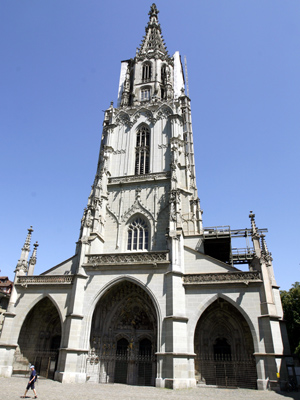
Living in Bern, I can’t help looking at the 17th and 18th century architecture and thinking, “Hmm… If I jumped up there and grabbed that ledge, then pulled myself up there and did a leap over to the other side… and the spire at the top should give me a great vantage point from which to plan my next assassination.” (Note: by ‘assassination’, I mean ‘shopping spree’. Or ‘cuddly kitten’. Or something else that’s inoffensive and doesn’t make me sound like a psycho.) Frankly, though, I think there’s only a slim chance that Assassin’s Creed III will feature the best of Swiss sandstone architecture – although Swiss banking would fit in nicely with Assassin’s Creed‘s conspiracy storyline.

More importantly than my geek musings, though, I’ve got an announcement to make that’s been a long time coming: a friend of mine will be posting book reviews on Eagles on Pogo Sticks. I asked him ages ago but then never got my act together. No more excuses, though – please give my friend a round of applause as he gets ready to introduce himself.

You better show Don Bartlett some respect, paesan!

Ah, The West Wing. Part political drama, part Whedonesque comedy (replace the supernatural or sci-fi elements with politics), part character-driven melodrama, part actors’ showcase. Part pinko liberal wish fulfillment.

I enjoyed the series from the beginning, but after lots of HBO fare season 1 often looked pedestrian in comparison. Great dialogues, great acting, but does TV have to look like TV, namely drab, conventional, boringly shot? Even dialogues can be filmed more interestingly – and no, WFTF (Walk Fast Talk Fast) doesn’t make for interesting cinematography after the nth time it is used.

We’ve now arrived at the end of the third season, and while the series hasn’t aspired to the cinematic heights of The Sopranos or Carnivale yet, it has definitely had its cinematic moments – and none more so than the season 3 finale. Not only do we get Shakespearean scenes of plotting in the shadows (okay, that’s dramatic rather than cinematic – but the dark-light contrast still looks as good as it did when the German Expressionists used it), the entire ending takes not just a page but entire chapters out of the Godfather playbook. Jed Bartlett watching a rousing Edwardian song during a performance of The War of the Roses (entire US administrations could rise and fall during the time it takes to perform all of these plays) while US operatives ambush and assassinate a Middle Eastern defense minister… The only thing missing is a few strains of Nino Rota and possibly a horse’s head, although reports have it that there was a shortage of good horses, in parts or otherwise, during Shakespeare’s history plays.

For all the homages in “Posse Comitatus”, the one scene that stands out most in my mind is the one that is quintessentially West Wing:

Give me such a scene and I’ll become a US citizen just to vote for Bartlett!

P.S.: Was “Posse Comitatus” originally broadcast before every single series decided it needed a sad scene set to Jeff Buckley’s version of “Hallelujah”?

I am not Prince Dastan, nor was meant to be…

In storytelling terms, Prince of Persia: The Sands of Time – the game, not the film of the same name – is quite possibly the most elegant game I’ve had the pleasure to play. It’s not deep, it’s neither Ulysses nor Shakespearean tragedy nor Moby Dick, but within the medium it tells a story, tells it well and does certain things that would be difficult to pull off as nicely in any other medium. Differently from the film, it also knows throughout that it’s basically a tale from the Arabian Nights. It doesn’t try to complicate things. It’s straightforward, and in that straightforwardness it finds a grace the film can only dream of.

There’s something ironic in Prince of Persia: The Sands of Time – the film this time – being more video game-like than the game that spawned it. It features a dagger with a big red button (okay, it’s a ruby, but it’s basically a button on a sharp, pointy gamepad) without even a sense of self-awareness. It does the whole slow-motion thing just to look cool. It has big-name actors called in to do very little of interest, but in grandiose RP accents.

What it mainly has, though, is a director who doesn’t know how to direct action in an interesting way, who doesn’t even seem to be interested in action scenes – which is fine, if you’re directing, say, Donnie Brasco (which I still like a lot), but I already thought that Mike Newell was the wrong man for Harry Potter and the Goblet of Fire. Funnily enough, that film felt like a video game to me: in this level, you need to retrieve the golden egg, in that level you must free your friends from the mermaids’ realm, and in the final level you must navigate the hedge maze and face the boss enemy. (Thing is, levels are okay in games, but in movies they make for clumsy, mechanical structure.)

There are many action setpieces in Prince of Persia: The Subtitle of Subtitles – but they’re largely handled in a clumsy way that breaks the flow when that is the last thing you want to do. Have a main character whose talent is for parkour? Don’t film and edit the scenes in a way that makes it hard to believe the guy is actually doing all those tricks. Tighly controlled continuity is key in such scenes (Casino Royale did this pretty well in its Madagascar sequence), but Newell insists of cutting after an acrobatic movement’s already begun and/or before it finishes, so what we get is disjointed staccato scenes that have as much flow as mud.

What is just as sad: the film aims for charming banter between its two main leads, but much of the time I found myself thinking, “The game had better banter.” Disregarding the plot differences between film and game (and there are many), if a computer game has banter that is better written than that of its big screen adaptation, you need to get a better script. I wouldn’t go so far as to say that Prince of Persia: The Thingamy of Doodah featured horrible writing – it was serviceable for most of the time, but it was oh so plodding. It was clunky. And whoever okayed Ben Kingsley’s lines and then decided to give him the direction, “Act as if you want the audience to find out you’re actually the villain five seconds into the movie”… Well, as I said: I don’t think that Mike Newell was the right man for the job. He wasn’t even the right man for the non-action scenes. And I’m starting to think that Donnie Brasco was a fugazi. Fuggedaboutit.

P.S.: One of my favourite parts of the game – the story is told in retrospect, by the Prince who has already lived through the adventure and is trying to convince the Princess of his tale. (Great reverse Sheherazade move, that one.) When his tale comes to the point where he falls to his death, is impaled by spikes or cut in half by a spinning blade (due to player carelessness), he stops himself and goes, “No, that’s not right. I didn’t die. Let me retell this part.” He basically retells those bits until he gets the storytelling (and the player the moves) right. Lovely touch of meta.