I can’t come up with a clever title for this Watchmen-based blog entry, so I’ll leave the cleverness to others – such as the evil, evil people who created this internet parody:
Okay, after that has seared your synapses, here’s something from the actual film – the very cool title sequence. Enjoy!
It’s good to see Leonardo Di Caprio and Kate Winslet in something that wasn’t written by an author whose ideas of romance (and class) are those of a 16-year old. Revolutionary Road is a beautifully, if at times somewhat archly, acted study of a marriage stifled by society and by individual cowardice.
The film could easily have gone wrong – the script isn’t particularly strong, with a number of oddities (e.g. where are the Wheelers’ children? they seem to exist only when it’s deemed necessary, whereas the rest of the time they seem to be locked away in a stasis chamber), clunky lines (“You’re the most beautiful and wonderful thing in the world. You’re a man!” Excuse me, but WTF?!) and hackneyed characters. The mathematician son of a friend of Frank and April’s is basically that old chestnut, the wise fool – but the acting makes him into something more real than the script would warrant.
It takes the film a while to spin on all cylinders and move beyond its conventional story of societal pressures and marriage as an exercise in mutual resentment, but once it does it’s gripping and moving, thanks mainly to Di Caprio and Winslet’s acting. And the ending is effectively devastating as Frank Wheeler surrenders to the quiet dispair, the “hopeless emptiness” of his life.
I was less taken with last night’s episode of Grey’s Anatomy. The series has never been particularly good at introducing new characters, and it’s even worse at giving a send-off to regulars. Dr Erica Hahn’s leaving was handled especially badly, coming across very much as a spur-of-the-moment decision by the producers to axe her and the budding lesbian relationship she’d started with Callie Torres. Similarly, the two new characters weren’t given any lead-in – they were just there suddenly. Especially with Sadie this was done quite insultingly badly; obviously we were supposed to think, “Eh, she really comes out of the blue, which doesn’t make sense if she’s supposedly Meredith’s former BFF, but she’s hot, so whatever…”
And her character Virginia Dixon, a heart surgeon who has Asperger’s Syndrome, highlighted one of the things I’ve come to hate about the series: its manipulative use of music. It’s okay if it’s earned, and they often have a good hand at choosing songs to underline sad moments – but the jaunty comedy music is annoying, especially when what we’re seeing simply isn’t very funny. It’s just a step away from canned laughter. And when the series invites us to laugh at the weird new doctor (after all, the music tells us that this is a comedic scene) to then turn around and have her say that she doesn’t particularly like being made fun of, chiding us for what the episode suggested was the intended reaction? Well, that strikes me as more than just a tad hypocritical.
Yes, I’m afraid I have to admit that I have been somewhat amiss in updating the blog. My boring, sad excuse? Work. Work, work, work. (I could write an entire scene just using variations of the word, but I think we can all do without that one.
But there are a number of things on my list of Things to Blog About. Even if some of them go back months, they’re definitely not forgotten.
Now, if only I could remember what they are…
The Wire, season 5. Most of the reviews I read were almost a bit embarrassed – yes, the final is good but it’s widely agreed to be the weakest of the series. If it had come earlier it would have been less of a disappointment, but after the potent tragedy, the incisive satire, the sheer all-round greatness of the earlier seasons – well, it felt like The Wire light.
This was perhaps clearest in how the season may just be the funniest of the five, but it lacks a strong tragic counterpoint. Yes, there’s sadness in what happens, even in McNulty’s harebrained scheme, but not to the level of Frank Sobotka’s tragedy, or Bunny Colvin’s, or that of the kids in season 4. And what tragedy there was felt like more of the same, not the deepending of previous seasons. Michael, Dukie, Prop Joe, Omar – they didn’t really bring anything new to the table. As such, season 5 felt less like the last chapter and more like an epilogue. Arguably, the only truly new aspect – the media – lacked the complexity of the series’ earlier depictions of deep flaws in the system grinding up people who try their hardest to get by.
Nevertheless, season 5 worked well as a sendoff to the series and its characters, not least due to its final episode and its uncharacteristic hopefulness. Yes, the system still sucks but – suprisingly optimistic for The Wire – our heroes, the McNultys, Danielses, Michaels, Bubbles, have a chance of surviving, of getting out. Which, in hindsight, may be a touch sentimental… but damn, if it didn’t bring a tear to my eye as I watched it.
I know I’m once again half a year (or more) behind the rest of the internet – but I finally got around to watching Dr. Horrible’s Sing-Along Blog, done by the Whedon brothers and some of their mates for a song and a half.
A lot has already been written about Dr Horrible, perhaps the world’s first internet-spawned super-villain musical starring Doogie Howser, M.D. So, not to bore people too much, let me fast-forward through the important bits (skip to the end!): I liked it a lot, the songs are infectious, it does have rather major tonal shifts, to the extent where some people thought that the ending sucked because it turned a light-and-frothy lark into something dark and depressing. Several critics accused Joss Whedon of doing what he always does (make the audience care about characters only to do horr- erm, heinous things to them) and of creating a female character that was supposedly a sexist cliché with no life or meaning of her own beyond what she meant to the male protagonists/antagonists.
While clearly some people might not enjoy Dr. Horrible, I do think that those who were surprised by the darkness of the ending weren’t really watching this. While the tone of the first two acts is largely fun and witty, there are some major scenes (and, perhaps more importantly, songs) that hinted at less fun things to come. I mean, honestly, people! Didn’t you watch the beginning of Act II? Or Penny’s song?
That’s also where my problem with the second main complaint comes in, namely that Penny (or “Whats-her-name”, as her close friends of the press know her) isn’t so much a character as a plot device. For one thing, clearly all of the three main characters are primarily stereotypes (with a couple of individual quirks, because otherwise it wouldn’t be Whedon). If Dr. Horrible is bad because Penny isn’t a character of Chekhovian richness, what about Captain Hammer, corporate tool? If any one character remains barely one-dimensional, it’s him. And yes, Penny is definitely also a projection pane for all the “nice guys” out there who secretly carry a torch for the nice, shy, somewhat nerdy girl with the cute smile, just as Billy is a perfect identification figure – which makes the ending more effective, in my opinion.
But what makes her a richer character than some have acknowledged is how, to some extent, she is complicit in what happens. Penny isn’t blind to Captain Hammer’s less charming qualities, but she projects her own needs onto him as much as Billy projects his onto her. Listen to her laundromat song and look at her face while she sings it, and it’s obvious that the character isn’t some Mother Theresa of the Laundromats: her niceness, her need to help others, these are a self-willed resignation that she’ll never get what she really wants, so the best she can hope for is to try and make things better for others while she’s pretty much given up on herself and her own wishes. Once the Hammer-man enters the pic, she can pretend that he’s her means of being happy, until even she can’t ignore his downright idiocy and vulgarity. But all of this is an act of will on her part: to do for others what she cannot do for herself, to resign herself to Captain Hammer because, well, it’s not as if she could do any better, could she?
I could spout some more pseudo-psychological drivel here, but I’m going to spare you. If you haven’t seen Dr. Horrible (and my post so far hasn’t turned you off it), do check it out. Get the DVD and you’ll even get Commentary! the Musical, Wiccan subtitles (?!) and fan-submitted application videos to the Evil League of Evil, such as this one:
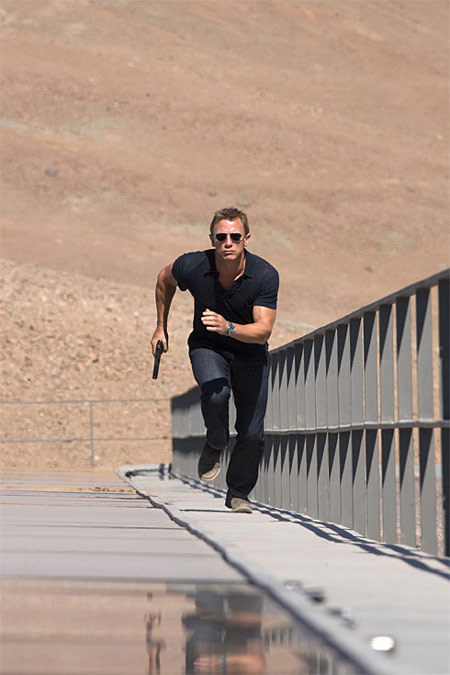
I’d better admit it right up front: I liked Quantum of Solace.
Okay, now that that’s out of the way and 90% of my readership (all nine of them) have decided that I’m off my trolley but not interesting enough in my insanity to keep reading, let me qualify this a bit. Yes, the film isn’t particularly well directed, especially in the action scenes – some were thrilling, some were muddled and done without any clear understanding of what makes an action scene work, and there were definitely way too many of them. Yes, the plot is equally muddled, confusing “complicated” for “complex” or even “deep”. Yes, it doesn’t hold a candle to Casino Royale. And yes, the title sequence sucked, to put it bluntly.
But (and this is where I go all heretical again) I liked it better than every single Bond movie I’d seen that starred Pierce Brosnan. Yes, even better than Goldeneye (which I saw on video years after it’d come out, and I thought it looked cheap and trashy). I liked that the baddie wasn’t some over-the-top madman out to destroy the world but just a businessman with the necessary lack of ethics to be good at what he does. I liked the running gag of Bond killing every single lead – in self-defense, mind you, but he’s still not exactly very good at this, is he? (He’s great at improvising and at being part hitman, part monk, as Craig’s Bond put it in the previous movie, but he still has a lot to learn.) And I liked how Vesper, while still dead and gone and sorely missed by most of the male audience (yes, Olga Kurylenko is also quite tasty), is still very much in this film, making its title more than just the last Flemying-penned Bond title they could use for a film. While Bond in this film isn’t the well-oiled machine out for revenge that some critics thought him to be, there is always this secondary motivation – to find something, some small measure of relief (see what I did there? sad, innit?), that would put an end to his sense of betrayal.
Clearly it did help that I’d almost only heard bad things about the film, so I went in expecting… well, something like Die Another Day, except perhaps without the invisible car, the ice fortress and, ideally, Brosnan. As I wrote earlier, the film isn’t nearly what it could be, especially with a tight rewrite (one that also allows for more moments of quiet in the first half rather than the breathless parade of action sequences we get) and better direction. (Sorry, Marc, I’m still not convinced you’re a terribly good director.) But it makes me think that the franchise, especially if it keeps Craig, still has some life in it.
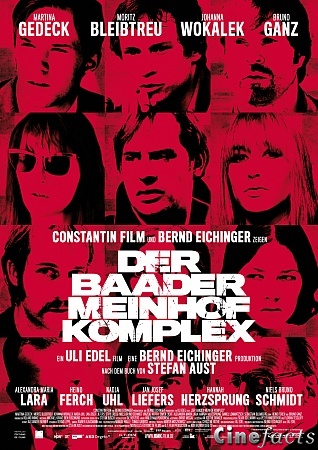
Uli Edel’s film Der Baader Meinhof Komplex is both fascinating and frustrating. It has some of the best actors Germany has to offer at the moment acting their hearts out; at the same time, it has a script that often feels like a badly edited Wikipedia article. I can imagine that the film becomes much more frustrating for those who’ve read the book it’s based on – I was in the lucky position to have known relatively litte about the RAF (Red Army Fraction, not Royal Air Force!) before watching it.
What the script would have needed, more than anything else, is an editor: it is packed with too many incidents, as if the author felt, “This has happened so it would be wrong to leave it out!” That may be true for history books – it is less true for films, obviously. Too many scenes feel like they’re a repetition of what was shown earlier, repeating the same points over and over again. “Yes, we know that Andreas Baader was an immature, self-righteous, misogynist asshole,” we want to say, “We know that Gudrun Ensslin was too much in love with herself! Get on with it!” As a result this 2 1/2 hour film feels strangely short-winded. There is little in the way of a Spannungsbogen, as we get what amounts to “This happened, and then this, and then this…”.
At the same time, there are moments when the film (almost despite itself) settles into a storyline, and that’s when the actors take over. Especially the scenes in prison where the incarcerated heads of the RAF turn on each other and on themselves are, at their best, riveting drama. Especially Martina Gedeck, at least as strong a presence as she was in The Lives of Others, creates a fascinating potrait of Ulrike Meinhof slowly falling apart in prison.
It’s in those scenes that I wished the film knew what it wanted to do. Mere chronology may be sufficient (at best) for documentaries, but it doesn’t make for very good drama. With the same actors but with a sense of focus, it could be so much better. As it is now, it ticks all the boxes but fails to bring them together into something satisfyingly coherent and whole.
What it did achieve, though, and quite strongly at that: I now want to find out more about the RAF and the people and events involved. And I definitely want to check out what else Martina Gedeck has done.
(I was going to write lots more here, on the inherent risk of presenting terrorism as sexy if you’ve got young sexy actors playing terrorists, and on the apparent development from the first generation of the RAF into a copy of a copy of a copy, reducing the sparse initial greys into stark black and white, but if I did that there’d be another week before an update. If you’re interested, let me know and I’ll write something about it next time.)
The Call of Duty games are prime examples of on-rail shooters done to perfection, with amazing production values. They’re not complex games, nor do they strive for realism: they’re the equivalent of a great 80’s action movie – Die Hard rather than some Van Damme or Seagal vehicle.
Call of Duty 4, subtitled Modern Warfare, was the first (and to date only) game in the series that didn’t take place in that most overused of scenarios, the Second World War. Instead, it tells a Tom Clancy-style story of Russian Ultra-Nationalists and, surprise, Middle Eastern terrorists. So far, so unoriginal.
What is fascinating, though, is this: in a genre that is usually about making the player feel like some super-hero with a gun and macho one-liners coming from his lips like so much testosterone-riddled drool much of the storytelling is about showing the player that he doesn’t actually have that much control over what is happening. In fact, two of the game’s most interesting scenes in a subtly subversive fashion give the player just enough control for him to realise that he’s powerless.
Consider the prologue, in which the president of a fictional Middle Eastern country is shoved into the back of a car, driven through his war-torn city, dragged in front of the apparent Big Meanie (who turns out to be a minor meanie, in fact) and shot in the head.
And you, the player, get to control the president. As far as he can be controlled: beaten and dragged by soldiers, he can barely move his head enough to glimpse scenes of loyalists being executed through the car’s windows. And whatever you do, the outcome is the same: gun pointed at your head, blam, black screen. It’s chilling and very, very effective. Clearly it’s also designed to make you hate the bad guys, but apart from this obvious aim it does throw in question the power-trip fantasy of first-person shooters.
The second scene is the one that every reviewer and most players remarked on. (If you’re planning to play the game without spoilers, DO STOP READING RIGHT NOW. In fact, STOP READING TWO PARAGRAPHS AGO! WHY ARE YOU STILL READING? IDIOT!) In it, you and your squad (platoon? team? posse? I’m afraid I don’t really know what the correct military term for “you and the guys with you” is…) have just rescued a downed pilot from the bad guys and you fly off in an army chopper – when a nuke goes off. You watch as the shockwave races towards you, crushing the helicopters behind you. There’s no way you can outrun it.
After you crash, the game gives you control of your character. He’s alive, just barely, having survived the crash. You stumble out of the wreck of the helicopter and look around at the devastation, your heart beating in your ears. In the distance you see the mushroom cloud. Obviously you don’t perceive the radiation, but you know it’s there. But you’re the player! You’re in a shooter! Surely there must be a way to make it out of there!
And then you die, perhaps of radiation, perhaps of your injuries. It doesn’t matter. You have a minute or two of stumbling around and then you die.
The game doesn’t have the ambition or the guts – or the stupidity – to end on your lack of control over the situation. Later on, as a different character, you do stop nuclear missiles from destroying half of the Eastern Seaboard (although you do that using a computer rather than an automatic weapon). And at the very end, you’re given the chance to kill the main bad guy who’s behind it all in a fairly heroic scene (although one with an interestingly bitter tinge).
Clearly Call of Duty 4 is a first-person shooter, not a treatiseon the powerlessness of the soldier. Clearly you want to give the player the feeling that he’s the hero. But it’s still interesting, in a game that is almost the perfect representative of its genre, that you get this subversive, and in this highly effective, streak… Sneaking it past the player that for all of his heroic fantasising, he’s not in control. Just don’t let him find out…
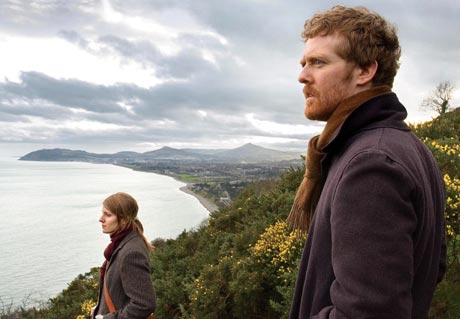
I’ve pretty much given up on the Academy Awards for years now, to the extent that I have no idea whatsoever which films have been winning since that hobbit movie. I did hear about that Irish indie romance Once, though, but I didn’t really follow it. On paper (or, more accurately, “computer screen”) it sounded rather twee.
Then a message board friend of mine mentioned seeing it. He didn’t write much about the film, but from what he’d written it was clear that I wanted to check out the film.
Now I’m in this silly situation: I loved the film and I’d go so far as to say that it’s one of the best, most beautifully told and acted love stories I’ve ever seen on film. I also fear that anything that I might write about it will make the film sound twee. Words such as “sweet” and “charming” come to mind, but they don’t really get at what makes the film work.
It’s funny (in a film nerd way, that is): we watched two films on two consecutive nights last week that were amazingly similar in some ways but couldn’t be more different in others: Michael Winterbottom’s Wonderland and, well, Once. Both were filmed simply, going for verisimilitude, especially in the acting and writing. Both were City movies, so to speak, very much rooted in London and Dublin respectively. Both were about people who have to struggle to make ends meet at times, and not the Guardian-reading upper middle class characters of, say, Anthony Minghella’s Breaking and Entering.
Yet Once has an artlessness that in its effectiveness is highly artistic, whereas Wonderland never lets you forget that you’re watching a film by a director who wants his directing to be visible on screen. In its digicam, improv way Winterbottom’s film is as much a director’s film as any movie by Scorsese. It is the sort of film that some people might call “pretentious” because it forms its material in unexpected ways and makes this very clear on every frame. Once, by comparison, wants to be a small film, is a small film and knows it.
But it’s by no means unambitious. Pulling off a simple, bittersweet love story – with songs, no less! – take courage, or stupidity, but whatever it was, they managed it. For lack of a better word, Once may just be the most honest love story I’ve ever seen. And in some ways I hope never to read the words, “From the makers of Once” because I’m afraid that there’s no way they could do anything other than disappoint. Poor buggers…
Anyway, enough words from someone who basically said, “Words won’t live up to the film so I’ll keep this short.” Both films, Wonderland and Once, are very much worthwhile. The former is probably more a matter of personal taste – Winterbottom’s films are not likeable as such, nor do they set out to be – but still a definite recommendation. And now I will leave you with trailery goodness and shut up.
Since we’ll be leaving the United States in just over 32 hours, we thought we’d check out another movie, if only for the experience of sitting in a movie theatre armed with a double espresso shot caramel macchiato and an apple fritter. I’ll never eat in this town again.
The film itself, Burn After Reading, was decidedly so-so. I think my main problem with several of the Coen Bros. comedies is that the characters are painfully flat and, as a result, I simply don’t care much. (The Big Lebowski gets around this by making its characters quite endearing and strangely poignant, which should be an impossibility with such a far out, potheaded plot.) Same here: apart from very few moments, all of the protagonists remain cartoons – added to which there simply isn’t much of a plot to hold everything together. While the individual situations are comical, there’s a “ooookay… what should happen next? dunno…” quality to this film.
So, since a lot has already been written about the film, let me talk about more interesting things: the trailers. Four of ’em, and all of them intriguing.
I’m not a big Meryll Streep fan, although I acknowledge that she’s a good actress. Much of the time she seems too much like “Meryll Streep acting her little cotton socks off”, just like Robert de Niro, even at his best, tends to make the strain of acting very visible. It works in some films, but I prefer acting that almost vanishes – or otherwise make it very overt acting that doesn’t even try to hide the fact that it’s an act. Having said all of that, this trailer made me look up. Added to which it’s got Philip Seymour Hoffman. Colour me intrigued.
Trailer no. 2. Okay… on the surface, this looks like it’s trying way too hard to win Oscars. Disability. Troubled musician. Based on a true story. Directed by the guy who brought you these middlebrow tearjerkers. And yet, and yet. Robert Downey Jr. can make most middling films interesting and Jamie Foxx definitely knows how to act. Also, based on the trailer the film looks beautifully shot, without going for the glossy, strings-swelling-triumphantly, one-step-away-from-Hallmark visual style.
I’ve only seen one film by Gus Van Sant: Finding Forrester. Yes, I like Anna Paquin, but that didn’t make it a very good film (although it was one of the weirdest, coolest, loveliest evenings and nights in my life that followed that film). Okay, I’ve also seen the vignette he directed in Paris Je T’Aime. I have no idea whether I like him as a director or not. Mostly I’ve read reviews of his films and thought, “Um… right.” (I am uncannily interested in Gerry, mind you.) Then there’s Sean Penn who, for me, is very hit-and-miss. When he’s good he’s very, very good; when he’s on a mission, he’s annoying as hell. But, I must admit, this trailer looks fascinating.
Finally, Frost/Nixon. So far I wasn’t interested at all. And if I’d remembered the director, my disinterest would have doubled, nay, trippled. Is there a more competently nothingy director than Ron Howard? But this may be just the right film for a bland director who nevertheless knows how to get good performances out of his actors. Added to which: Matthew Macfadyen. Yep – it’s Tom Quinn. It’s Henry IV. It’s one-eyed guy with bigass scar. (That last one was Enigma, in case you just went, “Huh?”) And the trailer doesn’t look like “Talky sort-of-historical film based on a play, with actors who wish they hadn’t played in those vampire movies” – it looks like a proper film.
So: main feature – meh. Trailers? Gimme more of that!
In case you were wondering: I haven’t abandoned you or the internet or my “way too late to be of any relevance whatsoever” blog. I’ve just been away, and still am. For the first time in my life, I’m not just witnessing the sheer bigness (biggitude?) of the United States of Thingamy through the TV screen – I’m in San Diego, enjoying the sun, the zoo, the predominantly Democrat people, the 24-hour shop at the gas station that sells juices made up of broccoli, spinach and garlic that nevertheless taste pretty damn good.
I’ve also made it to the fabled American movie theatre, and the first and most important thing to report is this: they show about 2 1/2 times as many trailers as they do back home! (That’s it, I’m moving here…) Okay, the number of trailers may not quite make up for the film that followed them in this instance…
As I may or may not have mentioned earlier, I’m not a Western fan as such… but some films and series that I like a lot happen to be Westerns. I like what you can do with a well established genre – such as showing up the genre’s limitations and giving alternate readings of its archetypes. I love Deadwood and The Assassination of is anyone still reading this title or have you already jumped to the end of the italics? is one of my favourite films of the last couple of years.
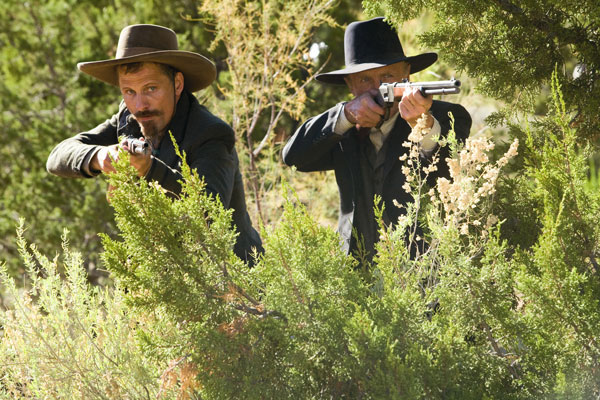
Appaloosa, Ed Harris’ second film as a director, could have been made 60 years ago, with little changes. It’s old fashioned. That in itself isn’t bad. What is a shame is that the film becomes way too comfortable with itself, to the point where, even when bad things happen, there is no urgency to the story at all. There’s too much there that is utterly predictable. And most of the characters have the emotional maturity of sitcom characters.
As a result, I sat there thinking, “Nice acting, but I don’t really care.” I didn’t care whether Harris’ character and Renée Zellweger’s golddigger would end up with each other and be happy. I didn’t much care whether any of the protagonists would die before the end. The few bits that made me look up with interest – the quasi-domestic relationship between Harris and Mortensen before it’s broken up by, gosh darn!, a woman is quite nice, and the film’s nicely aware of Harris’ character being rather thick at the best of times – were nice enough, but the overriding thought on my mind as I left the cinema was: “I wonder how many episodes of Deadwood season 4 this could have financed…”
On a slightly different note: Watched the premiere of the US Life on Mars. Was left with a deeply felt confusion as to why to do this remake and a mixture of pity for Harvey Keitel (he looked like he wanted to be somewhere else) and annoyance with him (if he doesn’t want to be there, why is he taking up the space?). I have no problem with remakes on principle – but if they’re as pointless, and joyless, as this one I have to wonder: “How many episodes of Deadwood…?”

 A Damn Fine Cup of Culture