Let’s face the oil well and dance…

There’s something weird going on in P.T. Anderson’s There Will Be Blood. Okay, there are many weird things going on – the film is quite confounding on the whole, as it doesn’t present its story the way you’d expect it – but when you watch the beginning of the film, a long sequence without any dialogue, you feel some strange sort of double vision. At least you do if you’re a film nerd like me, that is.

On the one hand, you’re watching a solitary prospector mine for silver in a desolate landscape, breaking his leg in a bad fall, striking it rich – and then, almost by accident, finding oil. On the other hand, the music and the landscape suggest very different images, recalling one of the most famous (and most parodied) scenes of cinema:

There is some sort of weird intertextual thing going on between There Will Be Blood and Kubrick’s movies that is discussed intelligently in this forum post. Beyond that, though, there something eerily ritualistic and religious about the film’s beginning: it’s as if the black liquid gushing from the ground is the harbinger of some new, cruel religion that will require sacrifices. In his way, Daniel Plainview (a disturbing performance by Daniel Day Lewis that is more complex than its detractors admit) is more of a mad prophet than his opponent, the self-righteous yet wheedling Eli Sunday. It’s just that human beings have no place in his religion.
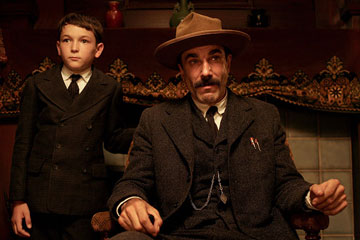
Is it better to rule in Hell…?

I recently re-watched Magnolia, which I still like a lot, so There Will Be Blood came as a surprise. Even Punch Drunk Love, which I didn’t particularly enjoy (or understand), felt more like the P.T. Anderson who made Magnolia and Boogie Nights. Those latter two films were quintessential ensemble movies. There Will Be Blood has barely enough space for one or two characters next to Plainview. It grows out of its central monolithic (if you forgive the Kubrickian pun) protagonist: perhaps the most frightening character in recent film history.

P.S.: Please keep in mind that I haven’t yet seen No Country for Old Men, so I can’t judge the scariness of that film’s Anton Chigurh. His hair’s plenty scary enough, though.
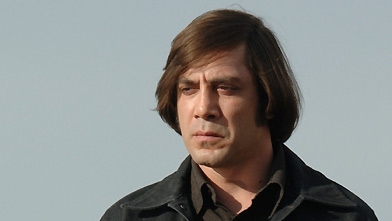
Prince Valiant, the Cleaner

P.P.S.: After Miami Vice used to be the top search term leading people to this website, it has now become “magenta”. So, my heartfelt thanks to one of my frequent readers. Hope you’re getting just as many hits because of me!

The Tube is not what it seems

Okay, gang. I’m afraid this entry is going to be short(ish) on words and long on film. Also, it’s only really going to be of interest to David Lynch/Twin Peaks fans. For all you other people: switch off your computers and go outside. It’s a lovely day. (At least where I am. For all I know, The Deluge: The Sequel has just started wherever you are.)

One of the features on the Twin Peaks Super Gold Fantastic Tacky Set is that the international version of the pilot is included. This was the version Lynch edited together in case the series wasn’t picked up by a network, and it ‘completes’ the plot. However, ‘complete’ has to be taken in the loosest possible sense here – for anyone who thought that Lynch’s works don’t make any sense, the international Twin Peaks pilot makes Lost Highway look like one of those “Run, Jane, run!” stories in terms of clarity.

It roughly goes like this: Mike, the one-armed man, calls Agent Cooper and tells him that Bob killed Laura. Coop and Sheriff Truman meet Mike at the hospital. They find Bob in the hospital basement. Mike shoots Bob. Cut to twenty-five years later: Coop is in the red room, little guy dances, Laura kisses Coop and whispers something in her ear. The end.

I’m somewhat reminded of the first time I watched Twin Peaks on telly. They were showing it on some second-rate channel, but they stopped roughly 2/3 into the series without saying that it wasn’t actually over. For years I thought, “No wonder people say that Twin Peaks doesn’t make any sense!” Even the ending that Lynch finally came up with had more closure and felt more coherent than what I’d seen…

P.S.: Even if the international pilot is rushed and incoherent, you gotta love Lucy and Andy.
P.P.S.: For those of you who want to see something that is more representative of the Best of Twin Peaks: this is pretty much my favourite scene in the series.

Where the wild things are

Sean Penn is clearly a very talented artist. He’s also annoying and self-righteous as hell, at least sometimes (and I’m saying this as someone who basically agrees with many of his opinions). So what happens if someone annoying and self-righteous makes a film about someone annoying and self-righteous?

In the case of In the Wild, what happens is that you get a beautiful, moving, disturbing and infuriating film.

The film clearly has admiration for the uncompromising cut Chris McCandless makes with his family and his past, and for the way McCandless – calling himself Alexander Supertramp (he doesn’t seem to be ironic about this) – goes out into the American wilderness to become himself. Penn’s movie, especially in its images, shares his protagonist’s awe at the beauty of the country and of nature, and so do we to some extent. Part of me definitely thought, “Yeah, man, I’ll get rid of all my belongings, get some survival gear and live like Grizzly Adams! Right on!” And I didn’t even need to be smoking pot to think it.

At the same time, McCandless (as portrayed in the film) can’t be described as anything else than a self-righteous, selfish adolescent. Clearly many of the societal conventions he abandons are also selfish in nature – do parents have any claim to their children’s lives? does a sister have a claim to her brother? But Chris makes people care about him and then he’s off. Being human, the film implies amidst the awe, also involves human contact, human responsibilities… and responsibilities seem to scare McCandless. It’s either that, or he’s cheerfully callous about waltzing into people’s lives and then waltzing out the moment they feel for him.

It is this ambivalence about the central character that makes Into the Wild more than just a beautiful film. Some critics have been rather negative about this: why feel awe for such a selfish jerk? Didn’t McCandless simply got what he deserved? Yes, he (the movie character – I don’t want to judge the real person on the basis of a movie) is selfish, and yes, he is a jerk. Yes, he’s a coward who doesn’t have the courage to forgive. Yes, he’s also an idealist and a dreamer, and his cowardice is also his courage. Strip the film of this central ambivalence, and you turn the movie into a simplistic cautionary tale: Don’t abandon your family and your cosy capitalist surroundings to go into the wild, because you’ll die of starvation in an old bus, only to be found by moose hunters two weeks later.

Personally, I prefer to feel both awed and infuriated. I prefer to be given enough space to make up my own mind. And space is something Penn’s film has in spades.

Into the Wild

A matter of life and death… and Japanese movies

There are a handful of films that give off a glow in my memory, like a candle flame. They’re not necessarily the Assassination of Jesse James etc. etc. or Magnolia type of films. They’re not by people such as Steven Soderbergh or Martin Scorsese. One of those films is Roderigo Garcia’s Things You Can Tell Just By Looking At Her (great acting in that one, but more than that, the film is amazingly gentle – not soft, mind you, not anodyne, but gentle), which I saw by sheer accident. Another one is Kore-Eda’s After-Life.

I’d been wanting to see the director’s Nobody Knows for a while now, but I only did so yesterday evening. After the very emotional final episode of Six Feet Under (it got to me just as much this time as it did when I first watched it) I wasn’t sure whether a film about four children who are abandoned by their mother and who try to continue their lives as best possible, ignored by the world around them, wouldn’t be too depressing.

The film is definitely not cheerful, and the ending is quite tough in terms of what happens, but there’s something as gentle and comforting about Kore-eda’s direction in Nobody Knows as there was in his deeply spiritual but never preachy After-Life. There are moments of simple joy in the lives of the children. There are just as many moments of joy in the filmmaking: scenes that are both realistic and subtly poetic.

Nobody Knows, by Kore-eda

It’s strange: in a way I feel the movie should get to me more, especially considering the ending – yet somehow I also think that I’d resist a tougher film more. Kore-eda’s work doesn’t do the emotional work for you. It doesn’t tell you what to think or feel. And it doesn’t allow for simple, clear-cut emotions. Yet you have to be willing to be taken along by the film’s flow. I don’t think I’ve seen many films that have this sort of pace; the film that popped into my mind when I tried to think of other movies that had a similar effect on me was Le fils by the Dardenne brothers.

Writing about the film now, I feel I’m only circling around the emotions that it touched upon. I don’t think I’m an inch closer to understanding the effect Nobody Knows had on me. But I think, somehow, that I may be remembering this film, much like After-Life, for a long time.

The Miami boys have lost their pull

It had to happen eventually, but still… for the first time in months, the top post in this blog isn’t the one about Crockett and Tubbs. What will I attract readers with now? According to the search terms used most often to get here, Hellboy’s become more of a pull. Sorry, Colin Farrell – some big red dude with filed-off horns gets the virtual punters in the seats these days!

We’ve now finished Jackie Brown (this blogger here is getting old – halfway through JB I realised that it was way past my bedtime… and that before midnight!), and it definitely more than holds up. The care Tarantino takes with his characters is wonderful, and not a little surprising: I’m more used to Tarantino caring about his lines and close-ups of feet than about characters.

More than anything, Jackie Brown is the most (perhaps even the only) mature film Tarantino has made. Now, his appeal doesn’t necessarily lie in his maturity – in fact, his adolescent hyperactivity is part of his appeal – but it’s beautiful to see his talent put to the service of a story that is not just a fun ride. In our youth-obsessed pop culture, it’s rare to see such a perfectly executed, entertaining film that is essentially about getting old but that takes its older characters seriously.

P.S. for all the Hitchcock fans out there: Vanity Fair has done a photo shoot of iconic Hitchcock scenes with today’s actors. People might ask what the point is – I don’t. I think the photos are eminently cool. The lighting, the painterly, expressionistic colours, the actors chosen… it’s perfect. Check all of ’em out here.

Okay, the seagull on her head may hamper the effect a tad for some…

… but I gots to be that kinda blogger

When you read Internet comments on anything concerning Quentin Tarantino, you quickly realise two things: 1) You shouldn’t read Internet comments unless you get some sort of masochist enjoyment out of sustained idiocy; 2) Quentin Tarantino is considered a hack by lots of people who, by extension, think that Tarantino fans are wannabe hip wankers.

Now, I understand that QT’s films aren’t to everyone’s taste, and he’s definitely not one of those directors/writers who can do no wrong. But I would think that anyone with half an eye and a minimum of appreciation for movies should appreciate that Tarantino is anything but a hack. Pulp Fiction still holds up amazingly well 14 years after it came to cinemas. Jackie Brown is a bit of an odd one out – its relationship to the rest of QT’s oeuvre is roughly like that of The Straight Story to most other David Lynch movies. Many people who loved Pulp Fiction and Reservoir Dogs found Jackie Brown boring, and people who hated Tarantino’s earlier films (or Kill Bill, if they started from the other end) probably didn’t even see the movie.

We started watching it yesterday evening – for the first time since the DVD came out, in my case – and from the very beginning, the Miramax logo appearing on screen to the strains of Bobby Womack’s Across 110th Street, I got the same giddy feeling that I got from most of Tarantino’s movies. Apart from anything else, the guy knows how to use a soundtrack to accompany and reinforce his images. The film’s intro is one of the coolest in all of American cinema, and its simplicity makes it even cooler. Pam Grier, seen through Tarantino’s lens, is both a real person and utterly iconic. Neither the music nor the images without the other would work nearly as well:

What I only realised yesterday was that, once that intro is over, it’s half an hour before Jackie Brown (the title character!) is back on screen. But that introductory sequence has burnt her into our mind’s retina. It’s her film.

But it’s also the rest of the cast’s film; most if not all of the main characters are played brilliantly. I still haven’t warmed to Bridget Fonda, I have to admit, neither in this movie nor in most others (except A Simple Plan), but it’s fascinating what Tarantino does with Samuel L. Jackson and Robert De Niro. In a way it’s a shame that Jackson was so good in Pulp Fiction, because in most films that followed it he did minor variations on Jules Winfield only, becoming a self-parody. He was never less than cool but neither was he more than Samuel L. Jackson(tm). Robbie Ordell, though, is different. Not wildly different, but he takes his earlier character and makes him into something colder, more real and more frightening.

Robert De Niro, though, is an actor who has rarely impressed me in the last ten years or so. He too has  been playing reduced versions of his earlier parts, also becoming a caricature of himself in so many movies. His Louis Gara is a comic figure in his slowness, yet it’s much more differentiated a performance than you might think at first. And his scene with Bridget Fonda is one of the most cuttingly funny sex scenes in American movies. For now, I’ll leave you with it:

Would you kindly read this blog entry?

Yesterday evening the internet conspired to conspire against me. Hotmail didn’t work, nor did WordPress. I wanted to write and post an update, knowing that the huddled masses were waiting for a few well-placed words of wisdom on movies or video games or something equally relevant to our daily lives. But no – technology decided that it’s Lent, so perhaps a techno-fast was in order.

Anyway, it’s working again now. Aren’t you all relieved? I know I am.

So, what have I been up to? Not much in terms of movies and TV. But I’ve started playing Bioshock, one of the best-reviewed titles of 2007. Can’t say I’ve played much of it so far, but I’m definitely intrigued by its thematic ambitiousness and its art deco aesthetics. And it’s got one of the best starting sequences I’ve ever played. More on Bioshock is likely to follow, but for now, enjoy this video clip:

It’s all fun and games after someone loses an eye

Even though Deadwood has some of the grimmest moments of any TV series I’ve seen so far (probably the top 5 series in that respect would be HBO, by the way), one of the reasons it works so well in creating credible, likeable characters is by infusing them with a sense of humour. This is rarely as obvious as in the scenes with Dan Dority and Johnny Burns – and in yesterday’s episode, the magnificently titled “Unauthorized Cinnamon” (you’d probably expect that sort of title more from some anime than from a gritty western series), there was a scene with Al’s henchmen that had me giggling madly to myself. I would quote it, but without the context and the acting it wouldn’t be half as funny. There’s also a priceless moment with a mad, effete tailor trying to convince Al to wear colourful swatches of cloth on his Heastified hand – good old Swingen has never looked quite that baffled. The tonal range of the actors on Deadwood is simply amazing… as the scenes depicting the growing closeness between Calamity Jane and Joanie Stubbs also show.

Al alone

However, don’t take my word for it. If you’re in any way interested in good writing, characterisation and gorgeously cinematic television, and if you don’t mind the occasional throat-slicing, go out, get Deadwood season 1, watch, and then go and get the next two series. And then hunt me down and kick my ass for getting you hooked on a series that was cancelled before they could finish the story as written.

Okay, enough blather from me about my favourite series. So, even though it’s Sunday and we’re about to watch the penultimate episode of Six Feet Under, let me just add two YouTube trouvailles. The first is a trailer for David Cronenberg’s Videodrome that is so gloriously corny and ’80s weird that I, as an 1980s movie goer, would have expected the film to be a soft-porn retelling of Tron. The second is a six-minute short by Cronenberg called Camera, picking up some of the themes of Videodrome, just without the porn creepiness, the graphic bodily mutilations and James Woods sticking his head in a TV. Hey – whatever shoots water up his stick, eh?

Out of Sight – not out of mind…

Out of Sight will always have a special place in whatever chamber of my film nerd’s heart is reserved for films. For one thing, it was my first taste of Soderbergh’s work – and, in spite of his lesser films, he remains one of my favourite directors. However, and this may sound strange, I like him most for the editing of his movies… even though he didn’t edit most of his films.

Nevertheless, it’s obvious that he doesn’t just leave the editorial work to his undoubtedly talented editors – many of his films play with jump cuts, freeze frames and achronological editing, whether he’s the one sitting in the Avid chair or not. There’s a strongly impressionistic feel to how Soderbergh places his scenes in relation to each other, to the point where it can become annoying for audiences that aren’t made up of editing geeks like me. The Limey is a case in point (and, even more film nerdy, the director’s commentary on the DVD edition plays the same games with jumbled chronology as the movie – I got a kick out of it, but chances are I’m part of a very exclusive club there).

What strikes about Out of Sight is how effortless the fractured chronology is presented. People were confused by Pulp Fiction‘s B-A-C-style narrative, but that’s nothing compared to how this film jumps, starting pretty much in the middle and liberally moving back and forth. Nevertheless, you’re never confused as to what is going on in the story. Soderbergh hides his positively avantgarde  editing in plain sight.

And it’s rarely been done as successfully as in the love scene between George Clooney (pretty much at the beginning of his career as an actor rather than clothesrack) and Jennifer Lopez (has she ever been better than in this film?), which cuts smoothly back and forth between the actual lovemaking and the buildup. The spark between Clooney and Lopez is made into one of the most erotic love scenes in American filmmaking. Yet the fades and the music also have something sad – it’s clear, somehow, from watching the scene that this will be the one and only time the two characters are in effect together.

P.S.: To be fair, the scene is not entirely original. Soderbergh has obviously watched his Nicholas Roeg closely, getting his inspiration from the Julie Christie/Donald Sutherland love scene in Don’t Look Now (gotta love the accidental synchronicity between the two films’ titles) which jumps back and forth between sex and the couple putting their clothes back on afterwards, infusing the mundane married life with the erotic.

P.P.S.: For anyone interested in the art of editing, do read In the Blink of an Eye by Walter Murch (Apocalypse Now, The English Patient, Jarhead).