I’m about to be off and teach a two-hour colloquium on film studies. I’ve never studied the subject, but somehow the person who asked me to teach the session thought that a) having a PhD in English and American Literature, b) being a film nut (and having 400+ DVDs to prove it) and c) having an opinion on everything qualifies me for this.
Hurm, as a certain psycho superhero might say.
Anyway, since I have to make a few last notes, I’m going to have to make this short. I’ll be analysing extracts from three films with them: The Talented Mr Ripley, Fight Club and Memento. Having re-watched the beginning of those three films, I was reminded again why I liked them so much in the first place. Ripley got a bad rap with some critics, but I still find it one of Anthony Minghella’s, Matt Damon’s and Jude Law’s finest movies. And for those who think the film lacks tension, I thought I could put a highly spoilerish excerpt in the blog. Those who haven’t seen the film yet, don’t click on the clip lest you do so at your own peril!
However, I don’t want to leave you with murder and mayhem (or soap – sorry, wrong movie…!), so here’s another, more peaceful clip from the same film. Dunno what it is about the song, but I always get an urge to snap my fingers and tap my feet when I hear it. Enjoy!
Good bye, Six Feet Under season 4. It’s been a wild ride, and it’s been emotional. What with graphic suicides, kidnappings by lunatics, illegal burials in the desert, and men getting squished in half by elevators.
I’d forgotten how much the last episode of season 4 sets up things for season 5. In between the second and the third season, there was such a strong break, and the same can be said to a lesser extent for the end of season 3. “Untitled”, however, the fourth season finale sets up most if not all of the pieces for the next season.
And it delivers the strange but compelling mix of tragedy, black humour and hope like no other series ever has. Yes, there’s some of the darkest material we’ve seen in the series so far, but there’s always rays of sunshine somewhere in between the clouds. Otherwise it would be unbearable at times.
I’m both looking forward to and dreading season 5 now, because I know that it’ll affect me just as much as the first time I watched it. And chances are my reaction to the last episode will be pretty much the same. I hope my love is ready for the spectacle of her guy being a weepy heap for an entire Sunday…
Season 4, I liked you. Perhaps you’re the weakest, most meandering of all five seasons, but being the weakest of such a strong bunch is nothing to be ashamed of. Season 5 – looking forward to seeing you!
The title should already give it away: The Assassination of Jesse James by the Coward Robert Ford is not the kind of movie you watch in order to find out what happens at the end. If that’s why you go to the movies, don’t see this film. If you tend to use the words “pretentious” and “artsy” fairly often when talking about films you didn’t like, don’t see this film. If slow equals boring when it comes to movies as far as you’re concerned, don’t see this film. If you’re hoping for gunslinging action, don’t see this film.
However, do see this film if you want to see a beautifully written and shot, psychologically fascinating, immensely atmospheric and deeply sad movie, and especially if you’re interested in good acting. Down to the last part, The Assassination has an impressively talented cast; for instance, even the few scenes that focus on Garrett Dillahunt’s Ed Miller (I’ve been a fan of his ever since watching Deadwood) tell volumes in themselves. But the film stands and falls with the two title characters, and they both carry their share of the load with distinction. I’d only seen Casey Affleck in the Ocean’s Double-Digit films, where it’s difficult to judge his acting, but his Robert Ford is a complex, riveting creation: in turn wheedling, puffed up, disturbing, pathetic, deluded, but finally truly tragic, he’s a relative of Matt Damon’s Tom Ripley. At one point James asks him: “Do you want to be like me? Or do you want to be me?” Their relationship recalls that of Tom Ripley and Dickie Greenleaf (Jude Law) in Anthony Minghella’s movie, but it goes further than that. And Ford’s longing, loathing looks at Jesse James carry so much.
I must admit that I am also becoming quite the Brad Pitt fan. I used to think that he was a star, but not much of an actor – and there are films where you need stars. It was only in Babel that I recognised he could play a part that was in no way that of a movie star. In that film I forgot for the first time that he’s a pretty boy, and I saw him as the character. The star quality is back in The Assassination, but it needs to be – Jesse James is a myth, so Pitt has to portray that facet of the character – and it’s made deeper and richer by Pitt’s performance. This quasi-mythic outlaw is also a paranoid, superstitious and at times cruel and petty bastard, and he’s got a deep streak of self-loathing. When he turns his back on Ford for the last time to wipe the dust of a picture, we’re basically seeing a suicide at least as much as a murder. While James is no Christ figure, Ford is as necessary as Judas to complete the narrative – and to some extent this is because James lacks the courage himself to end it all, nor to live on. It’s by no means clear whether Robert Ford is really the coward that the title suggests.
I don’t want to go on too much, because otherwise this blog entry will rival the film in length. If you don’t mind slow, long films, if you don’t mind portentousness, if you think that the western genre can do tragedy successfully; if you don’t mind hearing the same three pieces of music repeated frequently (and they fit very well), if you don’t mind artsy choices in the photography, editing and writing. Or simply if you want to see Nick Cave hamming it up with a guitar in a Brad Pitt movie. If any of these apply, go and see the film.
Okay, it’s “Plug an old game” time. Yesterday I finished my second or third playthrough of Grand Theft Auto: San Andreas. And it’s still one of the most versatile games I know – it’s probably the truest “sandbox game” that’s out there. For those of you who aren’t computer game nerds like myself, here’s a handy definition from Wikipedia:
A sandbox-style video game (or a video game with an optional sandbox mode) is a video game with an open-ended and non-linear style of gameplay, or a mode of gameplay within a game that is more often played in a goal-directed manner. The sandbox analogy is used to describe this style of gaming because, as with a physical sandbox, the user is simply allowed to do what he or she wishes (with the available game elements and within the limitations of the game engine — the metaphoric toys within, and boundaries of, the sandbox).
Now, what does that mean in concrete terms? San Andreas is a story-heavy game, it’s “played in a goal-directed manner”, but it gives you a lot of freedom in a) how you go about achieving the goal and b) how you spend your time in between missions. The game world is huge – you’re given three virtual cities/states to play around in: LA-inspired Los Santos, San Fierro (based on San Francisco) and Las Venturas, which is eerily similar to a certain desert city replete with casinos and organised crime. And while the story itself is enjoyable enough, some of the most fun can be had just boarding one of the many vehicles (cars, bikes, boats, planes) and zooming around. Personally, I get most of a kick out of navigating the hills of San Fierro on my trusty BMX bike, but here’s some of the fun’n’games that others came up with.
I finished (re)watching the Miami Vice movie yesterday, and I can confirm my impression that it improves on repeat viewings, at least for me. It’s still one of Mann’s weaker films, mainly because the characters are more sketchy, but it makes for a nice change from all of those ’80s and ’90s cop buddy movies. The main reason for this is the characters’ professionalism. You get the impression that these guys are good at their job, and so are the criminals.
In so many other films, neither the good guys nor the bad guys are very professional. Usually, the cop characters seem to be (bad) stand-up comedians first and policemen second. Similarly, the villains of such pieces fail because they’re so easily manipulated. How often in these action movies do you have to suspend your disbelief so much that it’s almost at sea level because the characters act in such stupid ways?
Yes, the professionalism of Mann’s Miami Vice also means that it packs less of an emotional punch. To some extent, the conflict between the guys wearing white hats and the ones in the black hats is so cerebral that I was fascinated, but I didn’t necessarily care. Ricardo’s relationship feels a bit more real, because there’s a sense of history; Sonny’s affair with the high-class gangster moll doesn’t seem like the sort of relationship that has a future, but the erotic charge between Colin Farrell’s Sonny Crockett and Gong Li’s Isabella is nevertheless quite effective.
It’s unlikely that anyone who completely hated the film the first time or who doesn’t like Mann’s work would like Miami Vice on a second viewing. If you don’t fall into either one of these camps, you may want to check it out again in the slightly extended version.
P.S.: And to make up for yesterday’s puerile homoerotic joke, here’s a different ’80s joke. Enjoy! (Note to self: Mwahahahahaha. Erm.)
Yesterday I started watching Miami Vice, Michael Mann’s recent film update of the quintessential ’80s neon series. I’d seen it at the cinema, and while I’d enjoyed the gorgeous visuals, I’d been rather underwhelmed on the whole. Now that I’m seeing it on DVD (in a slightly longer version), I like it a lot more. Some of that is probably down to the lack of expectations on my part. (I’ve talked about my Mann-love here before), some of it may be due to the Michael Mann atmosphere: his films tend to have a strong streak of loneliness going through them, which may not work as well in a packed cinema.
It’s rare that my appreciation of a film changes from “meh…” to something better on repeat viewings. The opposite happens a bit more frequently, but it’s still fairly unlikely. But sometimes I see a movie at the cinema and something about it stays with me. SOmehow my brain knows it needs to give this film a second chance. And sometimes it’s those films that I end up liking most.
Just for the record: 12 Monkeys was a film that I needed to see two or three times to like.
And now, for your appreciation, some more Mann love:
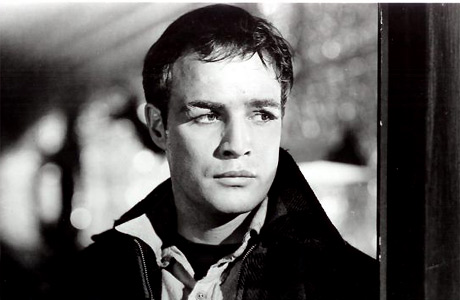
On the Waterfront is another one of those films that are parodied so often (at least the “I coulda been a contender” scene) that you feel you’ve already seen it. At least I did – and boy, was I wrong.
I’d previously seen that other big Kazan flick starring Marlon Brando: A Streetcar Named Desire. The latter is definitely a great film, but I must admit that I sometimes find Tennessee Williams too much of a drama queen. I expected similar high-class melodrama from On the Waterfront but was startled by the movie’s stark realism, both in its writing and its acting. So often, films from the ’40s and ’50s, especially films featuring sexuality and violence, seem rather arch these days. Even when they’re supposed to be realistic, they feel somewhat stiff and stagey.
Not so with Waterfront. Even the child actors are convincing (which is rare enough). One thing that helps the film’s realistic feel is that so much of it is filmed on location. None of the fake sets and back projection that you get in most films of the time. In fact, the movie has an almost documentary feel to it.
All in all, there were only two things that didn’t quite work for me, pulling me out of the realistic atmosphere. The first of these was the ending; I couldn’t really buy the scene where the badly beaten Brando walks down the dock, his fractured ribs probably sticking in his lungs like so many splinters. That one wasn’t so bad, though; what struck me more was Brando’s ex-boxer makeup which made him look like a Neanderthal wearing heavy mascara.
“The Enrichment Center is committed to the well-being of all participants. Cake and Grief Counseling will be available at the conclusion of the test. Thank you for helping us help you help us all.”
“Did you know you can donate one or all of your vital organs to the Aperture
Science Self Esteem Fund for Girls? It’s true!”
Portal is probably this year’s most written about game, even more so than Halo 3. And for good reason. It’s the first game I’ve every played (and I’ve been doing this since 1982, roughly) that I would call perfect. This weirdly wonderful offshoot of the Half-Life franchise, feeling like the movie Cube, if it had been written by Charlie Kaufman, doesn’t take a single wrong step. The brilliant idea that forms the premise of the game gets the usual Valve polish, but it’s the script that turns this into something special.
Which is also why I’d rather show than tell. So, here goes, courtesy of YouTube:
P.S.: Portal‘s AI GLaDOS, who gives good old SHODAN a run for her money, is brilliantly written. The funnier she gets, the more disturbing she gets. And the song at the end makes me want to cuddle and cuddle and cuddle this game.
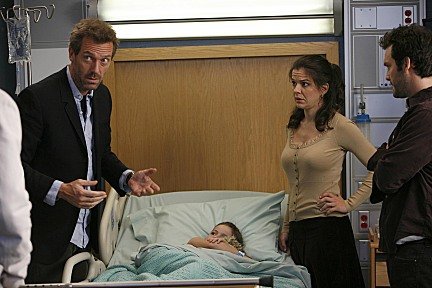
Yesterday’s TV series evening was fun. First “Finding Judas” on House, M.D., then Lost‘s “Flashes Before Your Eyes”.
Actually, I tell a lie. The “Judas” episode wasn’t fun, though it was eminently watchable. For the first time, House really seemed to lose it completely, becoming a strung-out bastard who used his incisive mind not to help his patient but to hurt those who are on his side. If Tritter wasn’t so clearly a bastard himself, he would have proven that he has a point in much of what he says. House’s words to Cuddy, for instance, were cruel and his general behaviour shitty. His suffering from withdrawal explains it, but it doesn’t excuse it.
Obviously the episode was manipulative (even more so than most of House), but effectively so. I knew they wouldn’t amputate the little girl’s arm and leg, but part of me sat there thinking “Ohshitohshitohshit…” nevertheless. I’m curious to see where they’ll take the Tritter plot and Wilson’s friendship with House, as that storyline seems to be coming to a head. And I wonder whether it’ll ever be lupus…
“Flashes Before Your Eyes” was an intriguing episode of Lost, and a heavy focus on Desmond is always welcome. For all its meandering and self-indulgence, the series has been fairly good at introducing new and interesting characters: Ben, Mr Eko, Desmond. The episode also had some interesting twists, such as the Precog Scot trying to save Charlie (and not Claire, as it appears at first), and the clever use of the flashback convention.
I could have done without the fake Englishness of some of it, though. The series’ England feels as if its makers only know the country from bad movies and TV. Especially Fionnula Flanagan’s character felt fake, when she should have been eerie. Still, though, it looks like Charlie – possibly the character who annoys me most – is heading for a rendezvous with the Grim Reaper. Can’t say I’m going to be too sad. Then again, they made me kinda like Shannon and Boone just before killing them off. The Lost writers are obviously bastards.
From Lowell Bergman to Ingmar Bergman. (Classy, huh?) Yesterday we watched Bergman’s The Seventh Seal. Call me odd, but I find his movies entertaining. They get a bad rap for being a film nerd’s wet dream (but actually somewhat boring), but I think that many of the parodies of his style are unfair.
At least in the two Bergman movies I’ve seen so far – Wild Strawberries in addition to The Seventh Seal – there’s always been a gentle sense of humour that puts the more lofty philosophical and metaphysical passages into perspective. For every scene with the knight Antonius Block contemplating life, death and the existence (or lack thereof) of God, there’s a scene with his more cynical, down-to-earth squire Jöns, puncturing the musings of his more pompous master. And beyond all this, there’s nothing boring, overly intellectual or pretentiously existential in the very real dread of the scenes with the flagellants or the distrurbed girl about to be burnt at the stake.
And there’s something refreshingly sly about both Block and Death cheating at the chess game they’re playing, even if they cheat for different reasons.
But, fair or not, without Bergman we wouldn’t have scenes like this (wait for a bit to get to the Seventh Seal bit):
P.S.: By the way, I don’t think it’s too much of a spoiler to give away that they both win in the end.



 A Damn Fine Cup of Culture