A Damn Fine Espresso: March 2026

It’s the Return of the Wuthering Brides! For this month’s espresso, Alan and Sam got together to discuss two recent cinematic riffs on classics of 19th-century literature, with both books penned by, and both films directed by, women: Emerald Fennell’s “Wuthering Heights” (apparently the quotation marks are an integral part of the title, based on Emily Brontë’s novel, and The Bride!, directed by Maggie Gyllenhaal, which builds on both Mary Shelley’s Frankenstein and James Whale’s iconic 1935 film Bride of Frankenstein. How do the two films succeed, as adaptations and in and of themselves? Where do they come alive, reinvigorating the original material, and where are they haunted by the ghosts of what could have been? So join us as we run across the wily, windy moors with Cathy (Margot Robbie) and Heathcliff (Jacob Elordi) in order to do the Monster Mash with Frank (Christian Bale) and the Bride (Jessie Buckley)!

Continue reading

A Damn Fine Espresso: February 2026

The show must go on: our recent podcast episode on Tom Stoppard’s Rosencrantz and Guildenstern Are Dead got Sam and Matt thinking. While there’s a long-standing link between the stage and the screen, theatre and cinema are nonetheless different forms of art. What makes theatre tick differently from film? What translates well from one format to the other, and what is lost in the process? Where could a lot of cinema perhaps learn from the stage? What films are there based on stage plays that survived the transition from one medium to another – and perhaps even benefited? And what movies escape the conventions of cinema and bring a dollop of theatrical magic onto the screen?

P.S.: For more theatre talk at A Damn Fine Cup of Culture, make sure to check out last year’s March espresso, in which Sam talks to Julie about putting Clare Boothe Luce’s Broadway play The Women – famously made into a film by George Cukor in 1939 – on the stage. And for a discussion of Miloš Forman’s brilliant film adaptation of Peter Shaffer’s Amadeus, may we recommend A Damn Fine Cup of Culture Podcast #53: Exactly the right number of notes – Amadeus (1984)?

Continue reading

A little less algorithm, a little more curation, please

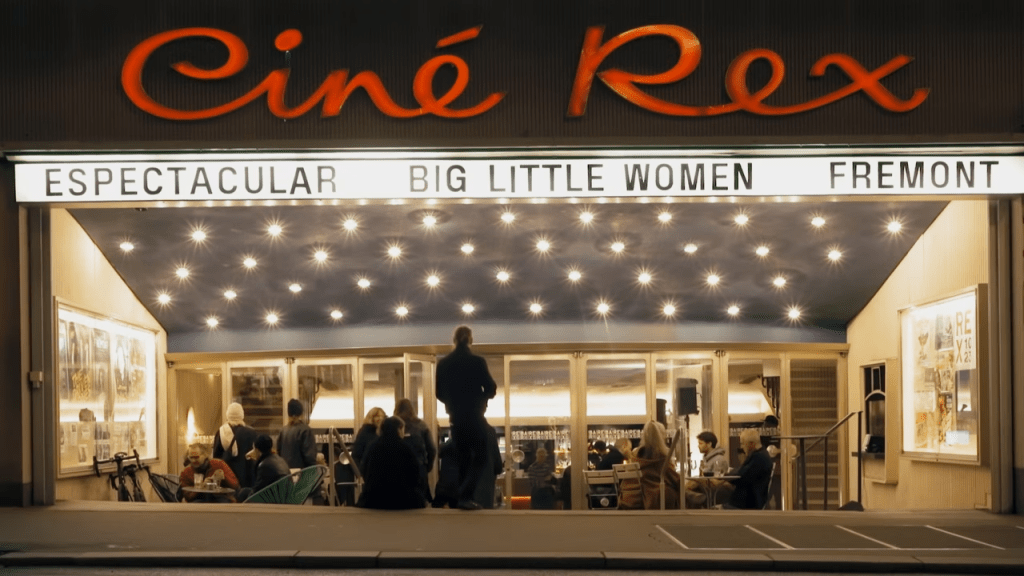
The Cinema REX in Bern, my favourite cinema, and indeed the best cinema in Bern/Switzerland/Europe/the world, shows new releases, mostly independent films or world cinema – but that’s not why they’re my favourite: it’s their curated programme. More or less every month, they’ve got a programme focusing on a theme, genre, country or filmmaker – in parallel to which they will also be running other, longer-term series, e.g. on film history or LGBTQI+ cinema or kids’ movies. Thanks to the REX I’ve seen classics on the big screen that otherwise I might not have had the chance to see at an actual cinema, from Apocalypse Now to Close Encounters of the Third Kind, from North by Northwest to Fanny and Alexander. The other movie theatres in the city that have survived the Great Cinema Purges of recent years also offer curated programmes, such as a series on Cult Movies and Worst Movies, but none are focused as much on providing a curated programme.

Continue reading

Six Damn Fine Degrees #194: Bong Joon-Ho’s “Memories Of Murder”

Welcome to Six Damn Fine Degrees. These instalments will be inspired by the idea of six degrees of separation in the loosest sense. The only rule: it connects – in some way – to the previous instalment. So come join us on our weekly foray into interconnectedness!

Warning: Spoilers ahead for the film Memories of Murder.

Towards the end of lockdown, when the cinema’s reopened, I have fond memories of my earliest trips to see movies. I mean, it wasn’t quite the same. At least half the seats in most cinemas had been removed to create gaps between punters. Masks were compulsory and the experience felt jarring. But there was still something about being able to see films again on the Big Screen – especially given concerns just a few months earlier that the cinemas might never reopen.

Continue reading

A Damn Fine Cup of Culture Podcast #60: Summer of Directors – Martin Scorsese

Our Summer of Directors comes to an end: after Jane Campion, Dario Argento, Ida Lupino and Robert Altman, we’ve arrived at Julie’s choice of director: Martin Scorsese. Poor Marty has come under attack in recent years, especially from fans of the Marvel Cinematic Universe – but ironically, Julie takes issue with Scorsese’ statements on the MCU more than the two resident MCU-heads Alan and Matt. What else do the three of them think of Scorsese as director and film buff extraordinaire? Join us for a discussion of some of Scorsese’s less-discussed works, The King of Comedy (1982), Bringing Out the Dead (1999), and the 1995 documentary A Personal Journey with Martin Scorsese Through American Movies. And let us know what you thought of our Summer of Directors!

Continue reading

A Damn Fine Cup of Culture Podcast #46: Post-pandemic cinema

It is July – and in many countries, cinemas are open again, albeit with some restrictions. Have our intrepid cultural baristas already been back to movie theatres – and if so, what has it been like to be back after several months? How have they coped with half a year without cinemas? How has COVID-19 affected movie theatres and cinema goers alike? And how will the cinema landscape change after the pandemic? Even if we’re looking at a summer and autumn with open movie theatres (fingers crossed!) and upcoming blockbusters like the new James Bond and Denis Villeneuve’s long-awaited, often-postponed Dune, will cinema be the same? Join Alan, Julie and Matt as they discuss these and other issues concerning post-pandemic cinema!

Continue reading

A hellish slice of throat for the gentleman?

It’s been a while since I really liked a Tim Burton movie. Sleepy Hollow looked great, but I felt that the romantic subplot between Johnny Depp and Christina Ricci was tacked on, and largely as a result the film felt mean-spirited to me. Mars Attacks! was half an hour of great over-the-top black comedy padded to an indecent extent with boring SFX bits and cameos. Planet of the Apes was, well, Planet of the Apes. Big Fish annoyed me more than most movies I’ve seen in the past few years; it was aggressively sentimental and the old guy simply angered me with his chronic need to be the centre of attention. (If I’d been the Billy Crudup character, I would have suffocated Daddy Dearest with a pillow ten minutes into the movie.) Corpse Bride was okay and nicely done, but it was no Nightmare before Christmas – the characters were flatter, the music less memorable, and the bits that were best felt like rehashed bits of Halloween Town.

 As I wrote recently, I enjoyed Charlie and the Chocolate Factory quite a bit, but it’s not the sort of film that I’d need to see more than once. All in all, I wasn’t sure what to expect of Sweeney Todd, since I’d heard mixed things. I’m not the greatest fan of musicals (even though I keep finding myself wanting to rewatch “Once More, With Feelings”), and I wasn’t sure whether anything new or interesting would come out of Tim Burton working with Johnny Depp and Helena Bonham Carter yet again.

They’re my friends…!

We sat in the very front row at the cinema, since all the other seats were already taken. Not the best starting point for an enjoyable evening at the cinema (and I’d rather not tell you about the Mexican restaurant beforehand… I may very well have woken tonight, screaming the lyrics of that horrible Latin-y Happy Birthday song they played at top volume).

I think I was riveted about two minutes into the film. Like Sleepy Hollow, the atmosphere was great – the film was one of those that you should be able to frame and hang on the wall. But unlike that throat-wounding movie, this one had better writing and, accordingly, better, more believable characters. While the film was visibly artificial, it didn’t feel fake like many of Burton’s worlds tend to do. And the emotions on the screen felt more… well, more grown up, for want of a better term. There’s something very child-like (sometimes indeed childish) to many of Burton’s works, and in the case of Edward Scissorhands and Ed Wood it works quite well, but it was getting tired and stale. By comparison, this film felt like Jacobean revenge tragedy – bloody, passionate, alive and raw.

P.S.: It’s a shame that Anthony Head (yes, I squeaked “It’s Giles!” at the cinema) didn’t get to do more on screen. Apparently he recorded some songs, but they didn’t make it into the final version of the film.

P.P.S.: For the first time, in this movie I saw why some people think Neil Gaiman and Alan Rickman look alike. When the latter doesn’t do his patented “Where are ze fucking detonators?” sneer, he does look and even sound a bit like Mr. Sandman.

Suffer the little children

I missed Monster’s Ball when it was on at the cinema, and I never really went out of my way to see it on TV. There’s no particular reason for this – except, perhaps, that there seemed to be more talk about the fairly explicit sex scene between Halle Berry and Billy Bob Thornton than about anything else. Okay, a good sex scene can make a film better (Don’t Look Now, I’m ogling you!), but there’d better be something beyond copulatory goodness.

Marc Forster, the director of Monster’s Ball, is one of the few Swiss people who’ve made it big in Hollywood – so big in fact that he’s now doing the new James Bond movie. He seems to be comfortable in many different genres and he gets in the good actors.

Stranger than Fiction

And yet. I wasn’t too keen on Stranger than Fiction, a film that desperately wanted to be more clever than it really was. True, Will Ferrell put in a fairly poignant performance, and I always enjoy watching Maggie Gyllenhaal, but all in all the movie felt like Charlie Kaufman Light, turning its metafictional veneer to the service of an essentially trite Carpe Diem story. And what was worse (at least for me): the book that the critically acclaimed author played by Emma Thompson was writing was drivel of the worst sort. It wasn’t even a parody of literary fiction – it was the sort of thing that a decidedly mediocre first-term creative writing student might cobble together, feeling awfully proud of himself.

Last week we watched Finding Neverland. Again, Forster’s assembled a lovely cast of actors: Johnny Depp, Kate Winslet, Julie Christie, Dustin Hoffman. The film is well crafted, obviously. But the story and dialogues render their work disappointingly toothless. Most of the performances are adequate, but let’s face it: it doesn’t take much to get an adequate performance from these actors. It’s more difficult to get a bad performance from them. But what can they do, when their characters can all be summarised in two sentences without being reductive?

Finding Neverland

There are small joys in both films. Dustin Hoffman is understated but great fun, both as the theatre impressario and as Stranger than Fiction’s literary critic. (I just wish he’d say what is so blatantly obvious – that the book Will Ferrell’s character is in is badly written rubbish.) And Freddy Highmore (who went on to play with Johnny Depp yet again in Charlie and the Chocolate Factory) is great. Not only is his acting subtle and moving, his character is probably the only one in the film who is ambivalent, who has depth, who doesn’t fit comfortably into a well-worn cliché.

Talking of children: perhaps the strangest, sweetest sight in any Deadwood episode is that of the school children lined up behind Joanie Stubbs and Calamity Jane holding hands, walking down the thoroughfare to their new school. For a few moments, the scheming and bloodshed comes to a complete halt as the inhabitants of Deadwood come out to watch the children. I have a feeling, though, that “Amateur Night” will be the last episode of the season (and, sadly, series) that will allow for such peace and quiet. Something is going to happen, and it’s going to happen sooner rather than later. I’ve rarely seen a series that managed as well to ratch up the tension. Somehow I have the distinct impression that the title of a recent P.T. Anderson film will describe the last three episodes of the series quite accurately.

And no, I don’t mean Punch Drunk Love.

Let’s face the oil well and dance…

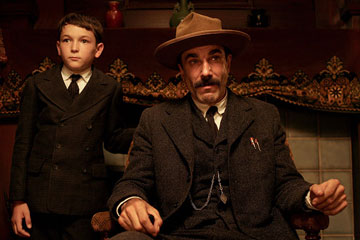
There’s something weird going on in P.T. Anderson’s There Will Be Blood. Okay, there are many weird things going on – the film is quite confounding on the whole, as it doesn’t present its story the way you’d expect it – but when you watch the beginning of the film, a long sequence without any dialogue, you feel some strange sort of double vision. At least you do if you’re a film nerd like me, that is.

On the one hand, you’re watching a solitary prospector mine for silver in a desolate landscape, breaking his leg in a bad fall, striking it rich – and then, almost by accident, finding oil. On the other hand, the music and the landscape suggest very different images, recalling one of the most famous (and most parodied) scenes of cinema:

There is some sort of weird intertextual thing going on between There Will Be Blood and Kubrick’s movies that is discussed intelligently in this forum post. Beyond that, though, there something eerily ritualistic and religious about the film’s beginning: it’s as if the black liquid gushing from the ground is the harbinger of some new, cruel religion that will require sacrifices. In his way, Daniel Plainview (a disturbing performance by Daniel Day Lewis that is more complex than its detractors admit) is more of a mad prophet than his opponent, the self-righteous yet wheedling Eli Sunday. It’s just that human beings have no place in his religion.

Is it better to rule in Hell…?

I recently re-watched Magnolia, which I still like a lot, so There Will Be Blood came as a surprise. Even Punch Drunk Love, which I didn’t particularly enjoy (or understand), felt more like the P.T. Anderson who made Magnolia and Boogie Nights. Those latter two films were quintessential ensemble movies. There Will Be Blood has barely enough space for one or two characters next to Plainview. It grows out of its central monolithic (if you forgive the Kubrickian pun) protagonist: perhaps the most frightening character in recent film history.

P.S.: Please keep in mind that I haven’t yet seen No Country for Old Men, so I can’t judge the scariness of that film’s Anton Chigurh. His hair’s plenty scary enough, though.

Prince Valiant, the Cleaner

P.P.S.: After Miami Vice used to be the top search term leading people to this website, it has now become “magenta”. So, my heartfelt thanks to one of my frequent readers. Hope you’re getting just as many hits because of me!

Where the wild things are

Sean Penn is clearly a very talented artist. He’s also annoying and self-righteous as hell, at least sometimes (and I’m saying this as someone who basically agrees with many of his opinions). So what happens if someone annoying and self-righteous makes a film about someone annoying and self-righteous?

In the case of In the Wild, what happens is that you get a beautiful, moving, disturbing and infuriating film.

The film clearly has admiration for the uncompromising cut Chris McCandless makes with his family and his past, and for the way McCandless – calling himself Alexander Supertramp (he doesn’t seem to be ironic about this) – goes out into the American wilderness to become himself. Penn’s movie, especially in its images, shares his protagonist’s awe at the beauty of the country and of nature, and so do we to some extent. Part of me definitely thought, “Yeah, man, I’ll get rid of all my belongings, get some survival gear and live like Grizzly Adams! Right on!” And I didn’t even need to be smoking pot to think it.

At the same time, McCandless (as portrayed in the film) can’t be described as anything else than a self-righteous, selfish adolescent. Clearly many of the societal conventions he abandons are also selfish in nature – do parents have any claim to their children’s lives? does a sister have a claim to her brother? But Chris makes people care about him and then he’s off. Being human, the film implies amidst the awe, also involves human contact, human responsibilities… and responsibilities seem to scare McCandless. It’s either that, or he’s cheerfully callous about waltzing into people’s lives and then waltzing out the moment they feel for him.

It is this ambivalence about the central character that makes Into the Wild more than just a beautiful film. Some critics have been rather negative about this: why feel awe for such a selfish jerk? Didn’t McCandless simply got what he deserved? Yes, he (the movie character – I don’t want to judge the real person on the basis of a movie) is selfish, and yes, he is a jerk. Yes, he’s a coward who doesn’t have the courage to forgive. Yes, he’s also an idealist and a dreamer, and his cowardice is also his courage. Strip the film of this central ambivalence, and you turn the movie into a simplistic cautionary tale: Don’t abandon your family and your cosy capitalist surroundings to go into the wild, because you’ll die of starvation in an old bus, only to be found by moose hunters two weeks later.

Personally, I prefer to feel both awed and infuriated. I prefer to be given enough space to make up my own mind. And space is something Penn’s film has in spades.

Into the Wild