Do hackers dream of digital love?

Can one fall in love with a fictional character? More to the point, can one fall in love with a character in interactive fiction, experienced only through (fictional) e-mails? And what if that character turns out to be an Artificial Intelligence?

Welcome to the nostalgia soaked world of Digital: A Love Story, an interactive fiction by the improbably named indie game designer Christine Love. Interactive fiction: does that mean Digital is a game? Well, it is, although it lacks many of the conventional traits of games – it cannot be lost, it isn’t difficult as such (there are a handful of puzzles that are well integrated into the plot, but that’s that), in many ways its not all that much more interactive than HTML pages filled with hyperlinks. The notion of an indie interactive fiction, especially one concerned with a theme as weighty and overdone as love, may strike some as pretentious, that most overused and pointless of critical words.
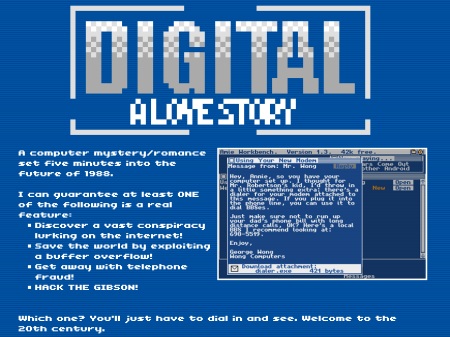
Don’t let any of that keep you away from Digital, though. I’d imagine that Love’s beautiful, intelligent and moving game works best for those who used computers in the late ’80s already and who are at least not completely opposed to the cyberpunk fictions of William Gibson. Digital‘s use of cyberpunk sci-fi is subtle and her interest is always in characters and emotions rather than in technology (at least as anything other than the vehicle for relationships). Her main interest, at least on the basis of this and its successor, the wonderfully titled don’t take it personally, babe, it just ain’t your story, is relationships and feelings – though not in a soppy way, as her writing and especially her use of the medium shows her to be eminently smart at what she’s doing.

The whole of Digital happens in the low-tech environment of BBSes or bulletin board systems – basically the pre-internet versions of webpages and message boards. As the player exchanges messages with other users of a number of BBSes, a plot emerges… and a romance develops between yourself, the player, and another user called Emilia. One of Love’s smartest decisions is that the player’s messages are never spelled out. You learn from the replies what you must have said, but the exact words, the details, everything that makes up your personality, is left up to you. It’s this specific kind of gaps in the narrative that is unique to games, pulling you in a way that is very different from how prose fiction engages its readers – and it’s difficult to imagine such compelling experiments in interactive fiction in big-budget mainstream games development. It’s the low-tech environment of indie gaming that makes gems such as Digital feasible.

There’s a twist roughly halfway through Digital, and (perhaps due to half-remembered spoilers in reviews) I’d figured it out fairly early into the game, but it doesn’t matter: Love deftly tells her story with the player’s help in a way that makes it much less about what happens than about how you react emotionally. As Digital came to an end, I found myself sitting there almost crying. A synopsis of the game, even a more detailed retelling, could not evoke the feelings I was going through: it was the sensation that this was my story, that I was living it as it happened, and that it would always be a part of me. Even as I could see the strings by which the puppets were manipulated (me included), there was an emotional reality to Digital that is rare in most fiction, whether interactive or not.

And if I haven’t already turned you off the game, consider this: it’s free. Want to see whether there is anything to my effusive praise? Download Digital here, play it, and then come back and tell me what you thought of it.

Living in a box

There should be a sci-fi subgenre called “brain in a box”. You know the type of story: the protagonist goes about his normal life (are there any female brains in a box in those stories?), but suddenly things start being… off. Things become strange around the edges. And then comes the revelation: the protagonist’s reality is actually ‘reality’. He’s plugged into some system that simulates life for him, often because he’s no longer a full-bodied human being. He’s a brain in a box. Cue existential despair and dramatic irony, though the upside is vastly reduced rent to pay.

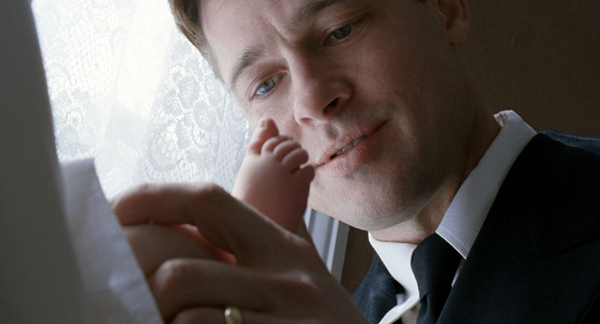
Duncan Jones’ Source Code belongs to that sub-genre, even if strictly speaking Jake Gyllenhaal’s character is more of a torso in a box. It’s definitely a clever, fun addition to the BiaB family – but unfortunately it isn’t quite clever enough. See, it also belongs to a different sub-genre: that of “the one before that was way better.” Duncan Jones set the bar pretty high with Moon, another philosophical, existentialist sci-fi conundrum. Moon was perhaps a tad too ambitious for its own good – it tried to tell two stories but only ended up telling one (who am I, and why are there two of me?) really well, while fumbling the other (heartless corporations are heartless). It was, though, a fantastic first movie: smart, entertaining, poignant.

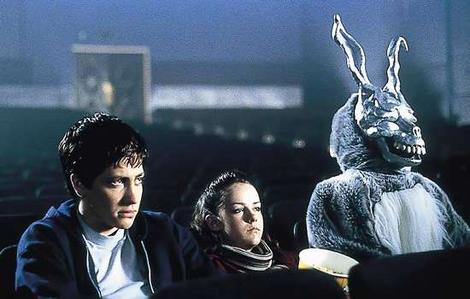
By comparison, Source Code is the earlier film’s cute but not quite as smart cousin. It’s unashamedly more Hollywood, which is fair enough – films want to be liked too! – but ends up being faintly disappointing. Perhaps I’m just a sucker for poignancy and melancholy, but what makes Source Code the lesser film is that it doesn’t balance its sci-fi plotline and its human element as deftly as Moon. Similarly to another Jake Gyllenhaal movie (think rabbits…) it’s most effective when it’s about a guy who tries to stay in control of his increasingly unhinged life, but when it decides it’s actually about these quasi-metaphysical sci-fi machinations the character drama becomes less touching, less real. It’s more difficult to care when the film geeks out over its sci-fi gimmick.

Not every sci-fi story has to have a strong human element, and not every story needs to be poignant. But Source Code tries to have its cake and eat it – be about the futuristic MacGuffin and be about its protagonist’s existential conundrum) without being quite clever enough to pull it off. Again, without its loony predecessor I might have liked it better, so perhaps I’m not being entirely fair; but in the end I can’t help thinking that Jones could do better than somewhat clever, somewhat entertaining, somewhat engaging. He has done better.

And perhaps, in some parallel universe he did do better the second time round, and there’s a quantum me writing a blog about how the successor to Moon was even better, even smarter – and so poignant it makes your tear ducts quiver with bittersweet glee…

When the morning stars sang together, each to each

If the cosmic astronaut God-baby from the end of 2001 came back to earth and made a movie, this would be it. (And we wouldn’t understand what it was trying to tell us, either.)
– Andrew O’Hehir, Salon

There can be no doubt about it – Terrence Malick has made some of the most visually beautiful films in the history of cinema. Narrative coherence, strong characterisation, those are not what anyone should look for going into a Malick movie, but they can expect to see awesome images. And not in the Michael Bay, big explosions, expensive CGI and Megan Fox’s cleavage way; Malick and his DPs create images that are poetic, both grand and intimate, and they’re masterful at evoking moods and emotions. Even if all the dialogue were stripped from his films, they’d still be powerful pieces of cinema.

In fact, perhaps the films would be more powerful without the dialogue. Malick is often accused of pretentiousness, and especially from The Thin Red Line onwards the voiceovers are less and less about characters and increasingly about giving voice to Malick’s philosophical concerns. The problem is that the questions voiced are not only grand but veer towards vague commonplaces. Why are we here? Why does Man fight against himself? Where are we going? Are we there yet?

No doubt, these are big and important questions, but they’re so big that they need to be broken down to be addressed, unless you’re having one of those student dorm, 2am, after a bottle or two of cheap red wine conversations. At his best, Malick breaks them down by providing many individual moments and perspectives, all of them contributing in impressionistic fashion towards answers. At his worst, the voiceovers evoke a sarcastic “That’s, like, deep, man!”

The Tree of Life has some of Malick’s most beautiful, evocative images to date, and I enjoyed the film more than his last, The New World. (I’m a Thin Red Line man, myself – and give me Days of Heaven any day.) It also relies less on voiceovers, which is good, because the more verbal Malick gets in his last few films, the more he risks becoming preachy and annoying, like one of those dreadful slim volumes of facile sub-Zen meditations on life. But in its elliptic nature, The Tree of Life becomes vague in ways that are condusive less to deep thought than to confusion. Who’s that kid? Is he one of the brothers? Are those Jack’s parents fighting? Why are we watching a dinosaur step on another dinosaur’s neck? Is Jack dead? Are those angels? Is that Aunt Petunia? Isn’t Smetana’s “Moldau” a beautiful piece of music, even if it’s criminally overused? Should I get a Coke in the break?

During the film’s strongest moments, its insistence on narrative ellipses is as evocative as the visuals. Malick can pull this off as well as Tarkovsky. At its worst, though, The Tree of Life is so intent on letting its visuals and the audience do its work, meditative becomes soporific and self-consciously coy. Does it make the film deeper, more meaningful that there are three brothers, if two of them barely become more than cyphers? Do glimpses of some kid having an epileptic fit in the background, while Jack is being led away, add to the experience if we have no idea whether that kid is a neighbour or a brother or just some random kid off the street? Gaps in the storytelling can be great starting points for our own thoughts, but if the gaps are too big, our thoughts become random – we’re as likely to think about what we need to get from the shops the next day as we are to ruminate about our existence and the grandiose beauty of creation. And the ending? I was torn between being moved, intrigued, “Huh?”ed and thinking, “I remember when this was an Orange ad.”

Would I recommend The Tree of Life? Probably not. Did I enjoy it? That’s a qualified yes. Was it beautiful to look at? Definitely, almost achingly so. Just don’t think too much about that plesiosaur. Just be awed, and don’t feel too bad if your thoughts wander to the shopping list.

P.S.: Is it just me, or is Hunter McCracken (who plays Jack as a child) almost eerily like a young version of Jim Caviezel’s character in The Thin Red Line?

One for the road…

No, this isn’t another post on The Road. (I’ve written interminable entries about one Nick Cave-scored film, I don’t need to add another one at this time.) It’s about the book I’ve just finished reading: Must You Go?, a memoir by Antonia Fraser about her life with Harold Pinter. I’m usually not much into memoirs and biographies – I’m very much a fiction reader – but this one was a present from a friend, and a fitting one; I’d directed that friend in a student production of Pinter’s The Dumb Waiter 13 years ago.

Fraser’s book is eminently readable, even if during the middle third or so it feels like it consists primarily of encounters with famous people and praises of Pinter’s writing – though obviously one wouldn’t go to a widow’s memoir for an in-depth appraisal of an author’s literary output. Must You Go? is also a sad book, as its final 100 pages lead up to the death that answers its titular question in the depressingly affirmative. But throughout the book there are passages that made me smile, grin and every now and then even laugh out loud. And there’s something so wonderfully British about the diary entry that describes what happened after Antonia Fraser told her husband at the time, Hugh Fraser, about her affair with Harold Pinter:

In the end I summoned Harold round. He drank whisky, Hugh drank brandy. I sat. In a surreal scene, Hugh and Harold discussed cricket at length, then the West Indies, then Proust. I started to go to sleep on the sofa. Harold politely went home. (p. 23)