Is there any other period in German history that feels as unsettlingly familiar in 2026 as the Weimar Republic? It’s become something of a cliché, but it’s frighteningly easy to tell a story about Germany after the First World War and before Hitler seized control of the country that also speaks to the present day: you don’t have to squint hard to see the Weimar Republic as a time akin to ours in many ways. In the years culminating in the Great Depression, authoritarianism and totalitarianism seem more and more attractive to all too many, while others put their heads in the sand and ignore the warning signs. (Stop me if this sounds familiar.) And the time lends itself to telling stories that appeal to audiences: the big-budget neo-noir series Babylon Berlin tells exactly that story, even if it may be too enamoured with its own aesthetic, making something of a fetish out of the period, and there’s Cabaret, the musical (and later film adaptation), based on Christopher Isherwood’s semi-autobiographical novel Goodbye to Berlin, which has been revived recently on the stage, attracting big stars.
During the era itself, too, you’ll find iconic films that are suffused with the anxieties of the day, such as Metropolis (1927) and M (1931), which film geeks will certainly be familiar with. Maybe less familiar, at least to those who didn’t go to school in a German-speaking country, is the 1929 novel Berlin Alexanderplatz by Alfred Döblin, one of the classics of modernist German literature – which Rainer Werner Fassbinder, enfant terrible of New German Cinema, adapted for television in 1980.

In 1928, the war veteran Franz Biberkopf is released from prison. Why was he in prison? Because he killed his girlfriend, not in a premeditated murder but in a fit of rage because he feared she might leave him. If that didn’t already do enough to endear Biberkopf to us: one of his first actions when he gets out is to visit Ida’s sister Minna… and rape her. All of this happens in the first of fourteen episodes, most of which are around an hour in length, which raises the question: is Fassbinder trying to set the baseline for what is to follow, so that anyone watching the series can decide to nope out at this point already? Sure, Fassbinder is only following Döblin’s novel in this, so arguably he’s just doing what it says on the tin, or in this case in the book, but I too asked myself: am I really in the market for 894 minutes of this kind of brutishness and squalor?
I did persist, and Berlin Alexanderplatz does succeed at making Biberkopf into something other than an irredeemable protagonist: we see him at his worst very early, but we also come to understand that his violence and misogyny aren’t only his. This is a world that is heading for collapse, and Franz Biberkopf isn’t an evil brute so much as he is someone who, for all his physical strength, is weak. He is impulsive to the point of violence, but also easily led. It is not so much that he doesn’t try to reflect on the world and on himself: he is just not very good at it. More than that, he is swayed by what he sees around himself, as he generally assumes that others know better than him. He is not a conformist in the sense of Alberto Moravia’s protagonist in the 1951 novel of the same title (portrayed so memorably by Jean-Louis Trintignant in Bernardo Bertolucci’s adaptation of 1970): there is little calculation to Franz, and he isn’t consciously amoral or even immoral. He wants to do right, but his moral muscles are flabby. Really, he is an overgrown child – which doesn’t excuse his actions in the least – and a dangerous one, considering the world he lives in: Germany between the World Wars is rife with people all too eager to find those who are easily manipulated and put them to the worst use possible.

Franz, in particular as performed by Günter Lamprecht, is an odd mix of traits: he is loyal to a fault, especially to his male friends, but also volatile. He wishes to be good, but believes whatever he was told last, especially by his more manipulative acquaintances. He can be sullen, thuggish and crude, but also surprisingly, if inconsistently, tender with the women in his life – until they anger him, and then he lashes out quickly. In spite of this, and oddly perhaps to most contemporary viewers: the women in Berlin Alexanderplatz are drawn to this man who can be a nasty brute and who often has the simplicity of an overgrown toddler. What is it that makes him attractive to them?
Fassbinder sticks closely to Döblin’s novels, often using passages verbatim, but the series is also very recognisably Fassbinder’s creation, from the visuals that depict 1920s Berlin through a decidedly 1970s lens, via the depiction of sexuality (Fassbinder doesn’t add the elements of homoeroticism in his adaptation, but the depiction is 100% his), and especially in the ensemble of actors, which includes regulars such as Hanna Schygulla, Brigite Mira, Gottfried John, Günther Kaufmann, and various others. Watching Berlin Alexanderplatz in 2026 makes for an interesting triple vision: the story set in 1928/29, the style that is very much reflective of Fassbinder and the 1970s – and the themes that are, once again, all too timely.
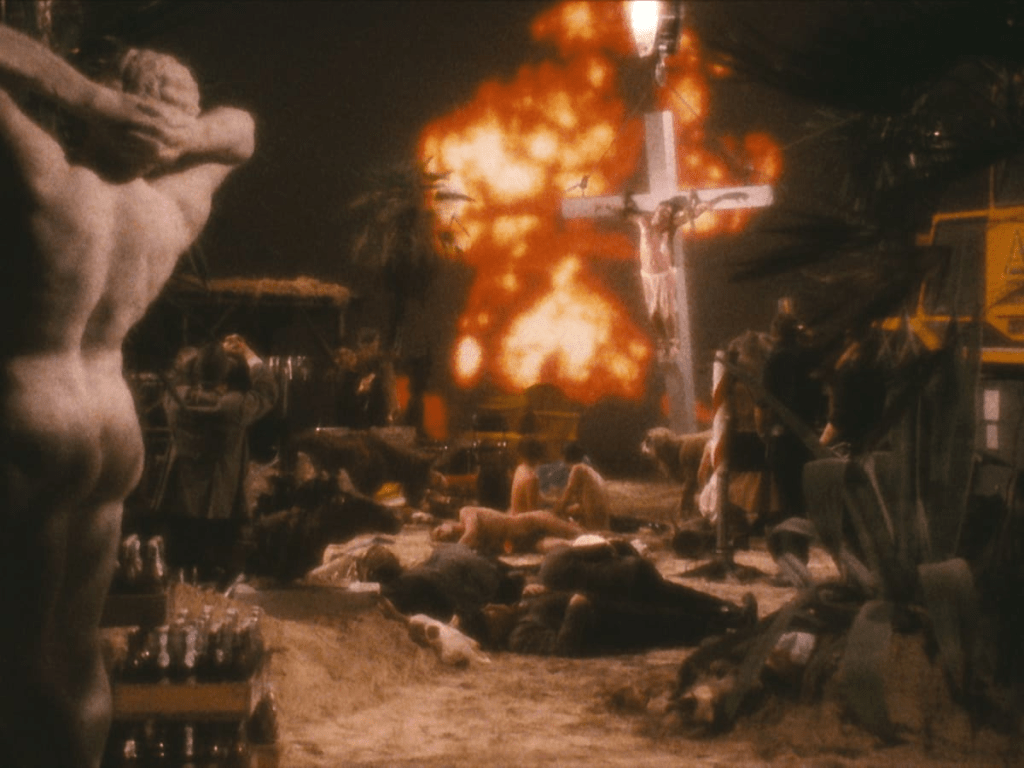
Verdict: I can’t make heads or tails of Rainer Werner Fassbinder. I can’t really say that I like his films, and in some ways they all feel off: not outright bad, but adjacent to bad filmmaking. His writing is unwieldy, his actors can deliver work that, in another film, would feel melodramatic almost to the point of parody, and the visuals of his films aim for a grungy, squalid kind of kitsch that, in a different context, might be laughed at. There is a self-conscious flirtation with trashiness to the work by Fassbinder that I’ve seen.
And yet, it is these idiosyncratic qualities that make Fassbinder’s films feel like nothing else – and the considerable length of the adaptation allows the audience to acclimatise to what Fassbinder does. Elements that at first, and in particular seen against the tasteful moderation of supposedly ‘good’ cinema, feel kitschy and trashy take on an energy that is quite unique to Fassbinder. And both Döblin’s story and his modernist style would likely have been served much worse by a more conventional adaptation. You can certainly imagine Berlin Alexanderplatz turned into a slick, well-crafted period piece – but it would have lost much of the sense that this is not just a story of the late 1920s, or even the 1970s. Fassbinder’s strident style, kitsch and camp to the point of anachronism at times, doesn’t allow us to settle into a comfortable mode of watching what seems to be the distant past, where the Weimar Republic might as well be the day and age of Jane Austen, the Middle Ages or Ancient Greece.

Having said that: even while Fassbinder doesn’t allow us to settle into the comfortable nostalgia of so much historical drama, not all of his creative decisions pay off equally. I don’t mind long-form storytelling, but I am not sure there’s enough mileage to his decision to cut very little plot from Döblin’s novel. Franz’ life in late 1920s Berlin often repeats the same kind of plot and character beats; and while repetition may be part of the point (Franz is certainly more than a little prone to repeating his mistakes), here it can backfire, causing audiences to disengage rather than see the point in watching variations of the same subset of scenes. A version of the series that is perhaps eight to ten hours long could have maintained the repetition without some of it risking becoming redundant in the storytelling.
Other than that, though, Berlin Alexanderplatz is worth a visit – definitely for Fassbinder aficionados, but also for those, like me, who find the writer-director and his work fascinating even while they can’t figure out whether they like the films or not. For all of the plot’s timeliness, this is very much a work of the German New Wave and a kind of filmmaking that never panders to the audience. There is a strangeness, indeed a queerness, to the story and its telling that is fascinating, and that amplifies its effect of not letting the audience watch this as a simple period piece.
 A Damn Fine Cup of Culture