One of the things that video games can do magnificently is create worlds. These posts are an occasional exploration of games that I love because of where they take me.
My first few visits to Night City weren’t auspicious: this place was too loud, too shiny, too neon. The people were annoying, the traffic lethal, and wherever you looked, there’d be advertisements, more often than not featuring so much sexual innuendo or outright T&A that you’d almost forget there could be any other body parts. And, obviously, the ads wouldn’t be silent, because that would have meant that you could ignore them, so from every other speaker you’d get the sound of moaning interspersed with someone trying to sell you something. They do say that sex sells, but what these ads were selling me on was, first, noise-cancelling headphones and, secondly, a quick flight out of Night City.
Except I couldn’t: I was a cyber-enhanced mercenary with a biochip in my head. A biochip containing the engram of legendary rock star/terrorist Johnny Silverhand – and, slowly but surely, Johnny’s consciousness was overwriting mine. So, sure, I could leave Night City and live the quiet life for a few weeks – until my own mind would be completely erased and, to all intents and purposes, I’d be dead. Or I could stay in Night City, tolerate the noise, and try to find a solution to my predicament… or die trying.
For a long while, whenever I’d pass one of those loud, grating ads for cybernetic sex aids or cybernetically enhanced sex work or booze being sold with the visual imagery of blowjobs and the like, I felt the urge to leave again (that is, play something else instead). Anything would be better than the hypercapitalist, hypersexualised, hyper-everything moment-to-moment of Night City.
And then I fell in love with, of all things, the architecture.
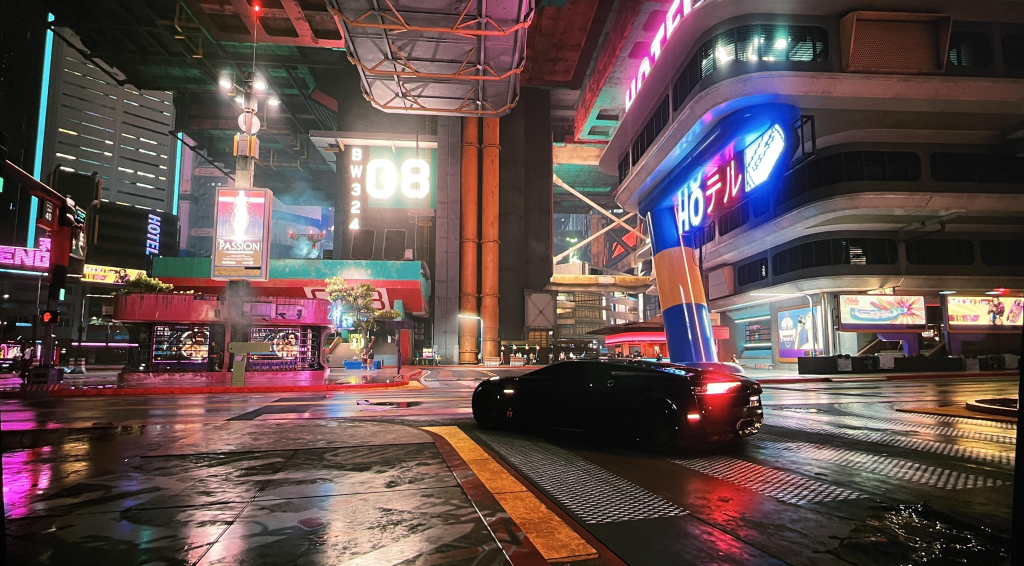
I’ve been playing video games since the early 1980s. And like so many Gen Xers who’ve been playing for that long, I have a fondness for old-school, retro games. But I’d be silly not to admit that there’s a clear appeal in games that take full advantage of modern tech. And Cyberpunk 2077 is certainly a great showcase of what a video game can look like in 2026. I could throw around terms such as ray tracing and path tracing and mention hardware named to sound like rejected Star Wars droids, but it all boils down to this: this game’s graphics sure are pretty. But it’s not just superficial bells and whistles: the graphics tech that Cyberpunk 2077 uses so well makes light behave much more like what we’re used to in the real world – and then tweak this to achieve specific aesthetic effects. Night City is a place of neon lights and animated adverts, and all of this reflects in glass, polished chrome and the glistening asphalt, in particular after rain. Lights, buildings, people and vehicles are mirrored in the shiny surfaces of this place. And yes, it does look pretty, but on a less conscious level it binds everything together and makes it feel real – even if we’re talking about the ’80s-inflected sci-fi of the Cyberpunk world. If you’re sitting opposite someone at a sci-fi diner, they reflect in the retro Formica table, and you might even catch a small mirror image of them in a beer bottle or a salt shaker. And if you’re looking at a shop window (selling some form of sex or using sex to sell anything else, natch), you can see the reflections of pedestrians and cars passing behind you. Light that behaves like the real thing makes this fantastic, stylised world feel more grounded and believable.
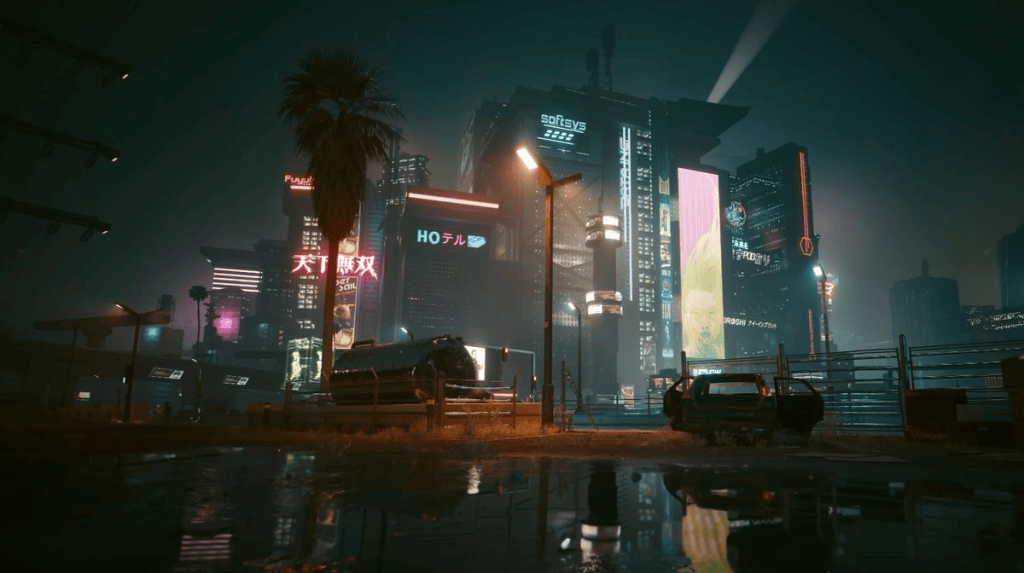
Sure, there is certainly a gaudy quality to the vistas of Night City, but its brash loudness wears off with familiarity. Rather than driving from one gig (that’s what us cyberpunk mercs call the jobs we take, in case you were wondering) to the next at top speed or even (gasp!) fast-travelling, I walked and sometimes ran down the streets and alleys of the city. We’re talking about a big game here, so while Night City itself is also big – the entire game world is the virtual equivalent of 75 square kilometres -, in the 70+ hours during which I played Cyberpunk 2077, I came to know the place. And Night City boasts some fantastic, and surprisingly subtle, design: its various districts all have their own identity, there are commercial, industrial and residential zones, and you can tell from the look and distribution of buildings and businesses when you’re getting close to the edge of town. The gangs that dominate various parts of Night City differ, and so do the gang tags and other graffiti. At first, this urban behemoth is overwhelming, but the more you spend time there and explore, the more it feels like a virtual home – that still is a hellscape of late-stage capitalism, like every good cyberpunk city, but you find moments of quiet in its small nooks and crannies. Character upgrades let you jump higher, so you can even explore rooftops, which can lead to some fantastic views of the neon jungle.
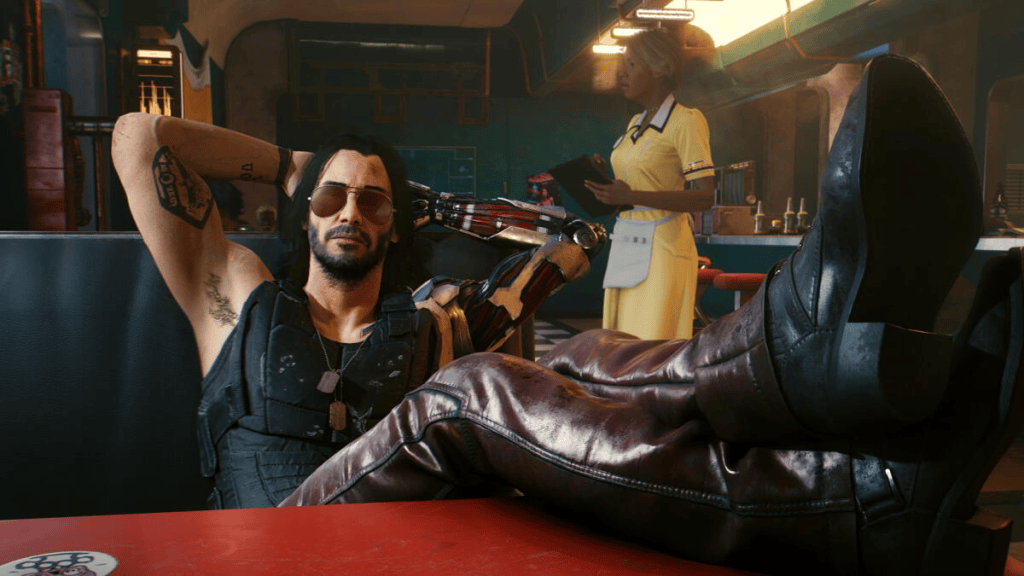
Cyberpunk 2077 is also noteworthy for its cast of characters – and perhaps more so from a certain perspective, the cast of actors who portray those characters. Johnny Silverhand, the dead celebrity madman that’s stuck on a chip in your head, is played by none other than Keanu Reeves, himself no stranger to cyberpunk stories, and Phantom Liberty, the expansion released three years after the main game, features a key character with the voice and likeness of Idris Elba. The moments where you interact with these or any of the other well-written, well-performed characters of Night City make for great storytelling – but Cyberpunk has another trick up its sleeve that brings together its colourful cast of protagonists, antagonists, companions and sidekicks, wheelers and dealers and what is arguably its central character, Night City itself: in many of the missions you play, at some point you’ll meet up with one of the non-player characters, you get in their car, and they drive you from A to B while the two of you talk about the upcoming heist, hit or high-level meeting with the rich and the powerful paying top dollar for your services.
While these drives can often be skipped, they are a fantastic way of reinforcing your developing relationship with Night City: while you’re listening to Jackie Welles or Panam Alvarez or Solomon Reed (the sleeper agent played by Idris Elba), you can look around freely and spot the apartment block where you live or the diner where you met up with some shady street samurai. You’ll see those familiar highrises contoured against the dawn sky or drive down the stretch of road that, only a few hours earlier, you’d hurtled across in one of the street races you can join. This may sound odd to people who don’t play games, and even to a lot of people who do play them – but for me, game worlds come alive most during those moments, when you just exist in a place and traverse them, without the challenge and stress of an action setpiece getting in the way.
Some say that the quiet moments punctuate storytelling, in games as much as in other media: for me, it’s really that the loud, exciting moments punctuate the stretches where I’m interacting with these virtual worlds in ways that don’t involve a gun or a katana but a car, a motorbike or simply my own two (in this case, massively cyber-enhanced) feet.