You can’t always go back

Before Sunrise seems to be one of those films that ‘people of my generation’ (the moment you use that phrase unironically, you’re getting old, man!) tend to like. Somehow many of them seem to feel that it captures their attitude towards romance and what they wish their EuroRail adventures had been.

Some films should be seen for the first time at a certain age. If you don’t see them when you’re ten or sixteen or twenty-two, you’ve forever missed your chance, and unlike your peers you won’t be able to watch them with a healthy dollop of nostalgia that makes them bearable to begin with. The Goonies is probably one of those films, with its ’80s cod-Spielbergian cast of kids. Having seen Before Sunrise for the first time less than a week before I turn 34 makes me think that this is another one of those films.
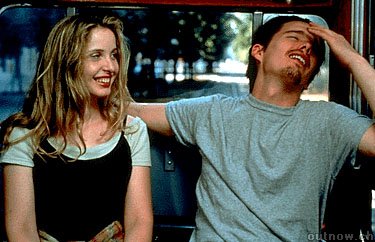
Gosh, aren't we all, like, cute and stuff?

It’s quite obvious that the movie itself is enamoured with its leads and their conversations – because that’s all there is. My thoughts, for most of the film’s running time, were, “Yes, I remember those kind of conversations, when I was an undergrad student, at 2am after lots of red wine.” In that situation, those wannabe deep talks are enough – but now? I sat there thinking, “Oh, grow up!” and making fun of the characters’ self-infatuation. Which worked for about ten, fifteen minutes… and then it got boring.

You can capture the feel of a certain age or a certain type of situation. You can do so with lots of affection. But the moment you give up on any semblance of critical distance, you’re likely to end up with something narcissistic – something you can only love if you identify 100%. But especially Julie Delpy’s Céline is way too serious about her ramblings, giving the impression of a second-year Philosophy student (with a minor in Gender Studies) thinking that she’s discovered The Meaning of Life. Personally I found Ethan Hawke’s Jesse somewhat more bearable, because I thought that he doesn’t have this po-faced seriousness, whereas my girlfriend found him way more annoying. Read into that what thou wilt.

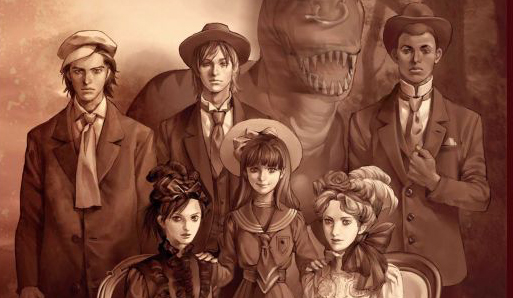
On a somewhat more positive note: I received Alan Moore’s new comic this week, the cumbersomely titled League of Extraordinary Gentlemen, Volume III: Century: 1910 (if we want to be exact, we’d have to add the intriguing, Brecht-inspired subtitle, “What Keeps Mankind Alive”). It’s very clearly the first part only of a longer story (parts 2 and 3 are to follow in 2010 and 2011, alas), but differently from Moore’s Black Dossier, he’s actually telling a story in this one. And he’s up to his usual clever intertextual games, his major inspiration for this one being Berthold Brecht’s Threepenny Opera.

And yes, Moore and O’Neill still like a good bit of nudity, although there’s less of the actual sex. Regardless of whether you like that sort of thing or not, Kevin O’Neill’s compositions are gorgeous:
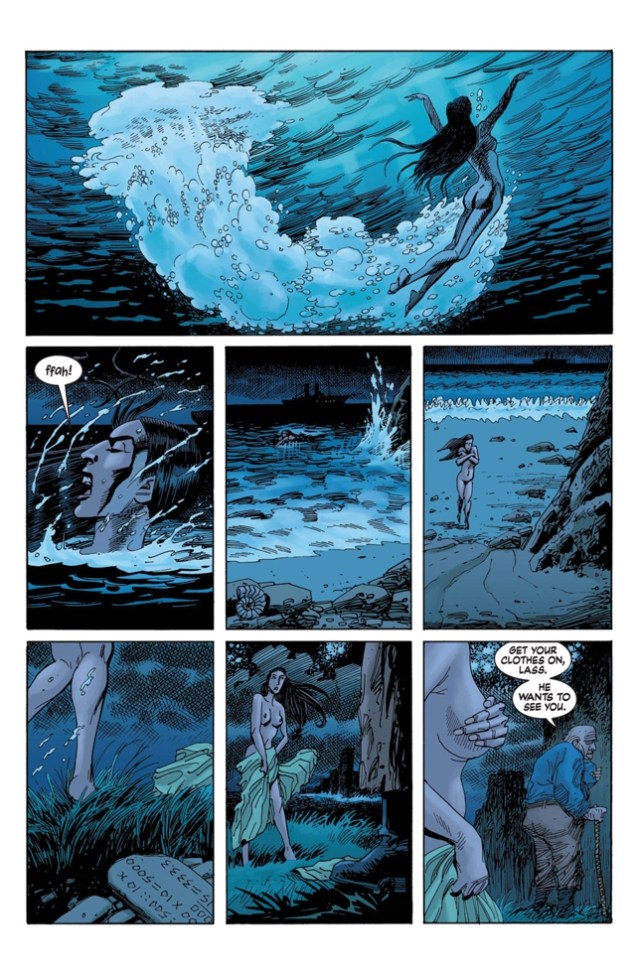
league-of-extraordinary-gentlemen-century-4

And to finish on a slightly less voyeuristic note – checking out the Threepenny Opera before reading Century: 1910 seems to be a requirement:
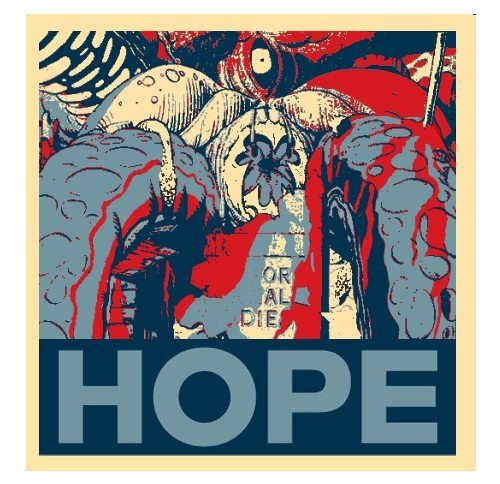
Sick squid? Not bloody likely!

Squid we can believe in!

The short version: I liked Zack Snyder’s Watchmen. It was by no means perfect and there are a couple of pretty bad flaws – mostly to do with the film’s interpretation of Adrian Veidt and the massive cuts in Laurie/Silk Spectre II’s backstory (to the point where there is almost nothing left of the crystalline glory of chapter IX, “The Darkness of Mere Being”) – but it’s the first film version of an Alan Moore comic that takes the source material seriously, even if it doesn’t always completely trust its audience.

One problem that Snyder seems to have, though, is that he’s too much in love with his talents and his cleverness. The use of music was one aspect of this, with too many jokes being used in a winking “Get it? We’re being clever as well as showing reverence to Moore’s original!” And whenever there was something semi-clever, Snyder had the tendency to linger on it for much too long, making these moments smug rather than witty and subtle. The cheesy soft porn scene on Archie? Prime example of that sort of smugness. Moore wasn’t above the occasional broad joke in the original, but they didn’t last for five minutes.

The other thing is Snyder’s propensity for over-the-top violence. Some fit okay, even though I didn’t particularly feel I needed to see a man’s arms being sawn off (not that the original scene with its throat-cutting was that much more harmless – I’ve got a thing about throat-slicing scenes…), but the first fight scene with Dan and Laurie didn’t make any sense story-wise. These two haven’t been wearing their costumes for years, they haven’t been out to beat up street ganes in a long, long time. Their first fight should be clumsy and exhilarating, not choreographed to a T.

My problems with the ending? No, they have nothing to do with Snyder’s re-interpreting the squid into S.Q.U.I.D. I agree that audiences wouldn’t have bought the comic’s finale – hell, I’m not sure I fully bought it, at least not the means by which Adrian executes his plans. What didn’t work was how clean everything was: in the original we’re treated to page after page of the apocalyptic, horrific results of Veidt’s plan. There’s nothing clean about it. Similarly, in the film Ozymandias more or less receives absolution from Dr. Manhattan – and in an utterly inexplicable move, the “Nothing ever ends” line that is so essential to the ending and to Adrian’s character ark is spoken, after her return from Antarctica, by Laurie in a conversation with Dan. As a wise man once said: Huh?!

Final quibble: why, oh why, did they feel the need to change the beautiful simplicity of “I did it 35 minutes ago”?

But still, as I said: I liked it… unlike a certain mustachioed madman.

Always running… from something!

Avid readers of this blog may have noticed that I’m fairly keen on Messrs. Vaughn and Whedon’s work in comics… so when Joss Whedon was set to write the next series of Runaways, I was excited. Both writers have similar strengths; their writing is witty, they create ensemble casts of characters that gel extremely well, and they tell a good story while providing more than enough ambiguity to keep things interesting beyond the plot.

I recently re-read Vaughn’s original three Runaways volumes and apart from a couple of minor issues (such as the slightly inconsistent quality of the artwork – there’s some gorgeous work there, but some panels and some of the inking feel rushed) I greatly enjoyed it. Coming away from Whedon’s run with the kids, however, has left me somewhat disappointed. When he’s at his best, Whedon is a fantastic storyteller, getting you involved way more than I would have expected from stories about teen vampire slayers or space cowboys. He’s not infallible, though; his first Serenity comic, while not abysmal, was in no way as memorable as the TV series, for instance.

And now, Dead End Kids: my first and main thought throughout was, “I wonder what Brian K. Vaughn would have made out of the material.” Again, Whedon’s writing isn’t bad, but there’s little of the sense of surprise or freshness that Vaughn’s stories had. The kids feel ever so slightly less real and more like comic book teens. (And don’t think you can worm your way into my heart by introducing a new regular character that comes from where I live, insiduous comic!) The art is absolutely fine, but it lacks the quirk of Alphona’s best panels. And the time travel gimmick, while fun, also comes across as a tad overused. In that respect, the story feels a bit as if Joss Whedon had written an episode of Star Trek.

Nevertheless, there are moments when Whedon’s talent shows. Even if the time travel plot is a tad overdone, its denouement is more poignant than I would have expected. There are some interesting hints at the direction in which especially one character might develop, with a daringly cruel punishment for two of the story’s villains. And there’s a couple of pages ending in the death of a minor (or should I say “small”?) character that had me giggle and go “Yewwww!” at the same time.

Was it worth getting the comic? Yes. Was it as good as the other volumes? That’s a definite no. In any case, I’m very much looking forward to Vaughn’s use of Whedon’s characters now. If I’m lucky, the first two volumes of Buffy: Season Eight (the comic-book continuation of a certain barely known TV series that Whedon supposedly had a hand in) should arrive this week, and if memory serves Vaughn has penned a Faith storyline. Should be fun to see how that one’s turned out.

On a very different note: we completed The Wire season 2. ***Warning: some spoilers to follow.*** Apparently there are people that didn’t like the second season too much, mainly because they wanted more Avon Barksdale, Stringer Bell and everyone’s favourite junkie Bubbles and fewer paunchy white guys with bald spots and union shenanigans. Okay, I could have done with more Bubbles too (who couldn’t?), but season 1, while tighter, didn’t have the tragedy of Frank Sobotka. The ending of episode 11, “Bad Dreams”, builds up to one of the saddest fade-outs I can remember. In a way, the reveal at the beginning of the twelfth and final episode of the season isn’t half as sad as seeing Frank walk towards his fate. Even Ziggy, one of the major fuckheads of television history, becomes a tragic character when you see the larger context of what is going on. Yet for all the sadness that permeates the season ending, the series never loses the anger and sense of humour that make it bearable. At least in the first two seasons – I may very well be setting myself up for a broken heart in any of the three remaining seasons.

Who watches the Watchmen? – We do, we do!

Okay, 95% of the people reading this will already know, and the other 5% are probably not interested – but for the remaining 0% (yes, that means you!), here’s the Watchmen trailer that came out recently:

Now, part of me looks at this trailer and thinks, “Wow… that is almost picture perfect!” Another part thinks that the last thing Watchmen is about are pretty pictures. This is a trailer, yes, which has one purpose: to get people excited and put asses in seats. But Zack Snyder strikes me as a director enamoured with glossy, stylised images – and that sort of thing tends to detract from the humanity of the characters. And one of the major points of Watchmen is that the superheroes in it (excepting Dr Manhattan, although that would make for a longer discussion) are utterly human. And the book is about ideas, not about wowing the audience with cool visuals.

Having said that, I like much of the casting. I like that Snyder didn’t go for the superstars (although I do think that Adrian Veidt could easily have been played by a good-looking star, since he is pretty much one of the biggest celebrities in the world he inhabits). I like the visual metaphor of the clockwork in the trailer. And I find the CGI representation of Doc Manhattan strangely affecting, especially in that shot where you’ve got three of them.

What worries me, though, is what I’ve heard about the ending. If it’s true… well, there’s one way of pretty much ruining Watchmen, and that’s by screwing with one or two elements of the ending. I just hope that they will be able to resist killing the ‘bad guy’.

Oh, and one last thing…

Heh...
Heh...

Hellboy is the new Miami Vice

Thanks to Hellboy II (or so I would imagine), I’ve been getting lots of hits in spite of a lack of regular updates. Messrs Mignola, Del Toro and Perlman, thank you very much! The film does look quite gorgeous, as do most of Del Toro’s films – obviously they give the Latin American version of Peter Jackson full reign, and his wild imagination thanked them accordingly.

But that’s not what I wanted to blog about. Instead, I’ve come to praise Yorick Brown, not to bury him.

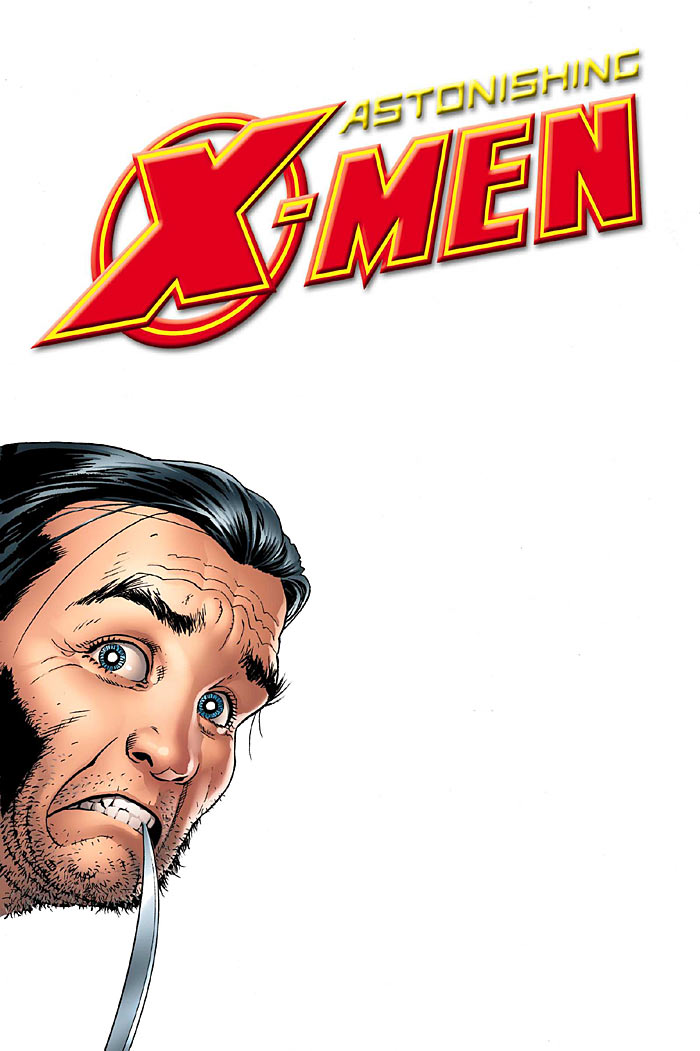
Remember what I wrote a couple of days ago about Joss Whedon’s Astonishing X-Men? Well, Joss is not the only sadistic bastard out there writing comics. Enter Mr Brian K Vaughan, who recently finished his long tale of a man, his helper monkey and a world full of women.

While I enjoyed all ten volumes of Y: The Last Man (the final volume just came out), the series isn’t perfect. There are moments when Vaughan missteps. The plot could do with some tightening. And the hook and setup are so breathtakingly big that it’s almost impossible for the ending to satisfy fully.

Warning: Here be spoilers!

The story strand that perhaps worked least for me was Alter’s trajectory. She’s intriguing to begin with, but Vaughan didn’t seem to know where to take her. She ends up as someone who cannot cope and, as an alternative to suicide, tries to get someone else to pull the trigger by being an all-round homicidal bitch. We’ve had similar motifs with Hero, with 355 (although more subtly, perhaps) and even with Yorick. It doesn’t help that there are entire issues that seem to forget completely about her.

Regardless of that, though, issues 58-60 are heartbreaking. 355’s death (apart from a flashback to Yorick’s intervention in an earlier volume (Safeword) that didn’t work as well as it should have) is done beautifully and practically wordlessly, to devastating effect. Pia Guerra’s simple yet effective art is at its best in the facial expressions: 355’s final look at Yorick, his silent exchange with Alter, and his face as he looks up at Hero, unable even to begin to express what has happened.

Issue 60 is a tricky one: with its “60 years later” conceit, it could easily have fallen flat. And there is something alienating about seeing a world where most of the familiar characters are absent and Yorick appears to be an old, white-haired loon in a straightjacket. My first reaction to the final issue was one of feeling at a distance from the guy we’d just accompanied for several years through a post-gendercidal world, where before he’d always been the ideal screen for all us white, somewhat nerdy male Lit majors to project ourselves onto. But with every flashback filling in glimpses of what happens during the 60 years in between the last two issues, Vaughan hooked me more and more.

At first I would have said that the best, worst moment of the issue is Ampersand’s death, euthanised by an old Yorick wanting to spare his friend the pain. It’s a simple, touching farewell to a character who, with his Eeps and Cheeps has become as much of a person as any of the human characters. This was topped, though, by the silent, moving last three pages, as our escape artist Yorick gets out of his last fix. Vaughan and Guerra handle it perfectly, giving us and the characters just the right note to end on.

So, on that note: Thank you, Brian K Vaughan. Thank you, Pia Guerra. Thank you, Yorick, 355, Dr Mann, Beth, other Beth, Natalya and, of course, Ampersand. It’s been a terrific journey.

And if you break my heart again, Mr Vaughan, I will do real damage to you with the Absolute Sandman vol. 3.

Mais le chat, elle ne reviendra jamais…

I don’t particularly like superhero comics.

I treasure my copies of Batman: The Killing Joke, Watchmen, Top Ten, Promethea (notice something?), Arkham Asylum, Superman: Red Son.

And now the complete Joss Whedon run of Astonishing X-Men.

Contradiction? No. What I like is that those books and those writers do something interesting, memorable, sometimes subversive and often just plain cool with the superhero template.

While I’ll always consider Watchmen one of the masterpieces of comics (and, if pressed on the matter, literature altogether), I’ve got a special soft spot for Whedon’s X-Men. Moore is a fantastic writer but he’s mainly an ideas man. Almost no one beats my man Whedon (check out this male white nerd and his command of embarrassing language!) at characters. Firefly and Buffy wouldn’t be a tenth as good if you didn’t want to spend time with the characters. Whedon is adept at making you fall in love with the characters…

… and then breaking your heart.

I’m over what he did to Wash. No, really, I am. I know why he did it and I appreciate it. I want fictional characters to generate feelings in me, and I’m the kind of morbid git who takes the death of a character as final proof of these feelings. Thing is, unless I can believe that a character may die, I will not develop any deep feelings towards that character because, well, they’re not real. In a way, what makes characters real for me (apart from good writing and acting, of course) is that they have a life, and that life may end. If I know that a character can’t and won’t die (because the writers, producers or fans won’t allow it), then they’re no more real to me than my avatar in a computer game, with an unlimited supply of credits.

The flipside of that is, of course, that it allows writers like Joss Whedon, again and again, to break my heart. And, morbid Whedon-bitch that I am, I like the way it hurts.

But if I ever meet him in real life, I’ll have to kick the man’s shin until it drops off.

P.S.: I don’t care whether you’re into superhero comics or not. If you’ve liked any of Joss Whedon’s writing, if you enjoyed Firefly (in spite of not being a sci-fi fan), if you got into Buffy (in spite of the bad make up and silly special effects and, worse, the whole high school vibe) – read Astonishing X-Men. For some silly reason, I started with vol. 2, definitely the weakest of the run, yet I was still hooked on his character writing.

P.P.S.: Another thing that Whedon does very well is sexual attraction. And there’s some of that in Astonishing X-Men, in the last place where you might expect it. Hee.

P.P.P.S.: Yes, today’s blog entry has a title à clef. I’m allowed to be pretentious every now and then.

Whys and wherefores: hot monkey love for Brian K. Vaughan

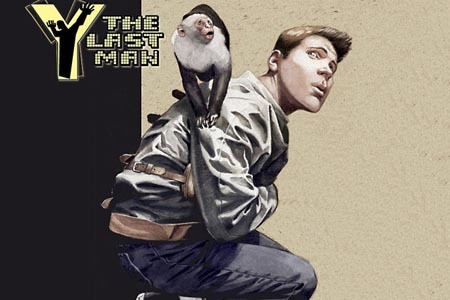
I’ve been re-reading Brian K. Vaughan’s Y: The Last Man over the last week or two, in preparation for the last volume to come out. (It shouldn’t be much longer than another month or so.) In the last few years, Vaughan has become one of my favourite comic writers. He’s no Alan Moore and he’s no Neil Gaiman (then again, these days Gaiman himself is no Neil Gaiman, it would seem), but his appeal is entirely different from those. In style, and in quality, he’s much closer to Joss Whedon – Vaughan knows how to tell a good story with wit and people it with characters you care about.

Like most of the Vaughan comics I’ve read, Y: The Last Man is a great example of high concept: the story’s premise is that every male mammal on Earth dies under mysterious circumstances, except for one Yorick Brown, ex-literature major and hobby escape artist, and his monkey Ampersand. However, it isn’t the premise that makes this a fun, exciting, witty ride. The world of Y takes a sketchy starting point and fills it with credible detail. (Well, mostly – I’m still not sure I buy the S/M intervention staged for Yorick in volume 4…) And, just like Whedon at his best, it’s just great fun to listen to his characters. This is one of the comics where much of the action is in the talking – but when there is action, it means something more than the nth installment of Super Guy vs. Evil Dude.

There\'s a monkey on your back, dude...

There’s perhaps one thing that I dislike a bit about Y, and it’s no coincidence perhaps that Vaughan also writes for the TV series Lost: at times the narrative meanders, goes zig zag. Most detours are fun enough to follow, but like Lost this is a series that at least pretends to have a plan, and just like Lost this pretense isn’t always very convincing. Without a plan, it feels like the story is arbitrary, which weakens the central mysteries and unanswered questions, such as, “What killed all the dudes?”, arguably a bigger question than “What exactly is that Smoke Monster?”. At times, if it wasn’t for the writing and characters, you’d be tempted to say, “So? Where exactly is this going?” I don’t mind some element of making it up as you go along, but arbitrariness is poison for a plot-heavy narrative.

And this might out me as the biggest closet case in history (which would come as a surprise to myself, really), but… Why is it that 90% of the women in Y are hot, slim, curvy babes? For once, we can’t blame the comic artist – Pia Guerra, the series’ co-creator and lead penciller, is very much a woman. So, for once, don’t blame us XY types!

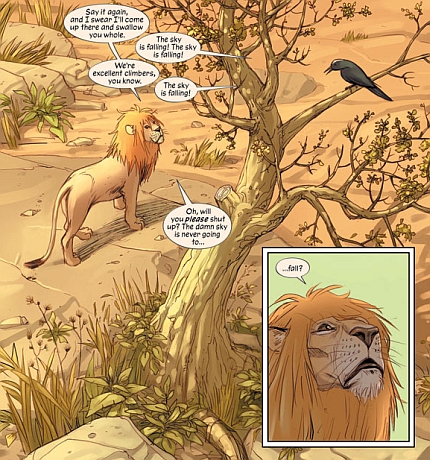
P.S.: Other Brian K. Vaughan comics that come with the Goofy Beast Seal of Approval: Runaways, Ex Machina and the one-shot Pride of Baghdad.

Pride of Baghdad

His name is Snot Boogie?!

This film nerd here is a complex beast. On the one hand, I get as much childlike joy out of well-executed genre films that follow the formula to a T. I enjoy the climactic showdown between Hero and Villain. On the other hand, I cackle gleefully when a film (or a book, for that matter) frustrates my expectations. No Country for Old Men is a good case in point, where the supposed hero dies off-stage and isn’t even killed by the bad guy of the piece. Even Raiders of the Lost Ark, a genre movie if there ever was one, doesn’t end with the hero triumphing: it ends with the hero tied to a stake as the ultima deus ex machina comes and melts the faces off a bunch of undeserving unbelievers.

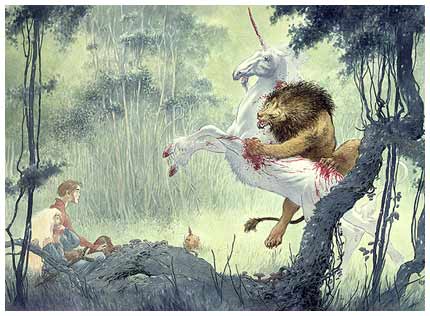
I just finished re-reading Neil Gaiman’s Stardust. I’d last read it in the summer of 2001, just after graduating. I have fond memories of sitting in a French café in Edinburgh during festival time, drinking good coffee, eating croissants and not looking up from my book until I’d finished half of it in one sitting. What I remembered much less was the plot, at least beyond the broad strokes. What I definitely didn’t remember was how differently it told its story from how Hollywood would (and, from what I’ve heard, did) do it. Here too, we don’t get a showdown with the villainess – instead, we get a melancholy coda and a bittersweet ending that made me realise how rarely Hollywood does “bittersweet”. I know that most Gaiman fans prefer American Gods, but I must say that even without Charles Vess’ pictures (I have the non-pic edition), this is a beautiful, wonderfully light, exquisitely crafted fairytale. In comparison, I feel that American Gods collapses under its own ambition, because its dozens of ideas never really come together in a fully satisfactory way.

Narnia it ain\'t...

Oh, and in case you’re wondering about the title of this entry? Well, we’ve just started watching The Wire season 1. Very different fare from Buffy, if you would believe it… But intriguing, with carefully drawn characters and lots of shades of grey. Definitely looking forward to seeing more of it – and telling you all about it, in epic detail. Shudder and despair.

Girl power

Buffy the Vampire Slayer is an odd beast. It is perhaps the wittiest series with what would seem to be the dumbest premise: HIgh school chick fights vampire. It was cheesy, it had bad fight scenes much of the time, and many of the actors weren’t terribly good.

Yet what Buffy got right, it got right. In every season, there were episodes that are up there with my favourite television fare ever – and yes, that includes Six Feet Under and Deadwood. Over the course of seven seasons, I’ve come to care about all the characters. That never happened with any of the Star Trek series that I watched as a teenager. Nor did I grow tired of Buffy in the way that I lost patience with The X-Files.

Much of that has to do with Joss Whedon’s characters. They quickly come to feel like people you want to spend time with. Yes, even Angel… and yes, even season 6/7 Buffy, although to a lesser extent. (There were moments – flashes – when I even liked Dawn. I’m sorry.) They come to feel real, which is an amazing feat, considering that these people tend to spend their time fighting rubber-mask baddies and being American teenagers.

Yes, the series lost some steam after season 5 ended. There’s a lot going on in seasons 6 and 7 where I thought, “Yes, I see what they’re doing there… I see where they’re going with this”, but it was less enjoyable than what had come earlier. But I do not get the hate those later seasons get from some of the fans. I do not get the vitriol or the sense of betrayal that you find on the internet. (But then, there’s so much on the internet I do not get…)

It’s interesting re-watching season 2 now (our Sunday morning fare), since this is pretty much when the series came into its own. In the sophomore year, the actors had found their feet and really got their characters, to the point where it didn’t matter that much whether they were great actors or not. The writing had got more comfortable, yet at the same time more daring. In season 1, a later episode such as “The Body” or “Once More, With Feeling” wouldn’t have been imaginable; after season 2, pretty much anything was possible. (Well, not quite. I was only prepared for Whedon’s sadistic glee in doing horrible things to his characters because I’d previously seen Serenity. Yes, Joss, I know what you were doing there, I know what you were going for, and if I ever meet you I’ll be sure to applaud you for your audacity while I repeatedly kick you in the privates.)
So, re-watching Buffy while cuddling up to my loved one keeps me from missing Giles and Willow, and Xander and Cordelia, Oz and Joyce… and Buffy. As Willow said so memorably, “Sweet girl. Not that bright.”

Good thing that Joss Whedon and Brian K. Vaughn (of Y: Last Man and Runaways fame) are doing season 8 in comic book form. Shiny.

Chekhov’s carotid artery

If you’re watching a hospital soap, and it introduces a patient whose carotid artery is only protected by a thin flap of skin after an operation, what do you think’ll happen?

Yes, it’s Tuesday, which means that yesterday evening was Grey’s Anatomy. While it didn’t figure any pencils-in-eyesockets, it was still not exactly the show I should be watching while eating merguez. However, what usually ruined my appetite while watching the show was the increasing lack of development as far as the characters and their relationships are concerned. At times, the show now feels like E.R. as scripted by Beckett – for all the romantic back-and-froing, there’s a distinct lack of getting anywhere.

However, while too many of the characters now behave like lobotomised idiots who shouldn’t be allowed to practice medicine (they’d probably be taxed by practising the recorder), the patients are where it’s at. The Grey writer are quite amazing, really: it takes them 3+ seasons to make me bored and annoyed with the main cast, yet it takes them 30 minutes to make me care about characters who come into the series to be sick and die.

Can’t say I care yet about Carotid Artery Boy, mainly because I keep looking at him and thinking, “I wonder if it’s full moon already…” Yep, that’s the problem you get when you play a werewolf on Buffy the Vampire Slayer. (I’d be the same if Leonard Nimoy turned up on House… “Do they have green blood on stock? I wonder…” Putting Greg House and Mr Spock in the same room would be sheer geek awesomeness, though.)

P.S.: Don’t worry, an entry on Fun Home is still to follow. Hopefully even before the move. (Sigh.)