Welcome to Six Damn Fine Degrees. These instalments will be inspired by the idea of six degrees of separation in the loosest sense. The only rule: it connects – in some way – to the previous instalment. So come join us on our weekly foray into interconnectedness!
Speaking of sci-fi novels: You guys, I did it! I binge read all the novels of Lois McMaster Bujold’s space opera, the Vorkosigan Saga, in about three weeks. All 17 of them.
Join us every week for a trip into the weird and wonderful world of trailers. Whether it’s the first teaser for the latest instalment in your favourite franchise, an obscure preview for a strange indie darling, whether it’s good, bad, ugly or just plain weird – your favourite pop culture baristas are there to tell you what they think.
This week, Alan wrote about his childhood love for Greg Bear’s novel Blood Music – which makes for a great Six Damn Fine Degrees post, but sadly, it makes the whole issue of finding a trailer difficult, since Bear’s writings had never been turned into films or TV series. However, YouTube does have a reading of the original short story that Bear expanded into the novel, so if you need one hour of audio while you’re cooking or doing the dishes, why not check this out?
Welcome to Six Damn Fine Degrees. These instalments will be inspired by the idea of six degrees of separation in the loosest sense. The only rule: it connects – in some way – to the previous instalment. So come join us on our weekly foray into interconnectedness!
Last week, Sam talked about the classic novels that were an essential part of an English curriculum, and I can well remember something similar from my school days. Those books that were seen as being the official, proper and right things for developing minds to read. However, they were not the only books out there. Alongside the worthy classics, there were popular reads that nonetheless bore the taint of scholarly respect. No teacher would be too angry with you if you were reading an Agatha Christie.
Welcome to Six Damn Fine Degrees. These instalments will be inspired by the idea of six degrees of separation in the loosest sense. The only rule: it connects – in some way – to the previous instalment. So come join us on our weekly foray into interconnectedness!
University reading lists as the one described in Matt’s latest post (and dare I mention I was one of his students to be on the receiving end of that particular list) can be a double-edged sword: There is a certain mechanical quality about ticking off titles one wouldn’t necessarily have chosen for personal reading, for sure. Yet gently forced exposure to such literature – if pre-selected well – can produce unexpected pleasures and open up new worlds and avenues for further reading. Starting out my English studies in the early 2000s as a slightly disoriented reader in the wide world of literature, the English department list (when diligently dealt with) certainly kept me busy, and struggling, for a while.
Welcome to Six Damn Fine Degrees. These instalments will be inspired by the idea of six degrees of separation in the loosest sense. The only rule: it connects – in some way – to the previous instalment. So come join us on our weekly foray into interconnectedness!
Tom Hardy is probably most famous for his hardman roles, Michael “Charles Bronson” Peterson, Britain’s “most violent criminal”, being just one of them. Ask people which of Hardy’s roles they first think of, I’m pretty certain that The Dark Knight Rises‘ Bane will come up, or “Mad” Max Rockatansky (who, admittedly, isn’t half as hardass as that film’s Imperator Furiosa), or perhaps his characters from Peaky Blinders and Taboo. It makes sense: Hardy is nothing if not an imposing figure these days, a far cry from the evil-yet-slender Patrick Stewart clone he played way back in Star Trek: Nemesis (not a recommendation, even for Hardy fans – or Star Trek ones, for that matter).
Frankly, though, as much as I like Hardy when he’s working with good material, he’s not nearly as imposing as the O.G. Tom Hardy: Thomas Hardy, the literary pugilist of English Literature. There’s nothing quite like the world of pain that Hardy can put you in.
Welcome to Six Damn Fine Degrees. These instalments will be inspired by the idea of six degrees of separation in the loosest sense. The only rule: it connects – in some way – to the previous instalment. So come join us on our weekly foray into interconnectedness!
ELSTER
And she wanders. God knows where she wanders. I followed her one day.

SCOTTIE
Where'd she go?

Elster almost ignores the question as he looks back to the day.

ELSTER
Watched her come out of the apartment, someone I didn't know... walking in a different way... holding her head in a way I didn't know; and get into her car, and drive out to...
(He smiles grimly)
Golden Gate Park. Five miles. She sat on a bench at the edge of the lake and stared across the water to the old pillars that stand an the far shore, the Portals of the Past.
Sat there a long time, not moving... and I had to leave, to got to the office. That evening, when I came home, I asked what she'd done all day. She said she'd driven to Golden Gate Park and sat by the lake. That's all.
Does a killer title make for a killer movie? When Philip Kaufman adapted Milan Kundera’s early-’80s novel The Unbearable Lightness of Being for the big screen, it made a huge splash at its release in 1988, drawing audience numbers that, at this point in time, are almost unthinkable for a drama focusing on the lives of three characters in communist Czechoslovakia – even if that drama is as erotic and adult as Kaufman’s film was. And how well does it hold up in 2025, both for those who’d seen it at the time and those who are only just seeing it for the first time? Join Sam, Julie and Matt as they discuss the film, its young stars Daniel Day-Lewis, Juliette Binoche and Lena Olin, the mirrors and bowler hats, and the Bourgeois dreadfulness of late 1960s, early 1970s Switzerland. What made The Unbearable Lightness of Being such a success at the time? Why is it barely talked about almost 40 years later?
Welcome to Six Damn Fine Degrees. These instalments will be inspired by the idea of six degrees of separation in the loosest sense. The only rule: it connects – in some way – to the previous instalment. So come join us on our weekly foray into interconnectedness!
Differently from some of my co-baristas here at A Damn Fine Cup, I don’t have any kids, which means that I can neither share all the books, films and series that I loved as a kid with them nor can they show me their weird and wonderful discoveries in pop culture. Which, in some ways, is perhaps what I would enjoy most about being a parent: telling them about the stories close to my heart and being there to see them discover those stories. Though I guess there’s also the flipside: I’m not sure I would be very happy to find out that a kid of mine read, say, The Neverending Storyand didn’t care for it.
To many fans of detective fiction, he’s the greatest sleuth of them all: Arthur Conan Doyle’s Sherlock Holmes. He’s figured in many stories, novels, films, TV series and video games, to mention just a few of Mr Holmes’ exploits. He survived death by Reichenbach Falls, he appeared in the Victorian era and beyond, including adaptations in present-day England and America. And yet: to date, the greatest detective has only appeared on this site very, very rarely. Well, in the podcast episode we’re releasing today, this will be remedied, as Julie, Sam and Alan share their deductions about three cinematic takes on Sherlock Holmes: the 1939 film The Adventures of Sherlock Holmes starring Basil Rathbone, Nigel Bruce and Ida Lupino; Billy Wilder’s 1970 classic The Private Life of Sherlock Holmes, in which Robert Stephens and Colin Lively play the iconic Holmes and Watson; and the 1976 made-for-TV film Sherlock Holmes in New York, which has Roger Moore don the inauthentic yet iconic deerstalker – and John Huston take on the role of Holmes’ nemesis Moriarty. Which of these do justice to Sherlock Holmes? Which are worth watching, and which are better given a miss? Make sure to join our trio of pop culture baristas as they get out their magnifying glasses and investigate the case of Three Sherlocks. The game’s afoot!
And if you’d like to hear more about less-than-successful takes on Arthur Conan Doyle’s famous detective or indeed other iconic trios, make sure to check out these past episodes:
A Damn Fine Cup of Culture Christmas Special 2017, in which Damn Fine O.G.s Matt and Mege share their dismay at the final episode (to date) of BBC’s modern-day Sherlock (warning: this was our first attempt at podcasting, so the audio quality is… Victorian, one might say)
A Damn Fine Cup of Culture Podcast #73: Three Draculas, in which Julie, Sam and Matt talk about three takes on another classic figure of Victorian literature, though one more likely to drain your blood than solve your murder
Welcome to Six Damn Fine Degrees. These instalments will be inspired by the idea of six degrees of separation in the loosest sense. The only rule: it connects – in some way – to the previous instalment. So come join us on our weekly foray into interconnectedness!
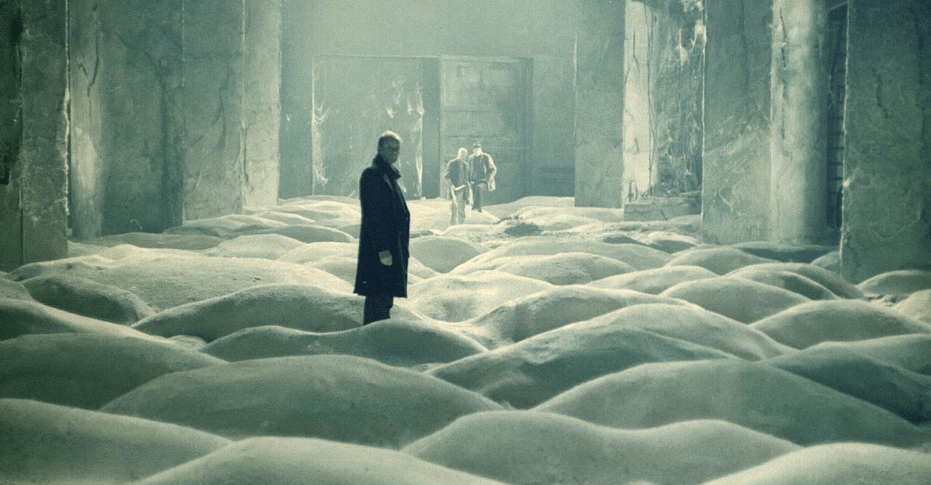
Key frame of Stalker (Copyright: Mosfilm)
As a Damn Fine Cup afficionado, you’ve probably already seen Andrei Tarkovsky’s Stalker (1979) or read the novel it’s based on, Roadside Picnic by the Strugatsky brothers, or both. You’ll probably have informed opinions on each of them. If you haven’t: sorry, there are spoilers coming.






 A Damn Fine Cup of Culture