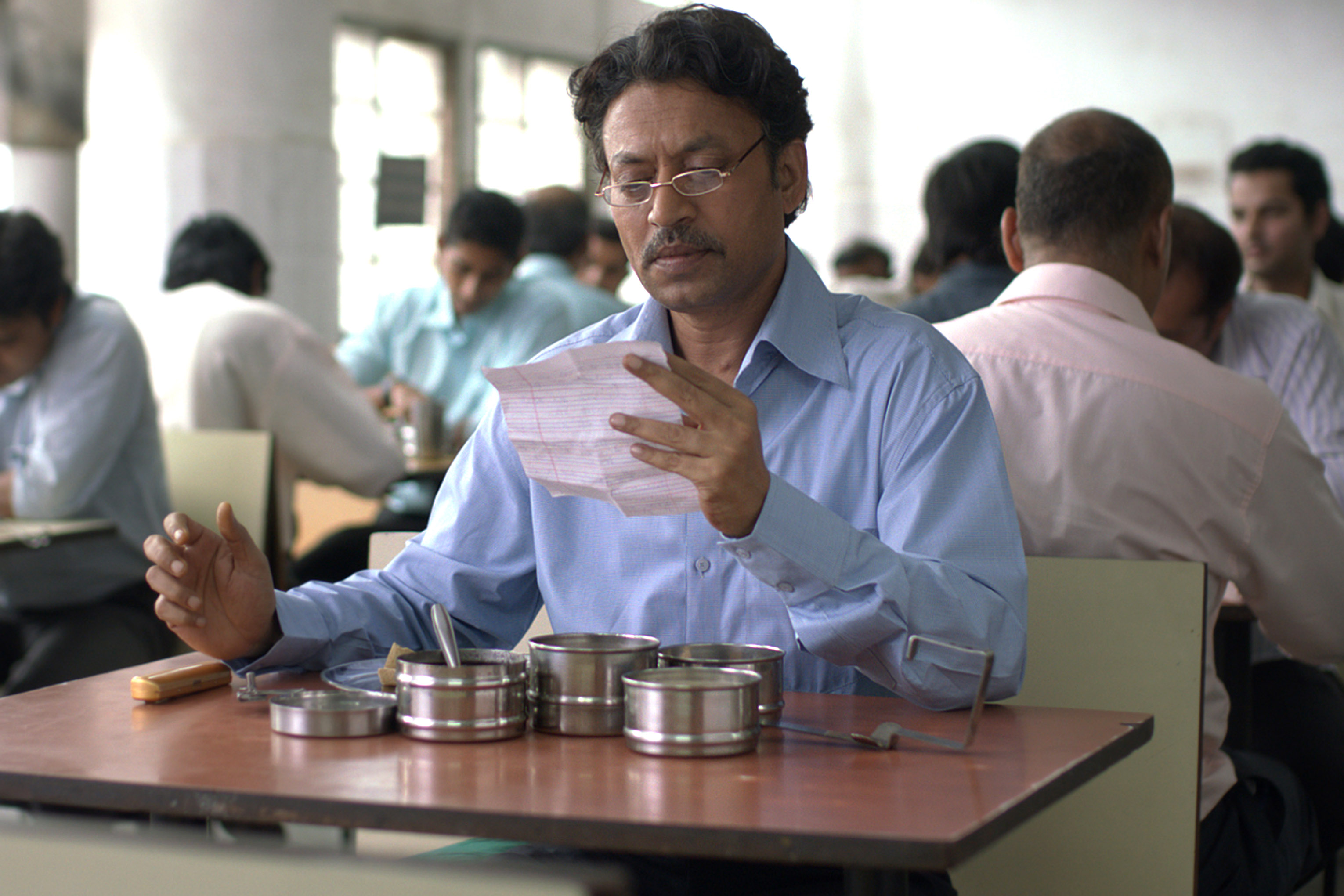
The Lunchbox starts with Ila, a Mumbai housewife and mother, cooking food and packing it in a metallic lunchbox that consists of stackable bowls. That lunchbox gets delivered across Mumbai to a grumpy, lonely office worker. He is mesmerized by the food.
If you want, you can look at The Lunchbox as a modern-day fairy tale. Ila wants to rekindle her failing marriage by enchanting her careless husband with outstanding food. We realize only eventually that Saajan, the grumpy office worker, is a complete stranger to her. The Mumbai lunch distribution industry has made a mistake. “Impossible!”, says the man who delivers Ila’s lunchbox. “The people from Harvard have confirmed that our system is faultless!”
She cooks lunch the next day, adding a little note of apology to the bowl with the naan. He writes back, complaining about the salt. A correspondence starts, in which Ila can tell about her loveless life, and Saajan, to his own surprise, tells Ila about his deceased wife. Although they have never met, they feel less lonely that way. The comfort of strangers is the best thing in both their lives right now.
A lesser movie would make them fall in love with each other. Not this film, although Ila’s food seems to have such power. Eventually, Mumbai and its overcrowded public transport system play a part. Saajan is assigned a successor, but is not keen on training the man. This movie manages to balance light comedy with darker undertones. I liked the unseen upstairs neighbor, an older woman who shouts recipe suggestions down into Ila’s kitchen. I also liked the small moments of coincidence, for instance the story about the ceiling fans.
The two main leads are played by Irrfan Khan and Nimrat Kaur, who left their impressions at this year’s Sundance festival. The director, Ritesh Batra, grew up in Mumbay and knows a lot about food and the lunchbox delivery system. This movie is his debut and is the result of a documentary he didn’t finish in favor of this feature. Towards the end, one or two scenes feel contrived and on autopilot, but no matter: The Lunchbox is a delight. All that food made me hungry. Maybe once in a while, you should go to the kitchen and cook as if your life depends on it.
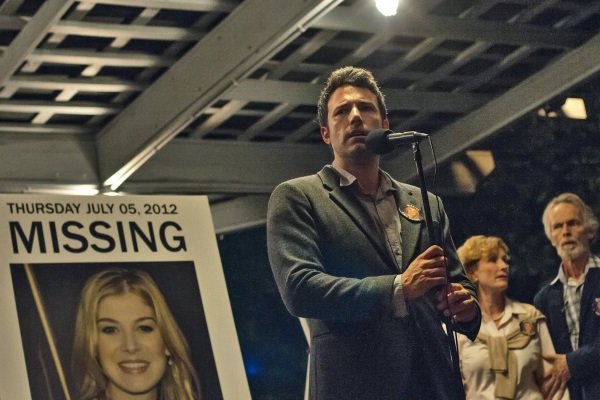
David Fincher’s Gone Girl is yet another example that Fincher is one of the most skilled directors working in Hollywood these days. It is gorgeous to look at, with the various elements of cinematic craft coming together almost to perfection. It is also a film that I found at turns annoying, ludicrous and distasteful, and that’s almost entirely due to the material. Similarly to Fincher’s previous film, The Girl with the Dragon Tattoo, it’s impossible not to admire the sheer craft while wishing that he had chosen better material to work with.
Gone Girl, that is, the story and storytelling, is not without merits, but it’s too glib for its own good. There’s a lot here that individually is interesting, clever, engaging, amusing and chilling, but much of the time it doesn’t really add up: one moment it’s amoral and cynical as hell, the next it turns to moralising with a misogynist slant; in one scene it’s an effective if obvious satire of the media and the audience’s complicity that goes for the uncomfortable laugh, the next it’s a psychological thriller veering into outlandish melodrama, with only the most superficial similarity to reality. There’s an OCD quality to the story, as if Gone Girl didn’t quite trust itself to hold our attention if it decided to be one thing only. Not that films can’t strive for different things at the same time, but in this particular case we end up with a bit of a Frankensteinian creature on screen.
Which is a shame, not least because to the extent that the film coheres it’s due to the dark, sharp performance in the emptiness where a different movie’s heart would be. I’d enjoyed watching Rosamund Pike in earlier performances, but I wasn’t prepared for how good she is in this. Again, though, there’s a tension here between the nuanced intelligence Pike brings to the part as a performer and the lurid, trashy quality of the material. For all its polish, Gone Girl is Grand Guignol, made up to look like, well, a David Fincher film, and one of his best-looking to date. Look beyond the aesthetics, though, and the one Fincher film that this most resembles is The Game, another movie of very effective individual parts that cohere less and less the more you look at the whole.
Arguably Fincher’s a stronger, more skilled director at this stage than he was when he made The Game, so Gone Girl holds together better by the sheer quality of the filmmaking, but as I left the cinema, more than anything else I was hoping that next time round he’d decide to film a better script. His particular skillset is well suited to clever writing (as, say, The Social Network shows), but ideally his scripts have to be as clever as they think they are, and I don’t think that’s true for Gone Girl. I hope that whatever he decides to do next he runs like hell from material that in the final analysis is glib more than anything else.
I haven’t yet seen Interstellar. I’m definitely curious about the film and looking forward to it – I’m still as much a sucker for gorgeous space imagery as I was back when I was eight years old and had a poster of the solar system and its planets on my bedroom wall. At the same time, I have to admit to some apprehension, and that’s due to two things: Christopher Nolan and his fans. There’s a lot of hyperbole about Nolan and his films, just as there is too much criticism that dismisses his films, or patronises them, due to his making genre cinema. It’s difficult to find discussion of, say, The Dark Knight or Inception that doesn’t treat the films as either cinematic masterpieces or as hollow and derivative, as the sort of genre movies that let some sci-fi and superhero fans go, “Look? That’s brainy, isn’t it? The genre’s all grown up now?” At its worst, Nolan fetishism brings forth silliness such as proclaiming the director the new Kubrick.
I like Nolan’s films, even The Dark Knight Returns for all its flaws. Nolan has proven that he’s a skilled, smart director who knows how to handle his material well. He’s also deeply flawed: several of his films, for all their complicatedness, aren’t actually all that complex. He’s too enamoured of Big Questions that aren’t actually all that big or relevant, and that have been done before. Nolan likes a bit of the good old “… ah, but is it?” at the end of his films, but try to answer those questions and there’s not all that much there. That spinning top in Inception, the question whether at the end of the film Cobb is still in the dream? That twist is already there in the film’s premise – it’s predictable. Similarly, Memento‘s conundrum concerning Sammy Jankis’ identity? It’s a twist too far, an example of Nolan not trusting his film to have made the same point about Leonard’s malleable identity in the absence of memory already, taking it to near-absurdity. If Nolan’s films, and especially his scripts, insisted less on their apparent depth (which often totters on the border to pompousness), they’d actually make a more convincing case for being deeper than your general genre fare. As it is, through his films Nolan doth protest too much that he’s making grown-up films for grown-up people with grown-up brains.
There’s something else that Nolan doesn’t do all that well, and that’s action sequences. Given the right conceit, his action can be amazing: look at the hotel fight in Inception, divorced from gravity. In the same film, though, you get the sub-Bondian mountain action, which is dull and generic. Look at The Dark Knight‘s truck sequence and it’s a confusing mess of direction, cinematography and editing, while the Heat-with-clowns intro works tremendously well. I remember seeing The Dark Knight at the cinema and loving some scenes while wondering in others whether we were being shown a version of the film edited (and badly at that) to be shown on planes.
At the same time, Nolan does excel at doing films about men who make convoluted plans to avoid facing the emotional wrecks they are. Memento, Insomnia, The Prestige and Inception: in all of these, Nolan finds striking images and interactions to show his protagonists’ helplessness and the lengths to which they go to deny just how lost they are. To my mind, these themes are much more interesting than yet another treatise on what is real and what is a dream, or that central question that mankind has faced for centuries: whether Batman can be broken. Nolan has been accused of making cold films that are thin when they try to be emotional, and I don’t think sentiment is something he does well, either as a director or as a writer: but give him characters, especially men, who don’t know how to deal when faced with their own failure and loss, and he’s riveting. This is a director who should do a modern version of the Orpheus myth – if he hasn’t already done so in various ways. His Orpheus, when told he cannot look back, would be likely to construct an ingenious device of smoke, mirrors and cameras to trick Hades, without ever realising that Eurydice is gone for good.
As I said at the beginning, I’m curious about Interstellar, and I’m sure it’ll be a visual triumph. The trailer worries me, though; it looks like Nolan is making his Contact, complete with daddy issues. I’m not sure I trust him as a director to handle sentiment head-on: he’s no Spielberg, and even Spielberg isn’t always up to the task. Nolan has been best so far when he had his characters approach emotion at oblique angles, because they’re rarely good at handling them. At his best, there’s an understated but effective undercurrent of emotion in his films. I’m very much hoping that Interstellar will prove more The Prestige than Contact, and that he didn’t try to be both Kubrick and Spielberg at the same time. It didn’t work for Spielberg either when he did A.I.
P.S.: For anyone else who has a yen for astronomy porn, there’s the upcoming game Elite: Dangerous. In space, no one can hear you become speechless at the sight of all those planetary rings.
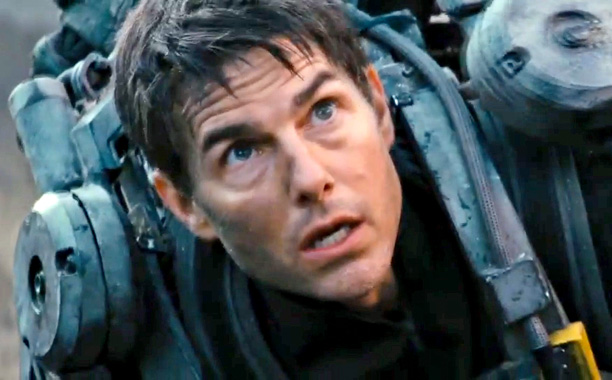
Edge of Tomorrow is a dark comedy, at least the first half. It’s a sci-fi action flick, sure, but that is more like a backdrop for the fun it has with its story. We meet William Cage (Tom Cruise), a high-ranking liaisons officer for the U.S. military, who are busy fighting an alien intruder. Within a few minutes, Cage gets blackmailed, demoted and arrested by his general (played by Brendan Gleeson), abducted by his own army and wakes up in an American army base near London being shouted at by a detail leader who looks like Bill Paxton.
Wait, it gets worse. And the worse it gets, the more I like that first hour. Cage is strapped in a high-tech weapons suit, put on a military aircraft together with his detail and dropped off over the coast of Normandy, where everything goes fubar. It’s like D-Day orchestrated by Windows 8. There’s a nice running gag about nobody telling Cage how to switch off the safety. Almost everybody dies because the aliens have somehow figured out when and where the U.S. will strike. Cage wakes up again with Paxton staring at him. Reincarnation on repeat is just too much of a hassle – just ask Bill Murray. After he dies a few times more, Cage meets famous war heroine Rita Vrataski who has singlehandedly saved mankind at Verdun.
That Rita is pragmatic. She knows about Cage’s loop because she has been in one herself. That loop, if you survive for long enough, gives you insight on how to vanquish the aliens, so whenever Rita feels that Cage is not doing too well, she reboots him. By shooting him. In the head. Repeatedly. I think Emily Blunt has just the right amount of gruff zeal with that role.
The second half of the movie has much less of that grim fun, and the movie is the worse for it. The sci-fi mission takes over, and I won’t spoil anything when I tell you that Cage destroys the alien headquarters. It’s all well made, but it’s by the book. Shame. The first bit has so much going for it. Imagine Tom Cruise running into the baracks, yelling at his platoon: “You’re doomed! Now listen to me! Your lives depend on it!” Cruise, like Cage, understands that this is a funny line, and has fun with it because he is the only one who will survive, no matter what.
Those aliens. Some of them look like really aggressive mops that come out of the ground whenever they sense that humans are near. More evolved ones look like Treebeard has gone digital. That’s not too bad, but they’re not as inventive as they could have been. The screenplay is by Christopher McQuarrie (The Usual Suspects), based on a Japanese novel, and the movie is directed by Doug Lyman, who did three of the Bourne films, so he knows how to do a good action flick. My guess is that Lyman knows that, when he’s at his best, his movies are more than just entertainment. That is true for only the first half of this one.
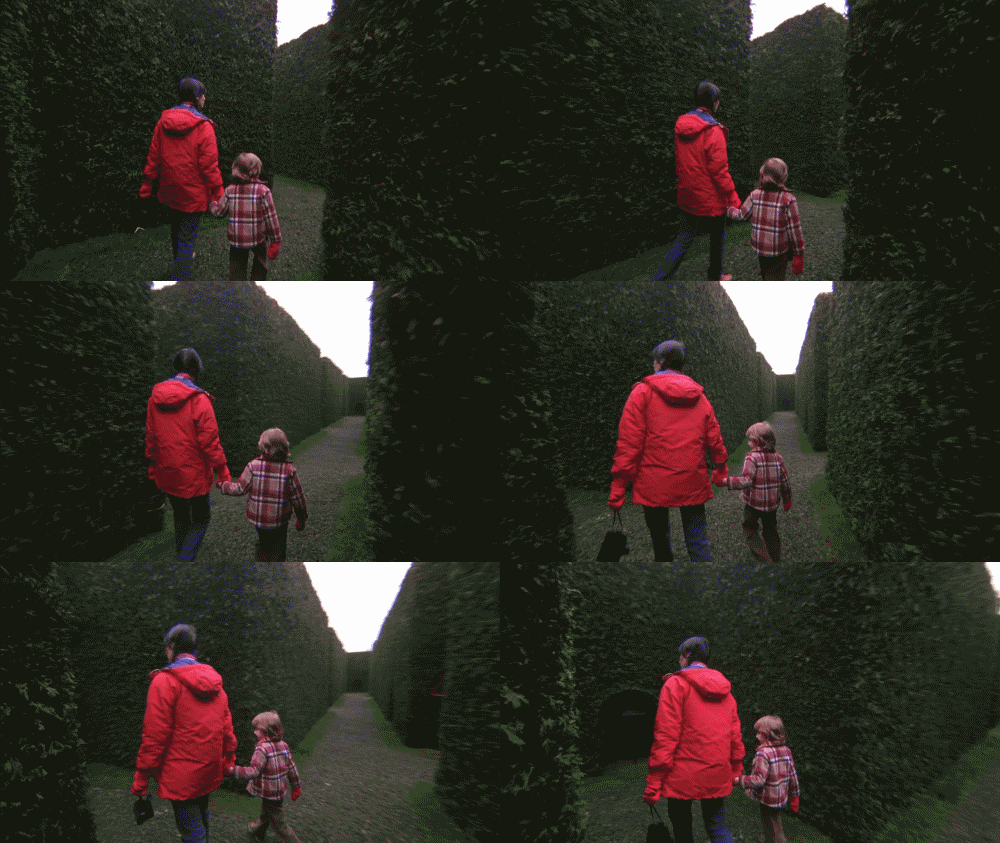
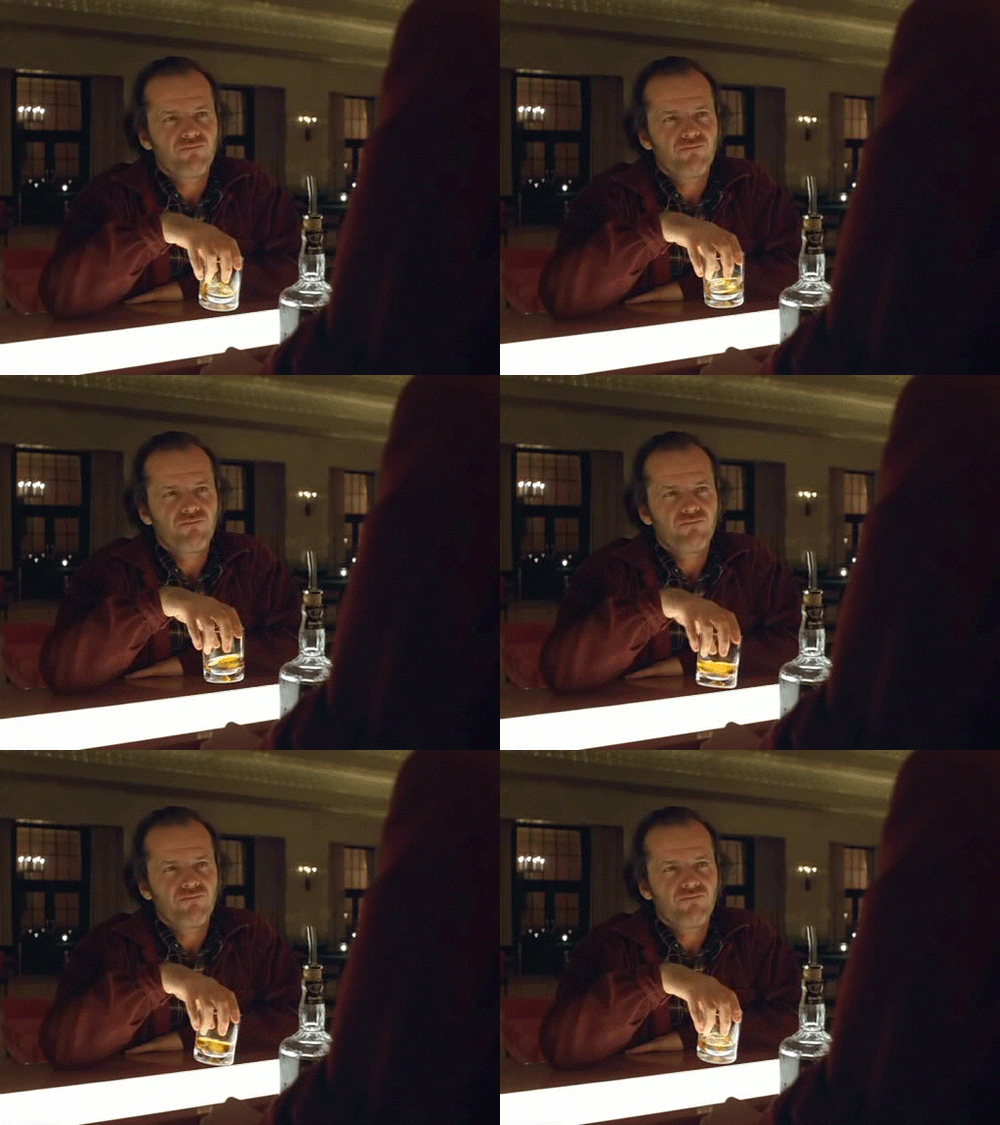
Room 237 is a strange beast. The documentary consists entirely of people talking about their interpretations of Stanley Kubrick’s The Shining, set mostly to clips from the film itself as well as of other Kubrick movies – and by and large the theories they espouse seem to have a shaky grasp of the process of film analysis, charitably put. Some of the speakers make interesting points and they don’t go out of their way to tie their observations into a grand theory of What The Film Actually Is About, but the majority come across as the film studies equivalent of conspiracy theories mixed with a flair for fabulation. The Shining is about the Holocaust! It’s about the genocide of the Native Americans! It’s Kubrick’s coded admission that he faked the moon landing footage for NASA! The poster of the skier is actually a minotaur!*
What is strange about the film, but partly accounts for how intriguing it is: it doesn’t overtly comment on any of the theories. Apart from the film clips, there is no voice in the film other than that of the Kubrick enthusiasts – which has prompted some film critics to read Room 237 as endorsing the theories, or at least as doing that relativist pomo spiel of flattening out hierarchies, so that any interpretation is as valid as any other. While Room 237 is subtle in its criticism, though, it trusts that the juxtaposition of the enthusiastic theories and the images from the film speaks for itself. There is no need to criticise or mock the Overlook Hotel’s conspiracy theorists: while their tones are engaging, their takes on The Shining are so obviously Through The Looking Glass that it’s unlikely any moviegoers will come away from the documentary thinking that Kubrick had indeed airbrushed his likeness into the Colorado clouds.
Having said that, I do wonder whether the average film audience will discern much of a difference between Room 237‘s theories and the analyses of poststructuralist, psychoanalytical or any other modern film criticism. As much as I enjoy Slavoj Zizek’s jazzy flights of fancy on film, I expect that to many they wouldn’t sound any less insane than the theories presented in Room 237. I do think there’s a difference, namely that most of the protagonists of Room 237 see The Shining as a puzzle to be solved, a spooky Rubik’s Cube of a movie, whereas critics at their best show how art – and yes, that includes the film adaptation of a Stephen King novel – can mean more, not less, through the act of interpretation. There’s a reductiveness to the theories: The Shining means this, and only this – and why doesn’t anyone believe me? This is where Room 237 is immensely effective: in hinting at the sadness that exists alongside the exuberance of obsession. Some people spend such a long time staring at the clouds that they start seeing Kubrick looking back at them, and at that point it may be more frightening to admit that the bearded guy isn’t actually in the clouds, he’s in your head.
*There are at least two speakers who don’t quite belong in this line-up of craziness: the topography of the Overlook is indeed very strange considering Kubrick’s own obsession with details, and one speaker’s screening of superimposing the film played back-to-front makes for an intriguing video installation, which is something that is categorically different from the outlandish theories.
If there’s one thing that the best of the Marvel movie adaptations have in spades, it’s personality. Compare the dour cinematic worlds of Batman and Superman to that of The Avengers or Guardians of the Galaxy, and the latter are simply much more fan to hang out with. It’s also what Guardians gets most right: almost from the start, we have a cocky, enjoyable Han Solo-alike to take us into a world of wonders and CGI, and differently than in Lucas’ bloated prequel trilogy we look past the pixels and shader effects and see characters. Rocket Raccoon, that rarest of things – a fully realised CGI character not motion-captured by Andy Serkis! -, pretty much repeats that trick; another hero from the mold of Han Solo, though arguably shorter and more furry, and one that is cynical where Peter “Star-Lord” Quill is excited for pretty much everything. Add Groot, Gamora and Drax, and you’ve got yourself the quintessential Marvel team. Batman may have his cool toys and Michael Caine, but I know who I’d rather hang out with.
There’s an element of laziness in the film, though. It is entertaining, it’s charming, but there’s a generic quality to Guardians‘ setup, which is the main reason why in spite of dancing baby Groot and “Hooked on a Feeling” The Avengers still works better for me. In Whedon’s movie, the characters don’t get along at the beginning but realise they need to form a messy, dysfunctional surrogate family to have a chance against the Big Bad; Guardians pretty much repeats this blow-by-blow. What it lacks, though, is strong motivations why Star-Lord’s motley crew are antagonistic to each other at the beginning. There are reasons, but they’re all underwritten and don’t really come from the characters: sure, Drax blames Gamora because she was working with the main villain when he killed Drax’ family, and Quill is seen simply as a paycheck by bounty hunters Rocket and Groot, but essentially the characters don’t get along at first because that’s what the plot structure needs. In comparison, the conflicts between the Avengers come from who the characters have been established to be: Tony Stark, arrogant millionaire playboy with a house full of toys won’t take orders from stick-in-the-mud WW2 relic Captain America, Thor is a god-of-sorts who isn’t all that into those teensy humans anyway, unless they look like Natalie Portman, and he’s mostly in it to get back at his brother Loki, and Bruce Banner thinks his life could be a hell of a lot better if people didn’t keep wanting the big green guy to come out and play. Oh, and that’s before we get to Nick Fury, who puts all of these in a room, barely united by their knowledge that Fury is not a man to trust.
The Avengers had charm too, but it did more heavy lifting to make sure that personality wasn’t the only thing it had going. Guardians has more, too, but it’s mostly of the “Ooh, look at that… shiny!” sort – arguably it takes us to visually more interesting places than Whedon’s first Marvel outing. But it’s a bit like the Cantina scene from Star Wars, two hours of weird creatures, exotic planets. It’s colourful and fun, and it works in a way that Batman’s Gotham hasn’t worked since the days of Tim Burton, when it really just worked intermittently.
However, there’s definitely one thing that Gotham City has that Marvel’s stable of superheroes is still missing, and that’s strong villains. The Avengers works well enough because Tom Hiddleston brings tons of personality to the table, and it helps that he’s connected (semi-literally) to the quasi-family at the story’s centre. Otherwise, though? Thor 2‘s evil space elf, any of the Iron Man villains, or Red Skull from Captain America? Good actors wasted on boring, perfunctory character conflicts. The interesting conflicts in the Marvel films are those between the good guys, but as soon as they unite to beat up the Big Bad, the films turn into CGI setpieces to fill the remaining fifteen minutes, with little to differentiate between them other than the make-up on the villain. Lee Pace’s Ronan is no different; there may be potential in the character, but in the film we mainly see a replaceable bad guy. Similarly, his henchwoman Nebula looks otherworldly and cool and is played competently by Karen Gillan, but she’s not what people will remember. Guardians is all about “I am Groot!” and awesome mixtapes, about cocky outlaws and cynical raccoons, but practically all of the Marvel films could have done with a Penguin, a Lex Luthor or a Joker. Captain America 2 came the closest to introducing an interesting conflict into the proceedings – and one of the reasons why its villains worked better than Red Skull or Malekith, and why Loki is probably the best bad guy of the whole bunch, is that these are closely connected to our heroes.
With Joss Whedon’s influence hanging over the Marvel Cinematic Universe, the writers may want to look at Whedon’s TV series and his Big Bads – both the ones that worked and the ones that didn’t. Usually it’s the ones that are, or were, or could be part of the family that worked best, as characters and as villains. Marvel has yet to do justice to their antagonists; they’ve got the actors, from Jeff Bridges to Christopher Eccleston, but they haven’t yet cracked the nut of conflict outside their bands of heroes. When they do, when their films have both personality and interesting conflicts that drive the stories? Then they might truly ring in an Age of Marvels. Hopefully one that still has a place for dancing baby tree creatures.
There are the stars, the big names, the recognisable faces, the Brads and Georges and Scarletts. Then there are those actors who may not be gorgeous and glamorous but who are great actors and win awards. And then there are those actors whose faces you recognise, whose names you may not remember immediately but seeing them always makes you like a film that little bit more, because it’s got Whatshisface and Whatshername in it. Unless, of course, you are a film geek and sigh contentedly whenever you see good old Whatshisface, mouthing the man’s IMDB link to yourself.
One of the actors that I always enjoy seeing, even in middling and even decidedly dodgy films, is Richard Jenkins. He is probably what is called a “character actor”, which more often than not seems to translate into “We want to say something nice about this guy but he’s not a hunk nor is he a tortured genius.” He can be utterly amazing, as in The Visitor, a film that could have been unbearable Oscar bait but ended up subtle, poignant and quietly devastating, an achievement that was in no small part due to Jenkins’ performance.
However, as good as the actor was in The Visitor, it’s Six Feet Under that best encapsulates why I love Jenkins. He’s good at playing dignified, often melancholy and sometimes stodgy everymen, but when given the chance to let loose he has a goofy, subversive energy, a Coenesque quality that is unmatched. (He’s been in three of the Coen brothers’ films, but what I best remember him for is his turn in The Man Who Wasn’t There: “Riedenschneider!”)
Jenkins has the face of a slightly disappointed man exhausted by life, but he has that gift of pulling off quirkiness without that precocious, grating quality that indie quirk often takes on. There’s a scene in the first season of Six Feet Under, where main character Nate finds out that his deceased father Nathanael Fisher Sr., undertaker and proprietor of Fisher & Sons, had a secret room above an Indian restaurant that no one in his family knew about. As Nate imagines what his father may have got up to in this room, we see several scenarios: Nate Senior playing solitaire, Nate Senior shaking his booty to a groovy record, Nate Senior having it off with a hooker, Nate Senior shooting at passers-by with a sniper rifle. It’s a tricky scene, and I can’t imagine anyone other than Jenkins pulling it off as he does, deadpan and perfect.
How long has it been since Kickstarter exploded onto the scene? My first pledged project was about 2 1/2 years ago, but there have been so many since. Some were successful, some weren’t; some have produced a film or a game and some are still running. Sometimes the results were mixed, but by and large I’m in the happy position of being able to say: I have contributed, in some small way, to the existence of a number of works that otherwise wouldn’t exist – and that’s a cool thing to be able to say.
I don’t want to overstate the effect my contributions have had; I didn’t tip the scales for any of the projects I pledged to, I was usually one of many thousands. Yes, a handful of the projects I supported were touch and go, but I’m still one of many. Nevertheless, for all the collectivist benefits of Kickstarter, with each of the successfully completed projects I got my hands on – whether the result was a movie or a game – I did get a frisson of “I did this!”, or perhaps rather “I was a patron to this!” In my very small way, I’ve been a mini-Pope Julius II to, say, the Veronica Mars movie or Wasteland 2.
And let me tell you: patronage is addictive. I’ve reduced but not kicked (no pun intended) my Kickstarting habit, but during the first year or so my patronage muscle was twitchy as hell. I don’t regret any of the pledges I’ve made – or, more accurately, I may not have been entirely satisfied with all of the resulting works, but I was still happy having pledged to begin with. Knowing that a group of artists with an idea that probably wouldn’t have survived the cold, hard realities of the free market were able to work on a project close to their hearts? That’s worth a lot – definitely more than putting money into the latest highly polished, much advertised but essentially generic triple-A hit. Put it this way: if you could do your bit to make Kristen Bell happier, what would that be worth to you? (As I said: Kickstarter is addictive – and most addictions aren’t necessarily altogether healthy.)
That closer emotional engagement has its flipside, though: if something I’m invested in turns out not to meet my expectations, it’s difficult not to take that personally. A couple of months ago, Divinity: Original Sin, a role-playing game I’d Kickstarted, came out to roundly enthusiastic reviews, and my endorphin levels went up with every piece of critical acclaim that I saw… until I played the game. Don’t get me wrong: Divinity: Original Sin, regardless of its silly title, is a good game and a typical case of something that simply might not exist in this form without Kickstarter. Whatever would be different if they’d made the game with the support of a traditional publisher wouldn’t address my issues with it. But I supported the project predicated on certain promises that I interpreted one way but that were meant another way. I don’t feel like the developers, Larian, lied to me – but it does feel more deflating to follow a project, read the update posts, religiously watch every behind-the-scenes video, and then check out the end result to find that my expectations were… inaccurate? Misguided? A bit naive?
Patronage doesn’t give me the right to expect a result that pleases me in every way possible. It’d be wrong to think that Larian was at fault for creating a game that meets their expectations but veers away somewhat from mine. I’m still glad I supported the project, out of principle, because more artists and craftspeople should be free to create things that risk-averse publishers wouldn’t touch with a ten-foot pole. But what I’ve learnt is this: Kickstart at your own peril, and manage your own expectations. In some ways I’m probably more disappointed with Divinity than with the handful of projects that reached their pledge goal but then failed in development, because the project lead had miscalculated or because the team consisted of one passionate person who fell ill and could no longer afford working on that particular dream. In the end, what’s more important to me: doing my small part to enable an artist to follow their vision, or wanting them to follow m*, even though the latter is vague even to me? (“I know it when I see it” doesn’t make for very stringent design or criticism.) Based on my Kickstarter experiences to date, I shall have to accept that a feeling of ownership is not the same thing as actually owning something. I support the Kickstarter projects, but they’re not mine. If I’m lucky – and that luck can be helped along by using my brains as much as my gut to decide what to back – I may like or even love the end result, but patronage doesn’t entitle you to liking the end result. Who knows, perhaps Julius the Second looked at the ceiling of the Sistine Chapel and thought: “If Eve ends up with cow-eyed Adam instead of that hunky David guy, the whole thing sucks. Team David all the way!” If he did, I hope he had the good sense to keep quiet about it.
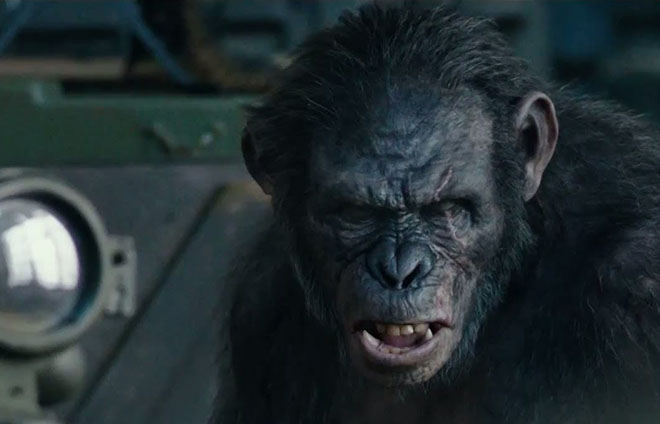
To get this out of the way first: Dawn of the Planet of the Apes, apart from having as clunky a title as its predecessor, is an uneven film. It suffers mainly from two things: its overall plot is perfunctory and predictable due to the movie’s premise and it being a prequel, and the human characters are usually less interesting than the apes, especially when they interact among each other.
At the same time, Dawn gets one thing very right, and that’s the simian drama. While it takes a while to get going – the film’s first twenty minutes or so are oddly reminiscent of 2001 (which is helped by a score that evokes György Ligeti) in how they are entirely set among apes, with no human interaction – it becomes a strong driver for the plot, even when it’s fairly clear where it’ll end up.
In fact, I would go so far as to say something that I usually find pretentious, annoying and inaccurate in reviews: this is some downright Shakespearean shit. Dawn sets up a character triangle that on paper sounds supremely generic: Caesar, the main simian character from Rise of the Planet of the Apes of the Title that Never Ends, is in conflict with his adolescent son Blue Eyes who thinks that his old ape is too much of an appeaser towards the human survivors. Meanwhile, Caesar’s second-in-command, Koba, holds a fierce hatred for humans due to having been the subject of experimenting before the apes rose against the humans. Blue Eyes is drawn by Koba’s strength and ruthlessness but not oblivious to his descent into cruelty and despotism.
Although this could very easily end up as a constellation straight out of Scriptwriting 101, the performances elevate it onto a level that is both archetypal, rather than generic, and specific to those characters. I write “performance”, though I cannot say where the actors’ motion-captured acting ends and the animators’ task begins. (This is a different discussion and one that the experts must debate.) For the audience, what matters is that Caesar, Blue Eyes and Koba utterly come to life on the screen. ‘Digital actors’, or whatever the term du jour is for all-CGI characters, may not look 100% convincing and integrated into filmed material at all times just yet, but in terms of animation and acting the film’s central trio of apes is entirely convincing and engaging.
To get back to my earlier description, though: I usually dislike reviews describing anything as “Shakespearean” because to me, what makes Shakespeare lies almost entirely in the words. Take those away or reduce their importance – and neither of the two recent Apes movies is focused primarily on language – and what is left? Nevertheless, Dawn deserves the descriptor to my mind, as even without language it evokes a conflict between its simian characters that is as potent and effective as those in Shakespeare’s historical dramas especially, and pushing much the same buttons. Blue Eyes may not be a Prince Hal, but Dawn juggles its conflicts between the personal and the political deftly enough not to be entirely embarrassed by the comparison.
I’m curious to see where they’ll take this new series of Planet of the Apes films next. I expect that the third film that Dawn clearly leads up to will suffer from similar problems in terms of plotting and predictability, but if they can build on the characters they’ve established they could still end up with a strong film. Never mind an infinite number of chimps banging away at typewriters: put the apes in the acting chair and you may just end up with a smidgen of Shakespeare’s magic.
I don’t go out of my way to watch films about the Second World War, and this is even more the case with respect to Holocaust-related movies. That’s little to do with the subject matter and a lot with the way such films often turn out to be samey in terms of form and content. Especially when it comes to the Holocaust, there’s a certain iconography, at least in Western films, that is rarely escaped or at least varied. The topic is an important one, undoubtedly, but important topics don’t automatically make for good films.
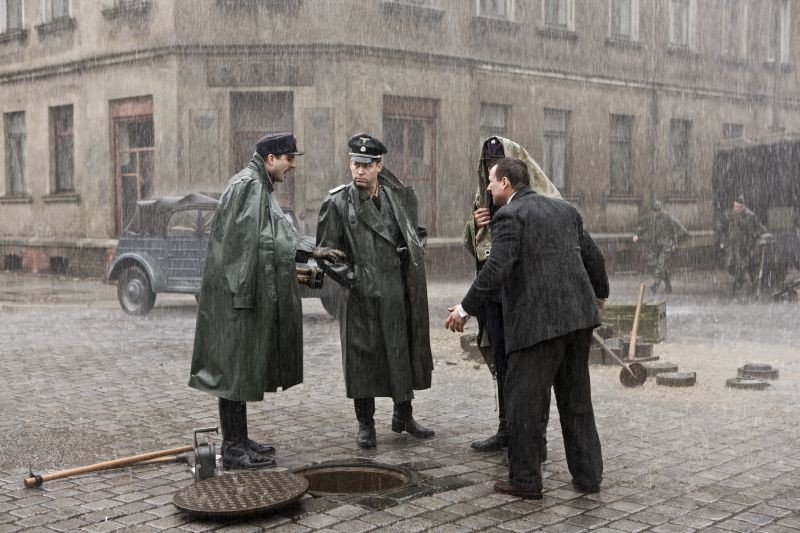
When Agnieszka Holland’s In Darkness was shown on TV recently, I was nevertheless interested. On the surface it sounded like a story we’d seen before, of how a simple, flawed man finds his own humanity to save a group of Jews at risk of being killed by the Nazis and their helpers. Holland, though, is an interesting director. I’d greatly enjoyed the episodes of The Wire and Treme she’d directed, and I’d heard very good things about Burning Bush, the miniseries she’d done about Jan Palach, the student who immolated himself in 1969 Prague to protest the Soviet occupation. While she’s worked in America, In Darkness is a Polish film, and the film is told from a perspective we don’t often see, without excusing or minimising Polish anti-semitism.
The story of a sewer worker protecting a dozen Polish Jews fleeing the massacre of their families and friends in Lvov and looking after them in the sewer system, first for money but later because he comes to see it as the right thing to do, is interesting in itself, but apart from the details it’s not altogether new. What makes the film effective even when it follows fairly well-trodden ground is what Holland gets out of her actors and how she portrays all of them as essentially human – though not in a sentimental way. The characters she shows us are flawed, petty, jealous, shallow, selfish, craven, and this is as true for the Jewish refugees in the sewers as for Leopold Socha, the Polish sewer worker. There’s often a tendency, not only in films, to idealise the persecuted and the victims, and while the impulse is understandable, such idealisation can be dehumanising. Holland never loses sight of the humanity of all her characters, the good and the bad, and the film benefits greatly from it.
In Darkness is not perfect, and its story, while closely based on the real events, doesn’t always ring true; a near-disaster late in the film may have happened the way it is shown, yet it doesn’t feel altogether believable as part of the film. Yet more than any film about WW2 and the murder of European Jews I remember watching since, well, The Pianist, I found it affecting. Holland’s film doesn’t come across like it wants to communicate a message, but in refraining from doing so, at least up until the very end, it succeeds all the more.
P.S.: There is a message in the title cards that close the film: after the war, Socha died saving his daughter from a runaway army truck. At his funeral, the screen text relates, someone said that perhaps this was God punishing Socha for protecting the Jews during the war. Holland ends on an angry, sad and bluntly timely note: “As if we need God to punish each other.”