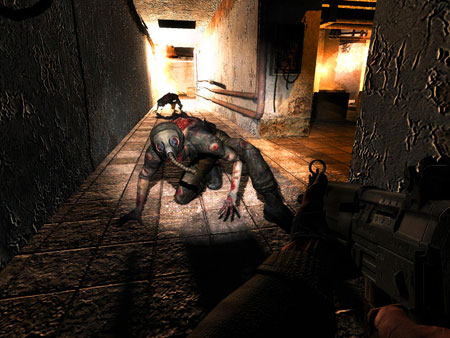
It’s the end of the world as we know it, and I feel blind

Cinema loves end-of-the-world tales – but then, who doesn’t? Who doesn’t get a big dose of endorphins out of watching zombie hordes ravaging mankind, asteroids punching holes through our planet, or killer chickens devouring us in revenge for kazillions of McNuggets? (Apparently we taste especially good with secret sauce.)

Obviously there’s a certain potency in telling stories of the end of the world that’s difficult to come by when what’s at stake is much smaller. End of your village? Your high school? Your local Tesco’s? Doesn’t quite pack the same punch as the potential end of everyone you ever loved, hated, sat next to in maths classes, bought frozen peas from.

The main problem with Fernando Mereilles’ Blindness is that it doesn’t just want to tell a story about an almost-apocalypse. It wants to have meaning beyond that generated by its story and the plight of its characters. It wants to be symbolic, too, and literary, which isn’t surprising as the film is based on a novel by Portuguese Nobel Laureate José Saramago. Unfortunately the story doesn’t carry the weight of some deeper, symbolic meaning. As a tale of a Very Special Apocalypse it works well enough, in a depressing Lars von Triery way, but it fails to live up to its own ambitions to such an extent, it risks turning the audience against itself. I’m always willing to feel empathy for fictional characters, like the bleeding heart liberal literature lover that I am, but I found myself getting annoyed with the way the film managed to escalate the sheer horridness of its scenario over and over again, mistaking misery for depth.
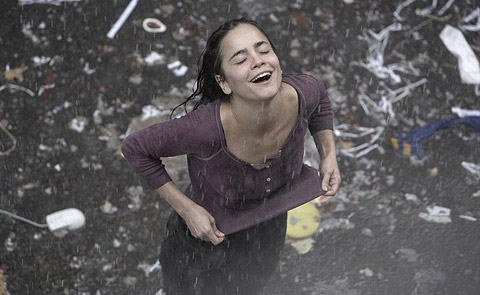
It’s a shame, because there’s so much skill in almost every facet of the film. It’s beautifully shot, the acting is largely impecable, the editing works. Yet the flawed apocalypse extravaganza that is Danny Boyle’s 28 Days Later finally works better as a film, mainly because it tries to be less and succeeds to be more. Mereilles’ film, undoubtedly the more ambitious of the two movies, fails to live up to what it so obviously tries to be, it’s difficult to see it as anything other than a noble failure, the emphasis being on the latter.

P.S.: Having said that, I’m greatly looking forward to the director’s future work. After City of God and The Constant Gardener, Mereilles would have to turn out the equivalent of Lady in the Water or The Village for me to start thinking that the previous displays of his talent were mere flukes. Even one of his failures is vastly more interesting viewing than a successful Brett Ratner flick.

P.P.S.: Blindness was adapted for the screen by Canadian author/director/actor Don McKellar (who also has a small part in the film). For people looking for an interesting end-of-the-world film that succeeds better, perhaps for trying less hard, check out his Last Night, the sort of apocalypse movie that only the Canadians could pull off.
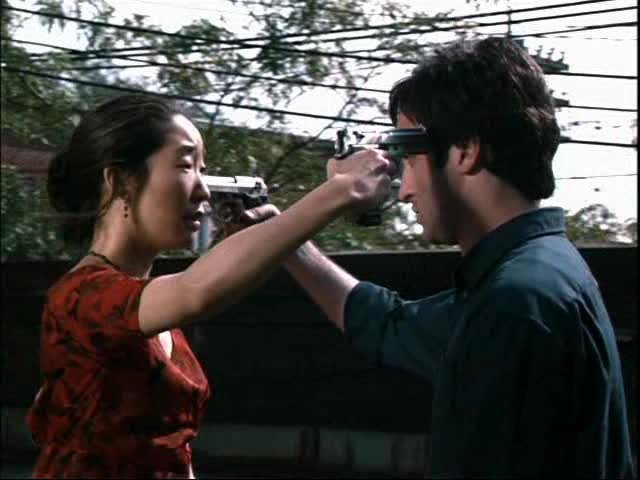
Swan on Swan

So, tonight’s the night. Stars all gussied up, waiting to hear those coveted words: “And the winner is…” A show that is best enjoyed with vast amounts of alcohol and decadent nibbles. (A couple of years ago, my girlfriend and I pulled out the sofa in front of the TV and made it into a bed, slept until early in the morning and then had toast and salmon while watching the Oscars. Good times. Much better than the one where we tried to do a Vacherin fondue and the cheese both smelled and tasted putrescent.)

I haven’t seen all of the nominees, far from it. Colin Firth hasn’t stuttered his way into my heart yet (aww…), an ageing Dude hasn’t yet shown us what True Grit is, and I have no idea whether The Kids Are All Right or not. In the last two weeks I’ve watched two of the multiple nominees, though: 127 Hours and Black Swan. I enjoyed both films, but I wouldn’t necessarily call both of them ‘good’ films. They both are showcases for their directors, full of stylistic flourishes – but I found 127 Hours exhilarating, thrilling and moving, and I was able to take the film seriously throughout. Black Swan, for all its technical accomplishment, struck me as silly to the point of becoming laughable.

It’s an eminently well made, well acted, well shot, well edited film – but it’s a B movie dressed up to be Oscar bait. It’s a Brian De Palma thriller pretending to be a relevant statement about the artist’s responsibility to destroy herself in order to produce true art. And it’s cheesy as hell – but like a good cheeseburger, it is a yummy treat and should be acknowledged as such.

My main problem is this: if you’re going to make a film about someone going mad, with scenes that signal at every edit, “Is this real or is this only happening in her poor, psychotic imagination?”, you need to have a certain base reality. Natalie Portman’s Nina, though, is a few feathers short of a cygnet from the beginning, and even the scenes that are supposedly real are turned up to 11, producing a hyper-reality that is only halfway removed from the all out insanity that eventually grips Nina’s mind. And the turny-twisty revelation at the end might be believable (I’m not talking about realism but about what is credible in the world established by the film) in opera, but decidedly less so in this movie.

What doesn’t do the film any favours is the spectre of better films that haunts it: All About Eve and obviously Powell’s The Red Shoes. And no hot (though imaginary – oops, did I give it away? The film already does a good job of doing so…) bedroom scene straight out of Lesbian Spank Inferno III: The Birds can banish these ghosts completely. There’s even a hint of Buffy‘s Faith, although that is one ghost that makes Black Swan look good by comparison – Mila Kunis is both hotter and a more convincing actress than poor Eliza Dushku.

So what about that much praised performance by Natalie Portman? She definitely does a very good job, but she’s not always helped by the script, which keeps the character samey for the first half, varying between forte and fortissimo, and then escalates it for too short a time. Portman finally makes for a magnificent black swan, but it’s difficult to say how much the performance is bolstered by make-up, costume and CGI effects.

So, who will win? Hmm… From the films I’ve seen, I can’t really say much about the nominated actors, having seen too few of them in these specific performances. I also don’t think all that much of a “Best Picture” category, since the best films in different genres can hardly be compared. (Is Chinatown a better film than Raiders of the Lost Ark? Does it matter?)

I am rooting for L’Illusioniste, though, because its doomed, beautiful magic has given me one of the most enchanting cinematic experiences, not only this year, but ever. Pixar’s got enough of those little golden men on their mantlepiece, after all.

Le retour du sous titre

You know what’s almost as bad as not having any subtitles in a series of films filled by mumbling Yorkshiremen? (Note that in the meantime a friend’s lent me the German edition of Red Riding, which features subtitles along with the English audio track. Blessings upon their Teutonic heads!) Buying a DVD that advertises, right on the back, subtitles in every language under the sun, or at least in English, German, French, Russian and a fair number of other languages – but then the actual DVD bears little resemblance with what’s promised on the box.

Other than featuring Andrei Tarkovsky’s enigmatic Stalker, that is. I’ve been interested in the film for, oh, about 15 years now, ever since a friend mentioned to me that it’s one of his favourite movies. My interest was piqued even more when I played the Stalker games, although they’re based less on the movie than on the novel Roadside Picnic (and ironically, while the games are relatively thoughtful, they still look like an ’80s action movie next to Tarkovsky’s film). I ordered the DVD on Amazon.fr ages ago – precisely because the edition promised subtitles in lots of different languages – but only got around to seeing the film now.

First impression: man, my French sucks. I was never very good at it, but after letting what ability I had rust for 15 years I understood perhaps 40% of what was being said. (Or rather, 40% of the subtitles; I understood even less of the Russian dialogue, although I did understand “бутерброд”!)

Second impression: even if I understand fairly little and the film is extremely slow – there’s something eminently compelling to Tarkovsky’s style. Even more than Solaris (which suffered somewhat from being set in an outdated future, the fate of so much sci-fi) Stalker is hypnotic… and gorgeous to look at. It is atmospheric without going for any of the predictable tools of atmospheric film makers. The world of Stalker is ominous and eerie, yet at the same time naturalistic, creating an effect I haven’t seen in any other film. There’s something almost documentary in its visuals, yet there’s a dream-like quality – and it’s this seeming contradiction, this tension, that is utterly fascinating.

More than that, perhaps it helps to see the film in a language I don’t fully understand. Films that are put in the ‘art film’ box tend to have a certain portentous, somewhat affectated quality to them; as much as I like Bergman, for instance, a number of his films have a certain self-aware heaviness that can be more alienating than is necessary. Perhaps Tarkovsky’s work has this same quality if the viewer understands the dialogues enough to realise that they’re unintelligible – but my impression was that while the world and themes of the film are portentous, the characters feel real. Not 100% and not all the time, but they’re more than just vehicles for themes.

In the end, though, I can really only judge Stalker as a visual experience until I’ve rewatched it (after a French refresher, perhaps), and on those terms alone it’s well worth seeing. Even if there’s a relative scarcity of Ukranian mercenaries, radioactive mutants and frantic gunfights.

But if I get my hands on the people responsible for that mendacious DVD edition, je m’occupe de vos miches à la médiévale!

To the North – where we mumble as we bloody want!

I’m torn on the subject of subtitles. Of course I like to know what’s being said in films, but often the sound mix favours things other than what is spoken, added to which not every actor enunciates like Sir Ian McKellen. (Though that would be funny; imagine The Wire‘s McNulty intoning “What the fuck did I do?” in that marvellously fruity RSC drawl.) But a) when I’m looking at subtitles, I’m not looking at the actors, and b) so many subtitles don’t discriminate – what is whispered and is supposed to be hardly intelligible is usually presented as crisply as what is spoken clearly. Subtitles – the great leveller of dialogue. (Still – vastly preferable to dubs in 99.9% of all cases, though that’s a different discussion.) There are times when I prefer not to understand everything to having every single word spelled out for me in big frickin’ letters.

And then comes along Red Riding, a Channel 4 produced trilogy of films about murders and police corruption. A beautifully produced series of movies, gorgeous to look at, feeling like someone had taken the best elements of David Fincher’s Zodiac and James Elroy’s L.A. Confidential and put them together. Gritty, dark, complex, compelling.

And then those Yorkshire coppers and criminals open their mouths… and out comes – what? Strange vowel sounds. The occasional half-strangled consonant. Words that sound like the H.P. Lovecraftian equivalent of English spoken through snaggle-toothed, monstrous teeth and lips. Honestly, I was under the impression that ‘oop North’ it was all “All right, luv!”, but I thought they still spoke a recognisable form of English!

And these films live off their dialogue. The intricate plots within plots, the conspiracies and betrayals, are conveyed by speech… and half the time I have no idea whether the characters are talking or expelling phlegm from their throats! To be fair, the second of the three films – 1980, following 1974 – is easier to understand, not least because the worst offenders against clear speech are killed horribly in the first film. But still – even for native speakers of the language, I doubt that understanding those Yorkshiremen and their dark, corrupt doings comes easily.

So, what better than to activate the subtitles. To understand what people are saying. Bliss… except the DVD doesn’t feature subtitles. I can choose between Dolby 2.0 and Dolby 5.1 – but subtitles? Something that would actually help me understand what is going on? Something that would allow me to answer questions of the “So, explain this to me: what the bleep is going on?” kind with some sort of authority. But no – I have a lovely sound system, and all the good it does to me in this case is this: it allows me to hear the unintelligible noises with perfect, hifi quality. Thanks a bunch.

Note to self: next time, check out the German DVD edition after all. Perhaps they’re kind and wish their foreign audiences to know what’s going on. Because, let’s face it: bugger those Southerners if they can’t be bothered to live in Yorkshire!

P.S.: There’s something wrong when Peter Mullan is more easily understood than half the rest of the cast.

No more gifts from Mr Soze

By now most people will already have heard, but on 2 January 2011 Pete Postlethwaite died. He’s never been one of the big stars, but he was undoubtedly a great actor, with a presence and gravitas that made so many of his roles – even in bad films, and he definitely had those – worth watching. I first noticed him in The Usual Suspects, where he was the improbably named Kobayashi (with an even more improbable accent – which the dimwits at Empire magazine voted the ninth worst movie accent, completely failing to understand what was going on in the movie). Not many people could make the line “I may only castrate your nephew, Mr McManus” work as he did.

After that, he started popping up in a number of films (usually ones I caught a while after they’d been on at the cinema), and the moments he was on screen were usually among the best scenes in those films. He was a great Father Laurence in Baz Luhrman’s Romeo + Juliet, showing the kids how to do Shakespeare; and of course he was the heart at the centre of Brassed Off:

I didn’t necessarily go to see a film because of Postlethwaite, but I definitely enjoyed films more if he showed up. I will miss seeing his rough face, his gravelly voice. Pete Postlethwaite, films are poorer for having lost you.

Another Rather Lovely Thing

Remember me going on repeatedly and at great length about last year’s film The Assassination of Jesse James by the Coward Robert Ford? Well, I’m happy to say that this may give the film some attention, which it definitely deserves – although from a very odd direction. Animator Edmund Earle did a beautiful, surreal take on the upcoming Yogi Bear film (which may be almost as obnoxious as the recent Alvin and the Chipmunks movies), recasting Brad Pitt’s Jesse James and Casey Affleck’s Bob Ford with Yogi and Booboo. Earle has no affiliation with the Yogi Bear movie and seems to have created this beautifully animated short in his spare time, which should get him the admiration of geeks, nerds and filmaficionados everywhere.

Read this for details: http://blogs.wsj.com/speakeasy/2010/12/13/yogi-bear-alternate-ending-booboo-kills-yogi-parody-video-creator-speaks/

P.S.: A special Christmas prize may just go out to the first person who ‘gets’ the reference in this blog entry’s title…

Light sabres… for kids, you know?

I’m one of the lucky ones – I was a kid when the original Star Wars trilogy came out, so I like the Star Wars movies that it’s okay to appreciate. Like so many boys of my age I wanted to fly an X-Wing or a snowspeeder, bringing down the Empire one AT-AT at a time. I got really good at making bad light sabre noises. It took me a long time to see anything other than A New Hope, because my parents were decidedly uninterested in anything sci-fi or fantasy; I still haven’t completely forgiven them for taping over the original movie the day after we got the Betamax tape from my uncle, recorded from ITV. By the time I watched Return of the Jedi, I still thought that TIE Fighters, Death Stars and raspy-breathed evil space samurai were cool, but Ewoks were just overgrown teddy bears.

I remember the original teaser for The Phantom Menace giving me goosebumps at the cinema. This wasn’t just nostalgia, it was nostalgia distilled, and then the distillation distilled again. It was all the best things from my childhood without the stuff I’d worked hard to forget or repress. It was Star Wars, for crying out loud.

Well, we all know what happened when the prequels came out and millions of nerd voices suddenly cried out in dismay. Let’s face it, though, Teddy Bear’s Picnic should have prepared us for Jar Jar & Co. In any case, if I wanted to write about the disappointment of the prequels, I’d be even more ludicrously late than I am with most of my blog posts.

What I really want to write about is this: that fine distillation of childhood with all its best bits left in exists. And next to Rock Band, it’s the best fun I’ve had with any video game playing with my girlfriend.

Lego Star Wars gets the appeal of Star Wars: its universe is a playground for overgrown kids – but while it’s childlike, it isn’t childish. It isn’t embarrassing the way the Gungans are in Episode 1, nor does it take itself as seriously as the worst moments of Episodes 2 and 3. The trials of Anakin are more relatable when he’s a mute toy figure… and the “I am your father” moment in Lego is simply perfect.

The Lego series of games extended to other fictional universes after covering the Star Wars movies in bric-a-brac glory: there’s Lego Batman, Lego Harry Potter, two Lego Indiana Jones titles… and Lego Pirates of the Caribbean is in the works. The games are all basically the same, with small variations in the designs – but for someone who grew up trying to imitate the roar of an Imperial fighter screaming past your cockpit, it’s the Star Wars game that carry a special magic. And sitting on the sofa, teaming up with my girl to dismantle the Empire brick by evil brick is bliss.

As is the ability to hit Jar Jar with an itty bitty light sabre. Again and again and again…

Eagles on Pogo Sticks likes this.

Yesterday evening, before we went to the cinema, we were discussing David Fincher’s other films. Which did we like best? Which least? I came up with my personal Top Three films directed by Fincher (in no particular order): Seven, Fight Club and Zodiac, with Alien 3 receiving special mention. (It’s flawed but the bits that I like I pretty much love.) Seven is probably the moodiest of his films, Fight Club the most enjoyable and Zodiac is perhaps the most perfectly crafted Fincher film.

Since yesterday evening, I’ve added The Social Network to the Top Three (which therefore contains four titles now, risking a possible world-destroying mathematical paradox), albeit on probation. Will I still like it that much in a week’s time? In a year? Once I’ve seen it as often as the other films? (Zodiac I’ve only seen three times so far, but Seven was my film for bad moods for a while when I was often in a bad mood.) We’ll see, but for now I would say this: it’s Fincher at the top of his game (Ebert rightly calls the movie “splendidly well made”), working with a script that complements his considerable skills. This makes for an interesting comparison: The Curious Case of Benjamin Button was decried by some because that film’s script pulled it in the direction of a mawkish sibling to Forrest Gump (scripted by the same writer, Eric Roth, not to be confused with Eli Roth). I thought that Fincher’s cerebral approach made for a fascinating film that was pulled in two different directions, namely sentimentality on the one hand (script) and a weird sort of Verfremdung on the other (direction), resulting in a tension that didn’t always work in the film’s favour.

Aaron Sorkin’s script for The Social Network, though, is sharp and witty, with little trace of mawkishness. It’s not cold or unemotional in any way, but it doesn’t do the Spielbergian brand of emotion that requires heartwarming performances and a John Williams soundtrack so obvious it makes you feel a little queasy because the sentiment is laid on so thick. The film thrives on repartee and verbal barbs that is delivered at breakneck speed – I’ve rarely seen a movie that is so dialogue-driven and feels this fast (though not rushed).

I’ve seen TV series like this, though, especially one little known one about the president of some far away country. I think it’s called… let me see… The West Wing? Which, coincidentally, was also written by one Aaron Sorkin. Having watched the first four seasons of The West Wing (the ones during Sorkin’s time at the helm of the series), I find The Social Network‘s fictionalised Mark Zuckerberg a dark twin of Josh Lyman, deputy chief of staff to President Bartlet. Lyman is more likeable because he’s got a strong sense of ideals and ethics, but he shares so many qualities with Zuckerberg: the sense of intellectual superiority that goes hand in hand with deep-seated insecurity, the way that every conversation is seen as a battle, the intense need to win, to be right, even if it means being a dick to others – the atrophied social skills and emotional immaturity that is fun to watch with Josh because he works in an environment and with people that ground him every now and then.

While the origin story for Fincher and Sorkin’s version of the Facebook founder is perhaps too simple – Zuckerberg basically gets started on the road to Facebook because of the Girl That Got Away, throwing his social dysfunction right back in his face – it makes for an interesting foil with Josh Lyman. Without his Girl Friday, Donna Moss, would he become increasingly insufferable as Zuckerberg does, ending up a sad, pathetic geek with a brilliant mind?