Up in the air with flying foxes and less-than-fantastic goats

What’s the best thing about an11-hour flight? It can’t be the dodgy movies on the in-flight entertainment system, can it? (I once failed to go to sleep on a flight that showed Marley & Me and Paul Blart: Mall Cop on all the screens. The lambs have barely stopped screaming on that one, Clarice.) Well, yes, it can, on one of those snazzy new planes where even down in Economy Class, with all the third class Oirish having a fun time before the plane hits the iceberg, you have a choice of oodles of films, music and games. And since Who Wants to be a Millionaire? loses its interest after a handful of games, especially when there’s no oily showmaster-wala with an Indian accent to foil your attempts to get the money and the girl, I decided to dedicate at least some of my flying time to watching first The Men Who Stare at Goats and then The Fantastic Mr. Fox.

Men, goats, intense stares… George Clooney, Jeff Bridges and Kevin Spacey – what could go wrong? Well, it’s not so much what went wrong; it’s more that way too little went right. The film is a brilliantly cast neat idea spun out over 1 1/2 hours, which makes for a great trailer (minus Ewan McGregor’s horrid American accent) and a decidedly mediocre film. It isn’t really worth saying all that much more about it, except to bleat mournfully.

The Fantastic Mr. Fox, though? I’m still surprised to say that I genuinely enjoyed it. I’ve had problems with the two Wes Anderson films I’d seen, The Royal Tenenbaums and The Life Aquatic. Anderson’s a great aesthete, but his style got in my way of enjoying both movies to a large extent. The problem is that the films and their characters are so stylised, in their looks, behaviour and neurotic quirks, that they feel wholly static – so when the plot contrives to make them tragic, I don’t buy it. The pathos turns into mawkishness, and when it kind of works in spite of the artifice, it’s largely due to the borrowed emotions of the songs Anderson chooses. To my mind, characters can only become tragic if there’s the illusion that they are free, or at least struggling to free themselves, from the master puppeteer that is Fate, the Script and/or the Director – Anderson’s characters have often struck me as being puppets at the mercy of a master stylist who doesn’t have freedom anywhere on his palette.

[https://www.youtube.com/watch?v=W460QxYQgh4]

I suspect that what makes Mr. Fox work for me is this: animated films are stylised to begin with. They are entirely created. And ironically that makes Mr. Fox feel less constricted by Anderson – whereas real people in a live-action film are made less unreal by the artifice that seems to be his favourite stylistic choice, the animated foxes, moles, possums and badgers, not to forget farmers Boggis, Bunce and Bean (one fat, one short and one lean), are infused with humanity, for want of a better word. The style becomes a part of the whole rather than being the whole and thereby threatening to suffocate both the actors and the characters.

The Fantastic Mr. Fox is very clearly a Wes Anderson film – the look, feel, costumes, even the character setup (father-son conflict anyone?) feel familiar… but by sidestepping live-action for once, Anderson’s made the first film that, being entirely artificial due to being animated, feels real to me.

And it’s got this lovely scene with Michael Gambon (as farmer Bean) and Petey, as played by Jarvis Cocker:
It’s a mad, mad, mad, mad world

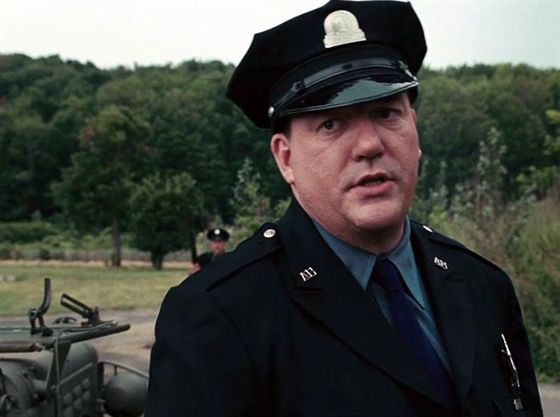
It’s a detail, a cinematic in-joke invisible to all but film afficionados, but it adds to the ominous atmosphere on Shutter Island: the two head wardens of the mental hospital are played by Ted Levine and John Carroll Lynch – Jame “Buffalo Bill” Gumb from Silence of the Lambs and Arthur Leigh Allen, the main suspect from David Fincher’s Zodiac. With these two in charge of security at Ashecliff Hospital, you wonder: are the inmates in charge of the asylum, or are the patients even more insane? Even the benevolent doctor, played by Ben Kingsley at his most unctuous, serves to make us more paranoid rather than comforted.

The main attraction in this Scorsesean Gothic horror, though, is Shutter Island itself: the location immediately joins an exclusive list together with Bates Motel, the Overlook Hotel and the abbey in The Name of the Rose, as one of those places that feed the imagination. Anything might be hiding in that old lighthouse, and the carpets of Dr. Cawley’s residence exude a sense of foreboding. The place breathes a diseased past: you get an almost tactile sense that things have happened here, things that shouldn’t be.

Things that, in fact, didn’t happen. The true horror house, as so often, is the human mind, protecting itself as it knows best: by inventing alternative histories that become more real, more believab le, and certainly more necessary than what has really happened.

Scorsese and Lehane’s psychological horror yarn isn’t original, and those who have seen or read similar stories will not be overly surprised by the main twist ten minutes before the end. But it’s been a while since the twist, its lead-up and denouement havve been told with such sensuality. The film is rarely subtle, but damn, if you don’t feel the clammy fog of Shutter Island stick to your skin as you leave the theatre.

Having said that, though, I have one quibble with the film. For the most part it plays fair with what is and what isn’t real. It doesn’t fool the audience in cheap ways and is usually pretty clear with respect to what’s in the protagonist’s mind. Hallucinations aren’t played for a cheap “Huhwha?” effect. There is one big exception to this, though, a scene which logically must be a hallucination, yet it plays more realistically than most other scenes in the film. On one level it helps that it features the always wonderful Patricia Clarkson, who invests the scene with a fevered intensity and conviction; on the other hand, it’s exactly the fact that she’s so believable in her part, her presence to solid, and the moment not a brief flash of unreality, that it takes on a solidity it shouldn’t have – logically, it must be a hallucination, yet it doesn’t have the markers of unreality that the film has established previously. And that’s why the scene keeps niggling at me. It stands out, yet I can’t help feeling that it doesn’t play fair. It’s a cheat – an eminently well-executed cheat, but a cheat nevertheless. And yet, and yet… Perhaps I need to see the film again to figure it out. Just when I thought I was out, Shutter Island pulls me back in. (Thank you, Sil.)

One for the film geeks

Okay, I’m afraid this is another cross-link with little input from myself – but I thought this was one of the more intriguing film blog entries I’ve seen lately. Have any of you seen Lars von Trier’s The Five Obstructions? I haven’t… yet. The DVD’s on my shelf, but somehow it hasn’t actually made it into the player so far. In any case, here’s the trailer:

The FilmSchoolRejects site has posted suggestions for ten films (and directors) that von Trier should obstruct, which makes for geeky though fascinating reading. Personally I’m not a big fan of von Trier, but there are some cool ideas in there. And yes, there are a number of directors who should be shaken, kicked and dragged out of their rut – by force, if necessary.

Les Absents Ont Toujours Tort

Yes, I know. I’ve been pretty absent lately, for which I apologise. In the last few weeks I’ve had a couple of blog entries half-formed in my head, but no time and/or energy to commit them to the screen and the depths of the internet. Here’s hoping that writing about my blogging anxiety might make me pull myself together and actually write a damn blog entry. That is, one that goes beyond a semi-interesting link. Talking of which:

Taxi Driver sequel in the works?

If it features Travis Bickle and Rorschach joining up to fight crime, one dead pimp at a time, I might just about watch it. Two psychopaths, both alike in’sanity…

A study in contrasts

Earlier this week I almost made my brain explode. I watched Pirates of the Caribbean: At World’s End (no, that in itself wouldn’t have done the trick)… and then, the next evening, I saw The History Boys. From loud, complicated, essentially dumb SFX-travaganza to smart Brit drama in about 24 hours – it’s enough to give you a bad case of the cinematic bends.

At World’s End (or Pirates of the Caribbean III: Why does everything have to be a trilogy?) is undoubtedly a fine-looking film. The visual effects, by and large, are amazing, and the film’s visually inventive to boot. There are sights to behold that I’d never seen before on screen, and the digital artistry on Davy Jones’ betentacled head and face is quite amazing.

If only it was in service of a better script. Remember the first entry in the Pirates franchise? It wasn’t Bergman, but it was witty and fun, which is exactly what such a film needs. Starting with the sequel Dead Man’s Chest, though, the film lost in lightness and wit what it gained in complicatedness. Not complexity, mind you, because that would mean the plot actually adds up to something and benefits the films. Nope, what we got was messy and uninteresting. failing almost completely to serve the movies’ characters.

Yes, Johnny Depp was fun in the third film, as he was in the first two, but Jack Sparrow being Jack Sparrow is simply not enough to keep me engaged for three hours. Geoffrey Rush’s Barbossa might have helped, but little was left of his wonderful scenery chewing in the original Pirates of the Caribbean. In fact, most of the actors acted their hearts out, but to no avail: the script is leaden and dull, only little better than George Lucas’ efforts in the Star Wars prequels. Honestly, Mr. Verbinski, here’s a suggestion: if you want to make a three-hour popcorn movie, give it a fun script, or don’t do it at all.

The History Boys, based on Alan Bennett’s stage play, is pretty much the opposite of Pirates of the Caribbean 3. It’s wordy and character-driven, it gives its cast a chance to shine, and it’s funny and moving. I’d never realised that Richard Griffiths did roles other than broad caricatures, but his Hector, a gay, sad English teacher with an absolute passion for his subject, is a beautifully judged, subtle performance with no trace of Uncle Vernon. However, as much as Hector’s at the heart of the film, practically every other part is as well acted and as necessary to the whole.

Bennett’s writing requires acting this good; I’ve seen amateur productions of his shorter works, and they all came across as terribly mannered and stagey. The dialogues in The History Boys are not realistic, they are stylised (as are the characters), but that doesn’t mean in any way that they feel phony. There’s a truth to all of the performances and writing that takes a bit of time to develop – during the first half-hour, I was thinking that some of the characters were a tad stereotypical, but that’s only true in the way that many people at first seem to fit certain types, and only as you get to know them they develop their individuality.

The movie’s also surprisingly good at not feeling like a filmed play. It may have a script that feels theatrical (which makes sense, given the subject matter – school is inherently theatrical and every classroom is a stage), but it doesn’t look like it wants to be on the narrowish confines of a stage (or like it desperately tries to escape those confines, which is often worse). The film breathes throughout the spaces it evokes.

The History Boys is definitely not for everyone, and if I want to be somewhat arrogant and dismissive about it, chances are that more people will like At World’s End. It’s a film that expects its audience to engage with it, intellectually and emotionally. But the effort pays off many times.

Als das Blog Blog war

Wim Wenders’ Der Himmel über Berlin (a.k.a. Wings of Desire, if you like your titles a bit more on-the-nose, a.k.a. The Film That City Of Angels Is Just Barely Based On) is undoubtedly a beautiful film to look at. Its visuals are a love letter to Berlin as much as to black-and-white cinematography. It’s also a film containing many gems: the image of many, many angels hanging out at the library, watching over us; Bruno Ganz and Otto Sander sitting in a show car, comparing notes; their conversation about the history of the world; almost every scene that Ganz has with Peter Falk, and the conceit of Falk being an ex-angel himself. There are many quietly beautiful, poetic, even funny moments.

And yet, in spite of the accolades the film has garnered, even after two viewings I can’t shake the impression that it tries way too hard to be poetic, to be art. The worst offender is the poem that the film picks up again and again, Peter Handke’s “Lied vom Kindsein”, that interminable bit of pretentious doggerel that begins with “Als das Kind Kind war…”. Not only does it offer the appearance of depth rather than the real thing, Ganz also keeps falling into this childlike singsong, making it wholly insufferable. It’s a series of idealising clichés about the innocence of childhood that make me want to hunt down the poem’s titular child and send it off to boarding school.

What bothered me even more, though, is the trapeze artist that Bruno Ganz’ Damiel gives up his angelhood for. Her lines – both her thoughts and her dialogue late in the film with newly mortal Damiel – are painfully faux-deep, making me think that if I was Damiel and had just given up immortality for her, I’d feel pretty ticked off right now. That whole last dialogue seems to boil down to “The meaning of life lies entirely in man and woman having it off, and that’s what makes life, like, deep, man!”

I guess that’s my main problem: when the film doesn’t try its damnedest to be deep and poetic, it actually becomes these things. When it aims at depth, it comes off as an overly earnest transcript of one of those conversations first-year students have at 2pm in the morning after lots of cheap red wine. I also had these conversations, I enjoyed them, but there’s a difference between being young and drunk, as much on wine as on one’s sense of understanding of the world and all, and having to sit through them as an outside observer.

I’ll probably end up watching the film again, five years or so down the road, because there are so many people who love it dearly. Perhaps Der Himmel über Berlin just isn’t for me, at least not in its entirety, but I keep thinking there’s something I’ve missed. Or perhaps I missed the opportunity of seeing this film first when I was younger. “Als das Kind Kind war” and all that jazz…

We do the same. – The same? – Exactly the same. (pause)

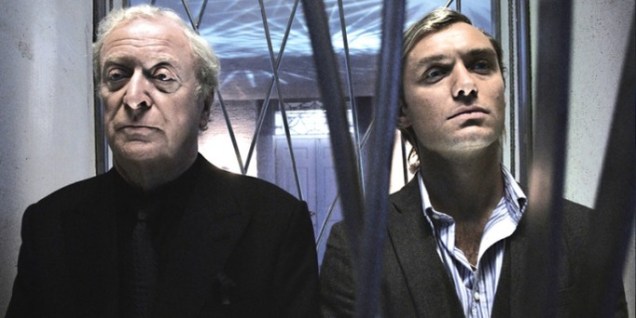
I’d be curious: did Michael Caine and Jude Law talk about Alfie on the set of Sleuth? Did they compare performances? Did they get drunk and watch the Stallone version of Get Carter? Or did they just stare at each other threateningly until Kenneth Branagh shouted “Roll camera”?

The Sleuth remake sounds like quite a compelling proposition at first: one of the grand old English actors facing off against a glittering, promising young guy. (Admittedly, Jude Law hasn’t quite followed up on the promise of his early films, has he?) Directed by Kenneth “Four fucking hours of Shakespeare” Branagh, who has a deft hand behind the camera when he isn’t trying to showcase his own thespian ego. And the original play and film adapted by Harold Pinter, master of intellectual menace and keeper of the weasel under the cocktail cabinet.

Alfie? Never seen it. Sounds like rubbish.

In practice, though, Sleuth is dead as a film. It has occasional moments where the individual contributors flare up and come to life, but it’s like putting an electrical current into a dead frog. Its twitches are easily mistaken for signs of life, but the poor little green guy is still as dead as, well, a dead frog.

Michael Caine probably fares best. He slips into the Pinteresque dialogue with ease and manages to make it sound relatively natural. Caine comes closest to convincing us that the film has a beating heart – but even he cannot sustain this against the wooden staginess of the proceedings. The script might work on stage, with the immediacy that a live performance brings to things, but if some scripts jump off the page, this movie lurches back onto the page.

I’ve liked Jude Law in a number of films, first and foremost Gattaca, The Wisdom of Crocodiles and The Talented Mr Ripley, and he’s got moments in Sleuth where he shines – but all too many of his line deliveries sound as if he imagined that This Is What Pinter’s Supposed To Sound Like. It gets worse in the second part of the film, after the first major twist, which I felt was badly handled; I sat there wondering whether it’s a genuine twist or whether the film suddenly decided to go all post-modern on us. I would have prefered the latter, since the twist made the characters even less credible. In any case, after half an hour Law turns up as a new character, but while his body language is convincing, his accent couldn’t be more fake. Yes, he’s supposed to be fake, but if it’s so transparent to us that this is Jude Law in disguise, it makes the Michael Caine character look stupid if he doesn’t get it… and since the film tries to convince us that the characters aren’t stupid while showing them doing utterly stupid things, it’s difficult to take anything happening on screen seriously.

The third act introduces a homoerotic component that seems to have popped in from a different film altogether. While the casting should work brilliantly here – Law has always had a peculiarly feminine quality – seeing Michael Caine trying to get his menacing paws on the younger man rarely feels anything other than awkward because the development comes out of left field, from another game, in a different country altogether.

Would the film have worked better for me if I’d seen the original? Perhaps – but I doubt it. Branagh’s main mistake in the end was to think that the staginess of the script could be counteracted by ‘clever’ (read: obvious) cinematographic choices. However, no weird camera angle will distract from the script and the performances if they’re geared towards the stage. Seeing this live might have been riveting. Seeing the film? Well. Dead frog.

Princely update

In case anyone’s interested, Rock Paper Shotgun has a “Wot I Think” on Prince of Persia. They say much of what I think about the game, putting it much more succinctly. I guess that’s why they are professional games journalists who get paid for this sort of thing, and I’m a lowly fan with a big mouth.

Also, after seven games and two reboots, the Prince of Persia series gets a movie  version, which will make any film afficionado rejoice. Or regurgitate. It’s one of the two. In any case, it’s got proper actors and even a director who’s made good films – which is more than most video game movies can say for themselves. It even features good ol’ Satipo:

You throw me the idol and I throw you the whip... as soon as I stop screaming, that is.

Could this be an actual video game movie that is worth the admission? Or will we be wishing afterwards that we could use the Sands of Time to rewind the previous two hours?

Habemus PS3…

… and a stomach bug brought home from Egypt. All in glorious HD.

So why have I, a stalwart PC gamer (with a PS2 obtained originally for entirely academic purposes, I swear!), got myself one of those newfangled PS3 Slims? Two reasons, really: 1) Blu-rays and 2) The Last Guardian. Obviously I had more reasons than that, but they’re the main ones.

1) When we originally got digital TV, I was told that our connection was fast enough for HD channels. And yes, it was pretty glorious (in a nerdy way) to be able to record and watch both volumes of Kill Bill in high-def. Even boring old football (that’s “soccer” for y’all yanks out there) just popped off the screen in a way that made it watchable. For five minutes. At most. But you could see every blade of grass, and every pore on people’s faces! (Makes you feel all Walt Whitmanesque…)

But then our digital connection was downgraded. Why? They couldn’t tell; in fact, they were pretty mystified why I’d been told to begin with that the connection was fast enough. Guess I imagined all those red pixels in Kill Bill…

In any case, yesterday we watched our first complete Blu-ray disk, Sunshine. To paraphrase another brainy sci-fi flick, “My god, it is full of details.” While I still have problems with the film’s ending, this visually stunning film becomes doubly so in HD. Almost makes you want to dive into the sun yourself… in a good way.

(If you’re interested in seeing a good comparison of DVD vs. Blu-ray, check out this YouTube video. Make sure to watch it in HQ though.)

2) This one is a bit more esoteric, perhaps. Two of my favourite games on the PS2 are called ICO and Shadow of the Colossus, and they may just be the main reasons why I got the PS2 to begin with. I was writing a paper on games as art (Et tu, Roger?), and both of these seemed to fit the bill, combining subtle storytelling, beautiful art direction and gameplay in ways that few other games have managed. The developer’s new project is called The Last Colossus, and the trailers definitely have left me more than curious: