Six Damn Fine Degrees #162: The Wonders of Wonka

Welcome to Six Damn Fine Degrees. These instalments will be inspired by the idea of six degrees of separation in the loosest sense. The only rule: it connects – in some way – to the previous instalment. So come join us on our weekly foray into interconnectedness!

Yes, I am of the firm opinion that Die Hard (1988) is a Christmas movie, but enough about that. In Paul King’s Wonka (2023), there is often snow on the cobblestones of the old town renowned for its chocolate. It could be Paris or Charles Dickens’ London, while the shopping arcades reminded me of Milan, but it matters little where the story is set: it’s an olden-time dream world where it’s possible to manufacture magical chocolate if you are ready to go and milk a giraffe at the local zoo.

Continue reading

Six Damn Fine Degrees #159: The delightful anarchy of Gremlins 2 (1990)

Welcome to Six Damn Fine Degrees. These instalments will be inspired by the idea of six degrees of separation in the loosest sense. The only rule: it connects – in some way – to the previous instalment. So come join us on our weekly foray into interconnectedness

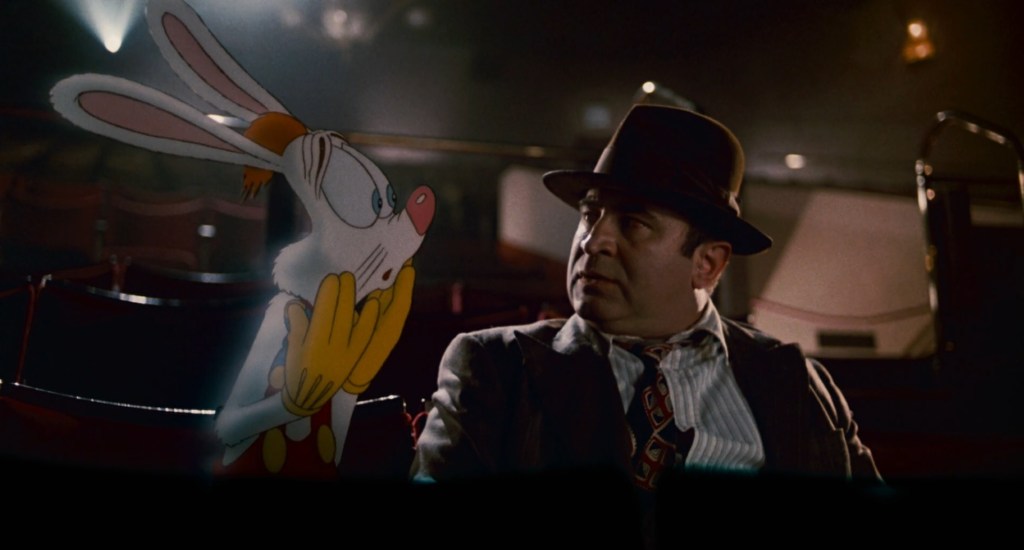
The perfect follow-up to the mixed media delight of Who Framed Roger Rabbit (so lovingly remembered in last week’s piece by Julie) for the pre-Christmas season, in my mind, is clearly the most insane, self-referential sequel of them all!

Continue reading

Six Damn Fine Degrees #158: Who Framed Roger Rabbit (1988)

Welcome to Six Damn Fine Degrees. These instalments will be inspired by the idea of six degrees of separation in the loosest sense. The only rule: it connects – in some way – to the previous instalment. So come join us on our weekly foray into interconnectedness!

Continue reading

Six Damn Fine Degrees #155: Best fiends and purely professional relationships

Welcome to Six Damn Fine Degrees. These instalments will be inspired by the idea of six degrees of separation in the loosest sense. The only rule: it connects – in some way – to the previous instalment. So come join us on our weekly foray into interconnectedness!

So, apparently Alfred Hitchcock wasn’t a huge fan of Ivor Novello? One wonders what Novello thought of Hitchcock. It’s not exactly a secret that Hitch wasn’t always the easiest director to work with. He famously said that all actors should be treated like cattle, and when he said that he was correcting an allegation that he’d supposedly said that actors are cattle. Arguably, his correction didn’t exactly do much to make him look any better. Of course, being treated like cattle might still have been the better deal compared to other ways in which Hitchcock behaved towards his actors – and particularly his actresses. (It’s no accident that one of the sections in the Wikipedia entry on Tippi Hedren’s is titled “Allegations of sexual harrassment”.)

Continue reading

Six Damn Fine Degrees #154: Ivor Novello – All Downhill From Here?

Welcome to Six Damn Fine Degrees. These instalments will be inspired by the idea of six degrees of separation in the loosest sense. The only rule: it connects – in some way – to the previous instalment. So come join us on our weekly foray into interconnectedness!

Julie’s wonderful reminder of silent film star Ivor Novello, whose most lasting screen appearance must indeed be Hitchcock’s The Lodger, but whose popular legacy was assured thanks to Robert Altman’s inclusion among the Gosford Park kaleidoscope of characters, reminded me of that other Hitchcock he made – and that’s why for my follow up post, it’s all Downhill from here!

Continue reading

Six Damn Fine Degrees #153: Ivor Novello in Gosford Park

Welcome to Six Damn Fine Degrees. These instalments will be inspired by the idea of six degrees of separation in the loosest sense. The only rule: it connects – in some way – to the previous instalment. So come join us on our weekly foray into interconnectedness!

Continue reading

Six Damn Fine Degrees #151: A walk in the park without a dog

Welcome to Six Damn Fine Degrees. These instalments will be inspired by the idea of six degrees of separation in the loosest sense. The only rule: it connects – in some way – to the previous instalment. So come join us on our weekly foray into interconnectedness!

I’ve been to the Europapark with my favourite daughter, and she had the good idea to go take the Valerian ride because she sort of liked Cara Delevigne in the Luc Besson movie. It’s with a virtual reality ride with a sturdy yellow helmet, but it is basically the Eurosat ride inside the silver globe, so that was a great ride for slightly nervous older geezers like me. It was also Luc Besson who co-wrote the series of Arthur and the Minimoys, and he was consulted for the park ride of the same name. It’s for the kids, but it was a pleasant change from the panic-inducing hellride called Blue Fire.

Continue reading

Six Damn Fine Degrees #143: How “Wednesday” puts the extra ‘d’ in Addams Family

Welcome to Six Damn Fine Degrees. These instalments will be inspired by the idea of six degrees of separation in the loosest sense. The only rule: it connects – in some way – to the previous instalment. So come join us on our weekly foray into interconnectedness!

It might somewhat seem like a bit of a short stretch from Alan’s previous piece on the long-term writing of author Douglas Adams, but here’s a chance to gush about a Netflix series that puts more than that extra ‘d’ into the famous family name: Wednesday, released late last year, puts the Addams Family daughter front and center of eight episodes and gives fresh blood to a cultural phenomenon that started over eighty years ago.

Continue reading

Six Damn Fine Degrees #139: The key to doomsday cinema

Welcome to Six Damn Fine Degrees. These instalments will be inspired by the idea of six degrees of separation in the loosest sense. The only rule: it connects – in some way – to the previous instalment. So come join us on our weekly foray into interconnectedness!

As our last two posts cleverly pointed out, movies dealing with the end of the world are almost as old as cinema itself. Yet, combined with times of crises, war and disorientation such as the present day seems to be, the genre has always been even more fruitful and frightening.

Continue reading