The One I Love, directed by first-timer Charlie McDowell and starring Mark Duplass and Elisabeth Moss, is a neat little Twilight Zone-style examination of Sophie and Ethan, a couple in their 30s trying to rekindle that original spark. When their couples therapist sends them to a secluded vacation home, they find that the adjacent guest house seems to accommodate uncanny doppelgängers: an Ethan who has cooler hair, doesn’t wear glasses, works out and does a much better job of taking Sophie and her frustrations with the marriage seriously, whereas the other Sophie doesn’t resent Ethan for his past infidelity, doesn’t nag and cooks a mean scrambled eggs and bacon for breakfast. Is this just the thing that their marriage needs, a reminder of who they fell in love with? Or is something else going on, something more ominous?
One of the things that video games can do magnificently is create worlds. These posts are an occasional exploration of games that I love because of where they take me.
I love exploration in games. I love it when developers create virtual worlds that hint at a story about its history and inhabitants: the shack in the wilderness with the single plate on the table and the gravestone in the back garden; the eerie, sparsely lit alleys with people whispering for you to go away and leave them alone; the ornate mansions with their ostentatious displays of wealth and the secret compartment hidden behind the owner’s portrait; the desolate, windy good at creating memorable characters, but their biggest strength for me lies in creating places.
I like the idea of Paolo and Vittorio Taviani’s 2012 film Cesare Deve Morire (Caesar Must Die) a lot: a group of inmates at a high-security prison in Rome, all former drug criminals, mafiosos and murderers, portray themselves rehearsing for a production of William Shakespeare’s Julius Caesar. The boundaries between reality and fiction are dissolved, as everything is a performance of some sort to one audience or another.
The British have perfected a certain kind of movie. They are tasteful, well-wrought, polite, but utterly unexciting. At best they are charming due to their cast – The King’s Speech comes to mind, which mainly works because of Colin Firth and Geoffrey Rush – but at worst they’re lukewarm and somewhat boring, expecting nothing from their audiences and going out of their way not to challenge them.
Mr Holmes is a prime example of such a film. It’s nicely shot, the script is well crafted and inoffensive, it all smacks of a certain middle-of-the-road blandness. Unless you’re into bucolic idylls, there is little about the movie that is memorable – with one major caveat: the central performance by Ian McKellen is a thing of beauty. Continue reading →
One of the things that video games can do magnificently is create worlds. From the satirical real-world analogues of Rockstar’s Grand Theft Auto series to the historical simulacra of Assassin’s Creed infused with secret meaning, from Super Mario‘s candy-coloured vistas to the stark alien worlds of Metroid: in games we can experience spaces that are uncanny twins of real places or that are thrillingly new. This isn’t exactly a series of posts or a new feature as an occasional exploration of games that I love because of where they take me.
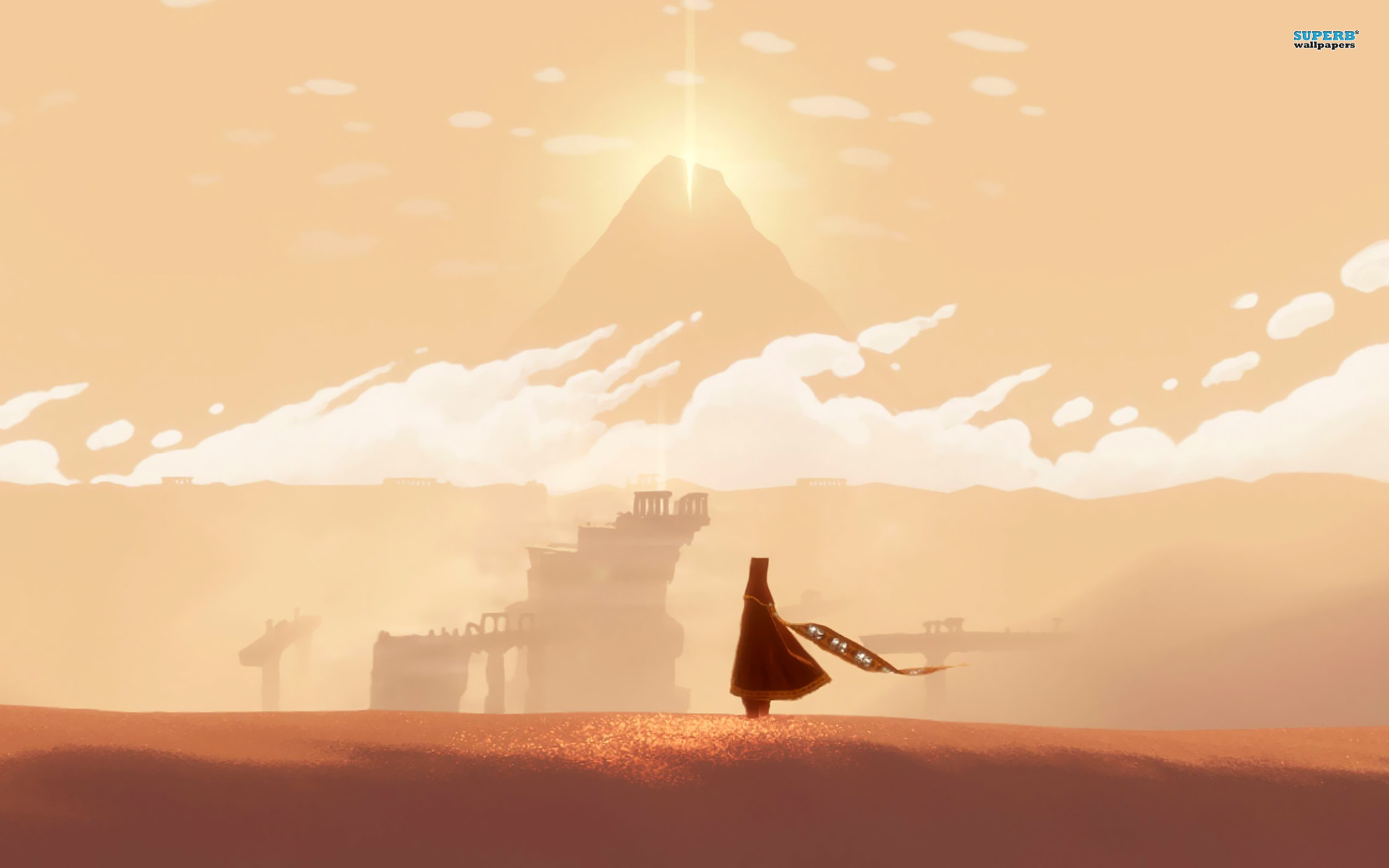
One of these games is Journey, originally developed by Thatgamecompany for the PS3 and now available for the PS4. In terms of its gameplay, it’s a simple game, almost entirely devoid of challenge; it has also been called an ‘art game’ and I’m sure there are some who would even deny it’s a game to begin with, for some reason or another. It wonderfully evokes a sense of place, though: in Journey you’re a lone traveller, perhaps a pilgrim, marching onwards towards the distant mountain through deserts, among abandoned ruins, across the bottom of the ocean and up snowy slopes towards the goal that keeps getting closer even as it remains tantalisingly out of reach.
While the actual virtual locations are fairly small and can be traversed in a few minutes, they come alive through a wonderful blend of the real and the imaginary. Visually, Journey has a minimalist but beautiful style, using strong colour contrast and simple shapes to evoke less real places than our dreams of such places. There’s a sparsely surreal quality to the deserts you travel through early in the game, as if Lawrence of Arabia‘s vistas had been reimagined by Giorgio de Chirico. At the same time, the place is tangible: you leave behind lines in the glittering sand as you move through it, sliding down dunes. There’s a tactility to these environments and your place in them; late in Journey, as you travel up the mountain towards your destination, the cold wind holds you back, slowly freezing you in place. Journey‘s spaces feel both alien and real – these are worlds you could otherwise only explore while asleep, but you feel the sand between your toes, the snow on your face.
Journey offers fairly little in the way of interaction to its players, its chief method of interaction being movement, and the game gets that very right. The player avatar becomes a part of the world, where in a lesser game that avatar feels superimposed on it. Other than walking around, the player can also fly, though this power is very much limited and feels less like the kind of power fantasy common to gaming than like a moment of freedom – again, very much like in dreams. There is one more thing the player can do, though, and that’s where the world gains a dimension: he or she can sing… and if others are around, they will hear that song. Journey is a multiplayer game, but it’s a most unusual one: on your pilgrimage to the mountain, you encounter other pilgrims, looking exactly like you. They walk, fly, and they sing; where one pilgrim may chirp in short, playful sounds, another may hold a note, almost as if inviting you to join voices.
It’s strange how other people can make a virtual space in a game feel more real, but that’s definitely how I experienced Journey. It’s maybe a bit like Marianne Moore’s “Poetry”, which talks about “imaginary gardens with real toads in them”: if you inhabit a world of the imagination with someone who may be incomprehensible to you but who is real, reacting to your movement, your flight and song, then that world becomes more real as well. Some of the pilgrims I encountered in Journey went exploring with me, others were kind guides pointing out an interesting ruin or a forlorn statue for me to find, and yet others seemed to sing at me in an increasingly frustrated voice, unable to make me understand their song. And then there were some that ignored me entirely. Yet most accompanied me, for a short while or for longer stretches, on my pilgrimage towards that mountain. For a few moments, they were friends, the only friends I found in that strange world. And when I dream of the desert and the bottom of the sea and that mountain, I also dream of their song. It’s those disembodied voices that we’ve left behind, floating over the dunes.
Can a machine ever be truly intelligent? Can it have feelings? If a machine fakes these things convincingly enough, at what point does the appearance become the real thing? Whatever the answer, Hollywood tends to remind us that it’s a bad idea to fall for robots and AIs, however seductive they look and however much they sound like Scarlett Johansson. Ex Machina is not alone in dramatising the Turing Test, but Alex Garland’s first film as a director is definitely a striking addition to the genre.
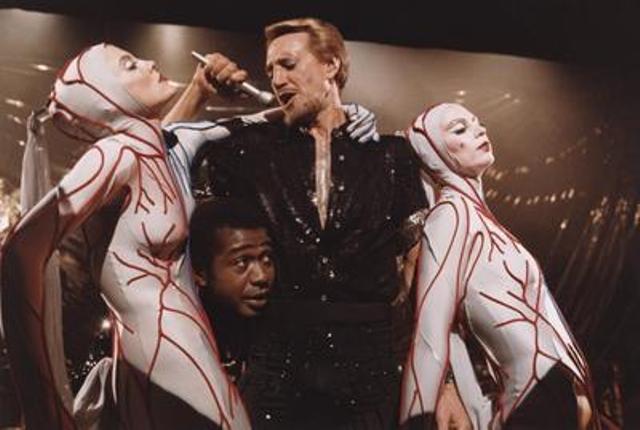
I almost managed to live to the age of 40 thinking that Bob Fosse’s All that Jazz would be a film I’d hate. High camp, stage dancers from the days when disco was just about still alive but definitely already starting to smell funny funny and the like aren’t exactly on my list of favourite things; I’m more of a whiskers on kittens and David Fincher’s Seven kinda guy. It was only when Criterion brought the film out on Blu-ray and Matt Zoller Seitz did his video essay on the film (embedded at the bottom of this post) that I thought I should perhaps try to get over my Fear of a Leotard Planet.
In short, I was transfixed. A couple of years ago I wrote about artifice and authenticity in films, and already while watching All that Jazz I was startled how well the former was used to evoke the latter. The film is often highly stylised, it eschews the surface markers of realism, it embraces camp and staginess like so few films do, and even fewer do successfully. The style of All that Jazz is showy, but it’s never insecure or needy: there’s an almost staggering confidence at play in the film. It’s rare to find a film that has learnt the right lessons from theatre, and that understands how limiting cinema’s obsession with realism is.
That’s perhaps the main thing I took away from All that Jazz: it’s exciting to see a film that isn’t beholden to a narrowly defined and all too often shallow representational realism. While it wouldn’t fit all kinds of films and stories, the kind of illusion that’s more common to the stage is something I wish film would embrace more often. Filmmakers try to make things look more real, but we know that what we see isn’t real: the dinosaurs and flying superheroes are pixels, that tower with a big flaming eye on top is a miniature, and that guy running with a gun is Tom Cruise. There’s a certain demented futility to the extent to which cinema is often at cross-purposes with itself: movies want you to get excited about the extravagant illusions they create, yet they want to hide the fact that they are illusions. There’s a fetish of the seamless – and it isn’t limited to CGI orgies: in a way, what Linklater was aiming for with Boyhood was also the seamless appearance of reality. There’s definitely a place for that, but realism isn’t inherently more valuable than other modes of representation. To my mind the most powerful illusion is often not the one that is seamless: it’s the one where the audience sees the illusion for what it is, a mirage, and fully buys into it nevertheless.
On the stage, we can watch an actor slip from one role into another, yet make them all real. There’s no need for Academy Award-winning makeup to hide the fact that we’re still looking at, say, Meryl Streep. A different hat, changed body language, all of these change an actor from a young man into an old woman, and both can touch our heart. The audience doesn’t just watch the illusion, it becomes complicit in it, intensifying the effect. I’ve seen a modern actor playing an Elizabethan player playing Thisbe, making us laugh at the incongruity one moment and cry the next as Thisbe’s pain and death feel utterly real. When it works, that reality is in no way diminished by the obvious artifice of it all. To make the audience see both the trick and the reality of what the trick presents at the same time, that’s magic. As Tony Kushner wrote in his stage directions to Angels in America: “It’s OK if the wires show, and maybe it’s good that they do.”
Obviously, film isn’t theatre, and what works in one medium has to be adapted for another. I wouldn’t want all movies to resort to the Brechtian strategies Lars von Trier resorted to in Dogville. I do want film to be less fixated on the invisibility of its illusions, though: the more magic happens entirely on the screen, the less it happens in my mind. All that Jazz‘ magic isn’t entirely that of the stage and its visible wires, but it rejects a superficial realism. It invites the audience into a much larger and more exciting space. Its reality is emotional first and foremost, its razzle and dazzle is artificial and has no qualms about this – artifice can heighten reality much more than a seamless illusion can. It opens up space and time, showing what a tiny stage realism is. How many leotarded angels can dance on the head of the pin that is realism? Many times fewer than Fosse was able to imagine, I’ll wager.
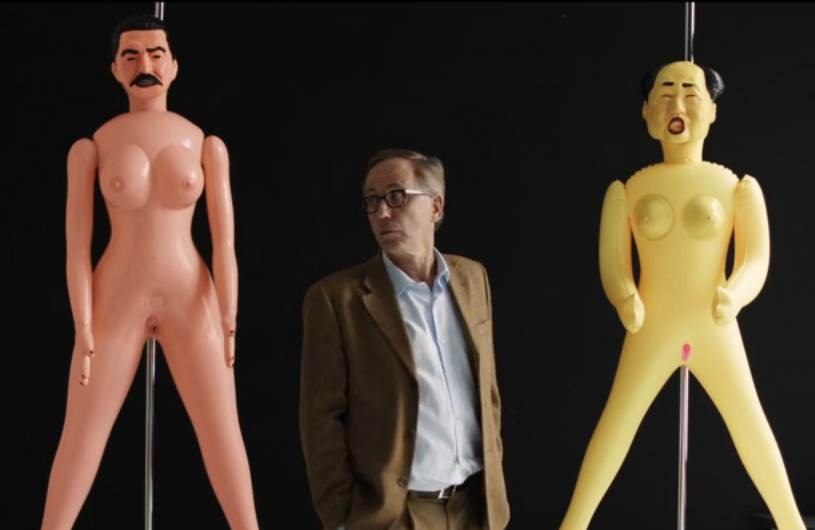
François Ozon’s Dans la Maison (In the House) makes for an interesting companion piece to his Swimming Pool. Both films are highly meta, both are about the process of storytelling, and both highlight the tenuous relationship between what makes a good story and What Really Happened. Based on these films, and on Ozon’s career as a filmmaker, his loyalties lie with the former – which is an attitude I very happily endorse.
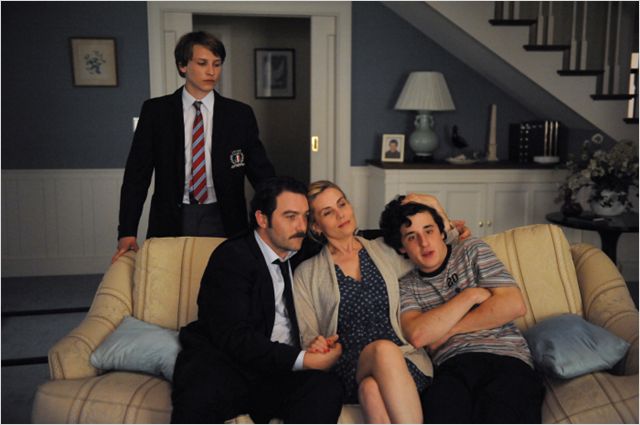
Dans la Maison is a cheeky variation on the tale of Sheherazade: Germain Germain (Fabrice Luchini), a jaded teacher in late middle age finds himself becoming first intrigued and then well and truly hooked on the essays of the one student of his that shows promise as a writer, in a sea of bored, uninterested pupils that would give even mediocrity a bad name. Claude (Ernst Umhauer), who appears to come from a less privileged background, recounts in a waspish tone how he insinuates himself into the decidedly middle-class home of a classmate, eyeing the seemingly happy family – and especially the attractive though fading mother – like an underage Tom Ripley. The very first of these essays ends in a teasing, even flirtatious “A suivre…” – To Be Continued.
Surely, it is no accident that the teacher’s name echoes that of another fictional middle-aged man who enters decidedly murky ethical waters in an ongoing affair-of-sorts with a teenager – but Germain is no Humbert and his student is no precocious twelve-year-old. The seduction we witness is done by means of storytelling, and while Germain says, and may even believe, that he’s letting Claude continue his story and his infiltration of the titular house only to help him become a better writer, it is only in part the intimate but controlling act of teaching that motivates him. Germain is hooked on the illicit voyeurism of observing this middle-class family through the eyes of a transgressing young man whose attitude is partly desire, partly envy and partly disdain of what he sees.
In writing what he observes, Claude shapes both his material and his audience, and as the film proceeds it becomes increasingly less clear to what extent his story swerves from what he actually sees and hears towards pure fabulation. Germain prompts these changes by criticising the story Claude tells – too ironic, too predictable, too melodramatic – but it remains ambiguous whether these critical notes are indeed genuine feedback or the desperate attempts of a captive audience to maintain at least the illusion of control. Claude seems to defer to his teacher’s criticism, but he may just be giving the man what he’s asking for so he can snare him all the better. Germain wants the story to meet his standards of good fiction, yet he also wants it to be true, and the more the former is the case, the more he believes what he reads.
It’s a shame that while Ozon gets the relationship between Claude and Germain precisely right, he falters when it comes to the teacher and his wife Jeanne (Kristin Scott Thomas). No doubt, there are interesting elements there: Germain is a snob who patronises his wife with respect to her fear that she may lose her job as an art gallerist, and he is oblivious of the growing rift between the two of them as he clearly favours his pupil’s fiction over the art she works with, showing off the former to her while dismissing the latter. Late in the film, Claude insinuates himself into Germain’s life, apartment and marriage, much as he inserted himself into his classmate’s family, and again it is not clear where fiction ends and reality begins – but in these elements Dans la Maison remains underdeveloped. While there is a coda that is strangely serene, reconciliatory and sad in equal measure, a fitting end for the characters and the story, what precedes it feels like a first draft, something that hints at ideas and themes but fails to develop them fully. Claude’s final story, about him and Jeanne, feels too sketchy and rushed to warrant Germain’s extreme reaction, and the teacher’s final confrontation with his wife falls uneasily between the stools of relationship drama and French bedroom farce. It’s a shame: the film falters especially because what surrounds its resolution is sharp, smart and has the necessary lightness of touch. In this, too, it makes for a good companion piece to Swimming Pool. Regardless of the film’s third-act problems, Dans la Maison shows that Ozon still has the wit for playful meta, and I’ll gladly consider myself a willing audience to this particular Sheherazade.
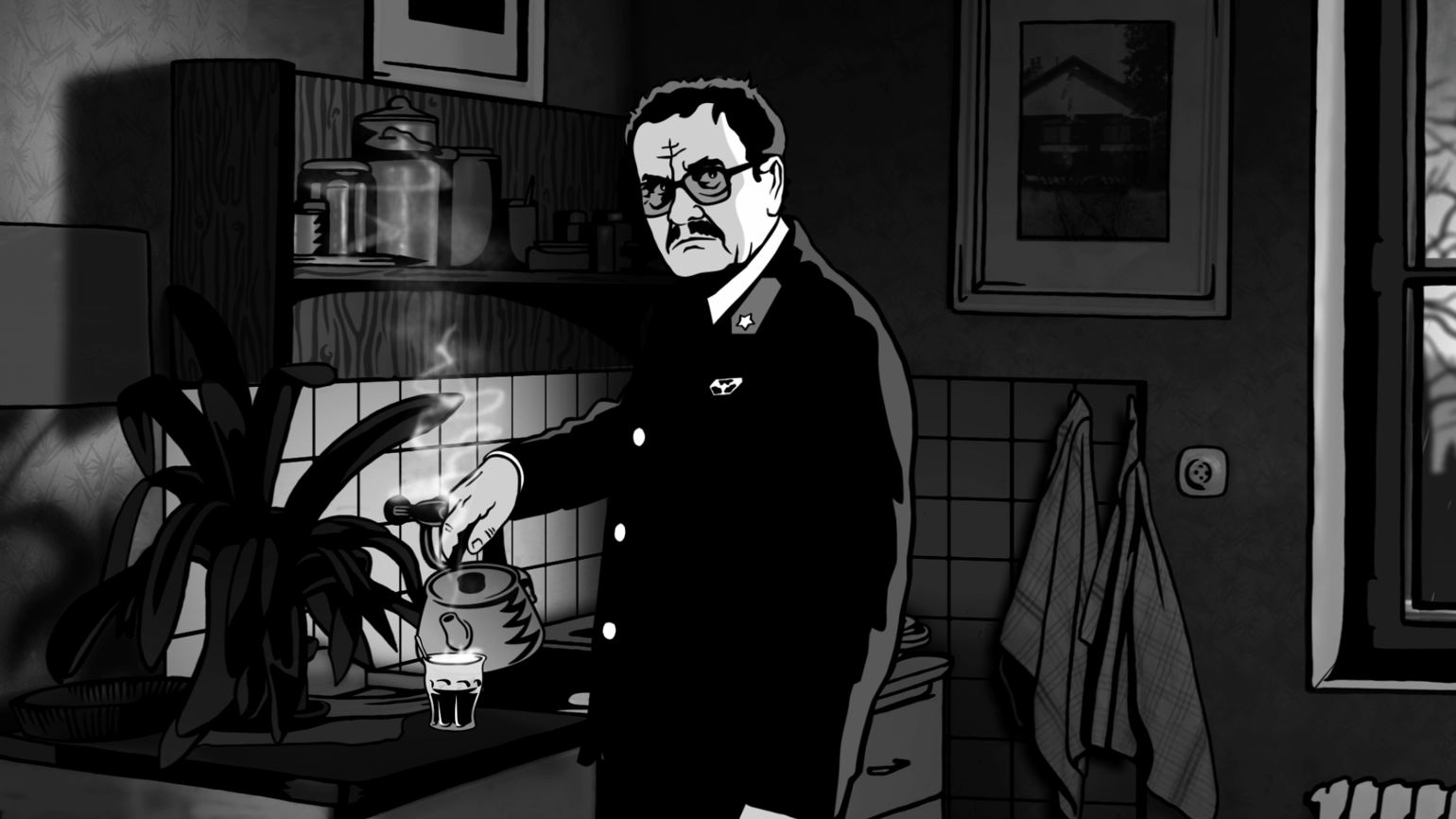
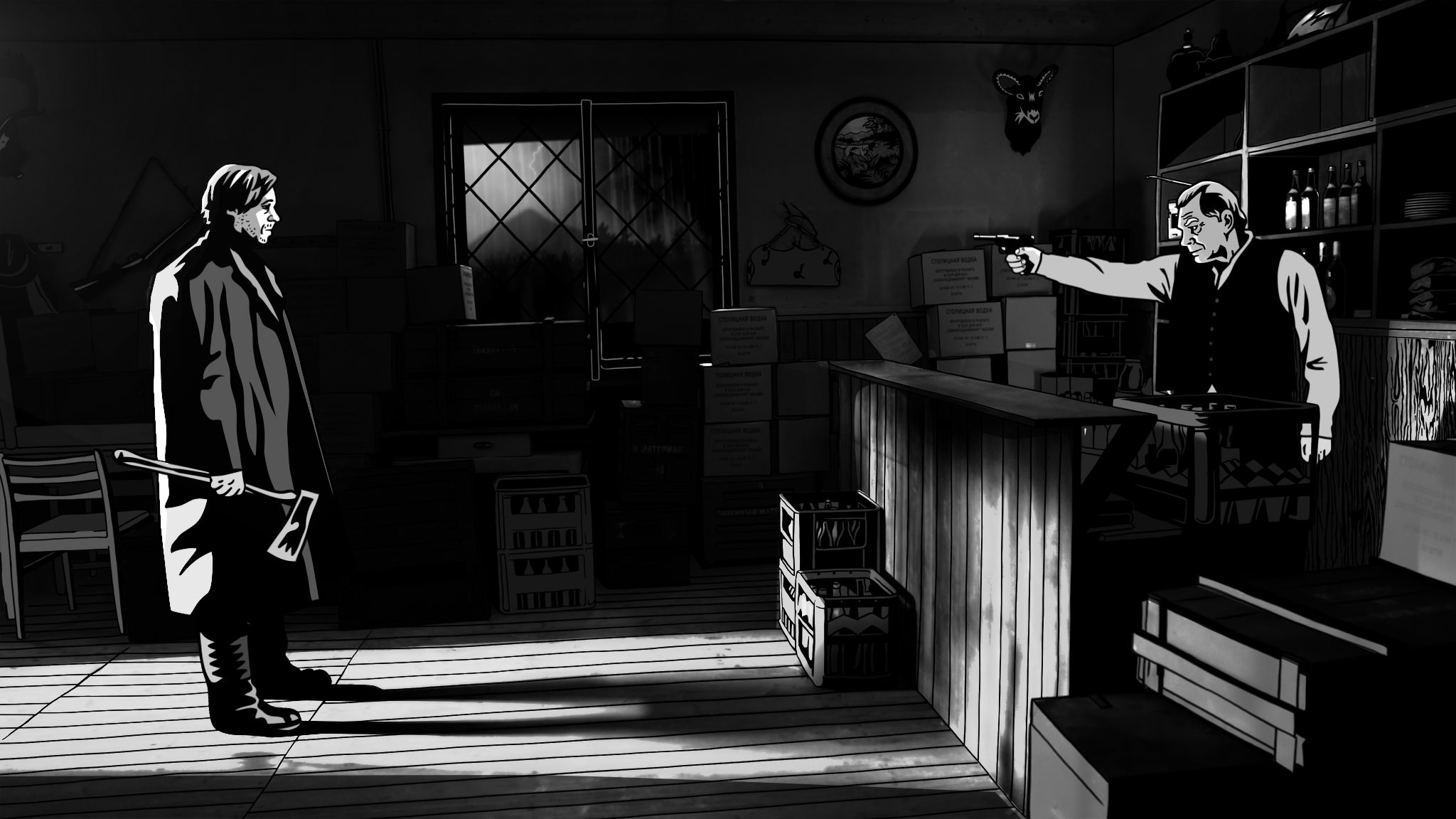
My first impression is this: Alois Nebel wants nothing so much as to evoke the animated documentary Waltz with Bashir, with its ligne claire images and its story and themes – in both movies an imperfectly remembered historical event is key to modern-day goings-on. Unfortunately, the ambitions of the recent Czech film very much outstrip its actual achievements, in spite of winning the European Film Award for Best Animated Movie in 2012. It’s a shame, because visually Alois Nebel is moody and sometimes arresting, but too much of it ends up feeling half-baked and derivative.
It starts with the film’s look: Alois Nebel isn’t a carbon copy of Waltz with Bashir, using rotoscopy rather than the combination of Flash and more traditional animation of the latter, but it is close enough to serve as a constant reminder of a stronger film that makes better use of the medium. Bashir reflected on the gap between memory and history, using animation as a more overtly subjective mode of representation. The Czech film, however, doesn’t seem to have much of a reason why it is animated, doubly so since the actual actors, surroundings and objects are clearly visible in the rotoscoped lines. Other than the choice of black and white, there’s little obvious stylisation; form and function seem to be uninterested in one another rather than serving a common purpose. In the end, Alois Nebel mainly seem to be an animated black and white film because this gives it a more unique look, but as such the visuals come across as a vaguely motivated Unique Selling Point, not a purposeful directorial choice.
Similarly, Alois Nebel is content to leave too many things unclear. Now, I like the effects that elliptic storytelling can have, but there’s a distinction between elliptic and vague, and the film tends distinctly towards the latter. Early in the story, the titular protagonist, a quiet-to-the-point-of-sullen train dispatcher is taken to a mental institution during the last months of Czechoslovakia as a Soviet satellite state – ostensibly because he has hallucinations about an event from his childhood, but the way the film represents it the one, sole hallucination he has, and in the privacy of his privy at that, could as well be a memory, a dream or simply a flashback. Why exactly is Nebel committed? Why is he released? What difference does either make to him? If it doesn’t matter to any of the characters we see, why should it matter to us?
After he is allowed to leave the institution, Nebel returns to this troubling memory several times, each time revealing a bit more about what happened, but the eventual moment of clarity comes as an anti-climax: it tells us little more than the original incomplete memory did, and it doesn’t flesh out Nebel. It does provide a motive for a secondary character looking for retribution, but that character’s story equally doesn’t add much to Alois Nebel – or indeed Alois Nebel. All of it feels like first draft material in need of being elaborated on; in order to pull off elliptic storytelling successfully, the author needs to have a strong grasp of the story, to know what to leave out and why, but this one seems to have been designed around pre-designated gaps to begin with. If the mystery comes before the story, it’d better be a damn good mystery, yet in this film the mystery is too perfunctory to matter much.
The film comes into its own most during its middle, when Nebel is released from the psychiatric hospital, finds that he has been ousted from his job in the village of Bílý Potok and goes to freshly post-Soviet Prague looking for work. While this episode of the taciturn, middle-aged railway man finding companionship, momentary happiness and later disappointment may not be original, it works better at telling a story than the overall film, which includes too many elements while doing full justice to none of them. It’s in the Prague section that the film focuses on one thing rather than a shopping list of ideas, and it does so well (if somewhat predictably). Its mood does not come across as atmosphere for its own sake, as a repeated moody railway station vignette does in the early movie, and it is the better for it.
Unfortunately the filmmakers were too intent on telling their story about past crimes and present retribution, axe murder and all. It’s as if the film forgets its title character, or quite simply isn’t interested enough in him. There’s potential poignancy in a story that sidetracks its title character (I’m wondering what the Coens would do with such a story) – but sadly, Alois Nebel’s poignancy lies mostly in how most of the time it reminds you of a film that is better because it has a clear understanding of what it wants to be.
I guess it had to happen sooner or later: if Miyazaki’s word is to be trusted on this, The Wind Rises is the director’s final film. While it’s not his best work, Miyazaki’s fictionalised biography of the aeronautical engineer Jiro Horikoshi is a fitting swan song for an artist whose fascination with flight is evident throughout his films (with Princess Mononoke being a notable exception). The Wind Rises is much less overtly fanciful than most of the director’s works, and its depiction of pre-WW2 Japan is striking in its prosaicness, but the film frequently soars with Jiro’s imagination. Flight is the dream that both the movie’s protagonist and its director share.
However, while the depiction of flight is often exuberant in Miyazaki, in some cases there’s a dark undercurrent to it, and this is definitely true of The Wind Rises. In his dreams, Jiro talks to the Italian engineer Count Giovanni Caproni, who tells him that “airplanes are beautiful, cursed dreams”, and that curse is the weaponisation of flight. In several of Miyazaki’s films flight and warfare are in close proximity to each other, and even the innocence of Laputa‘s air pirates’ ship or Porco Rosso‘s scarlet biplane and its whimsical pilot already hint at the violence of aerial combat. Although The Wind Rises doesn’t come out and say so explicitly, Jiro’s work will lead directly to the Zeros bombing Pearl Harbour and those piloted by kamikaze pilots. Even when the film is at its most elated, it is streaked through with sadness that man’s dream of flight so often serves only to come up with new and better means of inflicting death and destruction.
Except for a couple of scenes, the film keeps this as subtext rather than making it overt; if it had presented a more blatant pacifist message, The Wind Rises could easily have become preachy. Instead, Miyazaki weaves the theme throughout the film without forcing it onto the audience. However, it’s not clear to me to what extent the director wanted his protagonist, who can easily be read as something of a surrogate figure for the director, to come across as naive at best, and blithely self-centred at worst. The film wants us to like Jiro, clearly, but his actions and decisions come at a price that he never quite acknowledges. He is aware that his airplanes will be used for battle, yet he makes himself ignore this. Miyazaki’s depiction also seems to absolve Jiro too readily: he creates dreams, yet it is faceless others that pervert these dreams into killing machines. There is another, equally troubling instance of the film appearing to absolve Jiro’s actions, after he falls in love with and marries a Nahoko, a young woman who has tuberculosis. She leaves the sanatorium where she is supposed to get better to be with and support her husband, knowing that this is likely to worsen her condition, and while Jiro’s sister (a fictional addition to Horikoshi’s real biography, like Nahoko) blames her brother for allowing Nahoko to endanger her health even more, Miyazaki’s depiction of the couple’s love for each other suggests that everything is as it should be: Nahoko’s needs come second to Jiro’s dreams, just like these dreams come before any moral qualms that the airplanes he designs will be used as weapons. In his final imaginary encouter with Count Caproni, Jiro sees Nahoko again, smiling and waving, having fully become the beautiful ideal rather than a real, flesh-and-blood partner, but even here she subsumes her own needs to Jiro’s obsession:she conveniently dissipates in the wind so Jiro can continue talking shop with his idol.
It’s intriguing: The Wind Rises presents its protagonist as a good guy, but you don’t need to scratch the surface much to see that for all his charm and passion Jiro serves his own dreams before anything else. The film doesn’t present this as its preferred reading of the character, to my mind, but it definitely gives its audience enough space to interpret Jiro as increasingly self-absorbed. This tension between the presentation of Jiro as a Miyazaki stand-in and the now-you-see-it-now-you-don’t subtext of his more questionable qualities is interesting but also somewhat troubling; it’s still not clear to me whether The Wind Rises seeks this tension or whether it is at cross-purposes with itself. Miyazaki’s films usually don’t shy away from ambivalent characters, but I’m not sure this is what is going on in what is likely to be his final work.
Regardless of this, though, The Wind Rises is a beautiful, poignant work, and while I’ve only seen the English dub so far, I’d say that it is one of the better Miyazaki dubs, with one surprise voice actor especially that almost made me clap my hands in delight at how perfect the choice was. While I have the exuberant flights of fancy of Porco Rosso, Spirited Away and My Neighbor Totoro to return to, if Miyazaki makes good on his announced retirement I will miss seeing his imagination soar on the screen.






 A Damn Fine Cup of Culture