Well, that’s a lie. Obviously I can comment and I will. So there.
I’ve been watching the American remake? reimagining? resomething of House of Cards. On paper it seems a perfect proposal, updating the series and adapting it to the US context while giving David Fincher and Kevin Spacey something to get their teeth into. Critics largely agreed, on both sides of the pond. We’re now about half a dozen episodes into the first series, and I have to admit I’m not quite feeling it yet. I can’t even say it’s the series: my main problem at this point is that my memories of the BBC original (primarily the first series – the second and third got progressively worse in terms of writing and plot) keep getting in the way. I don’t have any issues with remakes on principle, but I keep thinking that BBC – no, scratch that, that Ian Richardson did it better. In fact, I think that’s my main problem so far: Spacey’s performance up to this point, or possibly the way his character is written, strikes me as somewhat lazy. He’s got the Spaceyisms down pat, but there’s no urgency behind it, no purpose. We’re told what this Frank Underwood wants to achieve, giving his machinations and manipulations a theoretical goal, but so far I don’t feel it. Manipulating people seems to be an end in itself to Underwood, whereas Richardson’s Francis Urqhart was a driven man, something his aloof, calculating irony sometimes covered but that was constantly seething under the surface.
I’m hoping I’ll learn to appreciate the Netflix House of Cards for what it is, rather than for what it isn’t and perhaps shouldn’t be. In the meantime, though, here’s a shoutout to Ian Richardson’s defining role, which he played to perfection even in the inferior second and third series. Is he the best neo-Richard III of all times?
The following is a guest post by Johanna Bucher, a friend and fellow gamer who has a keen eye for the potential of the medium. Thanks a lot to Jo for this end-of-year treat!
One aspect I love about video games is the potential for escapism. More so than film or literature video games enable you to be someone else, a powerful wizard, a Jedi knight, a bad-ass bomber pilot. In video games you fight dragons, fly spaceships, have super powers, and travel through time saving entire galaxies from impending doom. In short: you have a chance to do grand things you never can in real life. And the further away the setting of a computer game from the here and now, the better for me. Or so I thought.
Gone Home has none of the above. It takes place in the real world, it evolves around completely ordinary people leading ordinary, not to say, drab lives. Their fears and hopes are all too familiar. There is nothing striking about them at first, other than perhaps the big mansion they live in. So, what possible attraction could this game offer which puts you in the shoes of 20 year old Kaitlin Greenbriar, returning from a long trip to Europe, expecting to be greeted by her family only to find the house abandoned?
What the game “lacks” in grandeur or exotics it makes up in characterisation and attention to detail. Through audio diary entries at specific points in the game, notes and artefacts found in the house, the mystery (what happened to everyone?) slowly starts to unravel. Not all of the clues found in the house make sense at first but with each new room discovered, a more coherent picture can be drawn, of the goings-on and of the people involved in them. The rewards in this game, then, are not shoot-outs, levelling up or collecting loot, but picking up the threads of strangers’ lives and in the process of getting to know them discovering that you start to care for them and their small lives because, more often than not, they strike a familiar chord.
It is no coincidence that the game takes place in 1995: this is pre-internet, pre-cell phone. It’s the age of VHS, vinyl and audio cassettes, where people write notes and letters by hand, or maybe, if it gets really fancy, send a fax. This leap back into analogue times is more than a nostalgic walk down memory lane (although the game’s creators clearly revel in that.) It also sets a different kind of pace: it slows the game down to the sound of your footsteps pacing about the rooms, the rhythm of the written and spoken word (masterfully supported by wonderfully restraint music and great vocal acting). In a strange way the physical exploration of the space also becomes a mental one.
In a review to the game I read that calling Gone Home a video game is doing it a great disservice. And I agree, this game is not for everyone. It demands a certain amount of patience, the willingness to do rather a lot of reading and rummaging through drawers and armoires. But I would claim that although the game deliberately goes against many video games conventions it is the perfect and only medium to be told in. This story only fully comes to live through the narratology of video games.
Gone Home, then, is not so much about what the story is about and its conclusion (although the topic is not a trivial one and the conclusion is rather touching) but much more abut about how it is told. And summing it up would be the greatest disservice done to it. It has to be experienced. So, sod escapism, this time at least.
I’m afraid that this year autumn and the onset of winter got to me, much more than in other years and surprisingly so. The result was that the cold, grey weather sapped my physical as well as mental energy – which meant no blogging for the weary. Can’t say that my energy’s back, but I’m hoping to use this post as a gentle kick in the backside. Since it’s been a while, I thought I’d do a Variety Pack of sorts, on TV series for a change, so without much further ado…
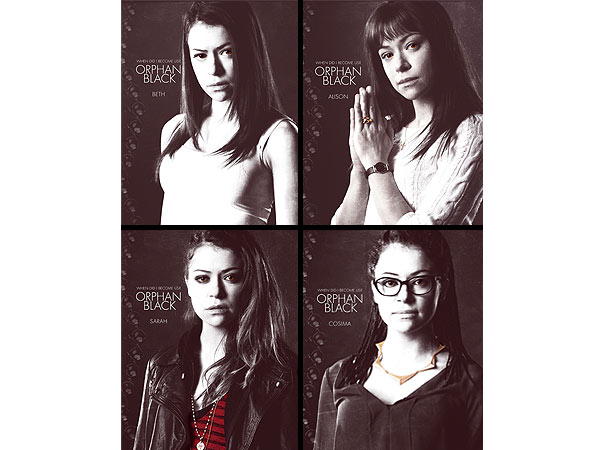
Orphan Black
I read the AV Club reviews of this one when it showed in the States; even though it was a BBC co-production the Beeb only showed it months later. The AV Club gang loved Orphan Black, and there is a lot to like about this sci-fi-ish conspiracy thriller, first and foremost Tatiana Maslany. Her playing several different characters isn’t flawless, relying a bit too much (especially at the beginning) on dodgy accents and costume choices, but as she gets into the parts she quickly becomes the series’ main asset. By the fifth episode I wasn’t thinking about the seamlessness of the special effects any more – I just accepted that there were several clone characters on screen who all looked more or less the same but were totally different in most ways. The plot, while perhaps too convoluted for its own good, definitely drives the series along to its conclusion/cliffhanger. Having said all of this, though, I’m not sure Orphan Black deserves the hyperbolic praise it received on the other side of the Atlantic: in terms of tone, it’s not altogether surefooted, and various characters – even the occasional clone – remain flat, uninteresting and even annoying. I’m intrigued for season 2, but it’s nowhere near the top of my list of favourite series. Entertaining, yes, but I’m glad I didn’t go for the box set.
Sports Night
Is there a TV writer as readily recognisable as Aaron Sorkin? In some ways, Sports Night feels almost like someone has fed the writer’s mannerisms into a computer and turned up the Aaron-o-meter to 150%. The cast is more than capable, but even for someone who loved The West Wing the series can be formulaic as well as overbearingly smug and self-satisfied. Still, there are moments when it clicks – mostly thanks to the likes of Peter Krause, Felicity Huffman and the rest of the cast. (And yes, there are moments when the series brings out the worst in its composer, the improbably named W.G. Snuffy Walden.) Would I have watched The West Wing if I’d started with this? I’m not sure – but there are worse ways to while away 22 minutes.
And just for the heck of it, here are seven minutes of Sorkinisms:
Real Humans
I was a bit wary of this one; there was a big brouhaha in newspapers when they started showing it here, but to me as a former(ish) sci-fi geek it all sounded rather “been there, done that”, with the main inspirations being Asimov and Blade Runner. We’re now six episodes into the first season, and while the ideas in the series may not be the most original to anyone who’s been following the genre, that’s beside the point. Being Human takes a page out of True Blood‘s book, looking at what our society might look like if this one foreign element (androids in the case of the former, vampires in the latter) were to be introduced into it – but differently from True Blood it shows relatively little interest in its lore. Instead, there are elements of allegory, but never to the extent where the series’ so-called ‘hubots’ become a facile stand-in for oppressed group X. The social critique and satire are balanced by a plot that keeps things going smoothly and by characters that are fun to watch, from the sad-sack who, after being left by his wife, blames all his misfortune on the machines to the icy renegade hubot leader who’d give Rutger Hauer a run for his money.
And that’s it for now. I hereby solemnly promise that it won’t be as long yet again before my next post!
Gravity is a gorgeously shot film, no doubt. It’s a film by a director who knows what he’s doing; there’s not an ounce of fat on that movie. It’s a thrilling piece of cinematic craftsmanship, and one that has rightly garnered praise from critics and audiences alike. It’s difficult not to see some of the criticism as internet-age contrariness. Is the film’s plot simple? Perhaps. Is it too simple? Well, that point was ably countered by that patron of upper-case criticism, Film Crit Hulk.
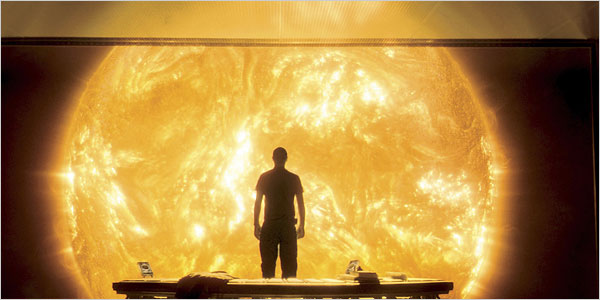
And yet, I came away from having seen Gravity being subtly disappointed. It’s a good film, definitely, and Cuaron does a great job – but already one or two days after having seen it, when I try to think about what I saw the images that come to mind aren’t Gravity‘s, they’re from Danny Boyle’s Sunshine.
Now, Sunshine… It’s a flawed film that’s almost sunk by its last third. It’s messy and confused. Yet it resonated with me to a much larger extent than Cuaron’s more accomplished, more consistent movie did. As a matter of fact, one of the reasons why I was somewhat disappointed with Gravity is this: I was immediately pulled in by the trailer, which evoked the visceral dread of floating off untethered into the infinity of space. The film itself didn’t bring back this dread, because of its structure: obviously Gravity wasn’t going to kill off Sandra Bullock, at least not before the final five minutes or so, which meant that there was little sense of risk. It’s possible for stories to solve this conundrum by involving their audience in a sleight of hand where they know a protagonist won’t die, yet they feel that they may just be wrong about that. Gravity didn’t do that, at least not for me, and I’m not sure it wanted to – its aim was to show Bullock’s character struggling and triumphing.
That’s the other thing, though: I did care about the character triumphing, but not much. Dr. Ryan Stone, first-time astronaut, works as an audience stand-in, especially in concert with the amazing cinematography (seriously, if Emmanuel Lubezki doesn’t get an Academy Award for this, the Academy should be shot into space!), but to be honest, I didn’t particularly care about her. Part of this is Bullock’s particularly American everywoman quality: a bit like a female Tom Hanks, there’s something to calculatedly likeable about her. She works well in Gravity, but I often find her (and Hanks) bland, compared to, say, the everyman characters of Jimmy Stewart that hinted at darker qualities under the folksy niceness.
Adding to this are my issues with Gravity‘s themes: Film Crit Hulk (and other critics) liked the rebirth motif running through the movie, but I found it somewhat hackneyed and distractingly obvious. By the time we get Bullock’s zero-G fetal position and realise that the line tethering her character to various space vessels doubles as an umbilical cord, the film is practically shouting its subtext at us in IMAX-sized captions: we’re witnessing her rebirth, get it?
Sunshine is hardly all that more subtle about its themes, but it’s less single-minded – it’s more messy, as I mentioned earlier – and for me this makes the film resonate more. It’s fair to say that Boyle’s movie doesn’t quite know what it wants to be, but the result is that Sunshine‘s themes aren’t as pushy. More than that, though, I cared about its characters and their plight much more than I did about Dr. Stone’s; she may be more likeable, but her likeability is largely predicated on the audience liking Sandra Bullock. Sunshine‘s characters are more flawed, more complicated, and to my mind more human. As a result, when those characters die it feels more like a loss, whereas Gravity‘s deaths were mostly forgotten a minute after they occurred.
There’s something else that Sunshine pulled off and that makes the film resonate more with me than Cuaron’s arguably more accomplished movie: both films have a metaphysical component, but Sunshine‘s goes beyond the individual level. It’s not just about the potential death of one audience stand-in, it’s about the possible death of mankind. It’s about the two directions in which playing God can go: the film’s protagonists are working on saving the sun and, by extension, mankind, while the antagonist wants to return us all to the stardust we came from. Both sides are torn between being flawed humans and aspiring to the kind of power that humans should not have. It is a shame that Boyle turns this metaphysical playground into a slasher movie, almost drowning the more interesting themes in a space-age retread of And then there were none, but the power of the filmmaking – always more disjointed than Cuaron’s, but for me more engaging in this – got to me to an extent that Gravity didn’t in the end.
Gravity is accomplished in ways that Sunshine doesn’t manage. It is the more coherent film, it gets more things right and fewer things wrong. But the things that Sunshine gets right – and even its noble failures – means that I’d rather sit in a tin can with Cillian Murphy, Rose Byrne and Hiroyuki Sanada than with Sandra Bullock and George Clooney. I’m glad that Dr. Stone made it, but for me her triumpant rebirth doesn’t even begin to touch Sunshine‘s final scene, which is confident enough to be simple and quiet – and all the more glorious for it.
There’s food porn. There’s nature porn. Apparently there’s even porn porn, out there on what is laughingly referred to as “the internet”.
I have virtual timelapse porn.
Since video games have become less Mondrianesque (read: big pixels in primary colours) and more visually rich, more and more bloggers, game photographers and videographers have been exploring their visual appeal beyond the simplistic “Great graphics, most realistic blood splatter, coolest lens flares, 9.5/10!” (I recently posted about the YouTube project Other Places.) It’s not so much about showing that games are approaching photorealism, at least not to me; it’s about getting to a point where the worlds created by games become interesting and arresting in their own right, and where they can be explored in various creative ways.
Are time lapse videos of game locales creative? Let’s put it like this: they can be beautiful, evocative, eerily poignant. There’s more to a good time lapse video than sticking a camera, virtual or otherwise, in one place and shooting one frame per second. And some games lend themselves more to such videos than others – I’ve previously posted about such videos made from the likes of Red Dead Redemptionand Assassin’s Creed. To my mind, just about the best worlds for video game photography and videography are those created by Rockstar Games, and their latest, Grand Theft Auto V, is a gorgeous case in point. Ignoring the controversy around the game for once (there are already more than enough articles out there on whether GTA V is misogynist, racist, homophobic, or even (yikes!) a bad game), I am yet again amazed at how well Rockstar can take a real place and boil it down to its essentials. Their Los Santos, while clearly a fictionalised Los Angeles, is more than a Reader’s Digest version of LA – it’s as if the Rockstar artists had taken the world’s collective dream of Los Angeles and put it into textures and polygons. To me, there’s a touch of the hyperreal, and even of Neil Gaiman’s dream of the city in Sandman, and of Calvino’s Invisible Cities (sadly Marco Polo never talked about “Virtual Cities”, but then again, each of his invisible cities is virtual), in how these places resonate, even more so when put into the format of (wait for it…) a timelapse video. They make me want to inhabit Rockstar’s dream of LA, especially at night, when the street lights shimmer through the distant haze.
Do yourselves a favour. Let the entire video download before you watch it. Go for the highest resolution. And definitely, most definitely, go for full screen. If you still don’t see at least a fraction of the fascination these have for me, I’ll spring you a drink. I know this great little bar just off Vinewood Boulevard…
Telltale’s The Walking Dead was a surprise to most critics. While many of their earlier adventure games received moderately positive reviews, no one expected them to deliver one of the critical successes of 2012, and they definitely didn’t expect anything as emotionally engaging and harrowing as what we got. I was just as surprised myself; I’d read the comics and seen some of the TV series, but to my mind the game was by far the most effective of the three incarnations of The Walking Dead. The TV series delivered on the action, but it meandered and had too many characters it didn’t know what to do with, whereas the comics to my mind decided that the most effective way to get to the readers is to shock them.
Myself, I quickly got bored with the escalating brutality and gruesomeness of the comics. It very much felt like they were telling variations of the same story, turning up the volume as the story progressed. The underlying emotional arcs, though, remained the same – and progressively got drowned out by the visceral cruelty.
Telltale’s game series didn’t skimp on bitey walker-on-human action, but it didn’t rely on shock to carry most of the weight. It mainly worked on the strength of the central relationships that developed slowly, decision by decision. Would you have the protagonist side with this character or that one? In a split-second decision, who would they save? In the long run, your decisions didn’t change what happened, but they changed how you felt about things. They made the story personal, and this was reinforced by the quiet moments. Similarly to Cormac McCarthy’s The Road, the story was less about “Will you be butchered horribly by cannibals and your flesh devoured by crazed survivors?” than about feeling responsible for another person succumbing to despair or clinging to hope. Yes, there were crazed cannibal survivors, but they were the background to a story that was relatably human.
Time was an essential factor in the game, however. The Walking Dead got players to care about its characters over several storylines, developing relationships slowly. You didn’t feel the same way about little Clementine at the end of the first episode as you did when the final credits rolled when you finish episode 5. When Telltale published the extra episode “400 Days”, with few direct links to the game’s first season, they decided to do away with what had worked so well: “400 Days” tells five stories, in chunks of no more than 15 minutes, starring five different sets of characters. By the time you’ve got to know one of them, you’re whisked away to play a different character. It’s zombie flash fiction, basically, and it’s a strange choice, coming from a developer whose most successful game depended on slow, gradual character development.
“400 Days” is not an unconditional success. Not all of the storylines are equally engaging, and as with all zombie fiction, there’s a risk of diminishing returns – there are a handful of tropes that stories of the undead keep returning to – but I was surprised by how effective the extra episode was nevertheless. The game ends with another survivor trying to recruit the protagonists of the individual episodes for a settlement up north, and they accepted or declined based on the decisions I’d made a few hours earlier. It didn’t feel like winning or losing the game: and when several of the characters decided to decline the offer and set off on their own, it felt like I’d failed them. I’d failed to show them that even in a world of the dead trust was something worth pursuing.
Both players and reviewers, while largely intrigued by “400 Days”, noted that whatever emotional resonance the game had was less strong by its end than the ones developed in the original five episodes of the first season. This is undoubtedly true – but as developers experiment with different story formats and different ways of engaging the player, we only benefit. Not all such experiments work, and few work 100%, but there are many as yet untried methods of telling stories with the medium. Doesn’t mean that every game has to tell a story in the first place, or that every game must be a formal experiment – but games are a literal playground for storytellers, from the likes of Braid and Journey to Dear Esther and The Walking Dead. Personally I’m excited to see where they’ll take us next.
I’m sure I’m not the only one who finds it difficult to make it clear to non-gamers what I enjoy so much about computer games at their best. While I think the medium has made great strides, it’s still quite alien to people who don’t get the same kind of enjoyment out of games. They see the silly writing, the weird genre conventions, the way that so much gameplay seems to be about doing the same thing over and over and over again, which should bore any sane grown-up, one would think.
For me, the main attraction of playing games is that it takes me to worlds I couldn’t go to otherwise. I’m not even talking about escapism, at least not in any conventional sense: just like fiction allows me to meet and spend time with people I wouldn’t meet otherwise, at its best gaming can put me in places that, whether they’re subtly or wildly different from our world, I could otherwise only enter in dreams. A good game is like a lucid dream. It’s not the power fantasy, at least for me – I can get as much enjoyment out of walking around a virtual deserted island exploring its nooks and crannies as I might get out of running and gunning.
This is also one of the attractions Virtual Reality – or rather, VR done right *coughOculusRiftcough* – has on me. It’s about putting me there in those worlds, with no obvious demarkation line where the screen ends. And that is why projects such as YouTube user ultrabrilliant’s Other Places hold such a fascination for me. Other Places shows video game worlds through the same eyes as Alastair Fothergill’s BBC documentaries show our planet.
So, since it is tritely said that pictures speak a thousand words, here are three epic monologues. Enjoy! (Ideally in full screen and with the resolution turned up as high as possible.)
From an atypical variety pack to a covert one – the Variety Pack that dares not speak its name. I recently celebrated my birthday, which I usually follow with some hedonistic binge buying of DVDs and Blu-rays. We’ve since watched two of the films I’ve bought, namely the indie sci-fi-tinged drama Another Earth and Wes Anderson’s latest Andersoniad, Moonrise Kingdom.
Let’s start with the one I’ve seen more recently, Moonrise Kingdom. I have an ambivalent relationship with Anderson’s films; I find his striking, hyper-arch style fascinating and irritating in equal measures. Having said that, I loved The Fantastic Mr Fox, and I have a lingering suspicion that I’ll come to feel similarly about Moonrise Kingdom. On the surface it very much does what all his films do: tell arelatively simple storiy that is tinged with melancholy using ironic artifice in the presentation. Anderson’s style felt too much like a pose to me in The Royal Tenenbaums, hampering the sadness because the form seemed to whisper constantly, “My, aren’t we being ironic and self-aware about all of this?” There’s something more felt, more balanced in Moonrise Kingdom‘s performances, though, especially those by the two young leads, which renders the sadness much more effective and credible. It no longer feels quite as much as if the director is constantly putting the air quotation marks of irony around everything in his tale, even though the film is stylistically pure Anderson. As a result, Moonrise Kingdom is both a typical, dollhouse-style Wes Anderson confection and a convincingly sweet, touching childhood romance, without the two being at odds with each other. The change is a subtle one – from stills, and probably from the trailer, this will look like any and every film by the director – but it’s definitely worth checking out for those who were ambivalent about his earlier works.
Another 2012 film that I’d heard good things about, Another Earth, turned out to be more of a disappointment. It attempts to marry a relatively generic drama premise (a young woman destroys a man’s life when she, drunk and distracted, crashes her car into his, killing his wife and child) to a sci-fi high concept: one day, a second earth appears, visible from our planet, and get this: that planet is identical to ours in every way.
What a weird, wasted premise. The film later goes back on it, but for most of its duration we’re made to believe that this other earth is identical to our own, the people on it are identical to us. It’s a mirror image – but what good is a mirror image if it doesn’t allow us to contrast what we believe we will see with what we actually see? Another Earth‘s mirage in the sky is a concept that’s used to surprisingly little effect, with little reality for much of the film. In a story that is about regret, wouldn’t a more intriguing move be to make this second earth a constant reminder of “What if”? Since the film has already suggested that things on this second world are identical to ours, it’s not a mirror so much as a copy.
Except, in the film’s last fifteen minutes, there’s suddenly the suggestion that while the two earth’s were identical, this synchronicity was shattered when Earth 2 was first glimpsed, moments before the crash that sets the story into motion. So why not have this as the premise to begin with? For more than an hour, the second earth is a visual, a concept, but a vague, abstract one, a pretty but pointless intrusion on a fairly standard drama about guilt, regret and second chances. Earth mark 2 only comes into focus for the film’s ending, coming across as a half-baked idea in serious need of a rewrite.
What doesn’t help is that the film is too languid, too slow, to keep the viewer distracted from some uncomfortable questions. The main character, before going to prison after the accident that kicks off the plot, wants to go to MIT. She is in love with the universe and its mysteries. Yet the second earth makes not a jot of sense: it starts off small, then gets bigger and bigger, so doesn’t that suggest it’s a threat to earth, a more familiar double of Melancholia‘s eponymous planet? How can such a planet be identical to ours in every way if it doesn’t share our orbit, miraculously appears one day and then comes closer, growing ever bigger in the sky? These questions, to be quite honest, should be absolutely irrelevant – von Trier’s film couldn’t have sustained such science-minded inquiries either – since the celestial doppelgänger ought to be relevant in thematic terms, not scientific ones, but Another Earth fails to make the sci-fi element resonate with its theme. The big blue bauble just hangs there while the fairly predictable, though well-acted, earth-bound drama ensues. Note to the writers: if your main story conceit is irrelevant to the story you’re telling for 80% of its running time, perhaps it’s not that good an idea in the first place. Think about it.
Mege Let me ask you this: Roger Ebert said “when I reach for it, my hand closes on air” with this movie. I know what he means, but in my opinion, he goes too far. The film is puzzling, but not to the extent that we are left with a lot of hot air. How do you see this?
Matt I’d agree with you. I find the film fascinating, confounding, perplexing, but I definitely wasn’t frustrated by all the questions it’s left me with. Like There Will Be Blood before it, I mainly felt that I’d seen something disconcertingly, intriguing different than what you usually get in American cinema. Yes, there are echoes to Kubrick, to ’70s filmmaking, and probably to lots of other things I didn’t even register, but there is still something entirely original about the film, its characters and what it evokes in me. It doesn’t make for comfortable viewing, but there’s enough of that already, I’d say.
Mege And another question: We know that PTA likes his music. Boogie Nights knows how to use the music of the era almost to perfection, Magnolia is based on several Aimee Mann songs. In The Master, many characters start singing songs for various reasons, not all of them clear. It’s probably one of the weirdest aspects of the movie, so is there anything that struck you about the singing?
Matt Well, for one thing, Phillip Seymour Hoffman’s singing creeps me out! Seriously, though: while I find Dodd the less puzzling of the two main characters, his serenading Quell with “Slow Boat to China” is extremely odd. There’s something about it that is moving, yet it’s also weirdly threatening – and I can’t imagine anyone other than Hoffman to pull off that particular scene. Music is definitely something that PTA obviously cares about, though his approach has also changed since Magnolia and Boogie Nights. I mentioned Kubrick before, and in both of the more recent films (though more so in There Will Be Blood) I heard echoes of some of Kubrick’s choices – György Ligeti’s less-than-whistleable ditties spring to mind. The Master‘s orchestral soundtrack has moments where it feels like a talented alien with no understanding of earth musicology has listened to a bunch of early 20th century music and then done his own, alien take on it. What was your reaction to the orchestral soundtrack?
Mege You got me. I am very difficult when it comes to musical scores. This time around, I only remember the weird guitar twang, and I would have to watch the movie again, concentrating on the score, in order to answer properly. – Maybe the music has strong ties to the mood of the movies we’ve mentioned: Boogie Nights and Magnolia have kindness and good intentions towards most of their cast, while There Will Be Blood and The Master focus on the dark side of human nature. The guys in Boogie Nights really thought they were making art – they weren’t, and the music reflects that. Stuff like “Jungle Fever” is a musical catastrophe, but it’s full of atmosphere, and there is no other song that brings that time to life more quickly. The Aimee Mann songs as well as the Jon Brion score from Magnolia sound like there is hope for most of its characters. And if I say that the music in There Will Be Blood is dreadful, I don’t mean it’s very bad, I mean it’s full of dread.
I guess Dodd tells Freddie goodbye with that song. They met on a boat, so it’s only fair that their farewell should include a boat. I agree that the singing is weird, but (this is a long shot) there is nothing quite as appealing to your subconscious as a song. Remember what happened to Freddie when the Master sang and danced through Mildred Drummond’s house? Freddie started to see all of the women as if they were naked. They have music during a break in the presentation of The Split Sabre (it’s actually Melora Walters’ voice we are hearing). Music is a great means of manipulation.
Matt Time for a final question: I just Googled for PTA’s future plans – and apparently he’s adapting Thomas Pynchon’s latest novel, Inherent Vice. IMDB summarises the plot as follows: “In Los Angeles at the turn of the 1970s, drug-fueled detective Larry ‘Doc’ Sportello investigates the disappearance of an ex-girlfriend.” The cast includes Joaquin Phoenix, Owen Wilson, Reese Witherspoon and Benicio Del Toro. What do you foresee: a return to the earlier drug-addled world of Boogie Nights, something dark, strange and full of dread such as PTA’s more recent films – or is it futile to try and predict what Anderson will do next, doubly so if it’s based on a novel by Pynchon?
Mege No idea – and I mean that in the best possible sense. I like filmmakers who take risks, and PTA has the ability to puzzle thoroughly, for instance with giving Adam Sandler the lead role. I am completely open, but for the record, adapting a Pynchon novel must be hard work by itself. What do you think?
Matt Apparently Inherent Vice is Pynchon’s most approachable novel – which, I expect, is still pretty much bugshit crazy postmodern goodness. From the sound of it, the material is funnier than Anderson’s last two films, which aren’t devoid of humour, but it’s of a pretty grim sort. (“I drink your milkshake!” comes to mind as both hilarious and horrific.) Perhaps he will reinvent himself again, or perhaps we’ll see what the missing link between Magnolia and The Master might look like. In any case, I’m definitely looking forward to the film and to Anderson’s continued career!
And that’s it! Thank you for reading our series on The Master. We don’t have any definite plans yet for future conversations along these lines, but we’re definitely hoping to return to this format at some point. Any comments on these posts and how we can improve them are very welcome.
Matt The film is mainly Phoenix’ and Hoffman’s, but there’s also Amy Adams’ fiercely protective Peggy Dodd, Lancaster Dodd’s wife. It’s an untypical part for Adams, isn’t it?
Mege Very. It’s the 1950s, and it’s unheard of for a woman to lead a cult. If you ask me, she is the brains of the operation, some sort of Borg Queen, while Lancaster brings truckloads of charisma and a talent for improvising to the Cause. There is that telling scene where she talks and he types away furiously at his typewriter. If he is not typing verbatim what she is saying, he may at least take her words as inspiration. In a way, that would make her the author of at least the second book, wouldn’t it? Then there is the scene where we learn that she controls her husband’s sexuality. She sees right through him. And there is that scene in England where she tells Freddie Quell exactly what’s what, and then leaves the room. Lancaster would never do that. Peggy Dodd is miles away from Amy Adams’ other roles. The Muppets. Enchanted. And I am sure the new Lois Lane cannot change her eye color.
Matt With you mentioning women leading cults and the Borg Queen, I have flashbacks to Alice Krige’s New Age speaker for The Plan in Six Feet Under… which sounds close enough to The Cause to get me back to the topic at hand. I agree, she’s a very strong, smart character, but I find her quite puzzling. On the one hand, she seems to see Freddy as a threat; even at the beginning, when she’s apparently nice to him, her eyes are cold and guarded as she talks to him. Why exactly does she see him as a threat? Is she jealous of his closeness to Dodd? At the same time, both she and Freddy are probably the most zealous about Dodd’s crackpot cult philosophy, so there is a link there – but she never wavers, whereas Freddy does have moments where he says, quite clearly, that the Master is making it up as he goes along.
Mege It’s Val, his son, who says that first, and Freddie almost beats him up because he knows that Val is right. But about Peggy: Maybe everyone is a threat, until they become their allies. I think the Dodds see themselves as threatened, as weak, but getting stronger because of their Cause. That the second book is probably much weaker is a threat to them. Newer disciples must be tested, so she might turn on Freddie with that cold stare of hers just to see how things are with him. After all, he appeared out of nowhere and by complete coincidence, and he might disappear the same way: anytime and without good reason.
Matt I wonder about that… While I see your point about testing new recruits to the Cause, my impression was more that Peggy, and the rest of the family to some extent, feels threatened by how quickly and completely Freddy is taken in as Dodd’s friend and confidant. One of the first things Peggy says to Quell is that since he’s arrived Dodd is writing like mad, and while on the surface this seems to be a compliment, underneath she comes across as guarded and wary. In some ways the film strikes me almost as a battle between Peggy and Quell for the Master – only Quell isn’t aware of it, but Peggy is, painfully so. In that last scene between the three, Peggy is barely visible on the sidelines and practically cancelled out by the intensity of the connection between Quell and Dodd. It may well be a combination of the two things: that Peggy is jealous of this new man in her husband’s life and how he might change Dodd for the worse, doubly so because Freddy is so volatile. She feels both jealous of and threatened by a man she sees as a human time bomb, so to speak.
In the final instalment of this four-part series of blogs, we’ll discuss miscellaneous issues.





 A Damn Fine Cup of Culture