My favourite kinds of imperialism

We’re getting close to the end of The Sopranos. Both Rome and Carnivale only have one more season to offer us. And at the speed at which we’re going through West Wing, President Bartlett will have finished his second term in record time.

How to find good, new series? Used to be, I could pretty much get three out of four HBO series on DVD and be happy for the next year or so. Even if some of them found an untimely end, the journey was absolutely worth it.

Now, though? Can’t say I’m all that interested in Hung, and I’m not sure I would enjoy Big Love (which may be due to my lack of trust in Bill Paxton’s acting abilities – “Game over, man!”, indeed…). What about all these new series starting on other channels, though? The Elmore Leonard series Justified sounds like it might be fun, and I’m definitely hoping to get Caprica, provided that it doesn’t get cancelled after one series.

However, HBO seems to be stepping up its game, with not one but three series premiering this year. The one I’m currently most excited about is the one I only found out about five minutes ago: Boardwalk Empire, by Sopranos alum Terence Winter and Martin Scorsese – yes, you read that right, the Raging Bull of mob cinema himself! Check out the trailer, which looks like the murderous bastard child of Once Upon a Time in America and The Sopranos:

Also looking quite promising, although in a more Norman-Rockwell-meets-Interracial-Slaughter way: The Pacific, which seems to be a sort of companion piece to Band of Brothers. Oh, and it stars the little kid from Jurassic Park, all grown up. Listen, boy, you should know better than to return to island jungles! (Cue bad “Doyouthinkhesaurus?” jokes about jungle warfare…) Again, let me peruse YouTube:

Finally, the creators of my favourite series (it shares the pedestal with Six Feet Under) are doing a new show on the aftermath of Hurricane Katrina. It’s called Treme and it’s got the usual awesome cast of actors, including Wendell Pierce and Clarke Peters. It’ll be good to see Lester Freamon and Bunk Moreland back in action!

It’s the end of the world as we know it… and I feel S.P.E.C.I.A.L.

Warning: if you’re not interested in my video game musings, you may want to skip to the end of this post. And now on with the regular programme…

Who doesn’t like a good post-apocalypse? There’s something about nuclear wastelands peopled with desperate survivors and mutated wildlife that brings a radioactive glow to the most hardened geek’s heart. And The Day After has been a topic dear to computer gamers ever since the heady old days of Wasteland, and it’s produced one of the most memorable games of the last five years.

In the ’90s, two spiritual successors of Wasteland, the original (and highly pixellated) post-apocalyptic CRPG (computer role-playing games, for those of you who aren’t fluent in nerd), came out, called Fallout and (somewhat uninventively) Fallout 2. They were ugly beasts at first, with a forbidding user interface and graphics the colour and consistency of irradiated cow dung. However, they were crafted with a wicked sense of humour and created an atmospheric world that was basically the mutant offspring of ’50s sci-fi, the “Duck and Cover” lies of the early Cold War and Mad Max, with Robbie-the-Robots and cathode ray computers sitting side by side with two-headed cattle, wasteland scavengers and slavers. And Fallout 2 had one of my favourite ever ironic uses of music – Louis Armstrong’s A Kiss to Build a Dream On.

Fallout also introduced one of video gaming’s most iconic phrases, delivered by none other than “Stupido Salavtore”, Hellboy, Beast: Ron Perlman himself. If I think of the world after the nuclear bombs have fallen, what comes to my mind isn’t a very young Mel Gibson pulling a Rorschach on the men who killed his wife, or even a touchingly naive elderly couple drawn by Raymond Briggs. No, what comes to my mind is this: War. War never changes. (Do it in a Ron Perlman voice and it suddenly changes from a trite phrase to- Well, listen for yourselves.)

So what’s brought on this attack of love for Fallout? It’s this: I’ve recently started playing Fallout 3, a monster of a computer game. I’m probably a dozen hours into the game and I’ve barely scratched the parched surface of the wasteland. I’ve already disarmed an unexploded nuke in the charming scrapmetal town of Megaton, I’ve ended a plague of firebreathing ants, I’ve faced mutants and feral dogs and giant scorpions. And I’ve lost my dad, as voiced by Liam Neeson, which makes me think that I must be some nucular Leo DiCaprio scouring the irradiated desert in search of a post-apocalyptic Bill the Butcher. It’s weird, but I haven’t enjoyed myself this much in a game in a long time. (Oh, and if you want an explanation of the title of this post, this video should help.)

Ahem. If you skipped all the rest of this post because you’re not interested in video games, I hope that you’re at least a fan of Rube Goldberg machines. If not, I’m afraid I haven’t got the slightest clue why you’d be reading this blog… Anyway, here’s the video of OK Go’s “This Too Shall Pass” – enjoy!

(Stolen from the Twenty Sided blog.)

USA! USA! USA!

As I’ve written before, I like The West Wing. Admittedly, season 2 lacks some of the urgency of the first season (except in the double episode that starts off year 2 of the series), but it’s still a witty, well written and acted, greatly enjoyable 42 minutes per episode. I appreciate its politics and the idealism of its characters, tempered as it is by an appreciation that there’s a gap between ideals and reality that needs to be negotiated almost constantly.

Every now and then, though, the series does something that strikes me as uniquely American, and it annoys the hell out of me: it goes into Pledge of Allegiance Mode. A typical example of this is at the end of the season 2 episode “Midterms”:

To give you a bit of context: after an assassination attempt by a white-supremacist group Toby, perhaps the character on the series who is furthest left-wing (and one of my favourites, the grumpy old Eeyore that he is), spends most of the episode desperately trying to find ways of legally restricting the constitutional rights of such groups. Obviously the Constitution is sacrosanct, this being the United States, but Toby’s take is that there may be things more important than a piece of paper, however old and revered that piece of paper is. By the end of the episode he comes around to believing that perhaps it isn’t all that bad that the government protects the rights even of those who try to bring it down. His “God bless America” is earned, it comes out of a process. I may or may not agree with the sentiment, but Toby’s not made this easy on himself.

The others, though? They’re basically joining in the choir, cheapening the sentiment. It’s not idealism in the face of ambivalence and reality: it’s facile, slogany patriotism. Now, I have to admit that patriotism is something my brain fails to comprehend in general, but I can accept that the main characters on The West Wing are patriots. At the series best I can almost grasp that when these people talk about the United States of America, they mean an almost mythical construct, a symbol of perfect democracy, and that they’re aware that there is, and always will be, a huge distance between the symbol and the reality. But when they go into cheerleading slogans, with everyone in the round repeating the words, there’s something disturbing about it to me. With every repetition it’s stripped of the self-awareness, meaning and complexity that a character like Toby brings to it and becomes something insultingly, childishly simple and chauvinistic. It’s this belief that the ideal, the symbol and the actual country are close enough to one another that allows for crusader-style action around the globe – hey, if your country is the embodiment of all that is good and just, then your actions must be good and just by definition, right?

To be fair, those moments on The West Wing are just that: moments. By and large, the series remains firmly aware of the clash between ideals and reality, and of the fact that it is practically impossible to negotiate the two without despairing that you’ll never get to where you’re going, that you’ll always be compromising your ideals in the end – but that, in the face of compromise, you can still keep fighting for your ideals and achieving small victories every now and then. I just wish they could do without the “Rah, rah, USA!” moments altogether, because they just feel tacky.

Okay, and after all this heavy stuff, dude, here’s a fun little something for those of you waiting for or already watching the final season of Lost. (Don’t worry, there aren’t any spoilers.)

One for the film geeks

Okay, I’m afraid this is another cross-link with little input from myself – but I thought this was one of the more intriguing film blog entries I’ve seen lately. Have any of you seen Lars von Trier’s The Five Obstructions? I haven’t… yet. The DVD’s on my shelf, but somehow it hasn’t actually made it into the player so far. In any case, here’s the trailer:

The FilmSchoolRejects site has posted suggestions for ten films (and directors) that von Trier should obstruct, which makes for geeky though fascinating reading. Personally I’m not a big fan of von Trier, but there are some cool ideas in there. And yes, there are a number of directors who should be shaken, kicked and dragged out of their rut – by force, if necessary.

Blood Wing? True West? Something along those lines…

Since Switzerland is behind the rest of the world in all things pop culture, we’ve only just finished watching the first season of True Blood. Now, for those of you who have been following my HBO fetishism for a while, this will come as a bit of a surprise, but… I thought that True Blood was nothing much to write home about. It was entertaining enough, but I wouldn’t give the best episode of the series for the worst of Deadwood, The Wire or Six Feet Under, that other Alan Ball series. (I might be willing to exchange any episode of True Blood for that episode of The Sopranos where Tony meets his father’s mistress. Shudder…)

One major problem with the series, at least from my point of view, is that the main characters are much less interesting than the side characters that wander in for a couple of episodes. Bill and Sookie (or “Sookaaah!”, as Bill might put it) are okay, as are Sam, Tara, Jason and all the others, but I never really cared all that much about what was going to happen to them. On the other hand, I cared about poor, shlubby, gay vampire Eddie, I cared about psychotic, sexy hippie/murderess Amy, and I definitely wouldn’t mind seeing more of Kurt Kobain lookalike Eric (a charismatic performance by Alexander “Iceman” Skarsgard) or the Magister as played by Zeljko Ivanek.

At the same time, True Blood is almost perfect fare for a tired evening after a day at the office. It’s fun, it’s nice to look at, and that title tune always gets my toes twitching. Now, if only it was on offer as a downloadable track for Rock Band

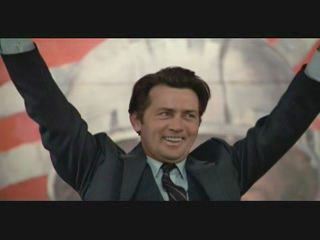
We’re also almost at the end of the first season of The West Wing. It took me an episode or two to forget that the guy playing the President had also been Greg Stillson in David Cronenberg’s film version of The Dead Zone, i.e. not a man you’d want anywhere near the White House, but now I’m okay with Prez Jed Bartlett sitting in the Oval Office.

So far I’m enjoying the series a lot, although it’s pretty much the opposite of True Blood – intelligent writing, heavy on words and ideas, and very little in the way of graphic sex, fangs, shapeshifters and blood. It does, however, have Allison Janney, an actress who I’ve come to like a lot. If I had to single out one of the characters from the series as my favourite one, it’d be her C.J. Gregg. Janney is as pitch-perfect with scenes of political drama as she is with understated humour and outright goofiness.

It’s amazing, though, how bad most of the characters on the series are when it comes to interpersonal relationships that aren’t primarily defined by work. They make great colleagues (when they’re not making vicious fun of you after a root canal) – they seem to make for lousy boy- and girlfriends (though mostly boyfriends). Déformation professionelle, I guess.

A study in contrasts

Earlier this week I almost made my brain explode. I watched Pirates of the Caribbean: At World’s End (no, that in itself wouldn’t have done the trick)… and then, the next evening, I saw The History Boys. From loud, complicated, essentially dumb SFX-travaganza to smart Brit drama in about 24 hours – it’s enough to give you a bad case of the cinematic bends.

At World’s End (or Pirates of the Caribbean III: Why does everything have to be a trilogy?) is undoubtedly a fine-looking film. The visual effects, by and large, are amazing, and the film’s visually inventive to boot. There are sights to behold that I’d never seen before on screen, and the digital artistry on Davy Jones’ betentacled head and face is quite amazing.

If only it was in service of a better script. Remember the first entry in the Pirates franchise? It wasn’t Bergman, but it was witty and fun, which is exactly what such a film needs. Starting with the sequel Dead Man’s Chest, though, the film lost in lightness and wit what it gained in complicatedness. Not complexity, mind you, because that would mean the plot actually adds up to something and benefits the films. Nope, what we got was messy and uninteresting. failing almost completely to serve the movies’ characters.

Yes, Johnny Depp was fun in the third film, as he was in the first two, but Jack Sparrow being Jack Sparrow is simply not enough to keep me engaged for three hours. Geoffrey Rush’s Barbossa might have helped, but little was left of his wonderful scenery chewing in the original Pirates of the Caribbean. In fact, most of the actors acted their hearts out, but to no avail: the script is leaden and dull, only little better than George Lucas’ efforts in the Star Wars prequels. Honestly, Mr. Verbinski, here’s a suggestion: if you want to make a three-hour popcorn movie, give it a fun script, or don’t do it at all.

The History Boys, based on Alan Bennett’s stage play, is pretty much the opposite of Pirates of the Caribbean 3. It’s wordy and character-driven, it gives its cast a chance to shine, and it’s funny and moving. I’d never realised that Richard Griffiths did roles other than broad caricatures, but his Hector, a gay, sad English teacher with an absolute passion for his subject, is a beautifully judged, subtle performance with no trace of Uncle Vernon. However, as much as Hector’s at the heart of the film, practically every other part is as well acted and as necessary to the whole.

Bennett’s writing requires acting this good; I’ve seen amateur productions of his shorter works, and they all came across as terribly mannered and stagey. The dialogues in The History Boys are not realistic, they are stylised (as are the characters), but that doesn’t mean in any way that they feel phony. There’s a truth to all of the performances and writing that takes a bit of time to develop – during the first half-hour, I was thinking that some of the characters were a tad stereotypical, but that’s only true in the way that many people at first seem to fit certain types, and only as you get to know them they develop their individuality.

The movie’s also surprisingly good at not feeling like a filmed play. It may have a script that feels theatrical (which makes sense, given the subject matter – school is inherently theatrical and every classroom is a stage), but it doesn’t look like it wants to be on the narrowish confines of a stage (or like it desperately tries to escape those confines, which is often worse). The film breathes throughout the spaces it evokes.

The History Boys is definitely not for everyone, and if I want to be somewhat arrogant and dismissive about it, chances are that more people will like At World’s End. It’s a film that expects its audience to engage with it, intellectually and emotionally. But the effort pays off many times.

The end is the beginning is the end

HBO has been known to do some killer season finales – no pun intended, although it would be a perfectly accurate one in the case of the last episode of Rome‘s first season. The lead-up to the murder of Caesar is masterfully composed and reminiscent of another plot to have a leader and father figure killed in another HBO series: Livia Soprano’s planned killing of that disappointment of a son. (Is it a coincidence that Livia was named for another larger-than-life mother from ancient Rome?)

Throughout the season I’ve been impressed with Ciaran Hinds’ layered portrayal of Caesar, a man whose fierce intelligence, pride and ambition inspire awe even when he’s at his most arrogant and dismissive. His death, even though it’s clear that it’s coming, is startling in its force and brutality – not just in terms of blood and gore, but in terms of the story and the characters. Another favourite of mine (other than Titus Pullo, of course, who’s just a big sweetie when he isn’t murdering people in a jealous rage) is Brutus, who is portrayed by Tobias Menzies with a fascinating mix of hurt pride, bitterness, self-loathing and, strangest of all, genuine love for Caesar.

Another HBO series finale that pushed all the right buttons with me was Generation Kill‘s final episode, “Bomb in the Garden”. It’s rare for a series that is so documentary in its approach to manage its story and character arcs so deftly, but David Simon and Ed Burns have done a brilliant job. The final scene recalls another work by Simon and Burns, namely the ending of The Wire’s season 2, both scenes using a Johnny Cash song (in both cases making me think that perhaps, just perhaps, I ought to check out that Cash guy’s music). And yes, I am quite okay with admitting my considerable man-crush on Alexander Skarsgard.

With all these endings, it’s only fitting that I finally finished Grand Theft Auto IV. So much has been written about the game already that I won’t add anything other than this: I enjoyed the latest installment of Liberty City. If there’s a more convincing, living and breathing city in any game, I haven’t played it yet. Take it away, Philip.

We do the same. – The same? – Exactly the same. (pause)

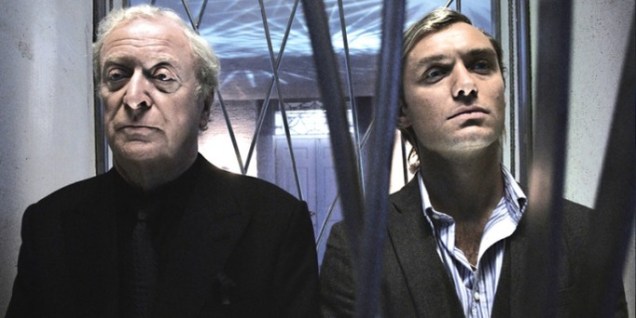
I’d be curious: did Michael Caine and Jude Law talk about Alfie on the set of Sleuth? Did they compare performances? Did they get drunk and watch the Stallone version of Get Carter? Or did they just stare at each other threateningly until Kenneth Branagh shouted “Roll camera”?

The Sleuth remake sounds like quite a compelling proposition at first: one of the grand old English actors facing off against a glittering, promising young guy. (Admittedly, Jude Law hasn’t quite followed up on the promise of his early films, has he?) Directed by Kenneth “Four fucking hours of Shakespeare” Branagh, who has a deft hand behind the camera when he isn’t trying to showcase his own thespian ego. And the original play and film adapted by Harold Pinter, master of intellectual menace and keeper of the weasel under the cocktail cabinet.

Alfie? Never seen it. Sounds like rubbish.

In practice, though, Sleuth is dead as a film. It has occasional moments where the individual contributors flare up and come to life, but it’s like putting an electrical current into a dead frog. Its twitches are easily mistaken for signs of life, but the poor little green guy is still as dead as, well, a dead frog.

Michael Caine probably fares best. He slips into the Pinteresque dialogue with ease and manages to make it sound relatively natural. Caine comes closest to convincing us that the film has a beating heart – but even he cannot sustain this against the wooden staginess of the proceedings. The script might work on stage, with the immediacy that a live performance brings to things, but if some scripts jump off the page, this movie lurches back onto the page.

I’ve liked Jude Law in a number of films, first and foremost Gattaca, The Wisdom of Crocodiles and The Talented Mr Ripley, and he’s got moments in Sleuth where he shines – but all too many of his line deliveries sound as if he imagined that This Is What Pinter’s Supposed To Sound Like. It gets worse in the second part of the film, after the first major twist, which I felt was badly handled; I sat there wondering whether it’s a genuine twist or whether the film suddenly decided to go all post-modern on us. I would have prefered the latter, since the twist made the characters even less credible. In any case, after half an hour Law turns up as a new character, but while his body language is convincing, his accent couldn’t be more fake. Yes, he’s supposed to be fake, but if it’s so transparent to us that this is Jude Law in disguise, it makes the Michael Caine character look stupid if he doesn’t get it… and since the film tries to convince us that the characters aren’t stupid while showing them doing utterly stupid things, it’s difficult to take anything happening on screen seriously.

The third act introduces a homoerotic component that seems to have popped in from a different film altogether. While the casting should work brilliantly here – Law has always had a peculiarly feminine quality – seeing Michael Caine trying to get his menacing paws on the younger man rarely feels anything other than awkward because the development comes out of left field, from another game, in a different country altogether.

Would the film have worked better for me if I’d seen the original? Perhaps – but I doubt it. Branagh’s main mistake in the end was to think that the staginess of the script could be counteracted by ‘clever’ (read: obvious) cinematographic choices. However, no weird camera angle will distract from the script and the performances if they’re geared towards the stage. Seeing this live might have been riveting. Seeing the film? Well. Dead frog.