Welcome to Six Damn Fine Degrees. These instalments will be inspired by the idea of six degrees of separation in the loosest sense. The only rule: it connects – in some way – to the previous instalment. So come join us on our weekly foray into interconnectedness!
Did you know? Your reading diet casts quite an accurate picture of who you are. Or, more precisely, of those aspects of yourself that you’re focusing on, perhaps even obsessing about. You do know it. Of course.
Welcome to Six Damn Fine Degrees. These instalments will be inspired by the idea of six degrees of separation in the loosest sense. The only rule: it connects – in some way – to the previous instalment. So come join us on our weekly foray into interconnectedness!
As a teenager, I read a lot of genre fiction – but, perhaps more importantly, I read a lot of bad genre fiction. Not only: I loved the likes of Lord of the Rings or the iconic novels of Arthur C. Clarke (mind you, his prose wasn’t always brilliant and his characters often paper-thin, but the ideas were fascinating), but I’d read whatever I could find at the library that had spaceships and aliens, or dungeons and dragons. I think that, even at the time, I was aware that much of what I read in the realms of fantasy and sci-fi was generic and derivative at best, pulp designed to be mass-produced and sold to kids like me who wanted their reading matter to transport them to other worlds. But, hey, those books did transport me to other worlds, even if those worlds seemed a lot like Middle-Earth or a galaxy far, far away, just with the serial numbers scratched off.
One of the things that video games can do magnificently is create worlds. These posts are an occasional exploration of games that I love because of where they take me.
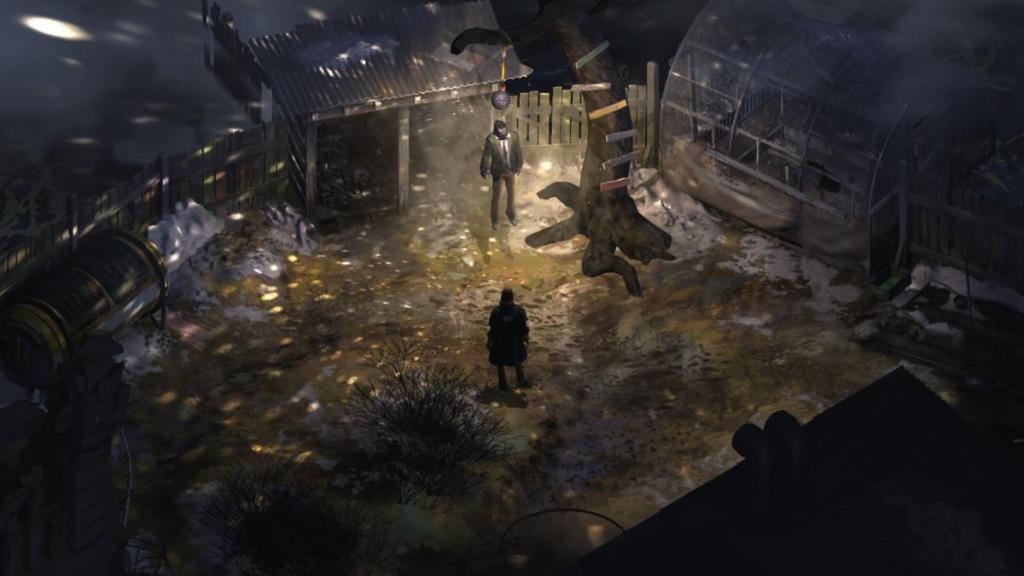
The moment I wake up, I know that something is amiss. My reptilian brain and my limbic system talk to me, one in a snarling, jagged voice, the other in a hoarse, high-pitched whisper. They urge me, mock me, lead me astray – but who is this “me” they’re talking to? I drag my sorry body to the bathroom and look at myself in the fogged-up mirror – and there is no moment of recognition. I see my face, and it could be anyone’s. I’m a blank – and like a blank, I’m there to be filled with personality and meaning and purpose.
One of the things that video games can do magnificently is create worlds. These posts are an occasional exploration of games that I love because of where they take me.
One thing that video games struggle with more often than not is giving their worlds a palpable sense of history. Sure, fantasy and sci-fi games are in love with convoluted lore, but that’s different from creating a world that feels old. We regularly play games where we traverse spaces that are ancient, from the titular tombs of Tomb Raider to the old temples of Star Wars: Knights of the Old Republic, but as impressive as these places are, more often than not they feel like movie sets, created for the purpose of acting as a cool backdrop to the game’s action. The signs of age, the water stains and crumbling pillars and fading tapestries, seem too consciously placed to be entirely convincing. Age seems a mere veneer, because in a virtual world there is no such thing as age. The ancient architecture was designed a couple of months or years ago at most and is being recreated for your enjoyment in every moment of the present. There is no such thing as an old polygon or texture.


 A Damn Fine Cup of Culture