Coming attractions

To be honest, I’m not completely up-to-date on what will be coming to cinemas near you (and me) in 2008. Right now, I can only think of a handful of films that I know of, and even fewer that I’m actively looking forward to. Two of these I’ve already mentioned, namely The Dark Knight and No Country for Old Men.

However, the film that I may just be looking forward to most is the latest movie by Paul Anderson. Nope, not the guy who did Event Horizon or Aliens vs. Predator. The man who directed Boogie Nights (the best Scorsese film by someone other than Scorsese),  Magnolia (the best Altman movie not by Altman) and Punch Drunk Love (the best- sorry, I have no idea what to compare this film to… the best Adam Sandler film, perhaps?).

People have called Magnolia especially a self-indulgent piece of something or other, but to them I say, “Bosh! Flimshaw!” If art isn’t inherently self-indulgent, I don’t know what is. Punch Drunk Love mainly left me non-plussed, but the cast and trailer of There Will Be Blood (as well as the title, which is reminiscent of the Deadwood season 3 premiere, “Tell Your God to Ready for Blood”) definitely have me intrigued and excited.

Marie Antoinette… She’s just zis girl, you know?

Apparently, Sophia Coppola’s Marie Antoinette was booed in Cannes. Now that I’ve seen it, I am tempted to say that French film critics are pretentious shrinking violets with an utterly neurotic attitude to their own past. It’s not a great film, and I would rank it lower than both The Virgin Suicides and Lost in Translation (both of which I liked a lot), but it’s a well made film with some good performances, and it’s definitely beautifully shot and edited. Frankly, I don’t know what les critiques Françaises are on about.

However, Marie Antoinette has one big problem: the beginning is by far the strongest, most subtle illustration of the film’s main motif – a young woman taken into a world that is foreign to her and that regards her as an alien intrusion into their rules and conventions – and almost everything that comes after is much more obvious, much less elegant. Coppola’s use of anachronisms, especially in her choice of music (but also in one semi-witty image of a Converse sneaker among the hundreds of Baroque shoes the young queen tries on), works well enough, but once you’ve seen one scene indicating that “she’s really just a lost, rich, poor teenager… and in the end, aren’t we all?”, you’ve seen them all.

In addition, the film does suffer from being under-plotted. This may be strange coming from someone who loves Lost in Translation, hardly the most plotty of movies, but because Marie Antoinette sticks pretty much to history, there’s little of the smooth flow that a well-told story has. There’s a sense that you could walk out for five minutes, to get yourself a drink or have a bathroom break, and come back without having missed much. I don’t think that films have to be plotted tightly, and in fact many of my favourite movies aren’t, but if you know from the beginning where the story will end – off with her head, and all that jazz – then the film can’t really afford to meander.

On related news, I’m going to keep myself short on Deadwood and Six Feet Under. Just know that there are things more frightening in Deadwood than Al Swearengen on a good or bad day, Francis Wolcott, or even E.B. Farnum talking dirty to a leather bag…

This man couldn’t be scary… could he? Could he?

P.S.: Brian Cox should be a fun addition to the citizenry of Deadwood… I wonder whether he’ll ever get that theatre built – I’d love to see auditions for amateur night!

HBO doesn’t believe in happy marriages

Okay, I haven’t seen Rome yet, or The Wire (which is next on my list of “DVD sets I should bloody well get”), but in the HBO series I’ve been watching marriage pretty much seems to be a recipe for unhappiness of one sort or another. Nate and Brenda (although they did get along better than last week, and for a change Nate had a point under all his aggression), George and Ruth Fisher, Rico and Vanessa… The marriages in Deadwood are somewhat less unhappy and antagonistic, but the happiest couples are the ones that aren’t married: Trixie and Sol (and golly, aren’t they a lovely couple – the whore and the banker?), David and Keith (well, it took them long enough to get their act together!), Dan Dority and Johnny… Okay, that last one doesn’t really count – because we all know that Dan only has eyes for Al.

New career move for Calamity Jane - primary school teacher?

Today’s episode of Deadwood, “I Am Not the Fine Man You Take Me For”, made it clear that the town has been changed by the arrival of Hearst. People seem to be talking in more hushed tones and walking around on tiptoes. Even the sex and violence is no longer as carefree as in the good old days, when the guy shot dead in the saloon wasn’t part of an elaborate power game but just a symptom of Dan Dority having a headache. However, the episode had more humour in it than the season premiere, although some of it was of the “Did E.B. really just say that?!” kind. It’s amazing that the guy’s small intestine hasn’t jumped up his neck yet to choke his brain’s blood supply, to the service of all mankind.

Sometimes I wonder whether Rico doesn’t need a stool to stand on in order to reach the corpses…

We’re steadily getting closer to the end of Six Feet Under, and while I’m already sad about where the season will take us, I’m quite looking forward to getting started on a new series. We’ve got a couple to choose from: Rome season 1, Heroes, Carnivale (I’ve got both seasons), The West Wing, Dexter (you’ve seen him be neurotic and gay for five seasons – now see Michael C. Hall as a cop and a serial killer!). So many series, so little time…

Mother****ing House on the mother****ing plane!

Just in case you didn’t get the reference…

“Airborne”, yesterday’s episode of House, M.D., was fun. I like it when they shake up the format, even though the episode was a tad high-concept (“House on a Plane!” Well, you get it…) Seeing the doc try to deal with the situation without his lackeys was enjoyably snarky:

House: Can you say “Crikey Mate”?
12 year-old Boy: Crikey Mate.
House: Perfect. Now no matter what I say, you’ll agree with me, okay.
12 year-old Boy: Okay.
House: Nicely done. You, disagree with everything I say.
Foreign Man: Sorry, not understand.
House: Close enough. (to random woman) You get morally outraged by everything I say.
Sour Faced Girl: (about House writing on the movie screen) That’s permanent marker, you know.
House: Wow, you guys are good.

The editing between the two storylines kept the episode dynamic throughout – and I’ve started to feel sympathy for Chase since last episode (especially the glow on his face when he looked at Cameron’s photo). So far he’d been the blandest of the supporting characters, but there’s something genuinely sweet – if still not terribly deep – to his growing feelings for Cameron. She, on the other hand, is becoming somewhat grating: the combination of self-righteous and self-indulging may be credible, but I find myself thinking, “How about you keep your mouth shut and your pants zipped for ten minutes, girl…” (Yes, every now and then I guess I am a bit of a sexist. Sorry. Feel free to throw things at me.)

In other not-so-news: we started watching season 3 of Deadwood, and boy, is the air thick with ominousness… ominosity- ominiminy? Well, you know what I mean. Quite obviously, Hearst is not a good egg, nor is he the kind of moustachioed bad egg who keeps heads in boxes and whom we secretly like. I can’t really put my finger on it, but there’s something in the balmy frontier air, and it’s not Calamity Jane’s heady aroma. We’ll see where this’ll take us, but somehow I doubt it will be anywhere nice. Or perhaps the episode’s title was ironic: “Tell your God to Ready for Blood” might really be the prelude to a season of goodwill, cheer and fluffy bunnies in Deadwood (no state yet).

Two deaths and three funerals… followed by two more deaths

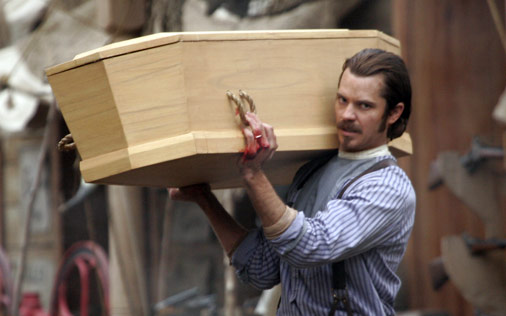
Yesterday’s TV evening was marked by a high number of funerals. The deaths I sort of expected – after all, we did watch Deadwood – but I could have done without the ominous onslaught of funerals. House, M.D. managed to do without a death, as it pulled off its last-minute Eureka! moment, House saving the hard-done by Marc Blucas at the last moment. (As if his breakup with Buffy hadn’t already done enough damage…) Then we zapped into some series with Craig T. Nelson (I don’t know what he’s doing on telly anyway – shouldn’t Poltergeist have taught him to stay away from the flickertube?) and an epic African-American funeral, complete with gospel choir. This was followed by the quite heart-rending Deadwood episode “Let the whores come” (and only Al Swearengen can pull off asking the whore who’s giving him his daily blowjob whether she’s dyed her hair and almost seem considerate).

ep23_seth_coffin.jpg

But the whole thing was topped by the double-funeral, followed by double-death (très E.A. Poe) of Nikki and Paulo, Lost‘s most hated characters since… well, depending on who you ask, since Kate or Ana Lucia or Jack or Charlie or Boone or Shannon or practically anyone. Except Hurley. No one seems to hate Hurley. (Okay, not true. There are people who hate him – but there’s only one TV Hurley that everyone can agree to hate.)

Hurley by name…

It’s called Deadwood… What did you expect?

Okay, I know that there’s at least one reader out there who hasn’t seen Deadwood season 2 yet and is planning to do so. This is where I tell you, very politely, to come back tomorrow, lest ye read a spoiler.

Still there? I’m warning you, there be spoilers!

Well, that’s about all I can do. If you’re still reading, well, I won’t take any responsibility. So there.

Yesterday evening, after two middling episodes of House, M.D., we watched the pen-penultimate episode of the sophomore season of Deadwood, aptly entitled “Advances, None Miraculous”. In it, we were reminded (after several episodes that seemed to suggest differently) that Al Swearengen can still be the scariest mother****er in the Valley of Death, if he wants to be. And all without drawing a weapon.

We were also shown that when he needs to be, Sol Star is just as much of a badass. After seeing Al frighten Mrs Isringhausen – not exactly a shrinking violet herself – into signing a piece of paper, accepting $10’000 and getting the hell out of Dodge in a brilliant piece of Al-manship, we get Sol telling him in his face that he won’t stand for bad Jew jokes. Now that takes a pair… or stupidity, but I’ve always thought of Sol as the intelligent one in the Star-Bullock friendship. (Except occasionally, when he’s led by his privates rather than by his brain.)

None miraculous

However, the emotional centrepiece of the episode was the protracted death of William Bullock. It was quite heartrending to see Sheriff Bullock face a crisis that he can’t beat down with his fists. William’s dying was a moving counterpoint to the political wheelings and dealings about the coming annexation of Deadwood, affecting everyone in their own way.

Talking about affecting: I’ve gone on at great length about The Assassination of J.J. by the Coward R.F. before. Yesterday I made the mistake of checking out the Nick Cave/Warren Ellis soundtrack of the movie on Amazon.com. The dark, subtle elegiac tunes (or rather the 20-second clips that Amazon plays for free) got to me to the extent that I felt the pull of the movie all day afterwards. Tunes like “Rather Lovely Thing” or “Song for Jesse” wormed their way into my heart, making me feel sad for semi-fictional characters long dead for hours.

P.S.: When I read who’d composed the music together with Nick Cave, I had this momentary vision of the writer of Transmetropolitan scribbling darkly sentimental tunes on some sheets in between writing another tasteless, hilarious, biting chapter of his near-future satire. For all I know, it is the same Warren Ellis. Then again… No. Probably not.

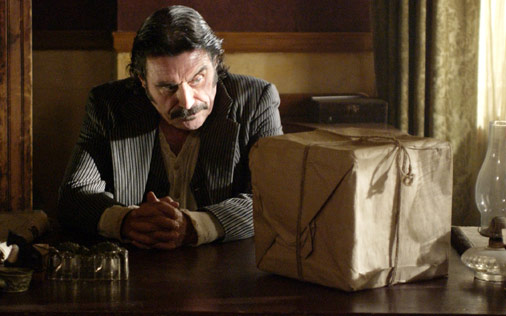
What’s in the box?!

I’ve thought before that Al Swearengen would make a good shrink (if shrinks took to stabbing their more annoying patients or slashing their throats, that is). I now think that the Indian head in a box he’s got might do an even better job; at the very least, it’s doing a great job of calming down Swingen’s temper. Or perhaps it’s gleets that do that to you.

A man and his head

I have to admit though that I wasn’t too keen on “Childish Things”, last night’s episode of Deadwood. There was something off about the writing and some of the acting – somehow it felt more like someone trying to imitate the Deadwood style and not quite managing. I wonder whether that’s also down to the director, Tim van Patten, who’s done quite a lot of Sopranos but no Deadwood. Added to which he directed some of the weaker episodes of the late, great HBO mobster series.

Still, there was a lot to like or even love about “Childish Things”. There was the gripping scene between Francis Wolcott and Joanie Stubbs in the darkened front room of the now defunct Chez Amis. (One of the things that make Wolcott so fascinating is that you really never know what he’ll do next. He doesn’t seem to know himself, and there’s this subtle trace of sadness at his own ignorance in him.) There was the priceless scene where Dan finds out about Al’s favourite rotting head-in-a-box. There was the moving scene where Charlie Utter confesses to Wild Bill’s grave just how worried he is about Calamity Jane. And there was Ellsworth sweet proposal to Alma Garrett.

But damn, boy, Bullock and his wife ought to go and see a marriage counsellor real soon. Who knows, perhaps Al and his amazing head could give the two of them a good talking to…

P.S.: No points for those who guessed what film the title quote is from. Anyway, perhaps you specifically need an Indian head to get the positive effects; Gwyneth Paltrow’s may have more of a “Must shoot the smug bastard several times and then go bonkers!” effect on people. Or at least on Brad.

What’s that? Jennifer Aniston?

Western promises

The title should already give it away: The Assassination of Jesse James by the Coward Robert Ford is not the kind of movie you watch in order to find out what happens at the end. If that’s why you go to the movies, don’t see this film. If you tend to use the words “pretentious” and “artsy” fairly often when talking about films you didn’t like, don’t see this film. If slow equals boring when it comes to movies as far as you’re concerned, don’t see this film. If you’re hoping for gunslinging action, don’t see this film.

The Assassination of Jesse James by the Coward Robert Ford

However, do see this film if you want to see a beautifully written and shot, psychologically fascinating, immensely atmospheric and deeply sad movie, and especially if you’re interested in good acting. Down to the last part, The Assassination has an impressively talented cast; for instance, even the few scenes that focus on Garrett Dillahunt’s Ed Miller (I’ve been a fan of his ever since watching Deadwood) tell volumes in themselves. But the film stands and falls with the two title characters, and they both carry their share of the load with distinction. I’d only seen Casey Affleck in the Ocean’s Double-Digit films, where it’s difficult to judge his acting, but his Robert Ford is a complex, riveting creation: in turn wheedling, puffed up, disturbing, pathetic, deluded, but finally truly tragic, he’s a relative of Matt Damon’s Tom Ripley. At one point James asks him: “Do you want to be like me? Or do you want to be me?” Their relationship recalls that of Tom Ripley and Dickie Greenleaf (Jude Law) in Anthony Minghella’s movie, but it goes further than that. And Ford’s longing, loathing looks at Jesse James carry so much.

I must admit that I am also becoming quite the Brad Pitt fan. I used to think that he was a star, but not much of an actor – and there are films where you need stars. It was only in Babel that I recognised he could play a part that was in no way that of a movie star. In that film I forgot for the first time that he’s a pretty boy, and I saw him as the character. The star quality is back in The Assassination, but it needs to be – Jesse James is a myth, so Pitt has to portray that facet of the character – and it’s made deeper and richer by Pitt’s performance. This quasi-mythic outlaw is also a paranoid, superstitious and at times cruel and petty bastard, and he’s got a deep streak of self-loathing. When he turns his back on Ford for the last time to wipe the dust of a picture, we’re basically seeing a suicide at least as much as a murder. While James is no Christ figure, Ford is as necessary as Judas to complete the narrative – and to some extent this is because James lacks the courage himself to end it all, nor to live on. It’s by no means clear whether Robert Ford is really the coward that the title suggests.

I don’t want to go on too much, because otherwise this blog entry will rival the film in length. If you don’t mind slow, long films, if you don’t mind portentousness, if you think that the western genre can do tragedy successfully; if you don’t mind hearing the same three pieces of music repeated frequently (and they fit very well), if you don’t mind artsy choices in the photography, editing and writing. Or simply if you want to see Nick Cave hamming it up with a guitar in a Brad Pitt movie. If any of these apply, go and see the film.

A season too far…

We watched another two episodes of the second season of Life on Mars yesterday, and while they were more enjoyable than a couple of the ones earlier this season, they still felt like variations on a theme – and minor variations at that. The impression I got was that they had material for a total of eight or nine episodes, at most. Instead they decided to stretch it to two seasons and 14 episodes altogether, and as a result much of the impact was lost. This could have been a little gem of a series, and instead it turned out to be an okay execution of a clever premise, extended past its sell-by date.

You doity rat (redux)

Quite a few series are milked, the episodes becoming tired, stale rehashes of earlier material. Even fans say that The Simpsons have been going on for too long (although they also argue that the last season has been a marked improvement). Same seems to go for Spooks (another BBC series by Kudos, the producers of Life on Mars), Buffy (I’ve seen few defenses of season 7), The X-Files or most of the Star Trek series.

And then you get series that are killed untimely. Firefly and Deadwood come to mind, but I’m sure there are other examples as well. (Futurama, perhaps, ending with one of the best episodes of the entire series, but it’s being revived right now, so I’ll wait and see.) Series that, quite simply put, had much more to say. Series that quite often also expected something from the viewer, that made demands – for instance, that you tuned in every week. You can’t really tell a good, sustained story if viewers may look in once a month, at best.

Death by trampoline?

To be honest, I can only think of a handful of series that managed to end when they should have. Six Feet Under is a candidate. M*A*S*H, perhaps, although the jury’s out on whether the series maintained its quality, got better, or simply got smug and self-righteous. Most people loved “Goodbye, Farewell and Amen”, but there are some who hated it with a vengeance for being Alan Alda’s soapbox.

I guess that, given the choice, most fans would prefer more material of their favourite series even at the price of diminishing quality. But it is frustrating to see them putting out yet another cop series or medical soap but at the same time not allowing more complex, more ambitious – and, admittedly, less audience-friendly – material the breathing space it needs.

Deadwood is other people

There’s many things you can say about Deadwood – many very complimentary things – but “endearing” may not be the first thing that comes to mind. Seeing Al Swearengen all dressed up and trying his best to be polite (and do without his usual colourful idiom) in his first face-to-face meeting with Alma Garrett was exactly that, though: endearing. Even when he asks Alma to tell her ward, young squeaky-voiced Sophia that there are “no hard feelings”. No hard feelings, that is, about his plan to have her killed back in season 1, since she could have put a spanner in his works. I’m still amazed at the tonal range this wonderful series has (or rather, had – more on that below), and at the complexity of the characters.

In general, these characters play eminently well with, and off, each other. You don’t even need much plot to enjoy what happens when you put Al and Alma together in a room. Or E.B. Farnum and Calamity Jane (although if they were in a room together, chances are only one person would come out). Personally, I wouldn’t mind putting Cy Tolliver in a room with Dan Dority, just to see Dan’s famous impulse control do its thing with the boss of the Bella Union.

Sadly, it’s looking less and less likely that the post-season 3 TV movies will ever be made. With so much garbage and generic rehashes of rehashes on TV, it’s sad that an intelligent, tough, beautifully crafted series such as Deadwood is shelved. But what can you do?

Perhaps David Milch should create a series about a team of forensic crime-scene investigators in the Old West. That should sell like handguns…