Airborne, tumbling down…

I resisted watching Band of Brothers for a long time, just as I still haven’t seen Saving Private Ryan and am not planning to do so any time soon. While I acknowledge Spielberg’s skills as a director, I tend to mind those films of his that purport to be “important”, because usually he mistakes pathos for importance. (I’m excluding Schindler’s List from this, though.) Band of Brothers came out in the wake of Spielberg’s Omaha Beach Party, and I assumed that it would be more American WW2 pathos.

When we watched the first episode, I was afraid that my expectations would be proven true. The main theme of the series, without the context of the actual episodes, dripped with solemn, righteous pathos, like a particularly constipated John Williams on Fourth of July. The episode itself neither confirmed or rebutted my fears, though: it concentrated on the battalion’s training in England, so there was little space for outright heroism. The episode was interesting enough, although it was hampered a bit by casting David Schwimmer as a bullying instructor. Schwimmer did a good job, but it’s more or less impossible to look at him without thinking “Ross! From Friends! and wanting to smack him in the gob.

bandofbrothers1_396x222.jpg

It was only in the second episode, “Day of Days”, that I came to realise that my fears were unfounded. Yes, there may still be lots of soldierly pathos in the remaining eight episodes, but there was little to none of that here. It’s extremely difficult for a war movie – even for a supposed anti-war movie – not to make scenes of warfare exciting, so the implication is “War is hell… but it’s a bloody adventure, innit?” Instead, the first scenes we get of the characters involved in an actual battle is them sitting in the planes, waiting for the jump, as flak fire shoots several planes to bits. The soldiers are powerless, and whether they live or die isn’t down to their heroism but rather to sheer luck.

We were eating lunch when we started watching the episode, but both of us stopped digging into our sandwiches pretty soon as horrible, frightening, saddening things started to happen on the screen: as a plane went up in flames, and you saw little human specks on fire tumbling from the conflagration to fall to their death. The surviving soldiers’ first direct encounter with the enemy was no more heroic, as they shot a group of Germans on a horse cart from the safety of an ambush, riddling the horses as much as the enemy troops with gunfire. At this point, you got the impression, wartime reality for these men was probably not that different from that of the German soldiers: you point your gun at the guys in differently coloured uniforms and you hope that they die before you do.

This impression that even the Good Fight is a pretty crappy fight became even stronger when Sgt. Malarkey gets to talk to a prisoner of war, a German-American born in the States whose parents decided to move back to the Fatherland. Just after he stops chatting to the young man who, but for the accident of family might have been wearing the same uniform as him, all the POWs are rounded up and shot. Can’t waste time and men on protecting these prisoners.

Right now I’m impressed at the lack of “Rah, rah, Allied Forces!” pathos and very curious as to how the series will continue. After a pretty gut-wrenching second episode, will it be able to maintain this level of intensity?

And, perhaps more importantly, will I manage to remember the names of all the soldiers (looking so similar under their over-sized helmets, where you haven’t even got hair colour to go on) before we get to the end?

P.S.: Talking of distracting cameos by TV comedians – there was this little guy in one of the scenes in the first episode, and I thought, “Man, he looks just like Shaun from Shaun of the Dead… but it can’t be him, because why would they want to cast a Brit for an American?” Well, turns out that Simon Pegg is far from the only Brit playing a US soldier in Band of Brothers. Is this payback for all of those villainous Germans played by British actors?
A moving moment

You’ve probably all noticed that my blog updates have become somewhat infrequent, at least compared to the beginning, where I’d hammer out an entry a day. Don’t worry, this is just a momentary slump (I hope); things are somewhat stressful at the moment, and I don’t get to watch or read as much as I’d like. Even when I do find the time, I’m usually somewhat too tired to appreciate films, series and books as much as I’d want to.

That’s where gaming comes in. I can be as tired as I want, yet I can still get some enjoyment out of Guitar Hero (where I’ve graduated to Hard mode, meaning that I’ve now got five fretting buttons to contend with!) or Splinter Cell. Or I could be “enjoying” Call of Cthulhu: Dark Corners of the Earth.

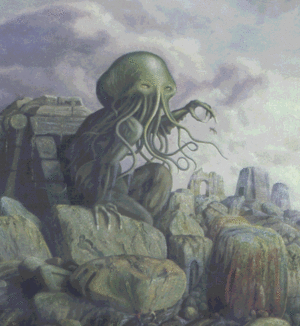
CoC: DCotE (doncha love acronyms?) is one of the creepiest games I’ve played since… well, since Thief 3 and that Holy Grail of computer game horror, the Cradle. I’m not particularly informed when it comes to H.P. Lovecraft and the Cthulhu mythos, but for those of you who know even less, Cthulhu is this cheerful fellow:

Yo, C-man!

(Any similarities to a certain crustacean Doctor are purely coincidental.)

The game has a couple of easy scares (boo! decomposing corpse!), but by and large it works with more subtle techniques: half-glimpsed horrors and whispers in the dark. Slowly going insane is as much of a threat in this game as things that go bump in the night. The game starts with the protagonist cuts his stay at an insane asylum short by hanging himself – what follows essentially is a long, drawn-out flashback – an odd way to motivate players to progress: “Just one more level and I can hang myself! Yay!” For the first two, three hours of gameplay you don’t even have any weapons, which makes for an original twist on the genre: for once, the solution to all your problems isn’t unloading a gun in some gilled horror’s face.

And the game has what is possibly the best chase sequence I’ve ever seen or played. You’re woken up in the middle of the night as a couple of shady guys (with serious throat problems, from the sound of it) try to break into your room to turn you into chowder. Your only option is to run, bolting doors behind you or blocking them with wardrobes and the like. Then, a bracing escape via the rooftops while you’re being shot at… and don’t even look down, because otherwise you’ll find out just how Jimmy Stewart felt in that classic Hitchcock movie about a guy with vertigo. I think it was called… “The Man Who Was Afraid of Heights”.

The Grim Brothers Coen

There are many things in No Country for Old Men that recall the Coens’ earlier films, specifically Blood Simple and Fargo; yet it feels notably different in many ways from those films. Intolerable Cruelty (and, from what I hear, Ladykillers) also felt unlike the earlier movies the brothers had made – in some ways, they felt more like someone was trying to imitate their style and succeeded in isolated scenes but, on the whole, failed… Failed, that is, to make a good Coen movie as well as a good film in general.

No Country for Old Men is a good movie. It may even be the best Coen film to date. Chances are I’ll never love it as much as Fargo, but that’s also for nostalgic reasons. Fargo is by no means anything less than a fantastic film, but it doesn’t have the sheer compactness and focus of No Country for Old Men.

And it doesn’t have Anton Chigurh.

Chigurh, as played by Javier Bardem, is one of the scariest movie characters in a long time. I’ve never read any Cormac McCarthy novels, and for all I know he was already frightening in the book, but what Bardem and the Coens make of him is chilling.

However, the film has plenty more going for it than Bardem’s psychotic Prince Valiant and his pneumatic slaughterhouse device. It works so well because the three main characters – Chigurh, Llewellyn Moss (Josh Brolin) and Ed Tom Bell (Tommy Lee Jones) – complement each other so well. The story and the protagonists are balanced to perfection; you’ll rarely see a film that is as intricately structured. Bell and Chigurh are like two poles, balanced on the axle that is Moss: not a bad guy, but deeply flawed and too sure of himself, even after he’s seen the force of nature that is the killer following him. Moss commits several stupid acts in the film, as well as some brilliant on-his-feet thinking, but his greatest stupidity lies in thinking that he has a chance against his opponent. Bell, on the other hand, seems to understand (and accept, in the very end) that there is some evil that is beyond comprehension and that cannot be tricked or beaten.

No Country for Old Men

If you’re like me, and an Academy Award is more likely to put you off a film, do yourself a favour. If you enjoy great acting and don’t mind bleakness that makes Sweeney Todd look like Charlie and the Chocolate Factory (okay, that’s not quite fair – like Edward Scissorhands, perhaps), do go and see this film. And see it at a cinema rather than on TV. Roger Deakins’ work, which once again is quite magnificent, deserves the big screen. I just say The Assassination of Jesse James by the Coward Robert Ford, The Man Who Wasn’t There, and, once again, Fargo.

Tell us something pretty, HBO

Phew. Remember the first and second season finales of Deadwood? Basically happy endings, complete with mercy killings and stabbed Cy Tolliver?

Don’t expect that sort of cheery capper to season 3. Expect, instead, to curse and swear at your television – standing in, of course, for the Powers that Be at HBO. For cancelling a TV series intended to run for four seasons, and a brilliant written, acted, directed, filmed TV series at that, after it’s run for three of those seasons. In a world where another HBO series about old-fashioned romanticism dressed up as postfeminism gets a big screen outing, it’s more than just a shame that we’re not likely ever to see Deadwood end as would befit the series. It’s a crime. And it makes me think that Al Swearengen should be let loose with his knife in the dreams of those HBO cocksuckers (as he might put it if he was in a good mood) to put the fear of Al into them.

Daniel Plainview, eat your black heart out

No, it’s not that Deadwood ends on an exclusively bleak, depressing note. There are lots of small moments that are beautiful, little smiles and touches that show some hope. Sol and Trixie. Richardson and Aunt Lou. Even E.B. standing on the roof of his hotel, bless his little cotton socks. But on the whole, the good (and not so good) people of Deadwood have been beaten, for the first time. They’ve been kicked in the kidneys. There has been blood, and for once, it’s less than clear whether any scrubbing will get rid of that blood.

So, until tomorrow I’ll try to get over my pissed-off-ness with the hoopleheads at HBO. Expect some lines on No Country for Old Men soon. At least that one’s got a two-time Deadwood veteran…

P.S.: Apparently, the person who was supposed to play Al Swearengen at first was one Ed O’Neill. Photo given below. No joke.

Can’t… joke… about… this

A tale of two movies

I like films that are cinematic, that show me images I wouldn’t see otherwise. I like directors who are audacious about their use of the camera and of editing. I like my movies not to look like TV fare. (I don’t like my TV fare to look like TV fare, for that matter.)

In spite of this, I very much like John Sayles’ movies. None of the ones I’ve seen so far are visually spectacular, although they’re definitely not drab. It’s more that Sayles clearly isn’t interested in David Lean-type filmmaking. As a matter of fact, his films don’t look like he’s trying to impress their audience. They seem, at first, unassuming little movies.

But, once you get into them, they pack a surprising punch. Much of this is down to the fact that they’re immensely political films, something not seen very often in American filmmaking. Certainly politics is often used as a backdrop for movies – how many thrillers or action movies get a kick out of putting the president in jeopardy? – but they’re not interested in politics, not really.

John Sayles

John Sayles’ films are, but they’re not of the finger-wagging, lecturing type. Clearly they’re mostly left-leaning in their politics – almost all of them are concerned with small communities being fundamentally changed by big business – but more than that, they don’t tell you what to think. They provide you with Sayles’ interpretation of facts, but you’re still the one who has to make up his or her mind.

Limbo, which we watched on Sunday, is a strange film. It starts very much like Sunshine State or Lone Star, depicting a small community undergoing changes, focusing on a small ensemble of characters… but about halfway into the movie, it turns into something else. There is a thriller element, just as there was to Lone Star, but what the second half of Limbo reminded me of more than anything else was Into the Wild (also see Roger Ebert’s comment on the movie). Sayles, whose focus on ensemble casts usually is almost as strong as Altman’s was, zooms in on the fate of three individuals in an exceptional situation. Yes, it ties in with earlier lines in the film about how Alaska is about to be turned into a themepark and how people want the illusion of danger – they want to feel at risk without actually being at risk -, turning these lines on their head, but in effect it feels like Sayles started making one film and decided half-way through that he’d rather make a very different film.

The net effect is strange but compelling. Ten minutes into the film, I thought I knew what to expect; one hour into the film I no longer knew where Sayles would take me, which was exciting and quite frightening. Anything, literally anything, could happen to these characters.

Limbo

And then came the ending. Absolutely fitting. And it felt like a punch in the stomach. Not because it was horrible or tragic or nasty. Because it was consistent to what had been set up. But, again, not the kind of thing you do if you want to impress or please your audience. I read that there’d been catcalls when the film was shown at festivals, and I understand why. But, the more I think about it, the more I feel that the “lady-or-the-tiger” ending was the only proper way to end the film.

But if I ever meet John Sayles, I’ll kick him in the shin.


P.S.: John Sayles is one of the consistently best writers for women, especially for middle-aged women, in American filmmaking. He should write for the stage…

Before the devil knows you’re dead

Anthony Minghella

I was planning to write an entry today on John Sayles’ Limbo, but that has to wait until tomorrow or the day after. Since my browser start page is BBC news, I’ve just read that Anthony Minghella has died. I’ve written about his films before (e.g. here and here); I liked many of the films I’d seen that he’d directed, and those I didn’t like I still appreciated. He knew how to work with actors that I didn’t particularly like (such as Gwyneth Paltrow or Robin Wright Penn). And he directed the film that convinced me that Alan Rickman wasn’t Evil(tm):

A Life in Pictures: Anthony Minghella. Rest in peace.

A hellish slice of throat for the gentleman?

It’s been a while since I really liked a Tim Burton movie. Sleepy Hollow looked great, but I felt that the romantic subplot between Johnny Depp and Christina Ricci was tacked on, and largely as a result the film felt mean-spirited to me. Mars Attacks! was half an hour of great over-the-top black comedy padded to an indecent extent with boring SFX bits and cameos. Planet of the Apes was, well, Planet of the Apes. Big Fish annoyed me more than most movies I’ve seen in the past few years; it was aggressively sentimental and the old guy simply angered me with his chronic need to be the centre of attention. (If I’d been the Billy Crudup character, I would have suffocated Daddy Dearest with a pillow ten minutes into the movie.) Corpse Bride was okay and nicely done, but it was no Nightmare before Christmas – the characters were flatter, the music less memorable, and the bits that were best felt like rehashed bits of Halloween Town.

 As I wrote recently, I enjoyed Charlie and the Chocolate Factory quite a bit, but it’s not the sort of film that I’d need to see more than once. All in all, I wasn’t sure what to expect of Sweeney Todd, since I’d heard mixed things. I’m not the greatest fan of musicals (even though I keep finding myself wanting to rewatch “Once More, With Feelings”), and I wasn’t sure whether anything new or interesting would come out of Tim Burton working with Johnny Depp and Helena Bonham Carter yet again.

They’re my friends…!

We sat in the very front row at the cinema, since all the other seats were already taken. Not the best starting point for an enjoyable evening at the cinema (and I’d rather not tell you about the Mexican restaurant beforehand… I may very well have woken tonight, screaming the lyrics of that horrible Latin-y Happy Birthday song they played at top volume).

I think I was riveted about two minutes into the film. Like Sleepy Hollow, the atmosphere was great – the film was one of those that you should be able to frame and hang on the wall. But unlike that throat-wounding movie, this one had better writing and, accordingly, better, more believable characters. While the film was visibly artificial, it didn’t feel fake like many of Burton’s worlds tend to do. And the emotions on the screen felt more… well, more grown up, for want of a better term. There’s something very child-like (sometimes indeed childish) to many of Burton’s works, and in the case of Edward Scissorhands and Ed Wood it works quite well, but it was getting tired and stale. By comparison, this film felt like Jacobean revenge tragedy – bloody, passionate, alive and raw.

P.S.: It’s a shame that Anthony Head (yes, I squeaked “It’s Giles!” at the cinema) didn’t get to do more on screen. Apparently he recorded some songs, but they didn’t make it into the final version of the film.

P.P.S.: For the first time, in this movie I saw why some people think Neil Gaiman and Alan Rickman look alike. When the latter doesn’t do his patented “Where are ze fucking detonators?” sneer, he does look and even sound a bit like Mr. Sandman.

Shredding geeks

Many gamers are looking for one semi-mythic, intangible quality in games: immersion. It’s basically the ineffable property of making you forget that you’re sitting in front of a computer screen or TV, grasping a gamepad or a mouse, and feel that you’re really there. But, let’s face it, even with the most immersive games you never feel like you’re a mute MIT graduate saving the world with a gun in one hand and a crowbar in the other, or a cyber-ninja special operative infiltrating terrorist strongholds or a Persian prince able to run along steep walls and turn back time. There are worlds between playing FIFA 08 and actually kicking a football – there’s little to no comparison between pressing X or O and propelling a leather ball towards the enemy goal with your foot. Possibly the only game that offers near-absolute immersion is computerised chess, because as if you’re, like, really playing chess!

Okay, enough sarcasm – what I’m getting at is this: there are few games that make you believe you’re really doing what your on-screen avatar is doing. Fair enough, really; there are limits to how much I’d want to believe I’m being shot at by alien armies while killer zombies are trying to chew my frontal lobe. And I definitely don’t want to believe I’m actually playing football at Wembley Stadium.

There is a game (or several games, by now) that gives you a fairly convincing illusion that you’re actually doing the thing you’re playing, and that game is called Guitar Hero. I’ve had it for a while, but I’ve only recently started to play it again. And it’s great fun. Looked at objectively, it should be a humiliating experience: you stand there holding a plastic toy shaped like a Gibson guitar, pressing colour buttons and strumming a white bar in sync with popular rock songs. You’re as close to rock stardom as Third French Lord in an amateur production of Henry V is from saying, “And I would like to thank the Academy…”

But, hell, if it isn’t fun… And it does a great job of making you feel like you’re playing complex solos, totally rocking the place, dude! The game mainly works because the rock songs used make for surprisingly good videogame levels. So far, I’ve only made it to the second of four difficulty levels with any success – I’m only using four of the five fret buttons, which means that my hands are in for some pretty bad strain. But the choice of songs is almost perfect: Guitar Hero has everything from ’70s glam rock to ’80s cheese rock (is that a term? it should be!) to 21st century alternative rock. And since I don’t really listen to the radio, it’s this game that has introduced me to the following eminently cool song:

However, there’s a further turn of the screw to my geek joy. I’m very much an old-school gamer – I played games on machines that are practically Etch-a-Sketches compared to a five-year old mobile phone. My first slice of nerd heaven was a Commodore 64, a name that still brings on a hush of awe in the right crowd. The C-64 has been defunct for decades, yet there are insane people still working with them… and this is where I don’t care just how nerdy and geeky I sound, but the following is just distilled nostalgic coolness:

They see dead people! (Ouija board optional)

As I mentioned recently, I’m currently watching both the first and the last season of Buffy the Vampire Slayer – season 1 has replaced our previous Sunday morning show, Six Feet Under (there seems to be a distinct funereal vibe to our Sunday mornings…), but since I was watching Buffy before, I didn’t want to wait for two or three years until we caught up with where I’d previously been.

Season 1 is fun, but damn, is it cheesy… It’s goofy to an extreme and somewhat difficult to go back to after the last few seasons of the series. It also allows me to see how much the series has grown up with its main character – it has changed a lot in terms of tone and depth. Lots of fans would say that it turned into rubbish in seasons 6 and 7 – but I must say, I don’t see it. Yes, there’s less of the careless fun of dusting vamps, partying at the Bronze and pining after tall, dark, mysterious Angel. But the development the characters have gone through makes sense.

Yes, some episodes of seasons 6 and 7 are rather meandering, but that happens with most US series that run for 22 episodes each season. Practically any of those series would have benefitted from tightening to, say, 16 episodes per season. (Yes, Lost, this is a not-so-subtle jab in your direction. Don’t screw up now!) But then again, there are some episodes there that a) are among the handful of best episodes and b) wouldn’t have been possible in earlier episodes. The development that Buffy, Willow, Xander & Co have gone through is what makes an episode like “Conversations with Dead People” possible.

I was surprised when I read that four writers worked on “Conversations with Dead People”, because it’s one of the tightest episodes of the entire run of Buffy in terms of its writing. Everything fits together. It was in “Conversations” that I felt most strongly: this series was made by the people who created Firefly. It has the same astute mix of humour, drama and action as the best episodes of that sadly-missed sci-fi series. The episode manages to tell five stories in its 42 minutes: Buffy fights, and is psychoanalysed, by a vampire she went to school with (much funner and less corny than it sounds), Dawn is visited by what may or may not be the ghost of her mother, Willow gets a message from her dead girlfriend (or does she? – you get the gist), the nerdtastic duo Andrew and Jonathan return to their erstwhile stomping grounds, Sunnydale High, and Spike goes in for a little non-verbal Blonde-on-Blonde action.

What this shortest of summaries doesn’t reveal is the subtletly with which “Conversations” shifts its tone from witty to scary (for a horror-themed series, Buffy rarely had genuinely frightening moments, but this episode more than manages) to poignant. Like so often, the Big Bad in the series is at its most effective when what it says is largely true, but the kind of truth that the characters don’t like to face up to.

Okay, anyone who sat through all of this stuff on an episode of Buffy the Vampire Slayer must be desperately bored or a fan of the series. In either case, here’s a little reward for you sitting this out. Enjoy!

I’ve drunk beers you people wouldn’t believe

Every now and then YouTube disappoints me. Today is one of those days. I was looking for a Guinness ad – one of my favourite TV adverts ever – that makes great use of that song from South Pacific, “I’m gonna wash that man right out of my hair”, a feminist quip and surreal imagery. There’s fish in there – Dave McKean would’ve liked it.

Why did I want to blog on a Guinness ad anyway? I’ve been re-watching the final cut of Bladerunner, this time with the commentary track. (Ridley Scott commentaries are sometimes interesting but often frustrating; the guy is a great craftsman, but he doesn’t really have much to say that is very interesting, intelligent or enlightening, and he comes across as somewhat arrogant. And the Thelma & Louise commentary is one of the worst I’ve ever forced myself to sit through.) Watching ’80s Rutger Hauer on screen, quite logically I thought of the Guinness ads he did a few years later (ah, the glorious days of Sky Channel), and from that I moved on to a Rutger-less, more fishy ad.

However, since I didn’t find that one, here’s one of the Hauerian adverts – short and sweet, at a point where the pretentiousness had already turned to irony. Enjoy! (And tomorrow I might post something on Buffy or on a comic series I liked rather more than Preacher.)