Heh. Okay, I lied, if only by implication. This update is not about Lost – it’s about Evil Uncle Disney. Cracked has a fun (though somewhat crude) look at the most violent deaths in recent(ish) Disney films. While I like some of these films, the hypocrisy is quite striking: in most of these cases the good guy is allowed to defeat but not kill the bad guy because, after all, he’s good – but the villain still has to be punished horribly, ideally by dying. Mercy’s all fine and dandy, as long as the baddie gets the horrible, painful death he deserves! Kill! Kill!
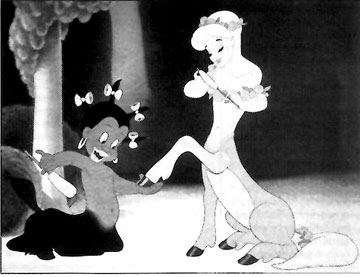
Click here to be reminded of just how gruesome your childhood favourites were. Somewhere the Brothers Grimm are shaking their skulls in envy. (And check out some of the other features – such as the best instances of racism in Walt Disney’s oeuvre. It’s almost as if Cracked has it in for the Waltster!)
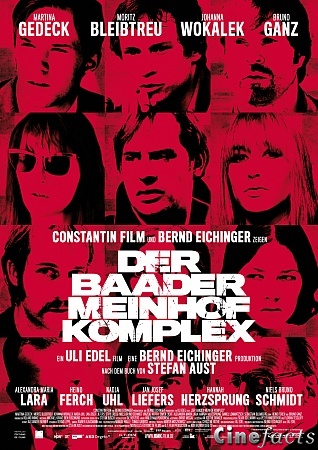
Uli Edel’s film Der Baader Meinhof Komplex is both fascinating and frustrating. It has some of the best actors Germany has to offer at the moment acting their hearts out; at the same time, it has a script that often feels like a badly edited Wikipedia article. I can imagine that the film becomes much more frustrating for those who’ve read the book it’s based on – I was in the lucky position to have known relatively litte about the RAF (Red Army Fraction, not Royal Air Force!) before watching it.
What the script would have needed, more than anything else, is an editor: it is packed with too many incidents, as if the author felt, “This has happened so it would be wrong to leave it out!” That may be true for history books – it is less true for films, obviously. Too many scenes feel like they’re a repetition of what was shown earlier, repeating the same points over and over again. “Yes, we know that Andreas Baader was an immature, self-righteous, misogynist asshole,” we want to say, “We know that Gudrun Ensslin was too much in love with herself! Get on with it!” As a result this 2 1/2 hour film feels strangely short-winded. There is little in the way of a Spannungsbogen, as we get what amounts to “This happened, and then this, and then this…”.
At the same time, there are moments when the film (almost despite itself) settles into a storyline, and that’s when the actors take over. Especially the scenes in prison where the incarcerated heads of the RAF turn on each other and on themselves are, at their best, riveting drama. Especially Martina Gedeck, at least as strong a presence as she was in The Lives of Others, creates a fascinating potrait of Ulrike Meinhof slowly falling apart in prison.
It’s in those scenes that I wished the film knew what it wanted to do. Mere chronology may be sufficient (at best) for documentaries, but it doesn’t make for very good drama. With the same actors but with a sense of focus, it could be so much better. As it is now, it ticks all the boxes but fails to bring them together into something satisfyingly coherent and whole.
What it did achieve, though, and quite strongly at that: I now want to find out more about the RAF and the people and events involved. And I definitely want to check out what else Martina Gedeck has done.
(I was going to write lots more here, on the inherent risk of presenting terrorism as sexy if you’ve got young sexy actors playing terrorists, and on the apparent development from the first generation of the RAF into a copy of a copy of a copy, reducing the sparse initial greys into stark black and white, but if I did that there’d be another week before an update. If you’re interested, let me know and I’ll write something about it next time.)
The Call of Duty games are prime examples of on-rail shooters done to perfection, with amazing production values. They’re not complex games, nor do they strive for realism: they’re the equivalent of a great 80’s action movie – Die Hard rather than some Van Damme or Seagal vehicle.
Call of Duty 4, subtitled Modern Warfare, was the first (and to date only) game in the series that didn’t take place in that most overused of scenarios, the Second World War. Instead, it tells a Tom Clancy-style story of Russian Ultra-Nationalists and, surprise, Middle Eastern terrorists. So far, so unoriginal.
What is fascinating, though, is this: in a genre that is usually about making the player feel like some super-hero with a gun and macho one-liners coming from his lips like so much testosterone-riddled drool much of the storytelling is about showing the player that he doesn’t actually have that much control over what is happening. In fact, two of the game’s most interesting scenes in a subtly subversive fashion give the player just enough control for him to realise that he’s powerless.
Consider the prologue, in which the president of a fictional Middle Eastern country is shoved into the back of a car, driven through his war-torn city, dragged in front of the apparent Big Meanie (who turns out to be a minor meanie, in fact) and shot in the head.
And you, the player, get to control the president. As far as he can be controlled: beaten and dragged by soldiers, he can barely move his head enough to glimpse scenes of loyalists being executed through the car’s windows. And whatever you do, the outcome is the same: gun pointed at your head, blam, black screen. It’s chilling and very, very effective. Clearly it’s also designed to make you hate the bad guys, but apart from this obvious aim it does throw in question the power-trip fantasy of first-person shooters.
The second scene is the one that every reviewer and most players remarked on. (If you’re planning to play the game without spoilers, DO STOP READING RIGHT NOW. In fact, STOP READING TWO PARAGRAPHS AGO! WHY ARE YOU STILL READING? IDIOT!) In it, you and your squad (platoon? team? posse? I’m afraid I don’t really know what the correct military term for “you and the guys with you” is…) have just rescued a downed pilot from the bad guys and you fly off in an army chopper – when a nuke goes off. You watch as the shockwave races towards you, crushing the helicopters behind you. There’s no way you can outrun it.
After you crash, the game gives you control of your character. He’s alive, just barely, having survived the crash. You stumble out of the wreck of the helicopter and look around at the devastation, your heart beating in your ears. In the distance you see the mushroom cloud. Obviously you don’t perceive the radiation, but you know it’s there. But you’re the player! You’re in a shooter! Surely there must be a way to make it out of there!
And then you die, perhaps of radiation, perhaps of your injuries. It doesn’t matter. You have a minute or two of stumbling around and then you die.
The game doesn’t have the ambition or the guts – or the stupidity – to end on your lack of control over the situation. Later on, as a different character, you do stop nuclear missiles from destroying half of the Eastern Seaboard (although you do that using a computer rather than an automatic weapon). And at the very end, you’re given the chance to kill the main bad guy who’s behind it all in a fairly heroic scene (although one with an interestingly bitter tinge).
Clearly Call of Duty 4 is a first-person shooter, not a treatiseon the powerlessness of the soldier. Clearly you want to give the player the feeling that he’s the hero. But it’s still interesting, in a game that is almost the perfect representative of its genre, that you get this subversive, and in this highly effective, streak… Sneaking it past the player that for all of his heroic fantasising, he’s not in control. Just don’t let him find out…
I’ve pretty much given up on the Academy Awards for years now, to the extent that I have no idea whatsoever which films have been winning since that hobbit movie. I did hear about that Irish indie romance Once, though, but I didn’t really follow it. On paper (or, more accurately, “computer screen”) it sounded rather twee.
Then a message board friend of mine mentioned seeing it. He didn’t write much about the film, but from what he’d written it was clear that I wanted to check out the film.
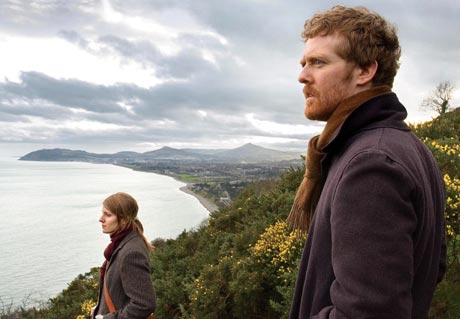
Now I’m in this silly situation: I loved the film and I’d go so far as to say that it’s one of the best, most beautifully told and acted love stories I’ve ever seen on film. I also fear that anything that I might write about it will make the film sound twee. Words such as “sweet” and “charming” come to mind, but they don’t really get at what makes the film work.
It’s funny (in a film nerd way, that is): we watched two films on two consecutive nights last week that were amazingly similar in some ways but couldn’t be more different in others: Michael Winterbottom’s Wonderland and, well, Once. Both were filmed simply, going for verisimilitude, especially in the acting and writing. Both were City movies, so to speak, very much rooted in London and Dublin respectively. Both were about people who have to struggle to make ends meet at times, and not the Guardian-reading upper middle class characters of, say, Anthony Minghella’s Breaking and Entering.
Yet Once has an artlessness that in its effectiveness is highly artistic, whereas Wonderland never lets you forget that you’re watching a film by a director who wants his directing to be visible on screen. In its digicam, improv way Winterbottom’s film is as much a director’s film as any movie by Scorsese. It is the sort of film that some people might call “pretentious” because it forms its material in unexpected ways and makes this very clear on every frame. Once, by comparison, wants to be a small film, is a small film and knows it.
But it’s by no means unambitious. Pulling off a simple, bittersweet love story – with songs, no less! – take courage, or stupidity, but whatever it was, they managed it. For lack of a better word, Once may just be the most honest love story I’ve ever seen. And in some ways I hope never to read the words, “From the makers of Once” because I’m afraid that there’s no way they could do anything other than disappoint. Poor buggers…
Anyway, enough words from someone who basically said, “Words won’t live up to the film so I’ll keep this short.” Both films, Wonderland and Once, are very much worthwhile. The former is probably more a matter of personal taste – Winterbottom’s films are not likeable as such, nor do they set out to be – but still a definite recommendation. And now I will leave you with trailery goodness and shut up.
 A Damn Fine Cup of Culture